This is the blog of Mark Wordsworm, the travelling worm. I’m a 36-year-old bookmark (give or take a few years) and I proudly boast my own Hallmark serial number, 95 HBM 80-1. You’ll probably want to read all about me and my Travelling Companion (the TC).
Today’s travel notes
Me and the TC dipped our toes into the Brand Bazaar, a large covered market in Istanbul. We visited approximately six of the bazaar’s 61 covered streets. So, that leaves a few to explore in our next visit.
Word of the day
Saffron is the most expensive spice in the world. It comes from the flower of a lily, Crocus sativus. To produce the spice, people collect and dry the stigma and styles (threads) from the flower and heat them on a sieve. Most saffron is produced in Iran.
The book I’m in
Live Wire, by Harlan Coben. This worm enjoys the no-frills style of this author’s prose. The style contrasts nicely with the tangled web of family intrigue and big-world evil that reader and hero have to weave their way through together.
The photos
Me at an entrance to the Grand Bazaar in Istanbul:
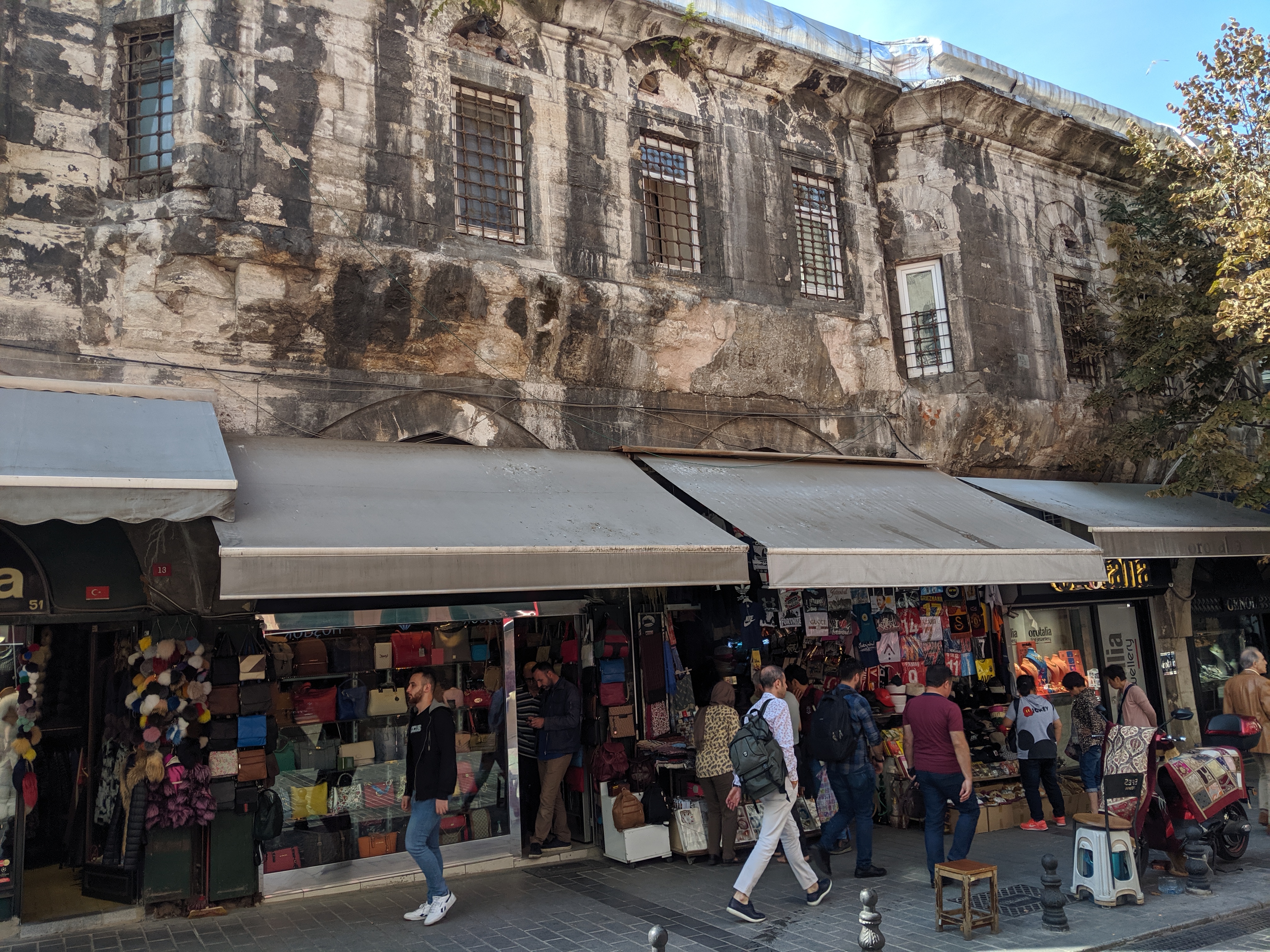
The road leading to the entrance features a row of character-filled buildings:
Ancient and modern combine – the shop to the left of the market entrance advertises Bitcoin:
Inside the Grand Bazaar:
Construction of the Grand Bazaar started in 1455, making it one of the oldest covered markets in the world. People continued adding shops and sections to the market over the years. By the beginning of the 17th century, the market had more or less the same shape as it does now.
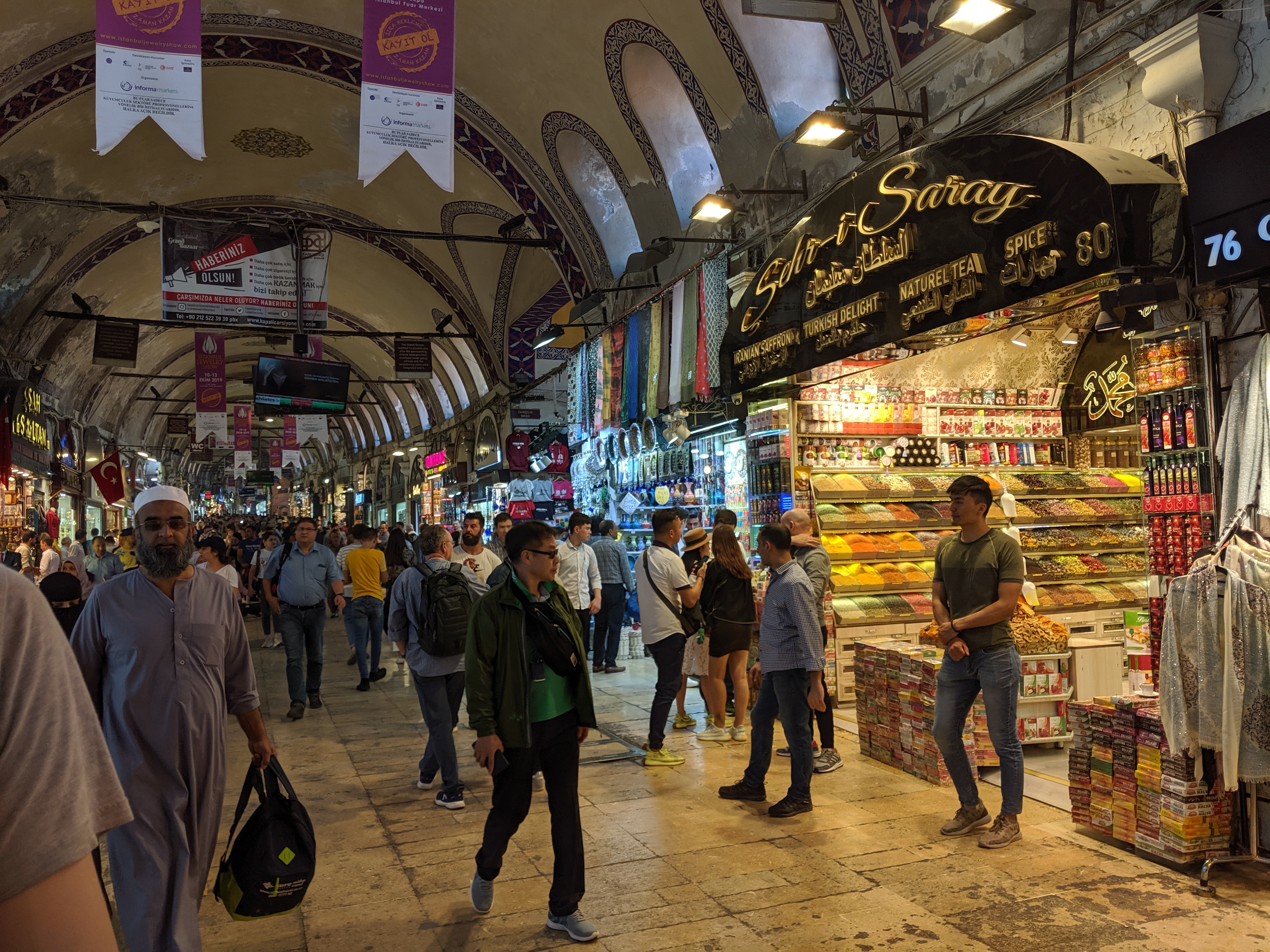
Saffron, spices, and Turkish Delight add to the colour and smells:
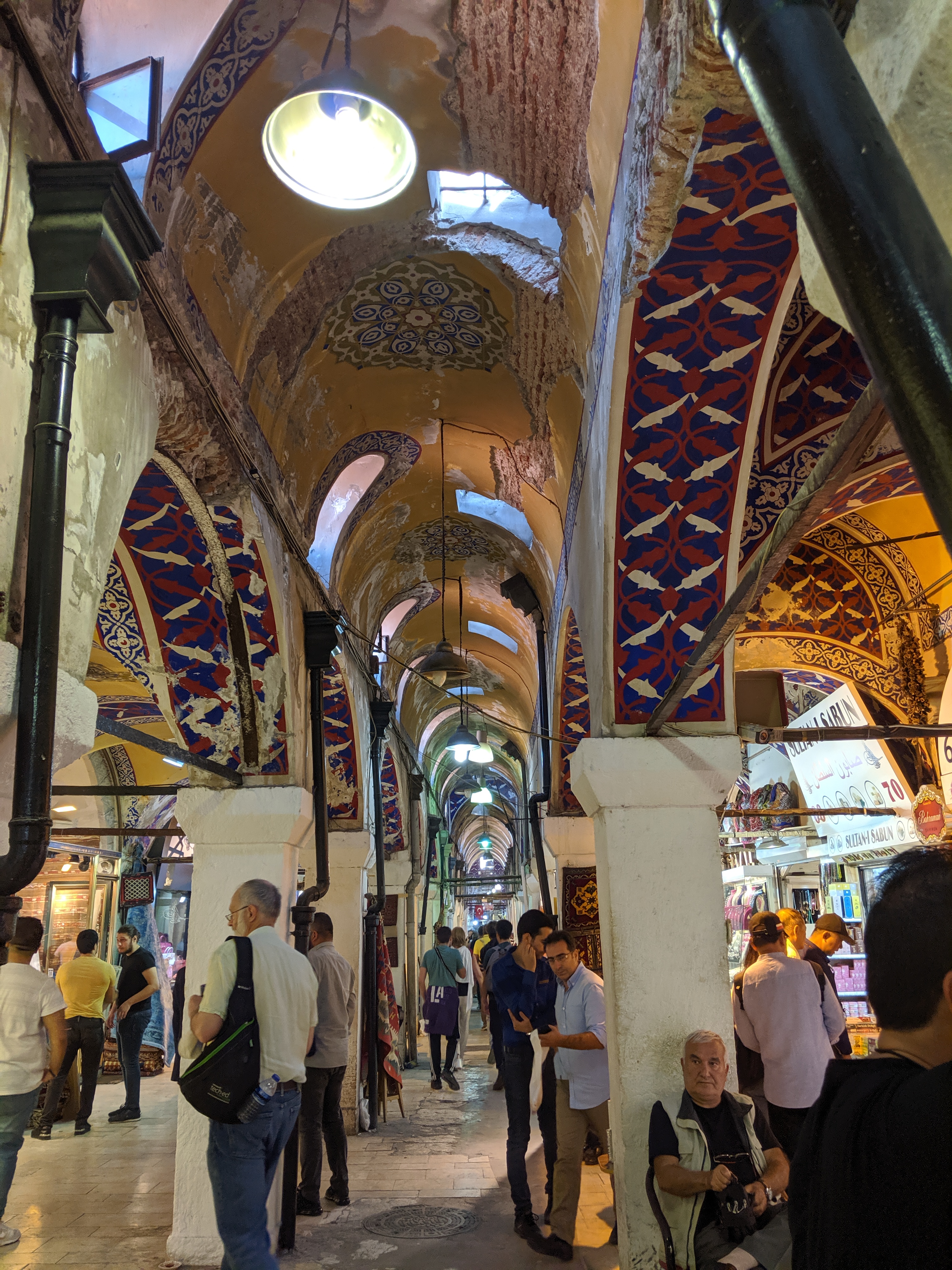
Arches receding into the distance, topped by a small window to let in air and light:
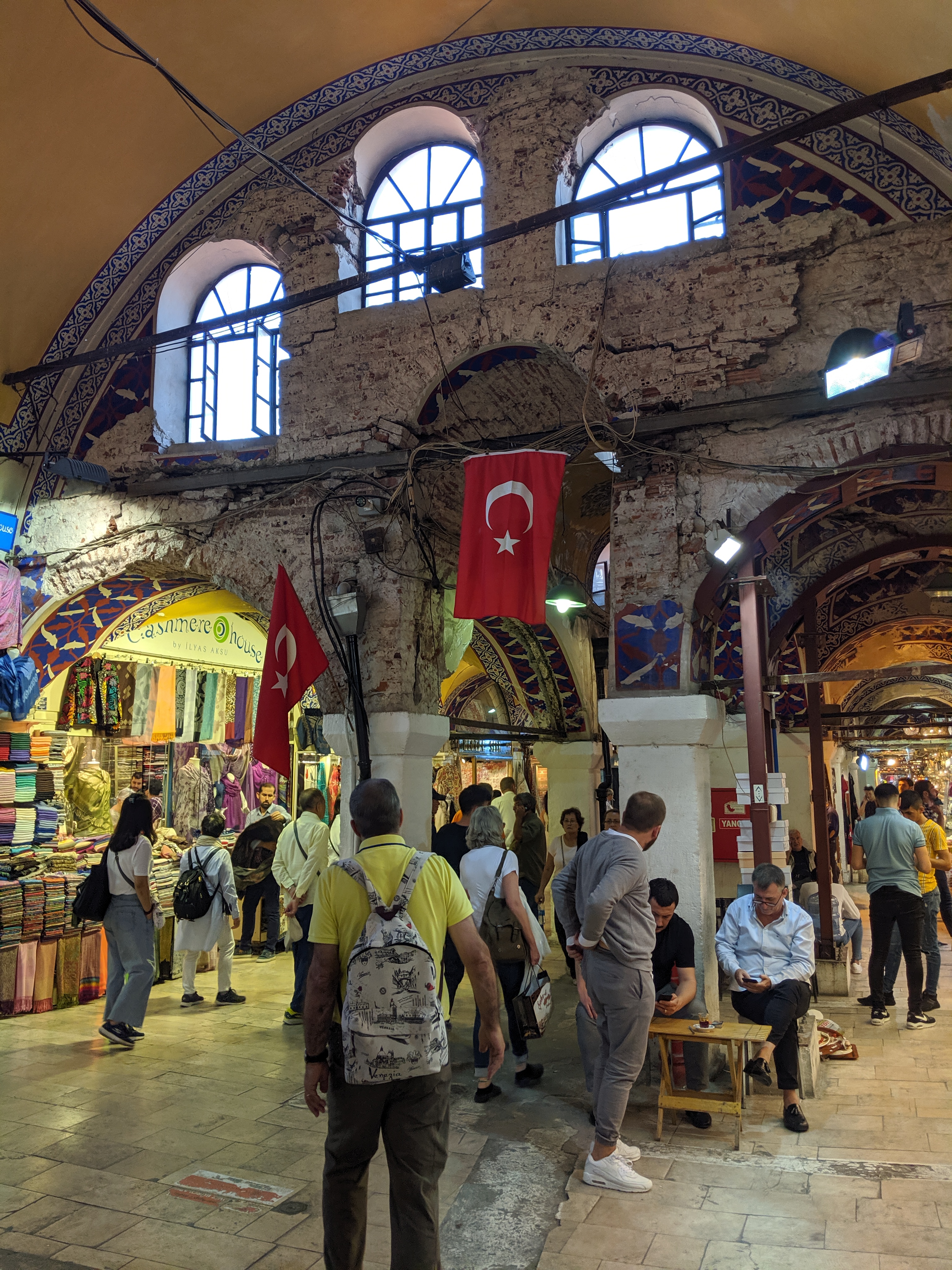
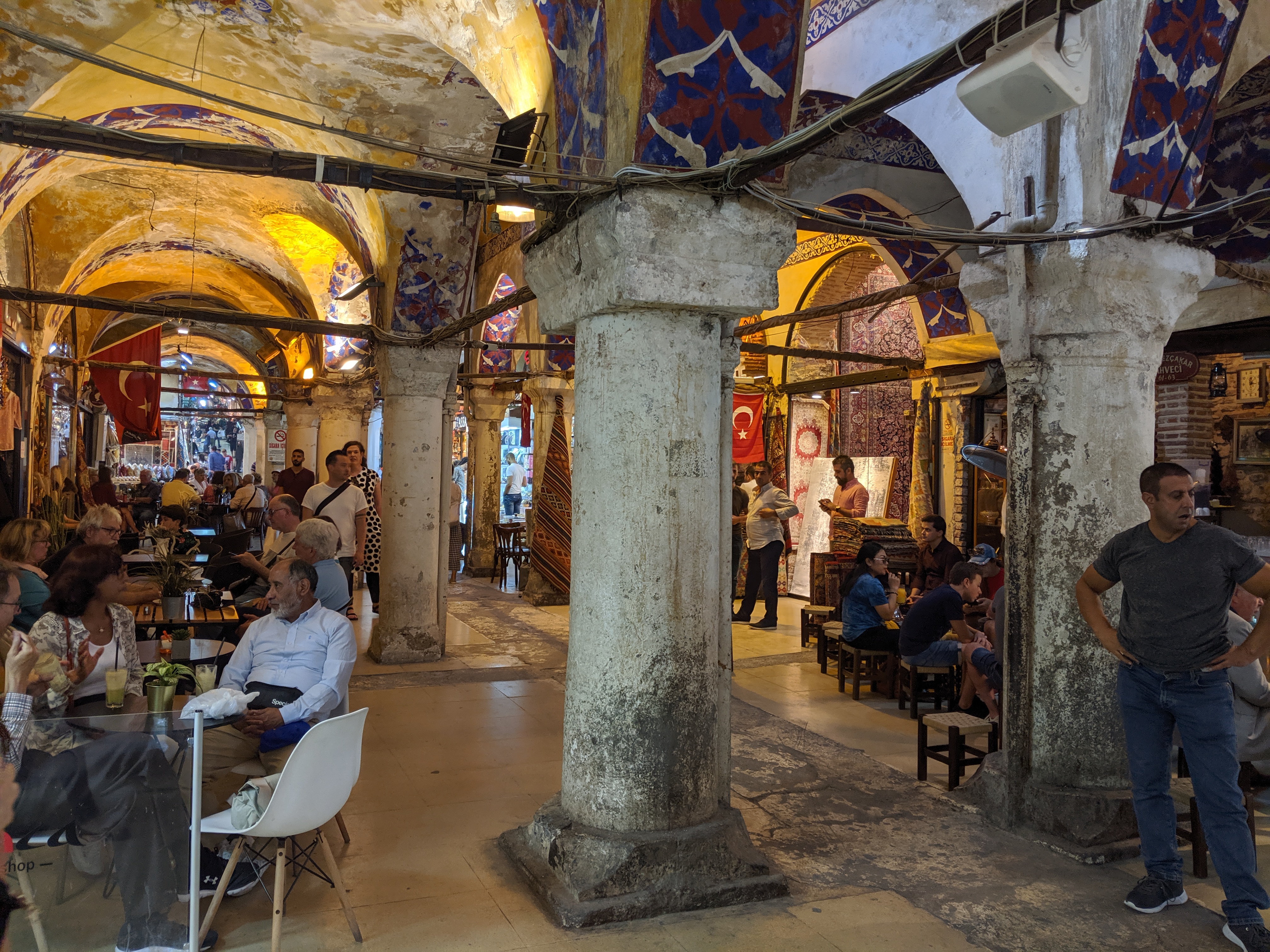
People enjoying refreshments and a break in older part of the market:
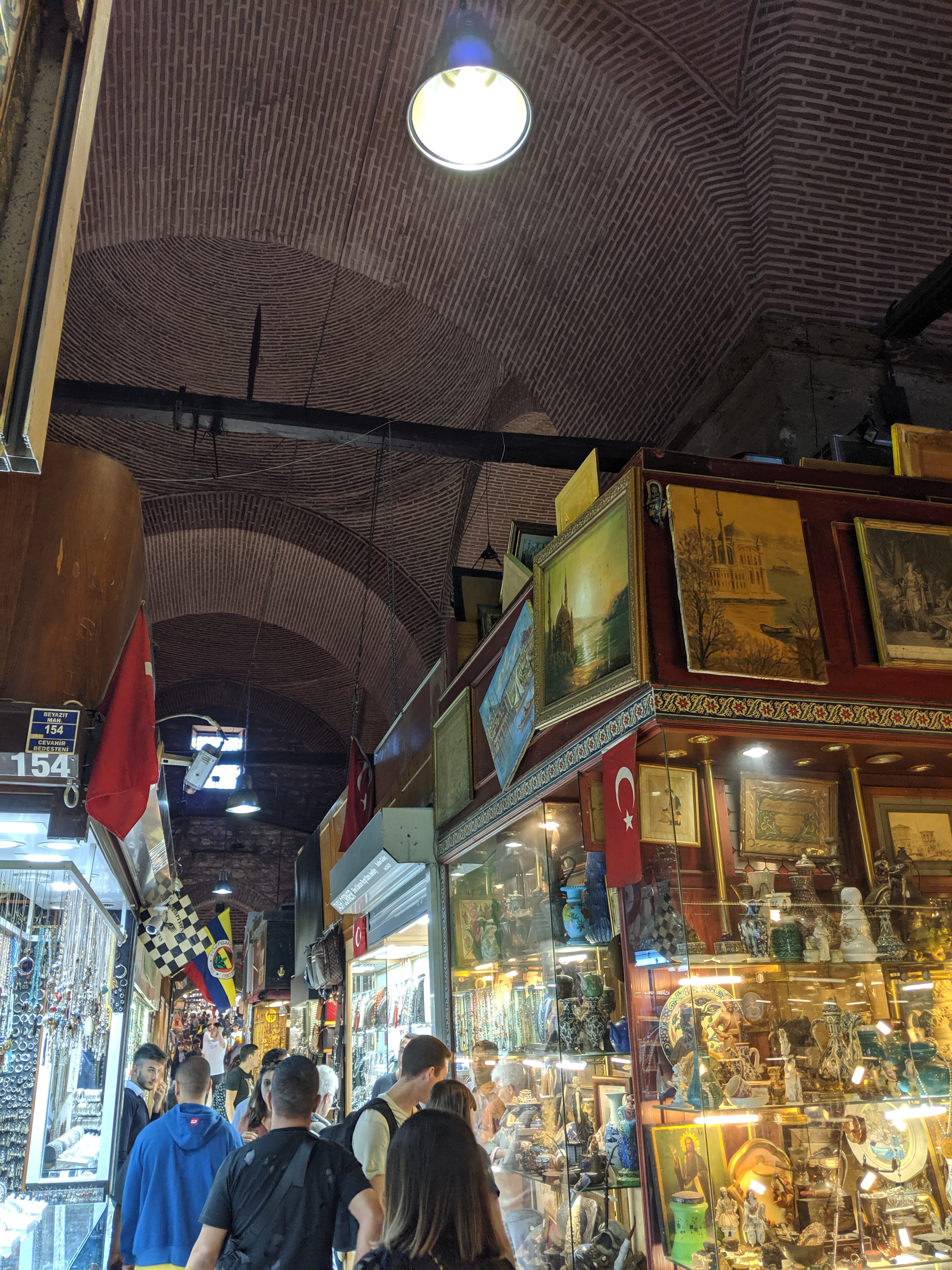
The bazaar offers more than 4,000 shops in 61 covered streets. Sections of the market have different characteristics. In the next photo, the ceiling is higher and darker, with the shops perched in glass boxes below it:
This is the blog of Mark Wordsworm, the travelling worm. I’m a 36-year-old bookmark (give or take a few years) and I proudly boast my own Hallmark serial number, 95 HBM 80-1. You’ll probably want to read all about me and my Travelling Companion (the TC).
Today’s travel notes
Me and the TC spent a week in Turkey recently. The Sultan Ahmed Mosque, known as the Blue Mosque, was on our itinerary. The TC, bless her cotton socks, confided that she was rather dreading the experience, as she felt she’d be viewed as a second class person, being a woman, and she’d have to cover her head with a scarf. She probably would not have entered, except that the rest of our group was planning to visit the mosque. Afterwards, she said it wasn’t as disturbing as she’d expected, since the other women looked happy and comfortable in their scarves too.
The book I’m in
We Are Legion (We Are Bob): Bobiverse, by Dennis E Taylor. The TC has just started this book. I predict I’ll find myself tucked into many more of the Bobiverse series.
Travel tip
If you’re a woman, take a headscarf with you. You need to don the scarf and doff your shoes before entering the mosque. If you don’t have a scarf, the mosque attendants supply you with one. They also give you a plastic bag for carrying your shoes around. You hand in the bag for recycling when you leave.
The photos
Me and a cup of coffee on a table in Turkey. It’s nowhere near Istanbul or the Blue Mosque::
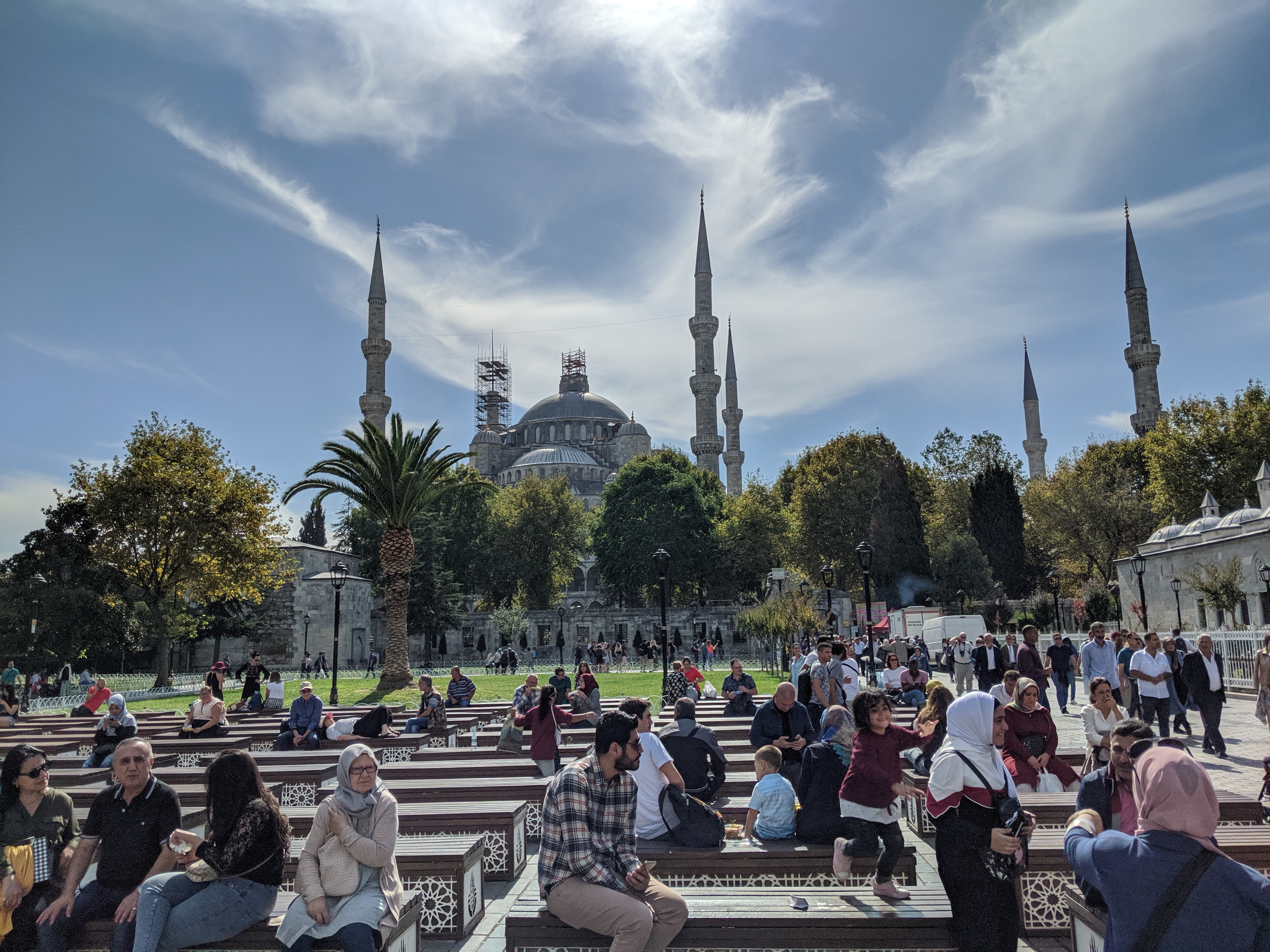
The Blue Mosque, seen from Kabasakal Cd, with the seating of Efsunlu Dünya in the foreground:
Another view of the Blue Mosque, this time from Ayasofya Meydani:
The Ottoman sultan Ahmed I built the Blue Mosque in the years 1609 to 1616, making it much less ancient than the nearby Hagia Sophia.
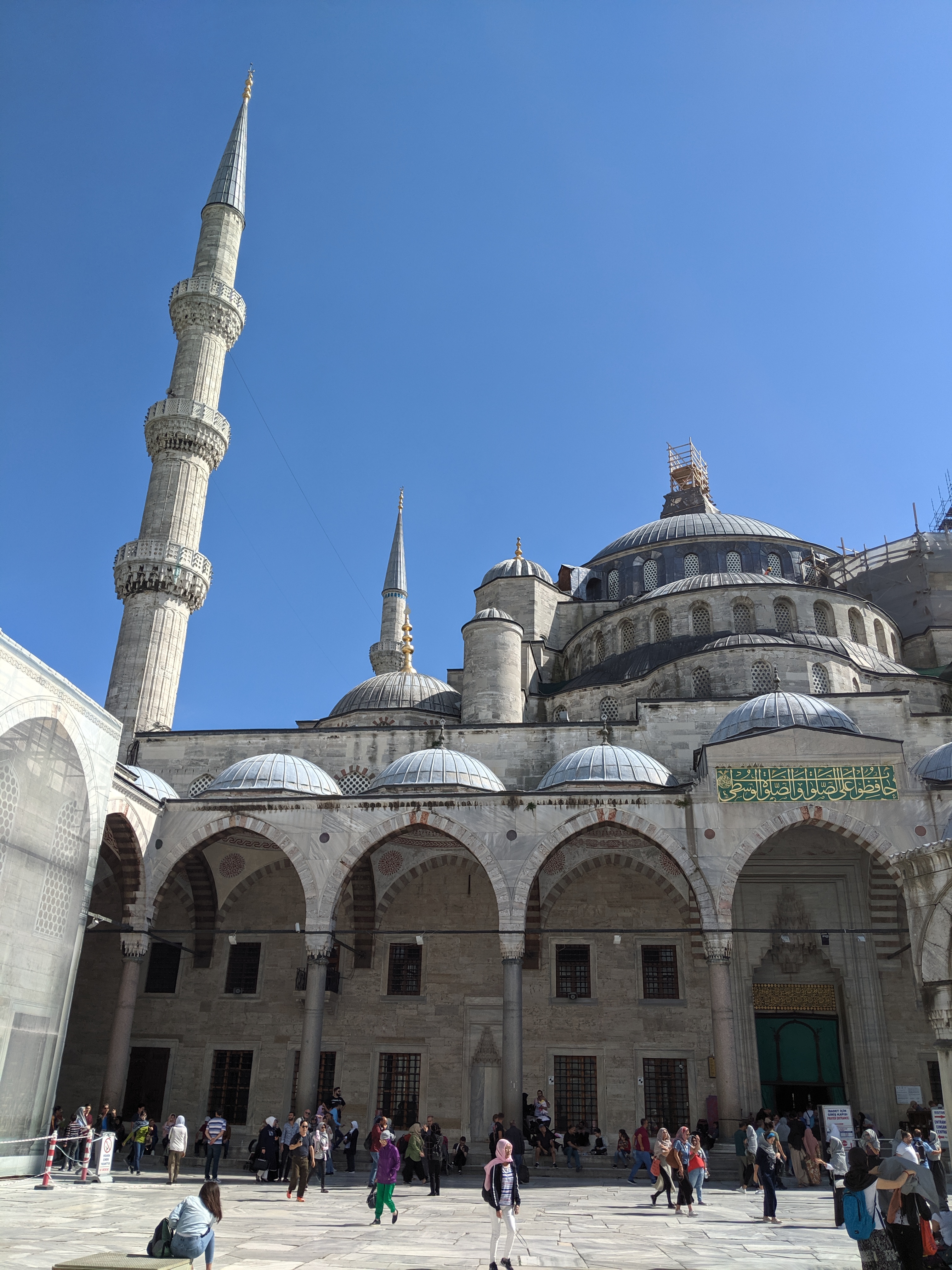
The inner courtyard:
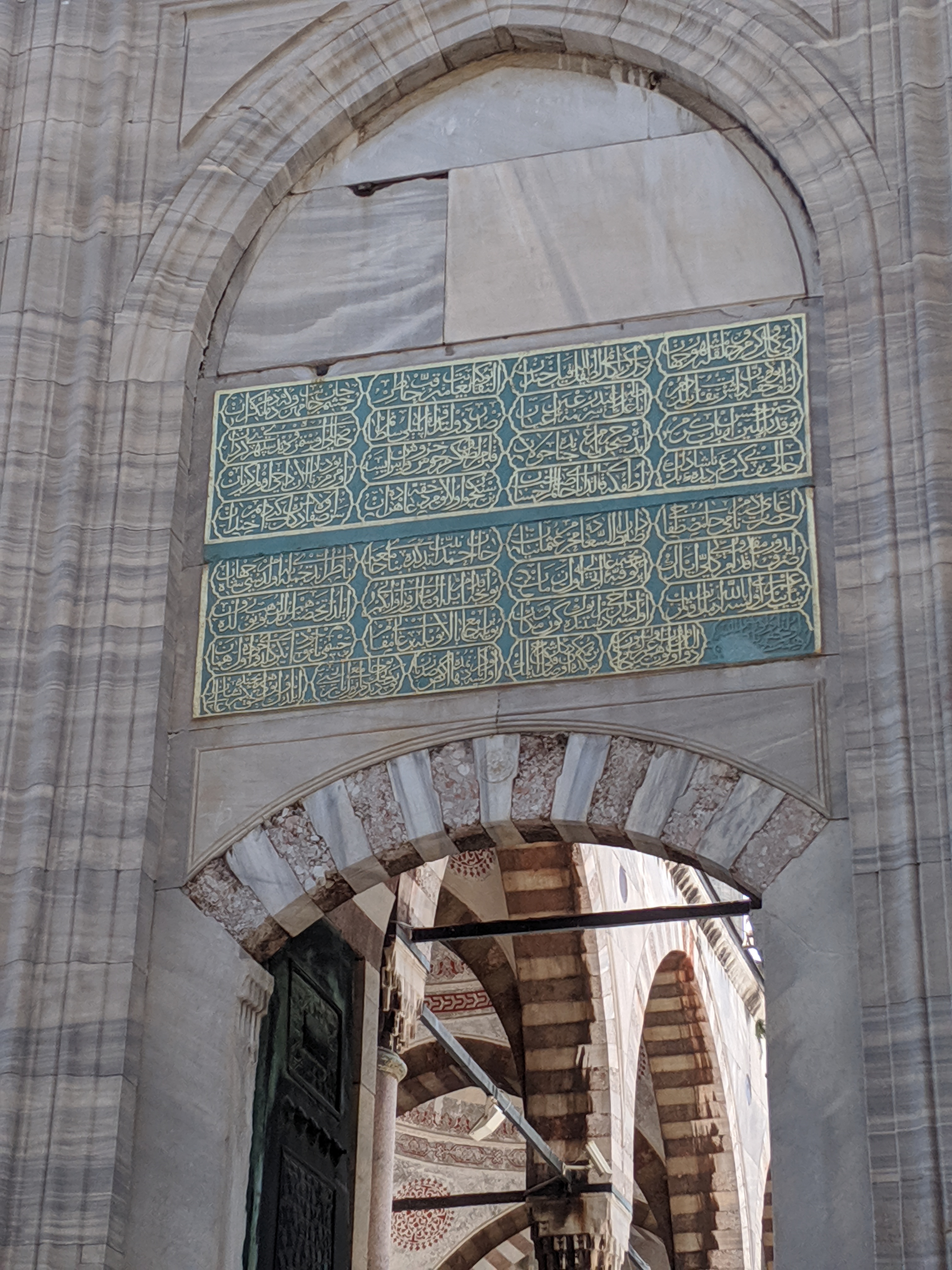
One of three entrances:
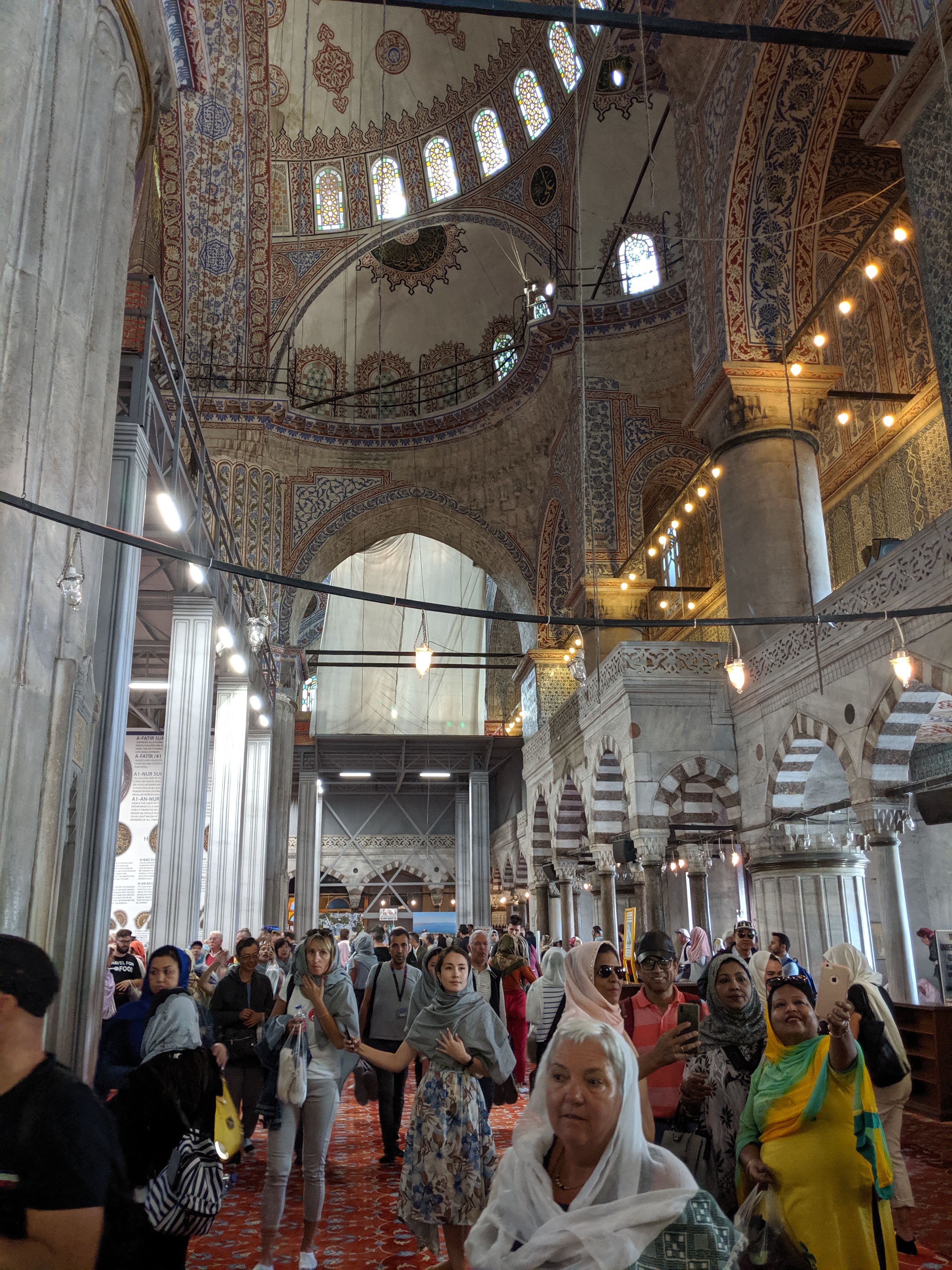
Inside the mosque:
The mosque acquired the name Blue Mosque because people notice quite a bit of blue in the decorations. This worm doesn’t think it’s particularly blue.
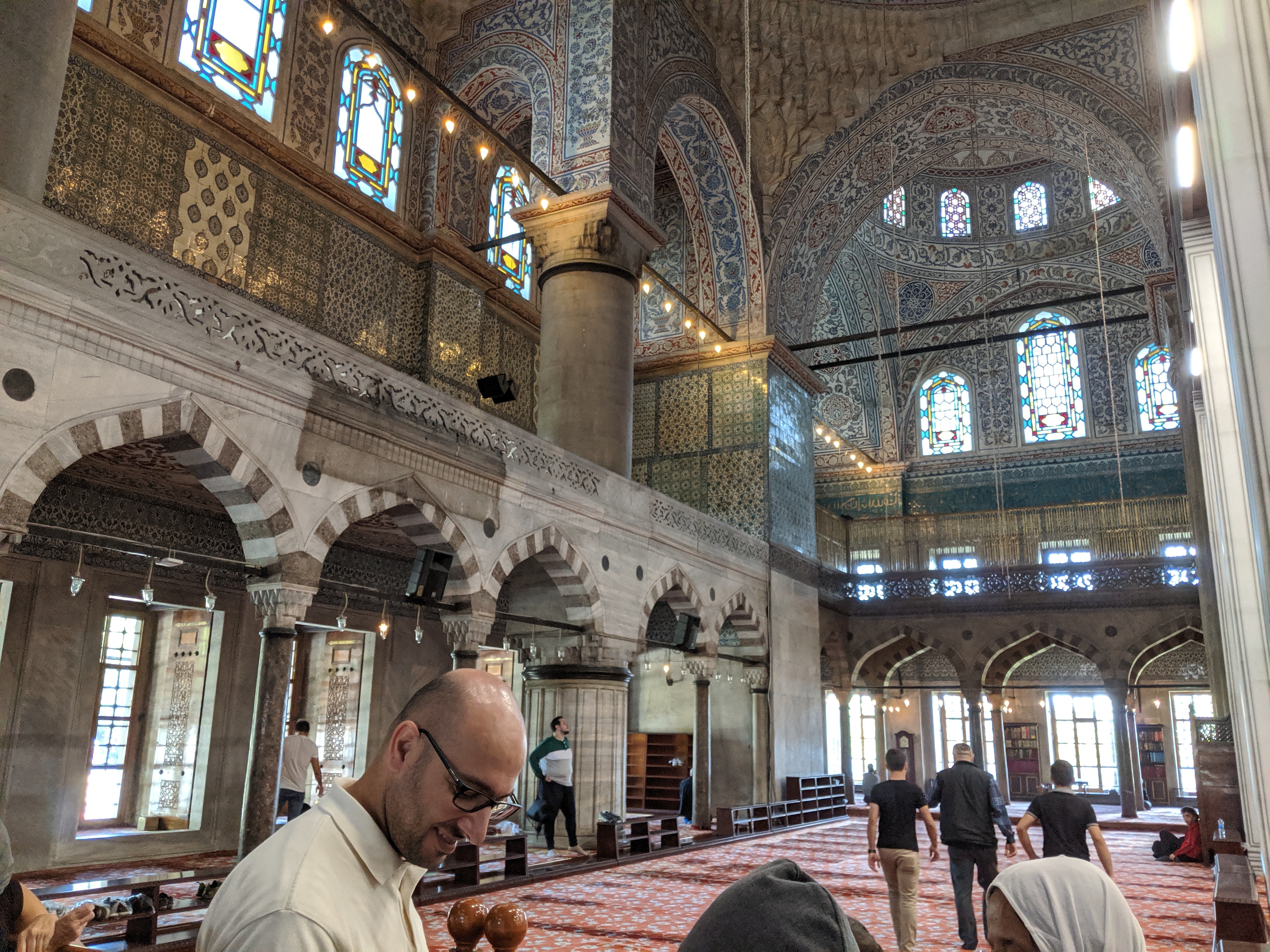
Part of the praying area for men:
The praying area for women is much smaller, situated at the rear of the hall.
More of the inside of the mosque:
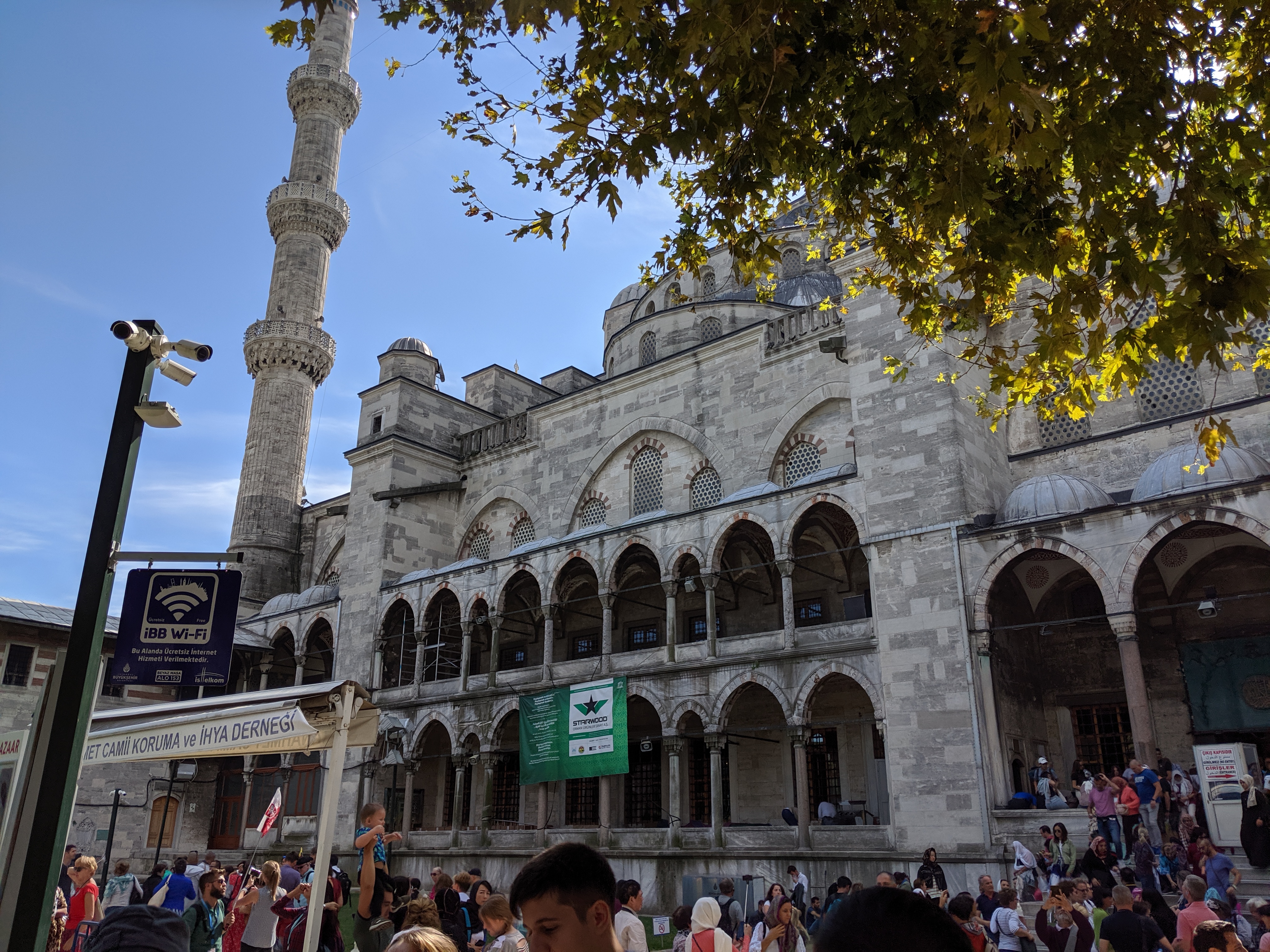
On leaving the mosque, you emerge on the Sultan Ahmet Cami. This is view of the mosque as you leave:
This is the blog of Mark Wordsworm, the travelling worm. I’m a 36-year-old bookmark (give or take a few years) and I proudly boast my own Hallmark serial number, 95 HBM 80-1. You’ll probably want to read all about me and my Travelling Companion (the TC).
Today’s travel notes
Me and the TC spent a couple of days in Cappadocia, a region in central Turkey, exploring the town of Uçhisar and its surrounds.
Word of the day
A troglodyte is a cave dweller. The word also means old-fashioned or deliberately backward-looking.
The book I’m in
Dreams and Shadows, by C. Robert Cargill. A dark tale of faerie and mortality, with a dose of undreamed-of power and doomed love. C. Robert Cargill is a versatile author, well worth keeping an eye on.
Travel tip
Look out for the stray dogs that live in the streets. They’re usually docile and friendly, but can become territorial at night.
Recommended accommodation
Art Residence Cappadocia, from host Derya with Airbnb. A luxurious cave dwelling built into the rock face above Pigeon Valley in Uçhisar.
Recommended restaurant
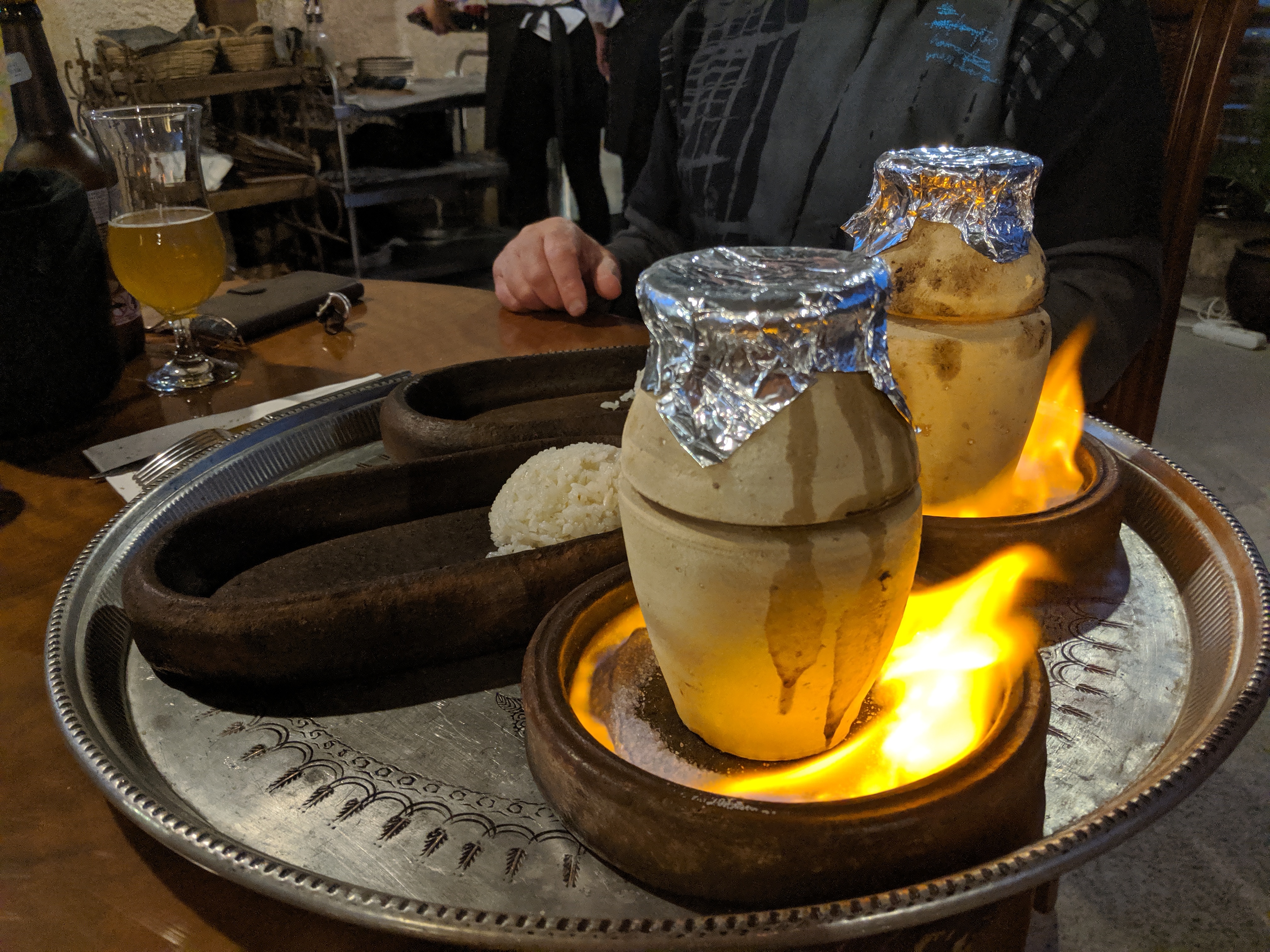
Muhterif, Tekelli, Belediye Meydanı No: 3, 50240 Uçhisar. Good food, very friendly and professional service. One of the photos below shows a the clay pots in which a beef dish arrived.
The photos
Peg’s one job is to support me on my travels, especially in case of wind. Sometimes Peg gets it wrong. Me doing a faceplant:
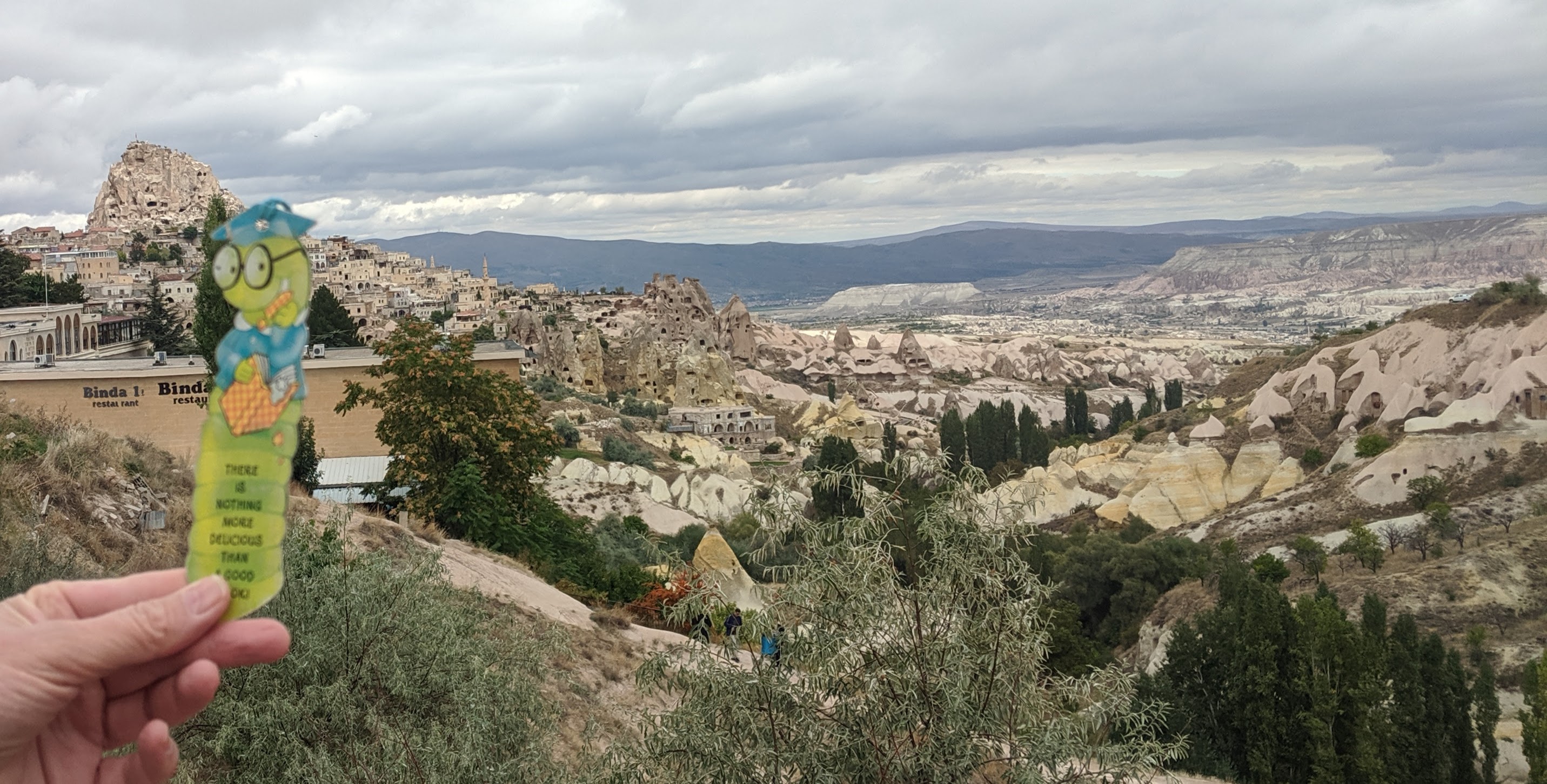
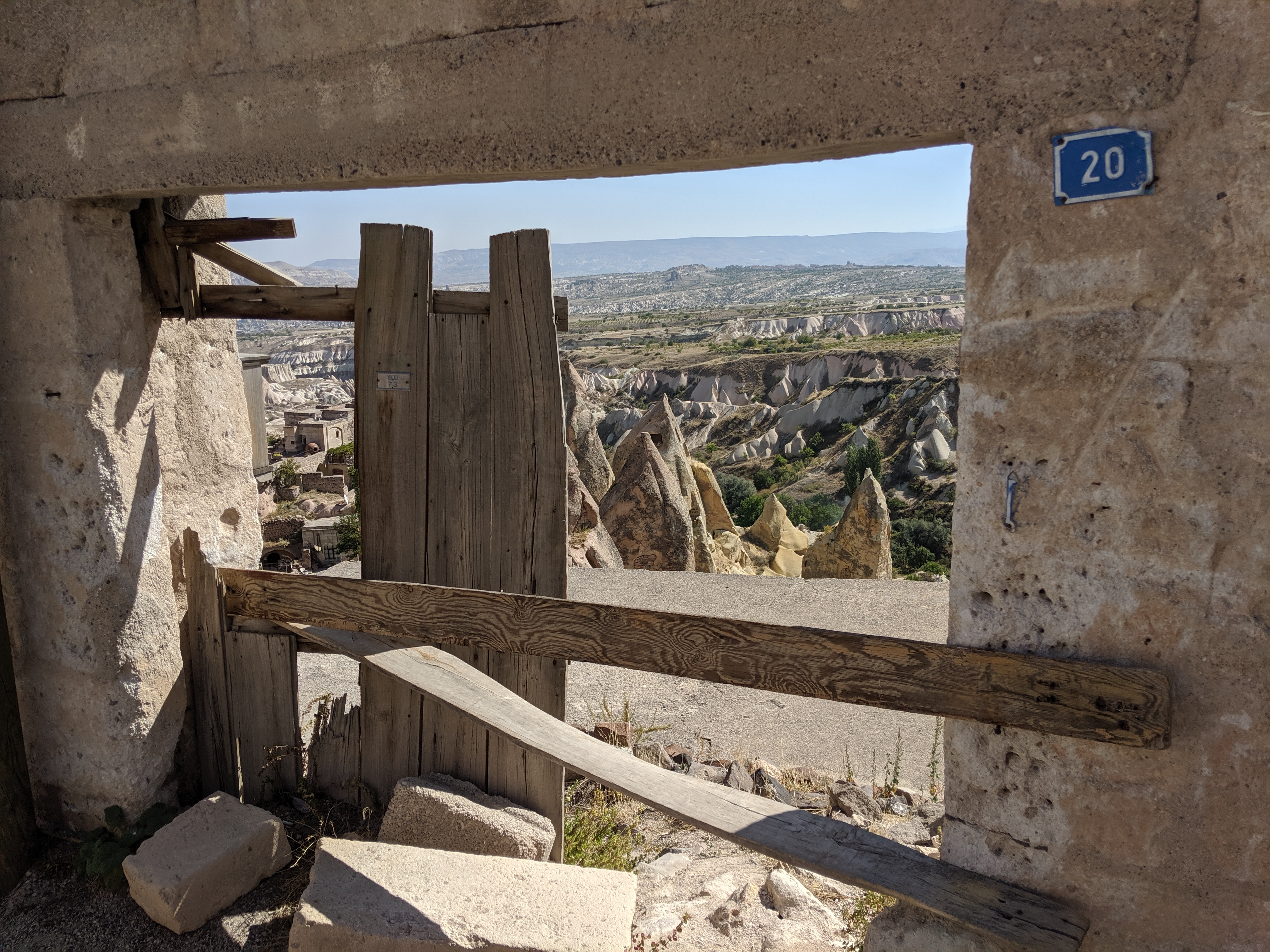
Once more, with feeling. Here’s yours truly, Mark Wordsworm, with Pigeon Valley on the right of the photo and Uçhisar Castle on the left:
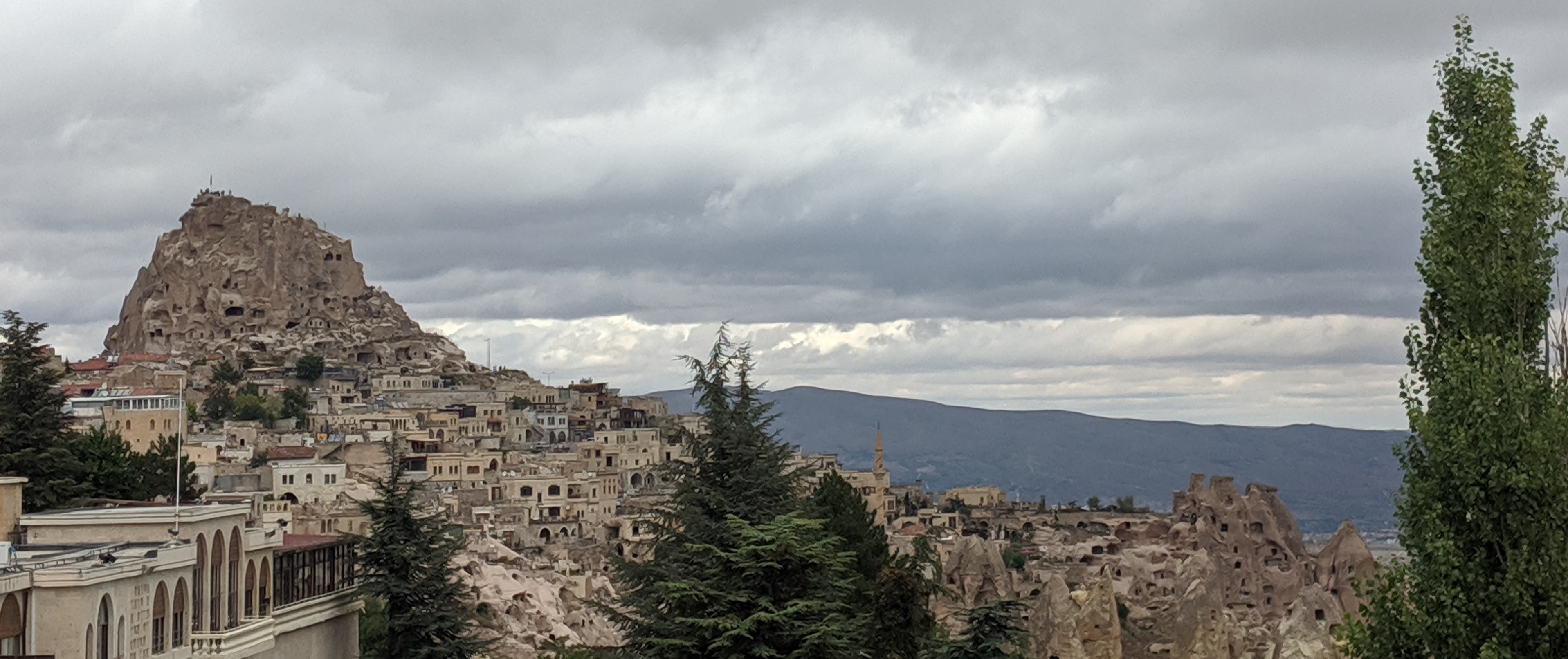
The settlement of Uçhisar stretches up the hill to the castle:
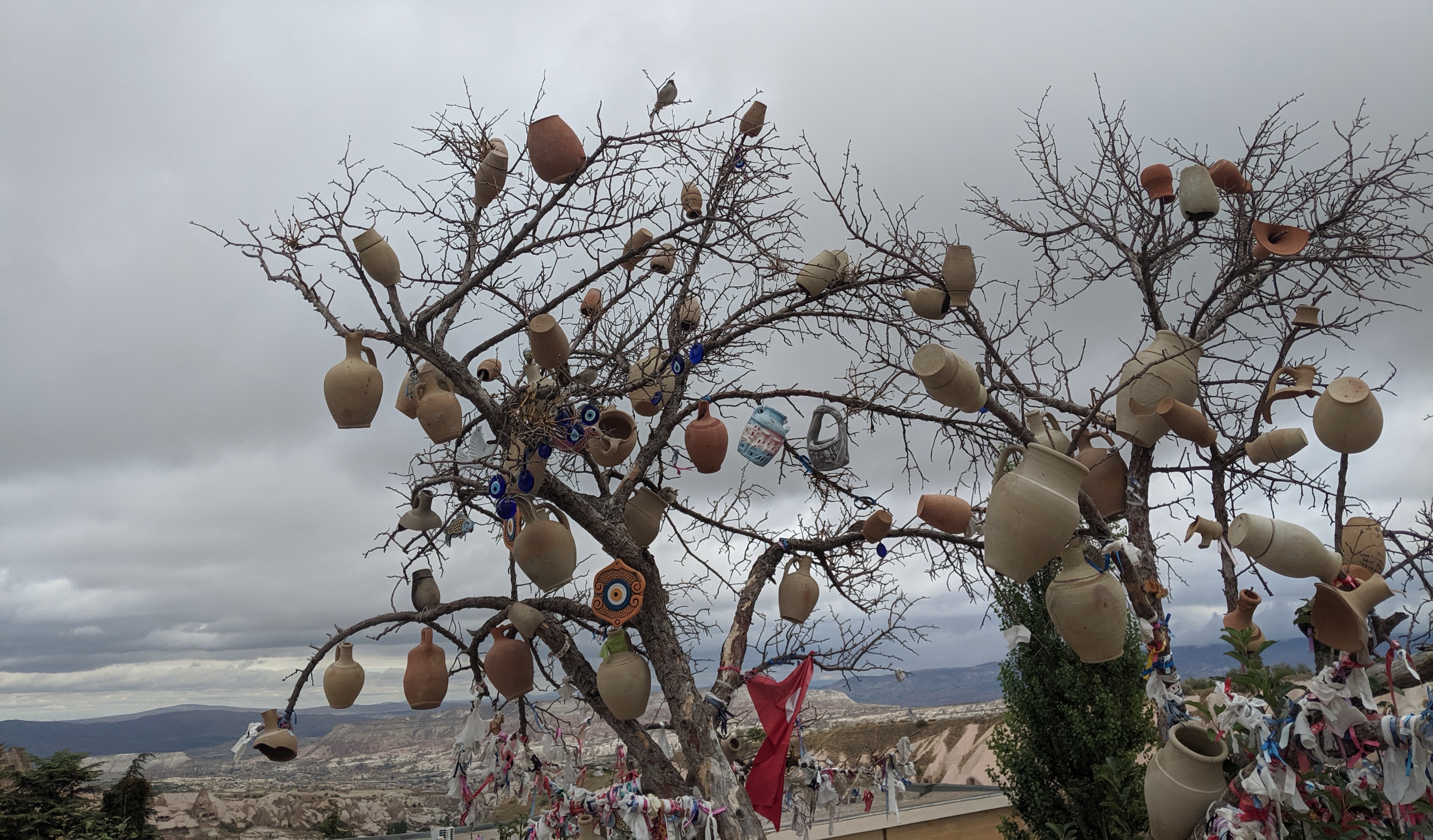
Clay pots and ribbons decorate a tree above Pigeon Valley, with a bird or two hiding in plain sight:
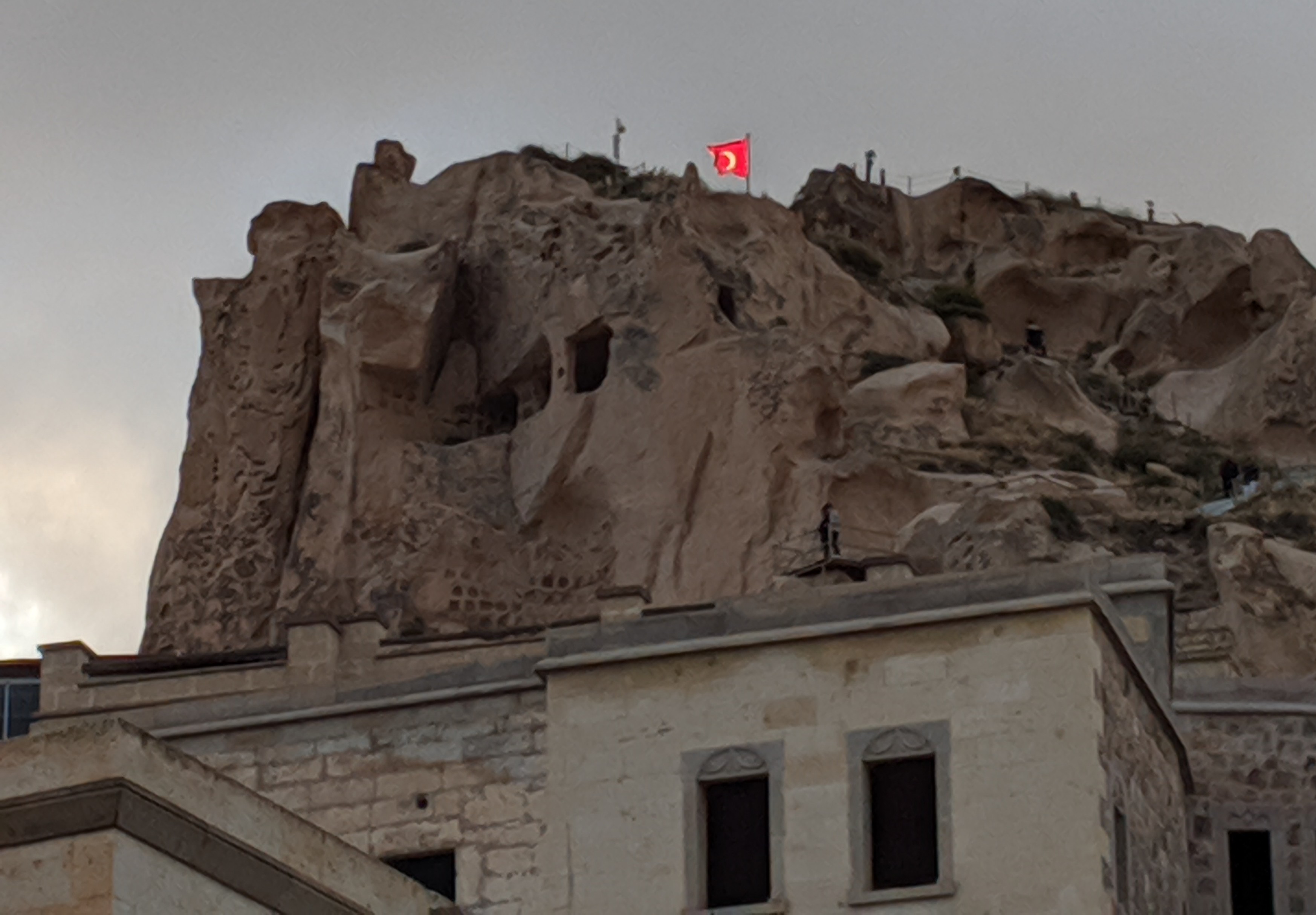
The Turkish flag glows in the late sun:
Looking down the winding road that leads from Uçhisar into the valley:
Old and less old:
Ruins of various ages offer photographic opportunities:
This worm was not the only creature exploring the terrain. Meet Dagbert the darkling beetle:
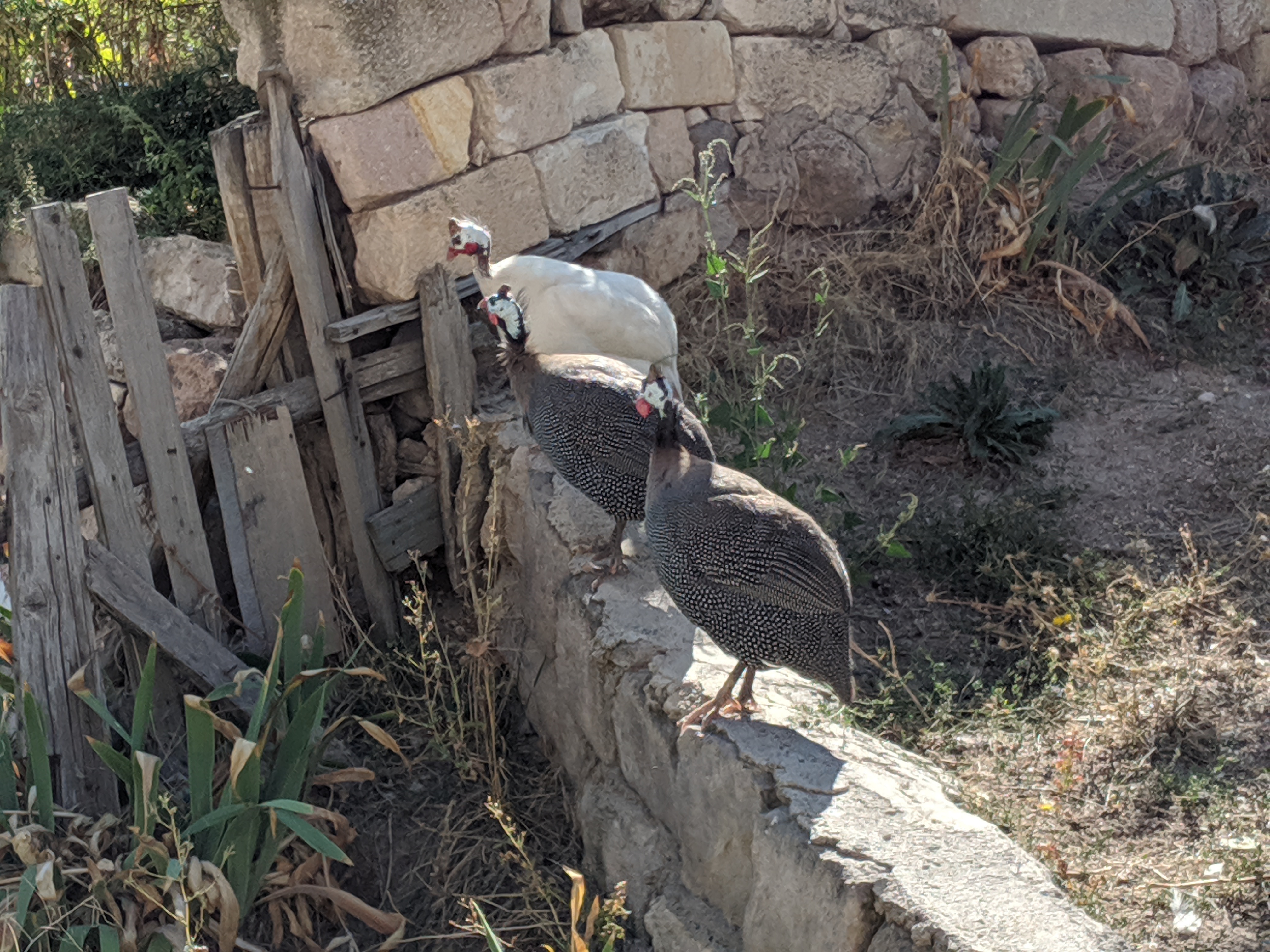
Dagbert warned me to avoid the Guineafowl prowling in search of an easy bite:
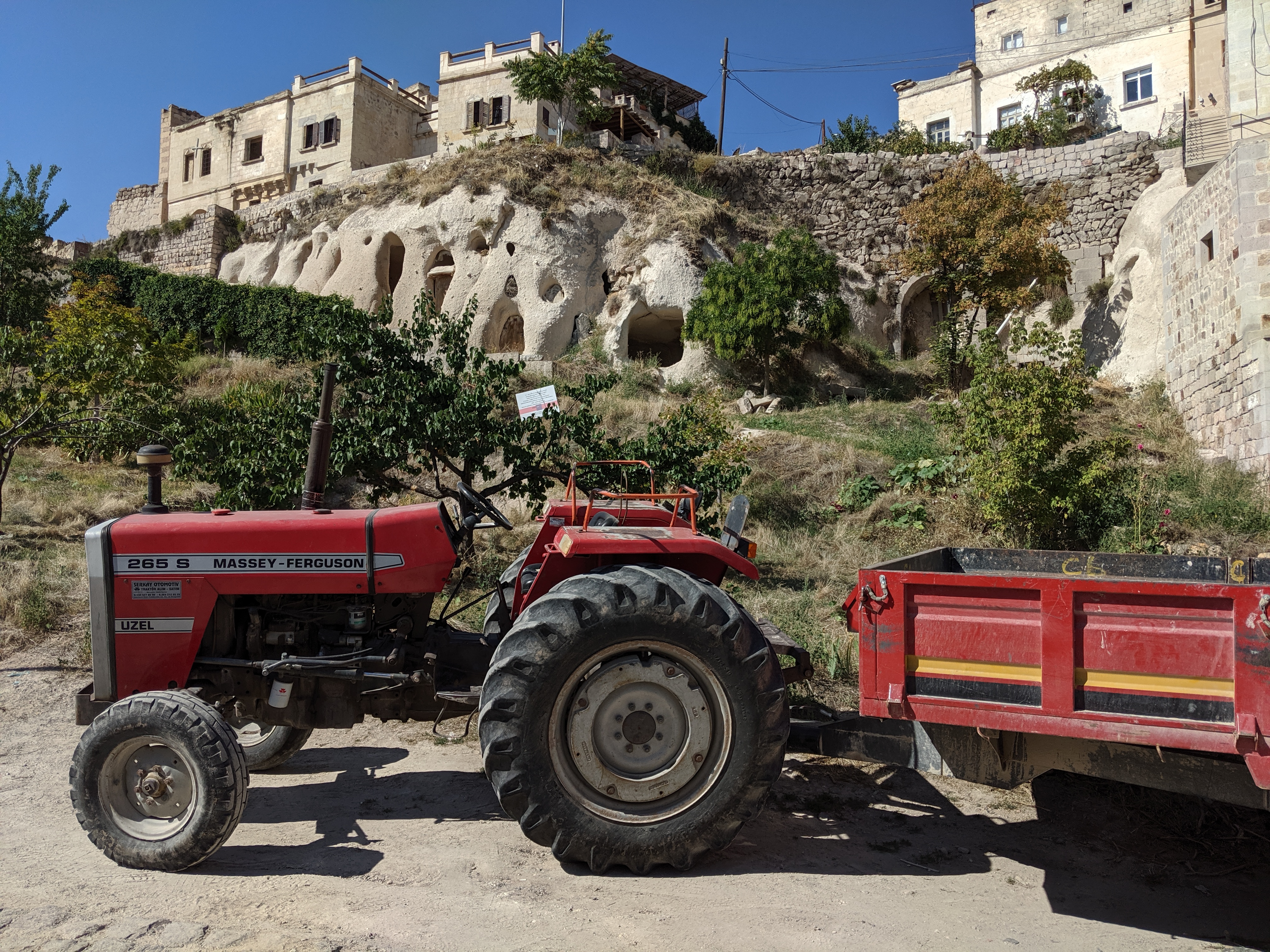
Tractors and other working vehicles traverse the narrow roads too. If you’re driving, be prepared to reverse uphill a long way if you encounter a vehicle coming in the opposite direction to yourself!
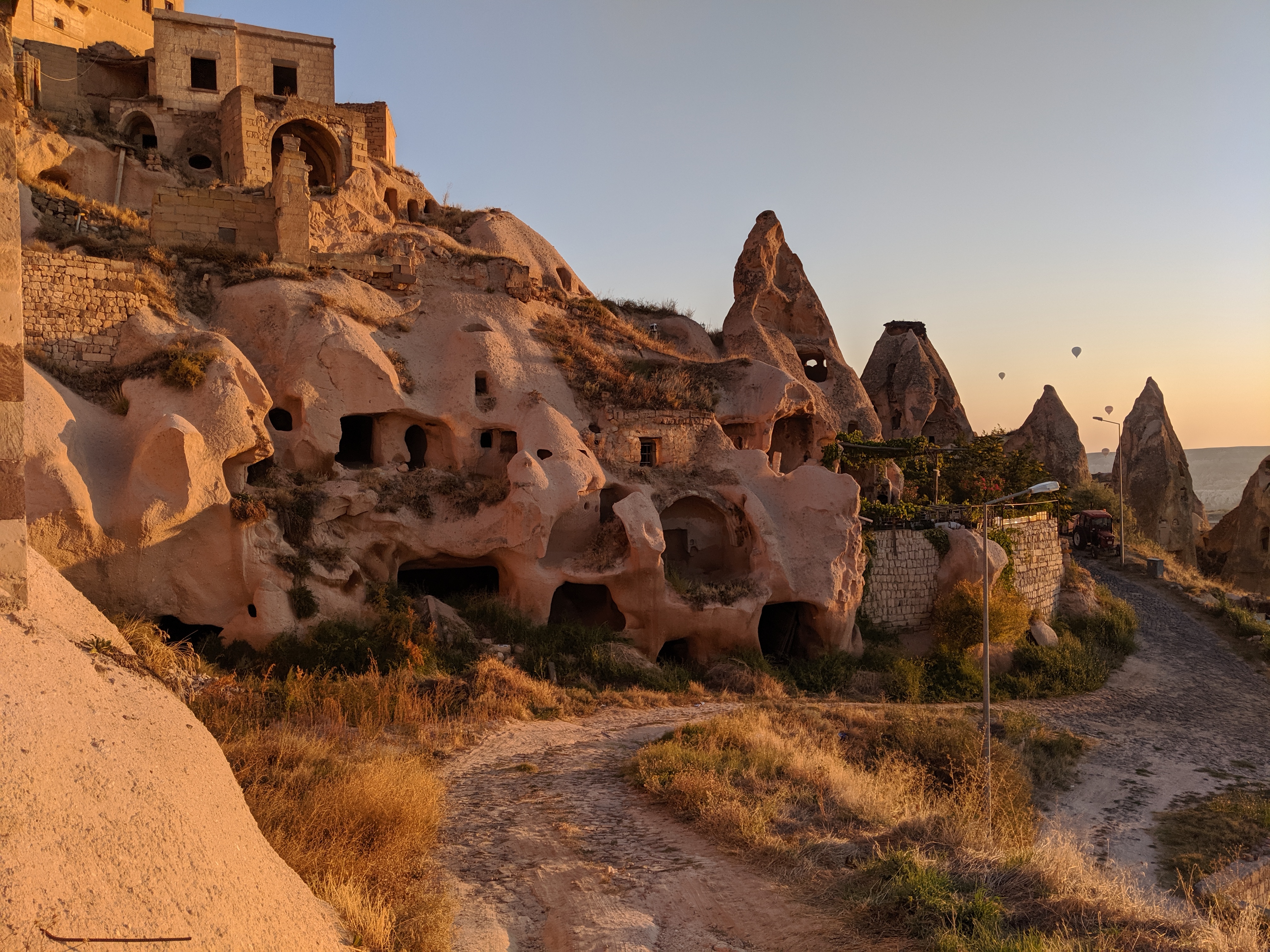
Fairy chimneys and cave dwellings cluster at one end of Pigeon Valley below Uçhisar, with hot air balloons rising in the early morning sky:
The strange pointy hills are knows as fairy chimneys. They’re formed from a type of volcanic rock called tuff. A long, long time ago, before even this worm was in the world, volcanic eruptions spewed up ash that formed a thick layer on the surface of the earth. The ash compacted and hardened into tuff. Thousands of years of wind and water wore away the less durable material.
So, the pointy hills are made of tuff’s toughest stuff.
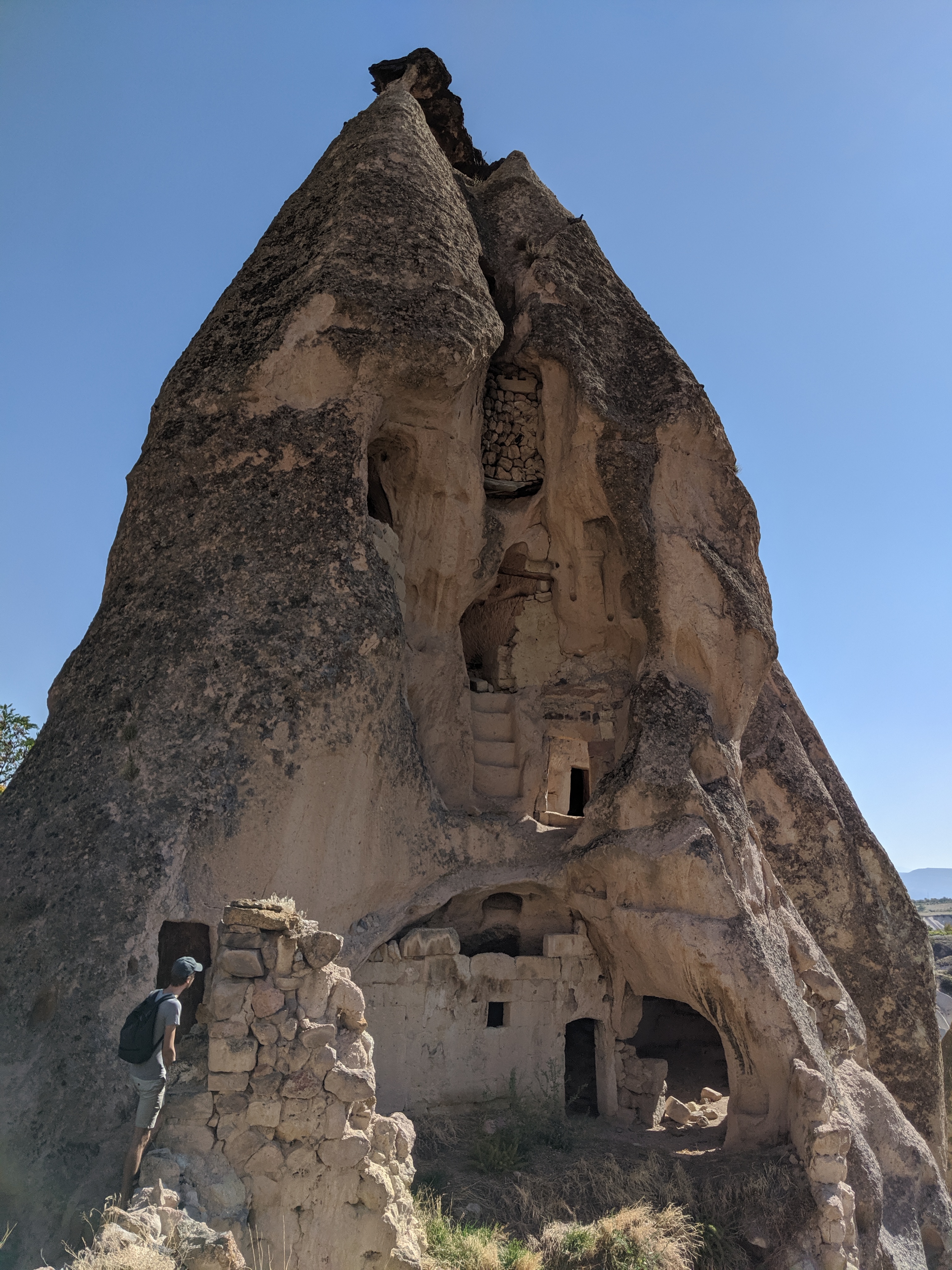
The next shot shows a closeup view of the tallest of the fairy chimneys in this area. The fairy chimneys were hollowed out to create tombs during the Roman period, any time from the third century BC to the early AD centuries:
Cave dwellings abound in the area. Some were built in the Roman period (third to fourth centuries AD) by Christians who came to the area to flee the Romans, and found that digging into the soft rock was an easy and convenient way to build solid, cool homes. People have been excavating homes in the rock for centuries, so it’s hard to know how old a specific cave is.
Some of the cave dwellings are easily accessible, in that they’re at ground level and unsupervised. It’s a bit of a scramble over rough terrain to get to them, and the grass hides unexpected deep holes and caverns, so be careful. Here’s a view inside a cave dwelling:
It’s surprisingly roomy and sophisticated in there. Another room in the same dwelling:
People also carve out pigeon houses in the tuff, and have been doing so for thousands of years. Farmers use the pigeons as a source of fertilizer as well as food:
To finish, enjoy a cheery shot of the flaming clay pots in which a beef dish is served at Muhterif restaurant in Uçhisar:
This is the blog of Mark Wordsworm, the travelling worm. I’m a 36-year-old bookmark (give or take a few years) and I proudly boast my own Hallmark serial number, 95 HBM 80-1. You’ll probably want to read all about me and my Travelling Companion (the TC).
Today’s travel notes
Today’s a red letter day, for no other reason than that I’ve decided to update my age after checking the date of my first post on this blog, My very first post was on 25 April 2008, titled The red centre. At that time, I judged myself to be 25 years old. Today, just over 11 years later, it seems like a good time for an update. I’m 36 years old, give or take a few years. Happy new age to me.
But now, on to the topic of my latest travel adventures. Me and the TC spent last weekend on Magnetic Island, a tropical island in North Queensland.
The book I’m in
The Wrath of Angels, by John Connolly. A fast-paced mix of murder, mystery, and fallen angels, featuring private detective Charlie Parker.
Recommended accommodation
Island Leisure Resort, 6 Kelly Street, Nelly Bay. The rooms are spacious, comfortable and clean, and the staff are friendly. There’s a swimming pool and a tennis court, and a games room with table tennis and pool tables. Accompanied by great hilarity, the TC rediscovered her mediocrity at both of the last-mentioned.
The photos
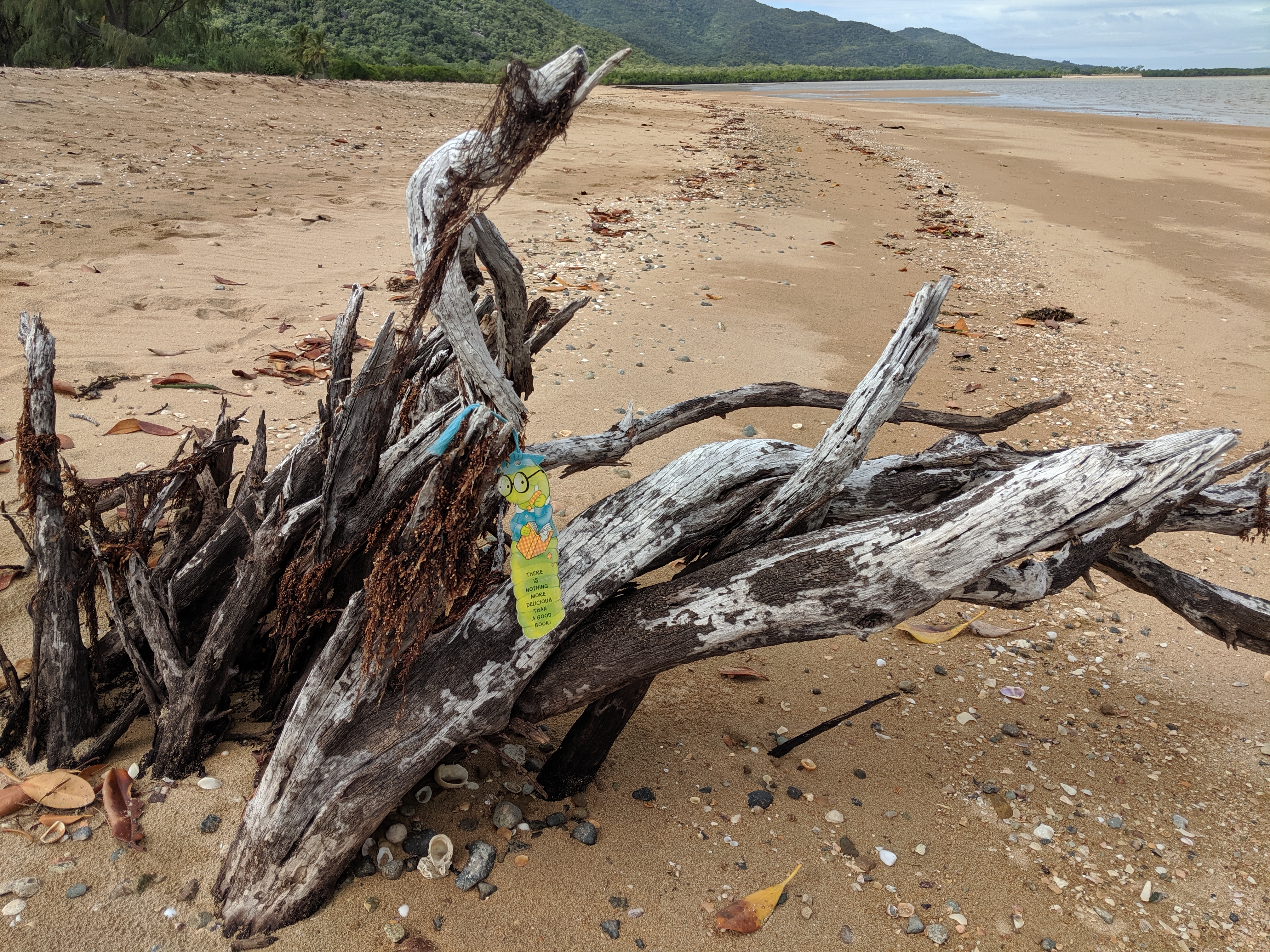
Me and an art piece created by sea and wind, on a beach at the north-west end of Magnetic Island:
The vegetation on the island was lush and green, at least in comparison to many parts of Australia. This photo shows the same beach at the quiet north-western end of the island:
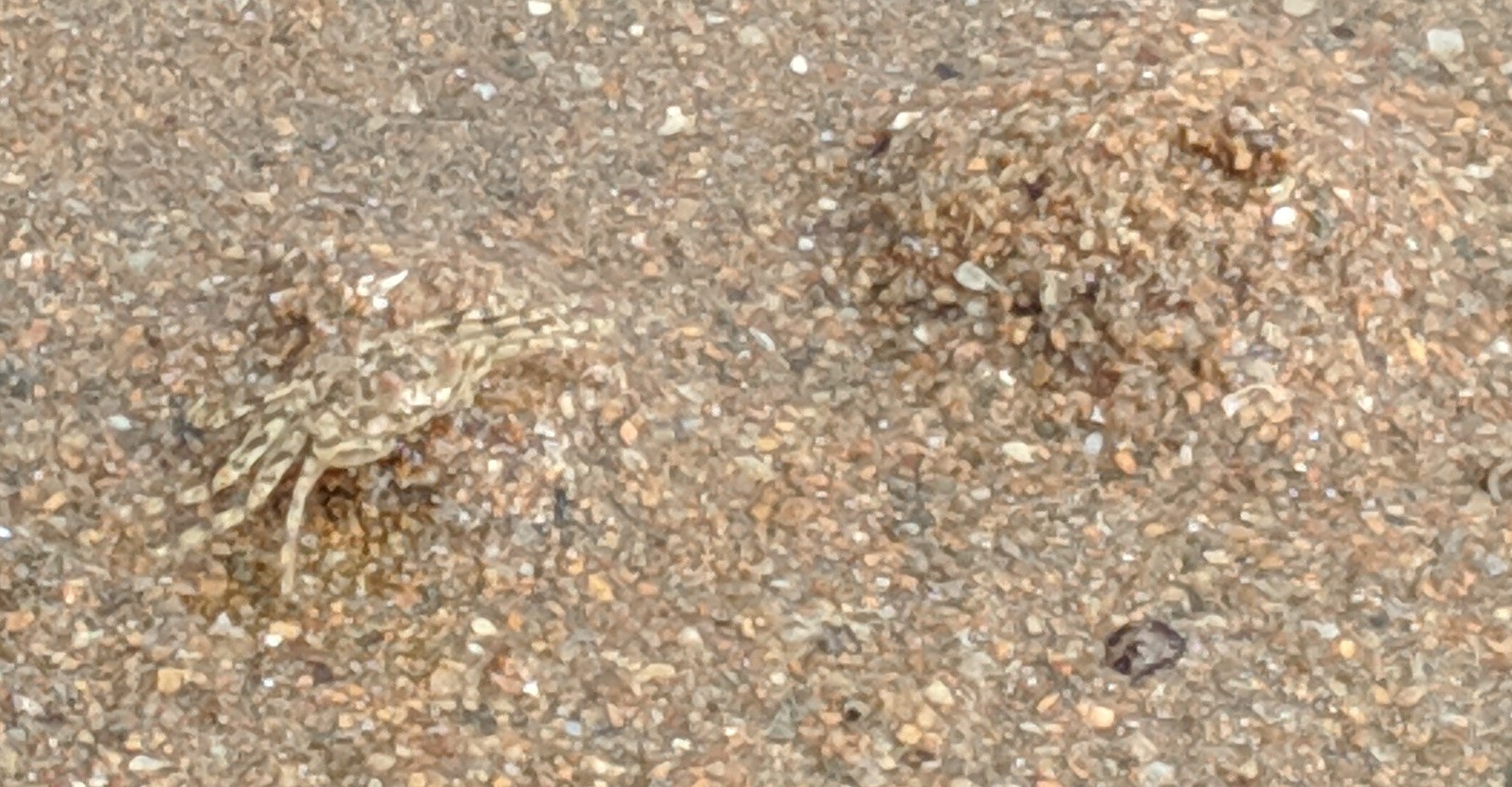
Denizens of the beach included super-fast, nigh-invisible crabs. In the following picture, the crab is on the left. At top right is a mound with a hole in it, probably the entrance to a crab palace:
Jonathan was there too. The presence of Jonathan and his mates constitutes good cause for the crab’s camouflage and speed:
The drive to the beach takes you along a dirt road, crossed by gullies and fords, surrounded by dense Australian bush. A four-wheel drive is useful. Here I am, your dauntless travel guide, surveying a pretty scene along the route:
Mangroves decorated a creek that crossed the road, where we spotted some pretty fish and crabs (not in the photo):
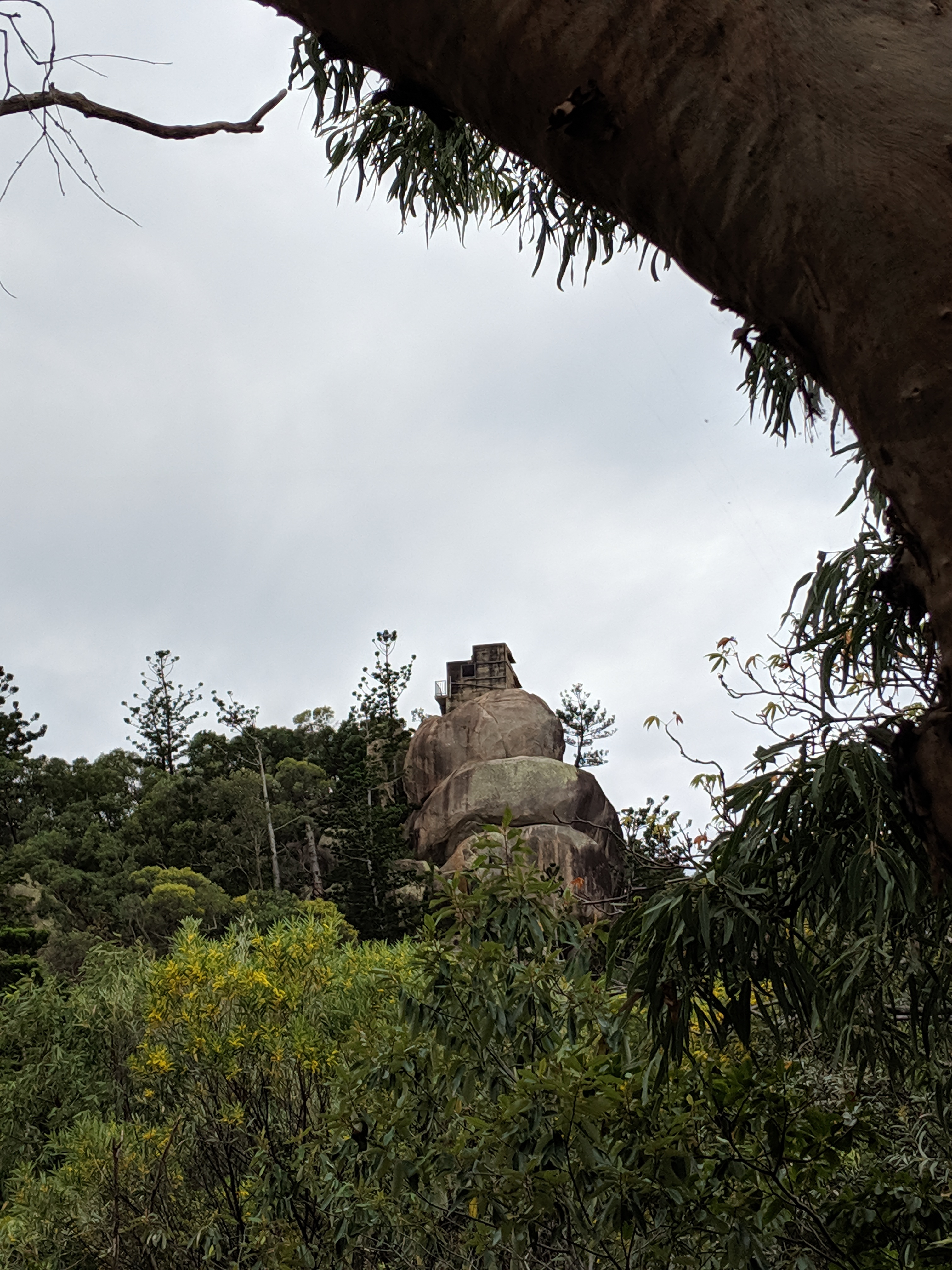
On the other side of the island, to the north east, a World War II fort and its out houses are valiantly fighting off the encroaching bush. Click this image to zoom in:
To get to the fort, the TC followed a winding bush track. The path is about four kilometres for the round trip, and takes about two hours. I stayed comfortably in my book in her bag, ready to hop out for each view and photo opportunity.
Here’s the fort’s lookout building seen from another angle as we approached the fort complex:
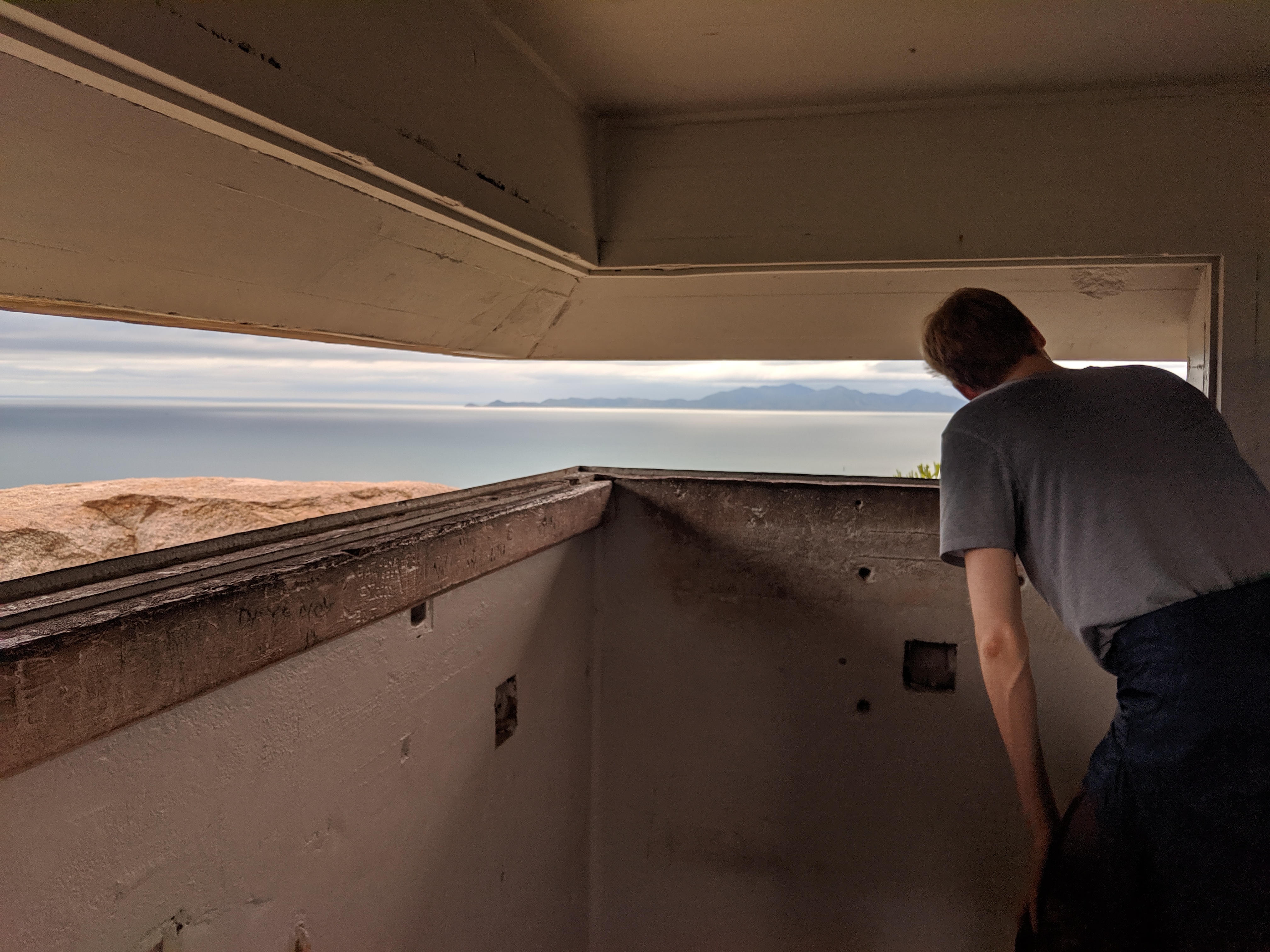
To get to the lookout, we climbed a series of stone steps and metal ladders. The TC did a good job, even hopping up onto the final platform inside the top room to see the view through the plane/ship-spotters slot in the wall. This shot shows an equally bold fellow traveller gazing out through the slot:
The views from the walk up to the fort had the TC ooh-ing and aah-ing:
Arthur Bay looks enticing from above. We didn’t get the opportunity to visit it on this trip:
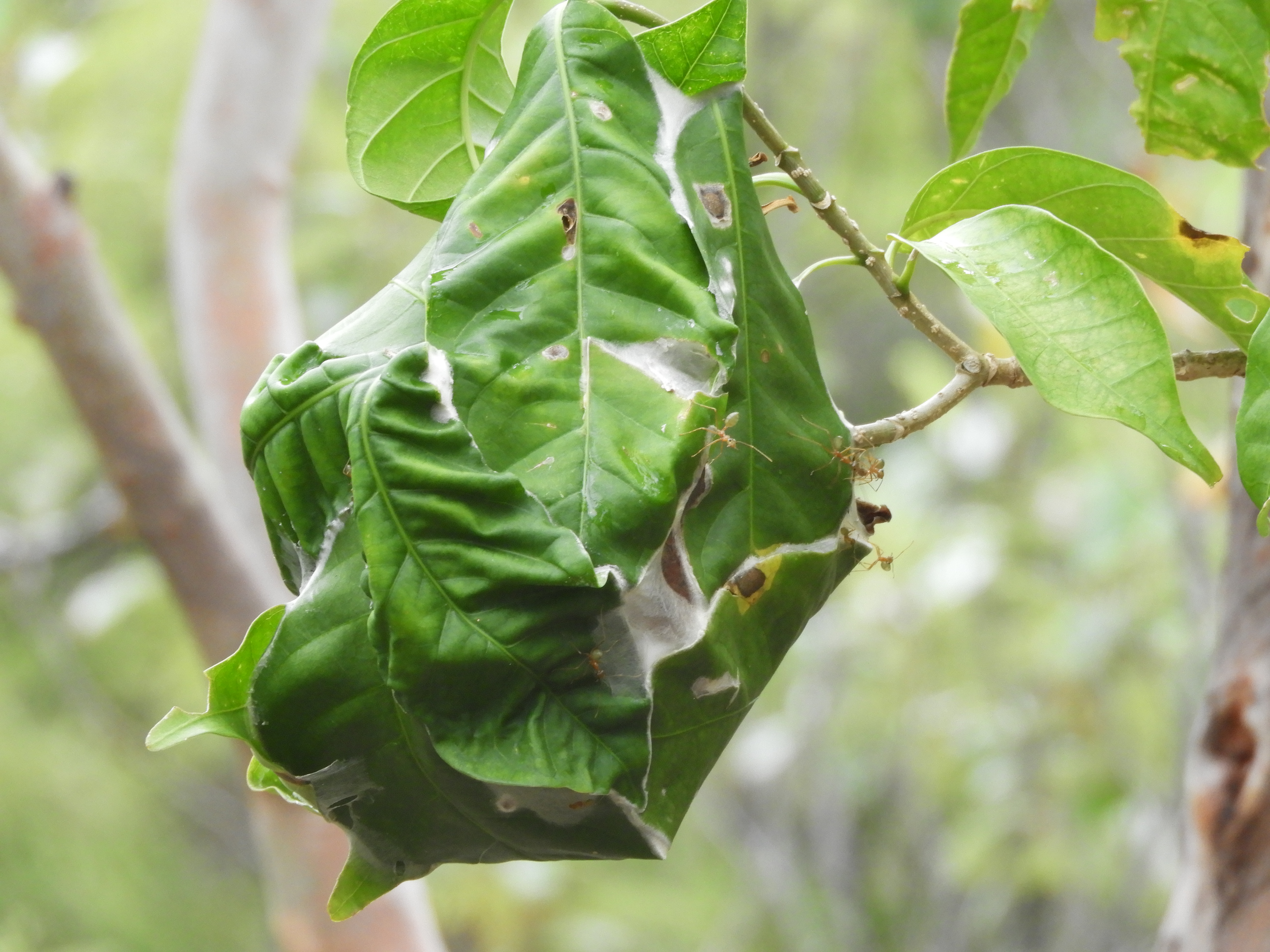
This worm was intrigued to note possible signs of activity by fellow worms. On various parts of Magnetic Island, including the fort walk, we saw bunches of leaves glued together with web:
Could this be the work of a caterpillar like that of the fall webworm or tent caterpillar, which create nests of silk? Looking closer, we noticed ants on the leaf bunches. I’ve since done some research and discovered that these are green tree ants, a type of weaver ant. The adult ants gather in large numbers and pull the leaves together. Then they bring an ant larva, which produces the web to hold the leaves in place:
Below is a slightly fuzzy zoomed-in section of the photo, where you can see a few of the ants:
The TC was curious and leaned in close to examine one of the leaf bunches, as did her two companions. Seconds later, they noticed lines of ants moving down the tree trunk and up their legs. They all jumped away and started stamping their feet in an effort to dislodge the ants. This curious but typical reaction is known by locals as the green ant dance. Poor TC, she does have a knack for getting herself into a pickle.
The guide books promised that we’d see wild koala on the walk up to the fort, and we did. It was as if someone put a cuddly toy up in a tree:
Mostly these wise creatures sleep all day, but this one needed to shift position:
Also interesting, though perhaps not as cuddly, was this deep red mushroom on the side of the walking track:
Another aspect of Magnetic Island that had the TC ooh-ing and aah-ing was the birdlife. For obvious reasons, this worm is not that fond of birds (Jonathan excepted). As a teaser for readers who’re keen on our feathered fiends, below is a clump of Rainbow Bee-eaters:
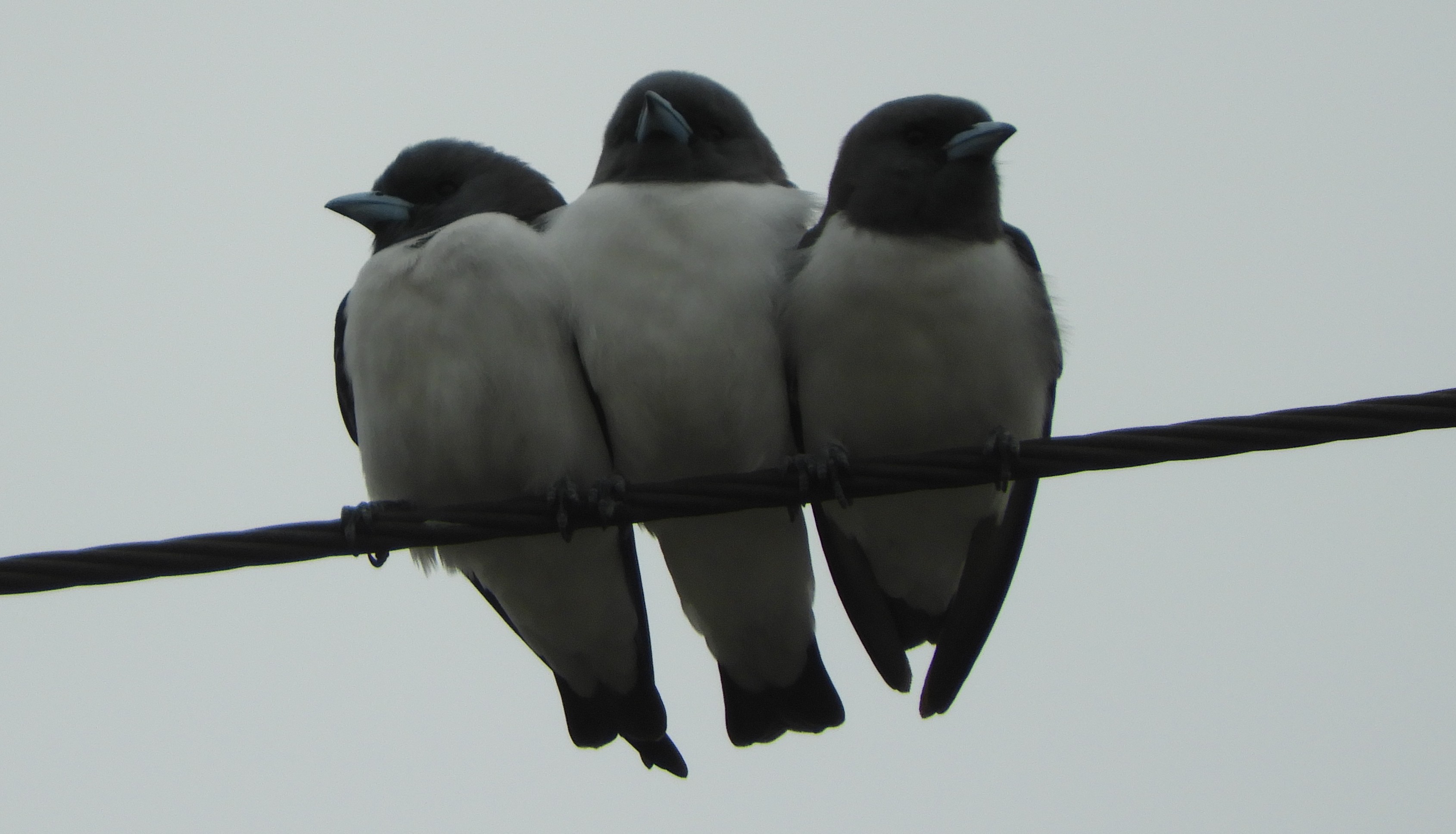
They say trouble comes in threes. Here’s another bird clump, this time of Woodswallows:
This is the blog of Mark Wordsworm, the travelling worm. I’m a 25-year-old bookmark (I haven’t aged at all since I first wrote this introduction) and I proudly boast my own Hallmark serial number, 95 HBM 80-1. You’ll probably want to read all about me and my Travelling Companion (the TC).
Today’s travel notes
Me and the TC are enjoying the superb weather of summertime Seattle. We’ve encountered some interesting folk, including a triffid (read my previous post), Sal the Salmon (photos below), and a metaphysical mastermind (coming up in my next post).
Yesterday we trickled along to the Ballard Locks, north west of Seattle. The locks are also known as the Hiram M. Chittenden Locks, named after the engineer who led the first phase of construction starting in 1911.
The book I’m in
Never Go Back, by Robert Goddard. Two hapless RAF veterans find themselves mixed up in murder and mayhem, tied up in a nice bit of historical cold war skulduggery.
The photos
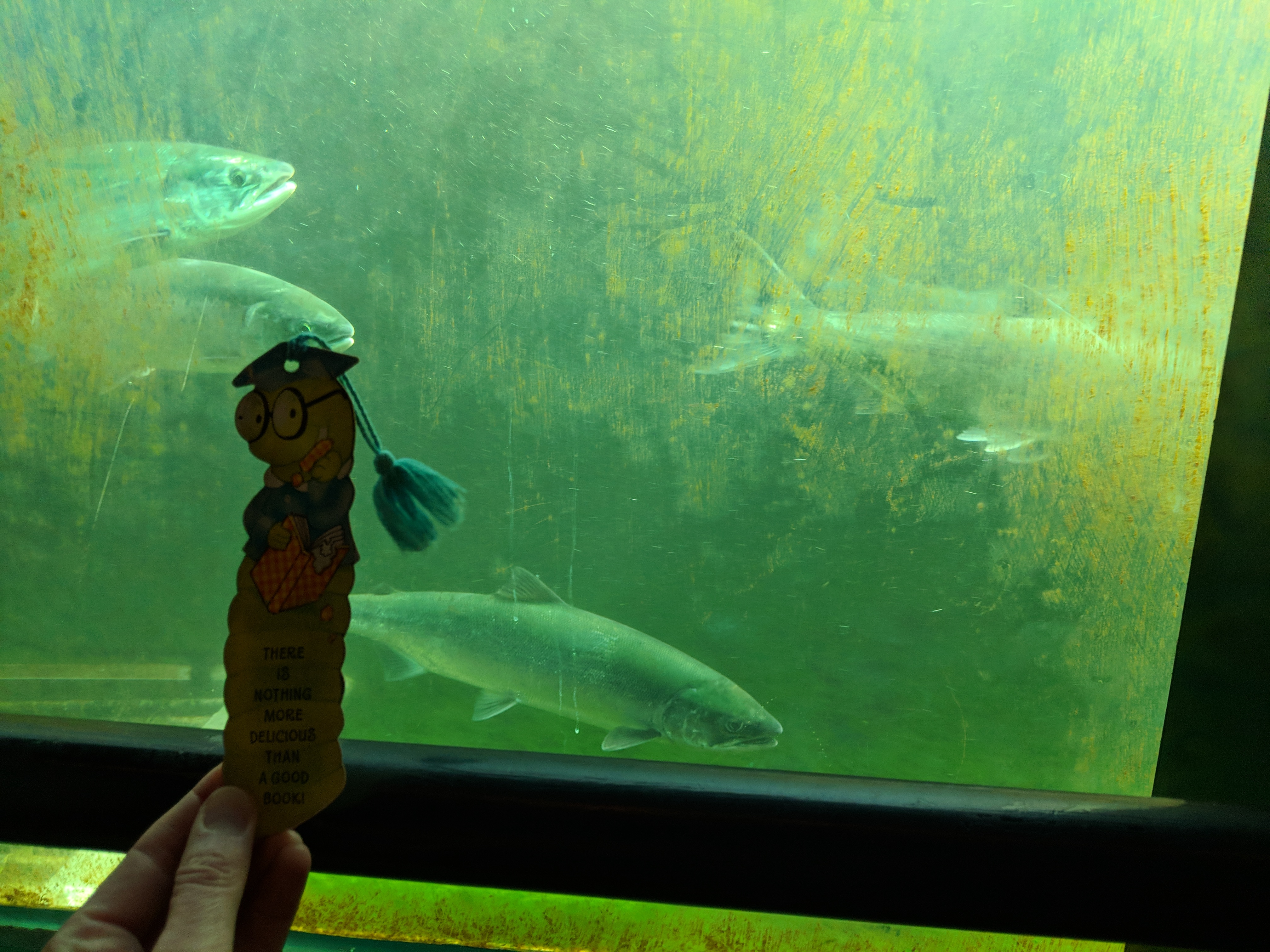
Me with Sal the Sockeye Salmon, at the fish ladder built alongside the Ballard Locks. Sal and his mates are taking it easy in the deep waters before tackling the next jump up the fish ladder:
The fish ladder is built so that you can see it from above and also go underground to view the fish through glass windows in the walls. The Sockeye Salmon are making their run at the moment, but in lower numbers than past years.
The Ballard Locks are part of a series of constructions built in the early 1900s to make a navigable pathway from Lake Washington to Puget Sound. Once the various construction projects were finished, ships could carry cargo such as log, wood, and fish from the lake to the coast and in reverse.
The locks make it possible for boats to move up and down the Lake Washington Ship Canal, travelling inland from the coast or vice versa, even though there’s a big difference in the level of the water in Lake Washington (which is more than 6 metres above sea level) and in Puget Sound (which is at sea level).
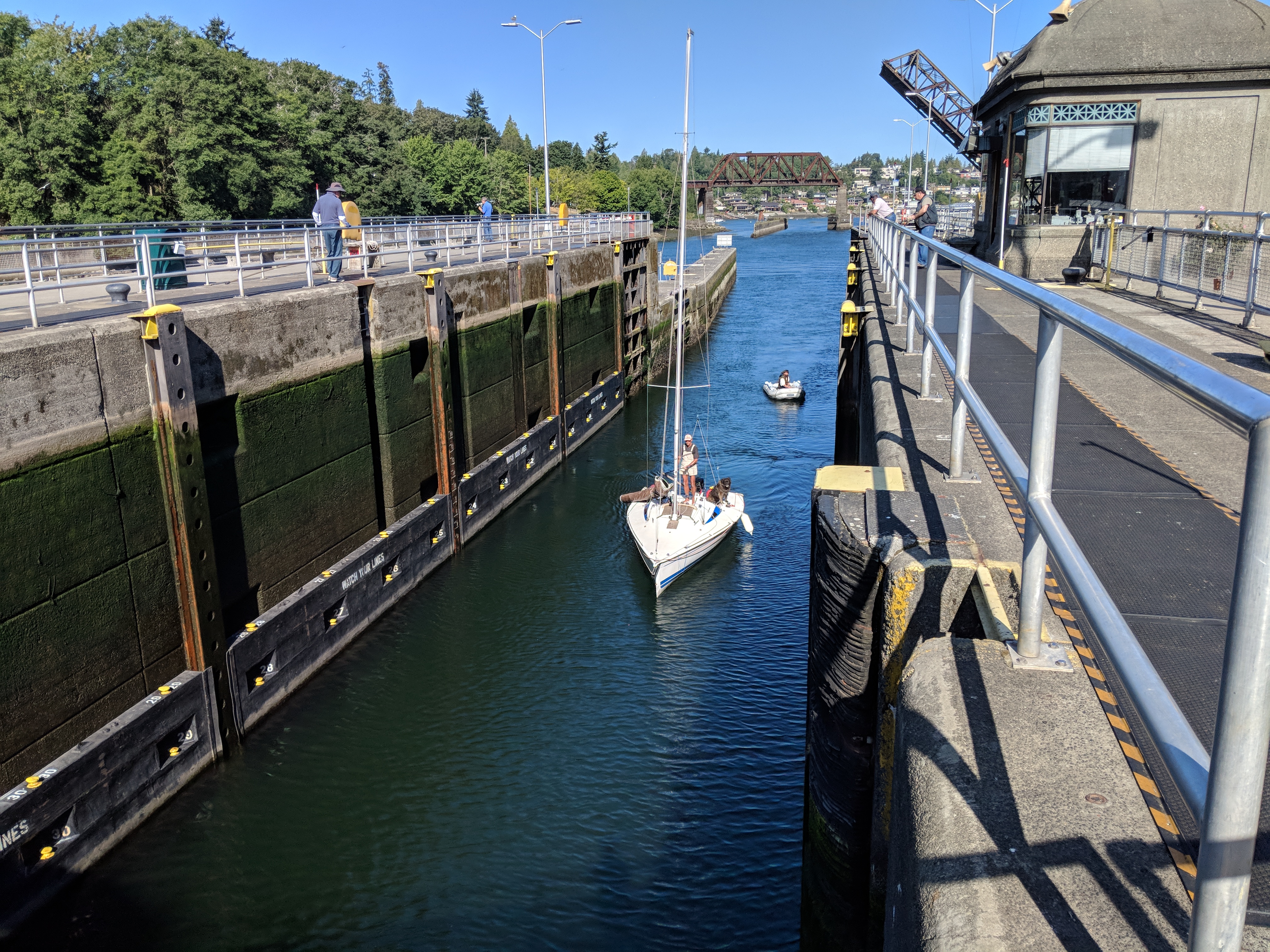
Here are a sailing boat and a dinghy entering the locks from the direction of Puget Sound, wanting to jump vertically upwards by a few metres into the canal. There’s a dog accompanying the sailor on the yacht:
The yachtsman secures his boat in the lock:
The lock gates close behind the boats:
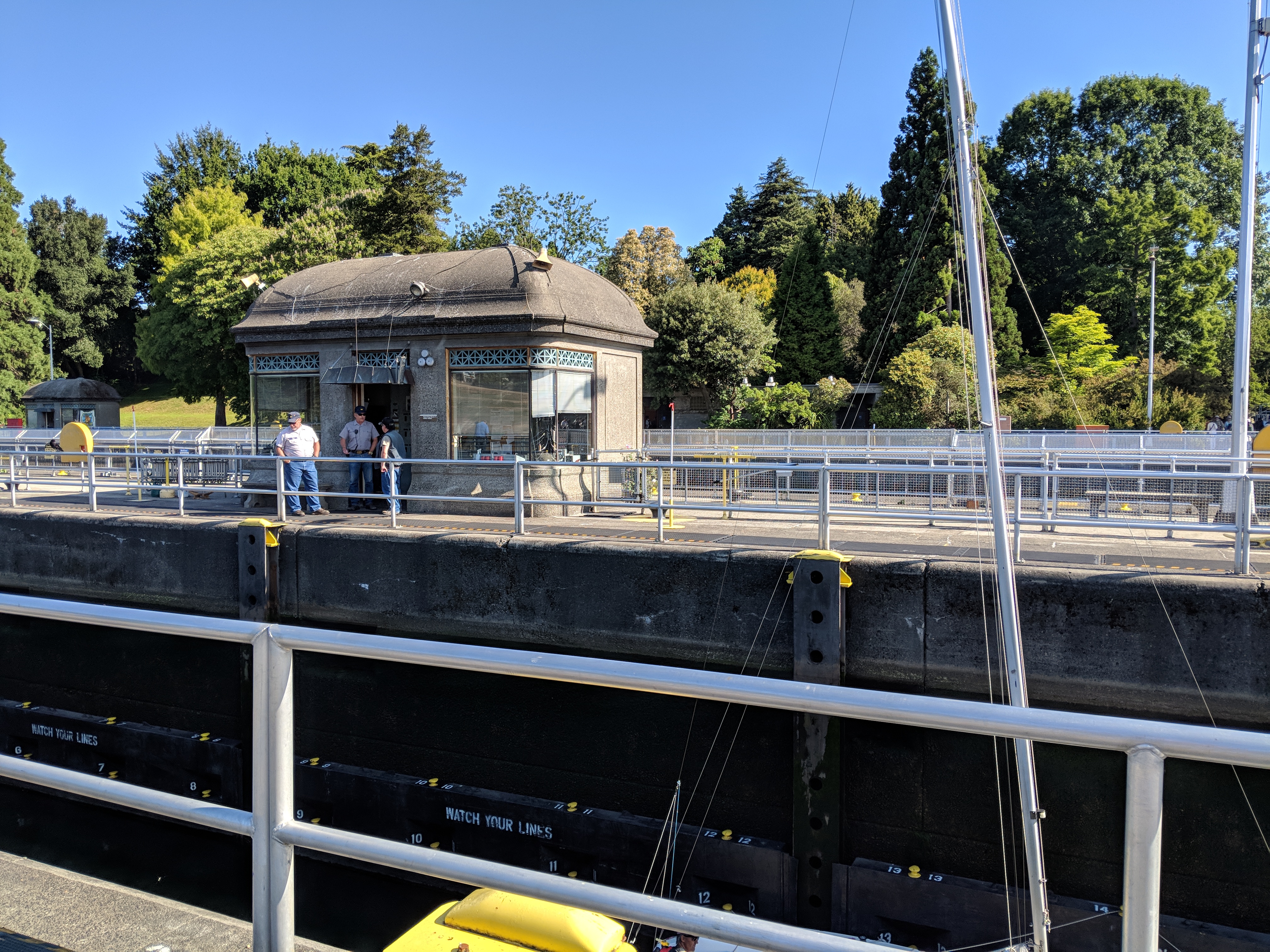
The lock operators watch from the side:
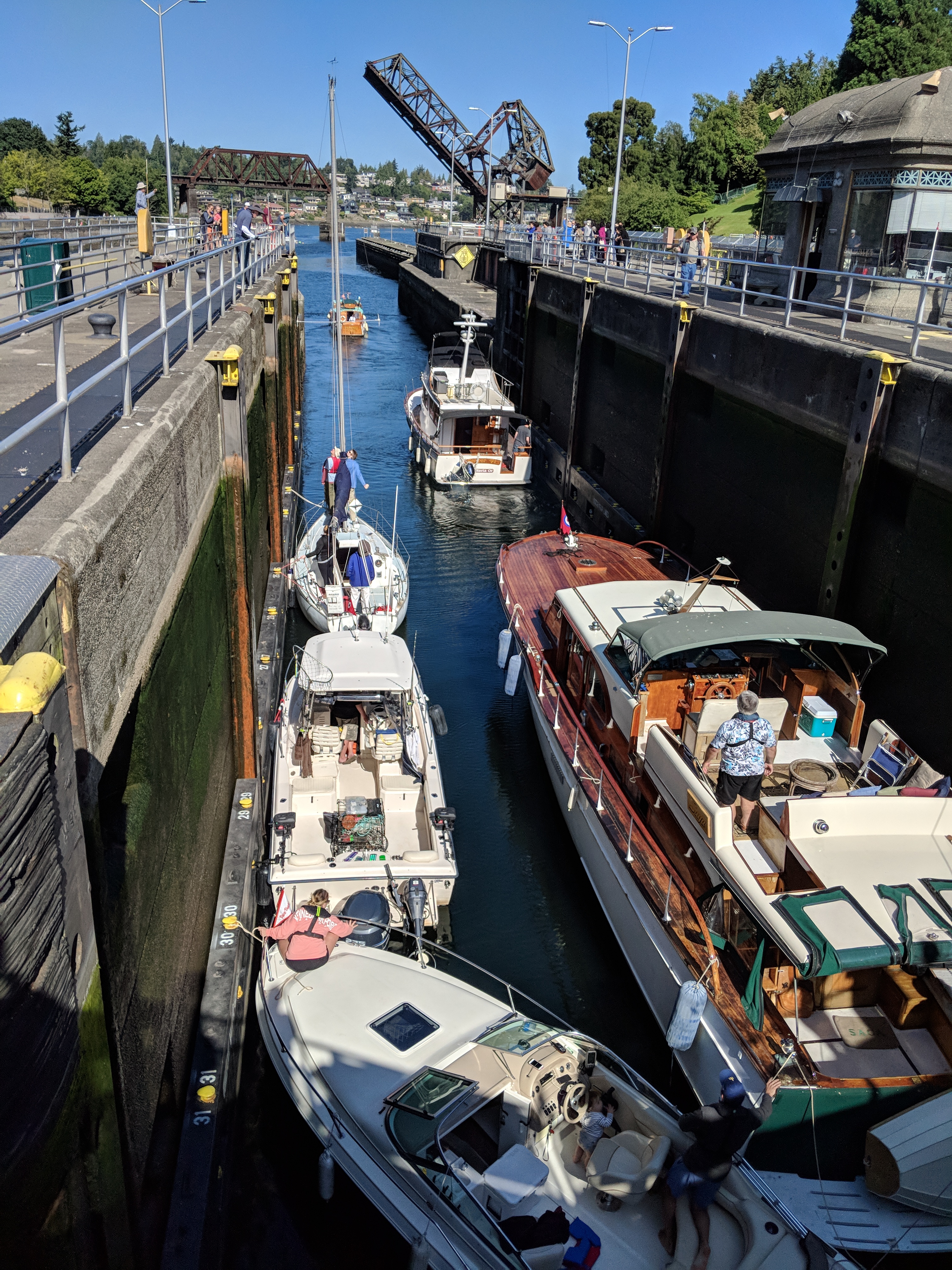
The filling-valves open below the water level, letting in the water from Salmon Bay. The water rises in the lock, lifting the boats with it, until eventually the water level is the same on both sides of the top gate, and the boats can move into the lake:
This lock is the larger of the two Ballard Locks. Things can get quite busy. In fact, the Ballard Locks are the busiest locks in the US:
A dam wall with a spillway holds back the waters of Salmon Bay from plunging down into Puget Sound. This picture shows the spillway, viewed from the Commodore Park side of the canal, which is on the side opposite the locks:
This video is taken from the walkway above the spillway, looking down at the patterns on the moving water, then raising the camera to look out towards Puget Sound.
This is the view from the spillway, looking west towards Puget Sound:
On the Commodore Park side of the canal is the fish ladder, winding up the bank from sea level at the bottom to the lake level at the top of the ladder. In all, there are 21 steps in the ladder:
This is the dam wall seen from the Salmon Bay side, with part of the fish ladder in the foreground:
Here’s another picture of the salmon under the water, on their way up the ladder from the ocean to the lakes:
This is the blog of Mark Wordsworm, the travelling worm. I’m a 25-year-old bookmark (I haven’t aged at all since I first wrote this introduction) and I proudly boast my own Hallmark serial number, 95 HBM 80-1. You’ll probably want to read all about me and my Travelling Companion (the TC).
Today’s travel notes
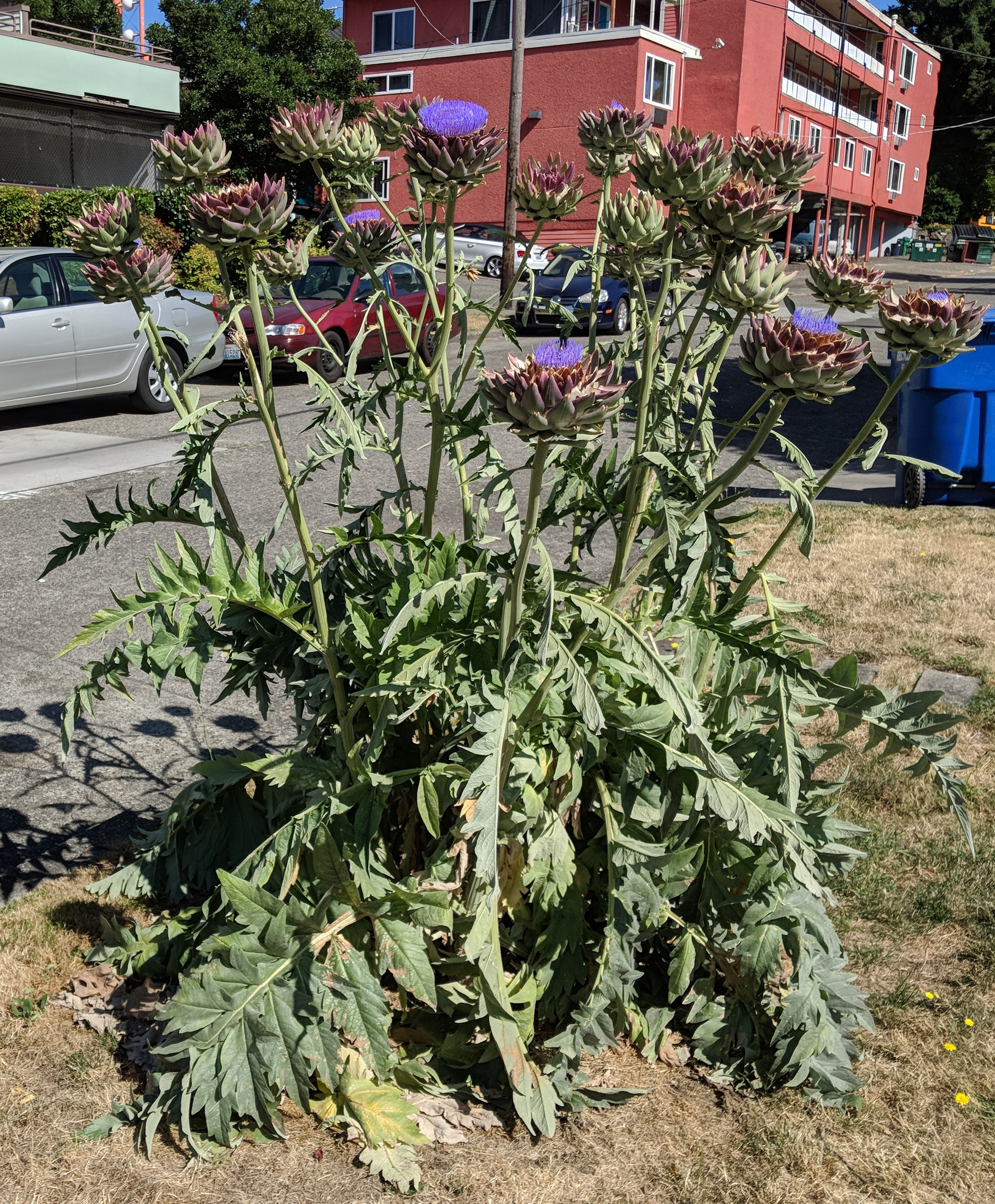
Alarm! This worm was wandering along a quiet Seattle road when I encountered a triffid. Fortunately for me, the creature was firmly rooted in the ground, gathering sustenance no doubt for its next foray into the world of us earthlings.
The photos
Approach with caution! A triffid rooted on a suburban Settle street:
The thing dwarfed the TC, but nevertheless, as is her wont, she insisted that I approach it for the obligatory portrait.
This is the blog of Mark Wordsworm, the travelling worm. I’m a 25-year-old bookmark (I haven’t aged at all since I first wrote this introduction) and I proudly boast my own Hallmark serial number, 95 HBM 80-1. You’ll probably want to read all about me and my Travelling Companion (the TC).
Today’s travel notes
Me and the TC, and the “TC once removed”, are in Boulder, Colorado. Yesterday we took a day trip into the Rocky Mountain National Park. It’s an easy drive from Boulder. Once in the national park, we wound upwards along Trail Ridge Road, passing the highest point at over 12,000 feet (3,700 metres), then descending slightly to the Alpine Visitor’s Center.
Word of the day
Lustrum is the word of the day. It means a five-year period. The term originates in ancient Rome from the name of the closing ceremony after each census of the Roman people, which took place every five years.
The book I’m in
Lustrum, by Robert Harris. I’m embedded in book two of the Cicero trilogy. Roman intrigue is a cutthroat affair.
Travel tip
Take lots of water with you, and moisturise copiously. In summer the air is hot and dry. This worm’s skin felt like paper each time I stepped outside.
Recommended restaurant
The Kitchen in Boulder has good food, graciously served, in an attractive and restful environment.
The photos
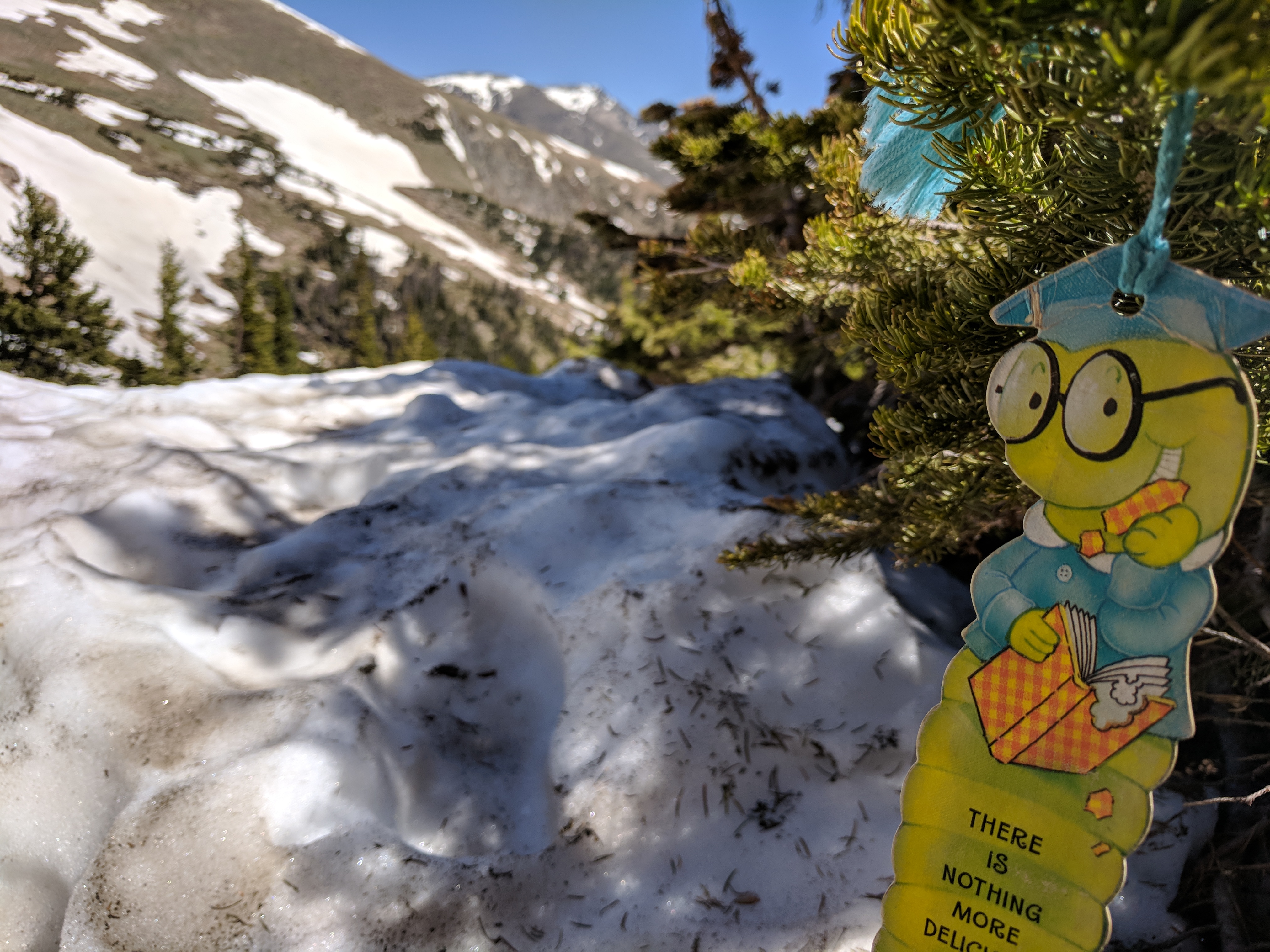
Me and a few alpine aspens and pines, on the way to the Alpine Visitor’s Center in Rocky Mountain National Park:
Yes, that’s snow. In summer. (The TC would have inserted double exclamation points at the end of the last two sentences. I refrain, but you, dear reader, may imagine them there if that brings the scene alive for you.)
Here’s another shot of the same scene, this time not graced with my noble form, but with the background in focus:
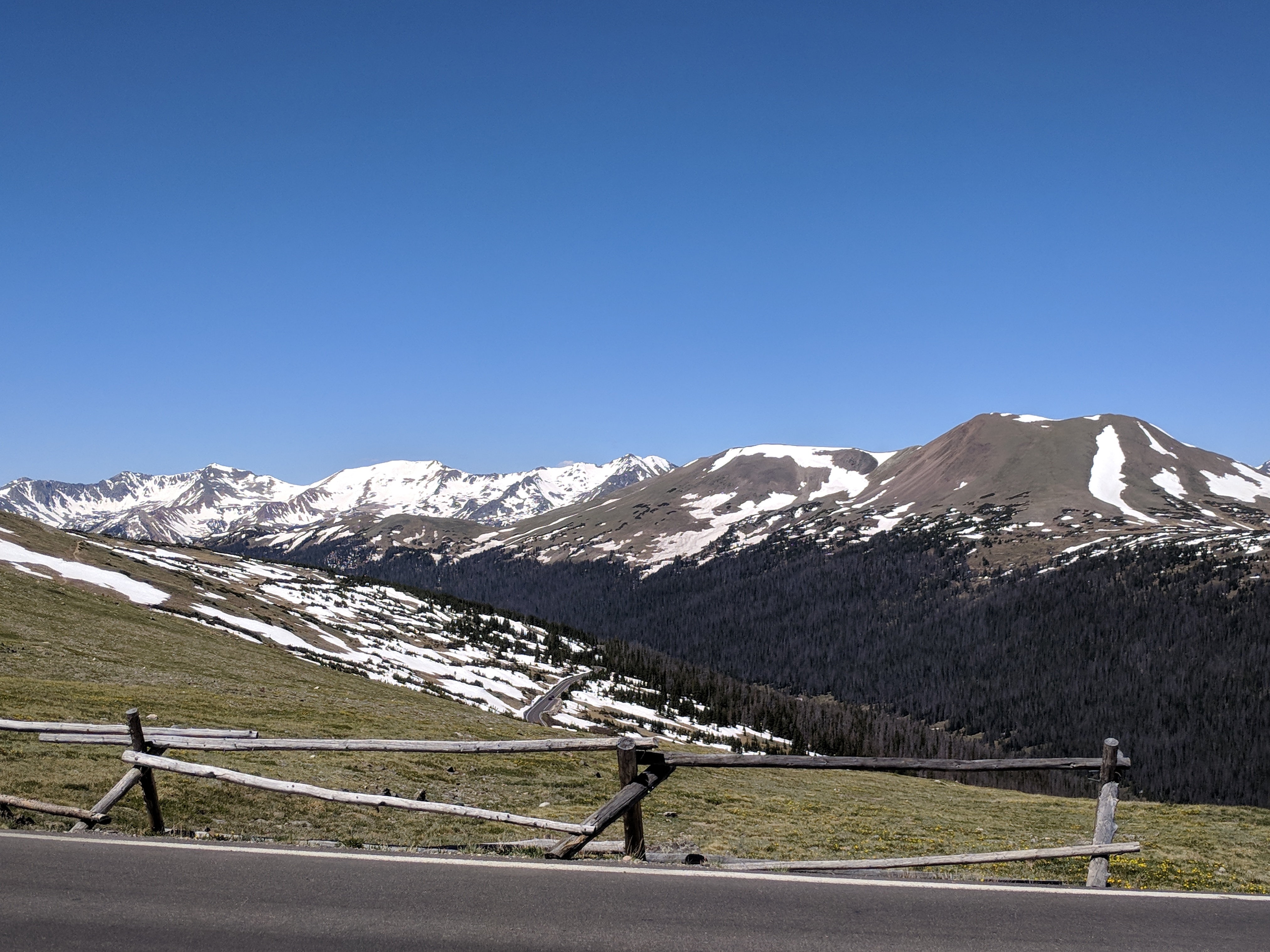
At close on 12,000 feet (3,600 metres), the Alpine Visitor’s Center on Trail Ridge Road is the highest of all visitors centres in the US national parks system. This shot shows the range of snow-capped peaks visible when you stand with the visitors’ centre behind you, looking to the left:
Beware the effects of the high altitude. (The previous sentence provides another opportunity for an exclamation mark, if the whim takes you.) The TC and the “TC once removed” were both affected by dizziness and fatigue.
This photo shows the view from the same spot, looking towards the right:
This is the blog of Mark Wordsworm, the travelling worm. I’m a 25-year-old bookmark (I haven’t aged at all since I first wrote this introduction) and I proudly boast my own Hallmark serial number, 95 HBM 80-1. You’ll probably want to read all about me and my Travelling Companion (the TC).
Today’s travel notes
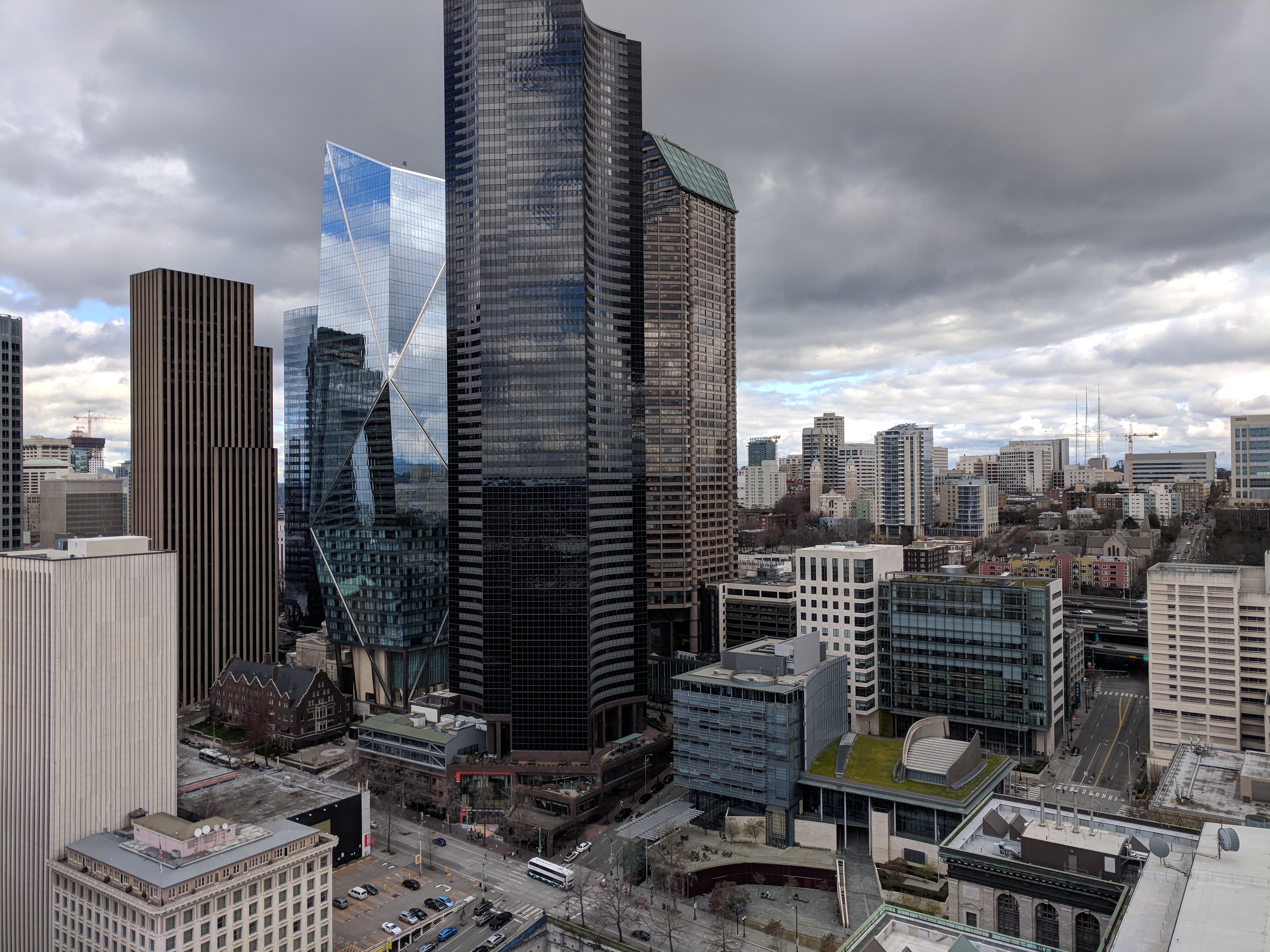
The picture below shows the Seattle skyline, as seen from the top of Smith Tower. The TC, bless her cotton socks, says that the light-coloured angular shape on the left half of the image looks to her like a glitch in the space time continuum. We more sober souls know it’s more likely to be yet another a skyscraper plated in reflective glass.
Word of the day
Glitch is the word of the day. This worm is surprised to learn that it’s a relatively new term, originating among space scientists in the 1960s. The word glitch first meant a sudden surge in current, which often was the cause of a malfunction. Later the word’s meaning broadened to mean a short-lived fault that’s difficult to track down.
The book I’m in
The Hunter’s Oath, by Jason Dean. Yes, I’m still stuck in the same book as I was in the previous two posts. It’s a good read, featuring action hero James Bishop. The hero is a little like Jack Reacher, only meaner.
This is the blog of Mark Wordsworm, the travelling worm. I’m a 25-year-old bookmark (I haven’t aged at all since I first wrote this introduction) and I proudly boast my own Hallmark serial number, 95 HBM 80-1. You’ll probably want to read all about me and my Travelling Companion (the TC).
Today’s travel notes
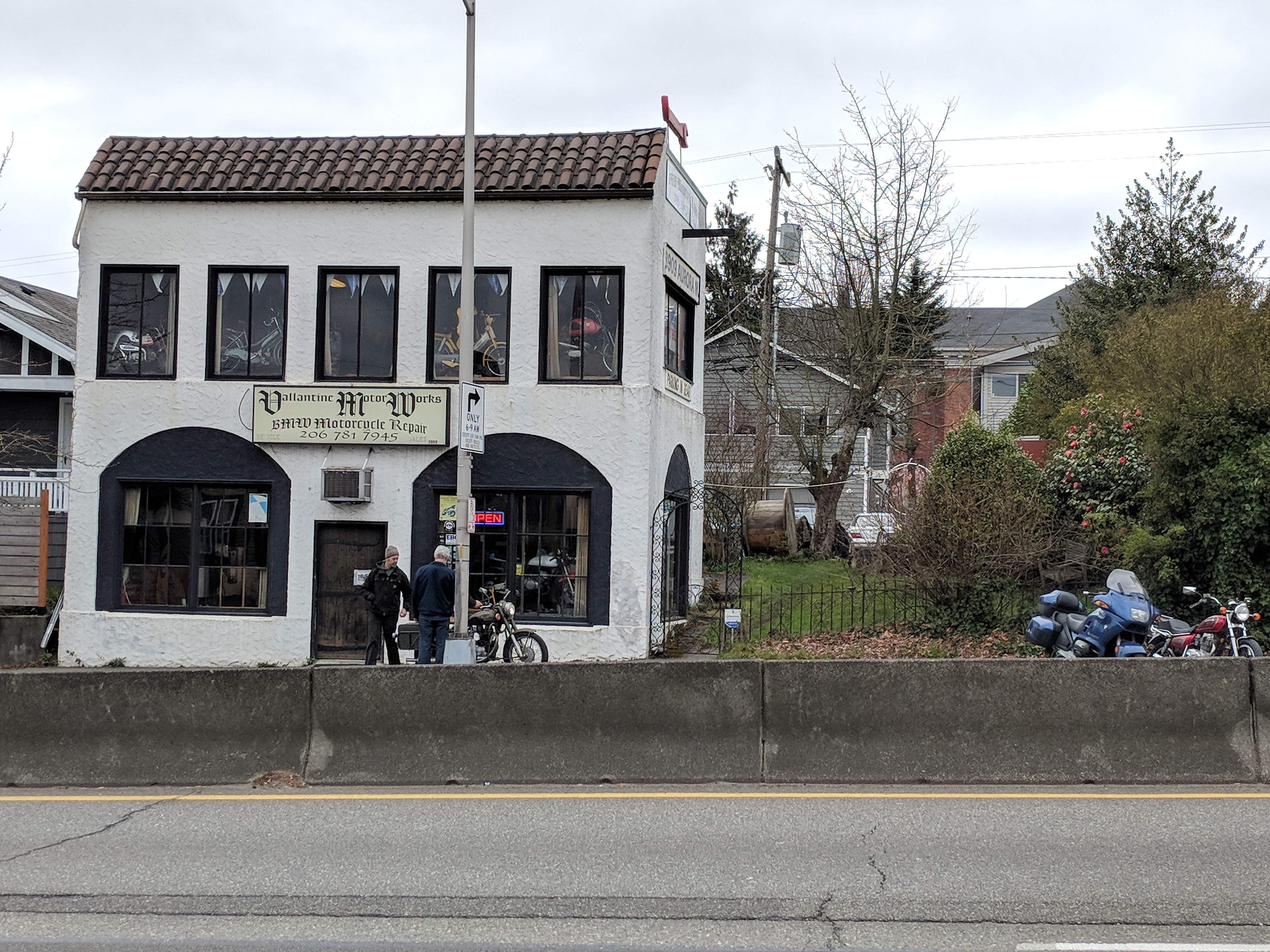
This atmospheric motorcycle repair shop is on Aurora Ave N in Fremont, Seattle:
Click on the picture to zoom in, and take a look all the bikes and flags behind the windows.
The business is Vallantine Motor Works. This worm likes the combination of gothic styling and beautiful machines. It quite makes me want to wander in and see what’s going on.
The book I’m in
The Hunter’s Oath, by Jason Dean. A good, fast read with action hero James Bishop. The hero is a little like Jack Reacher, only meaner.
This is the blog of Mark Wordsworm, the travelling worm. I’m a 25-year-old bookmark (I haven’t aged at all since I first wrote this introduction) and I proudly boast my own Hallmark serial number, 95 HBM 80-1. You’ll probably want to read all about me and my Travelling Companion (the TC).
Today’s travel notes
The TC, bless her cotton socks, has visited Seattle a few times, but without seeing the renowned Mt Rainier. Friends and colleagues assured her it was a spectacular sight, but often hidden by cloud.
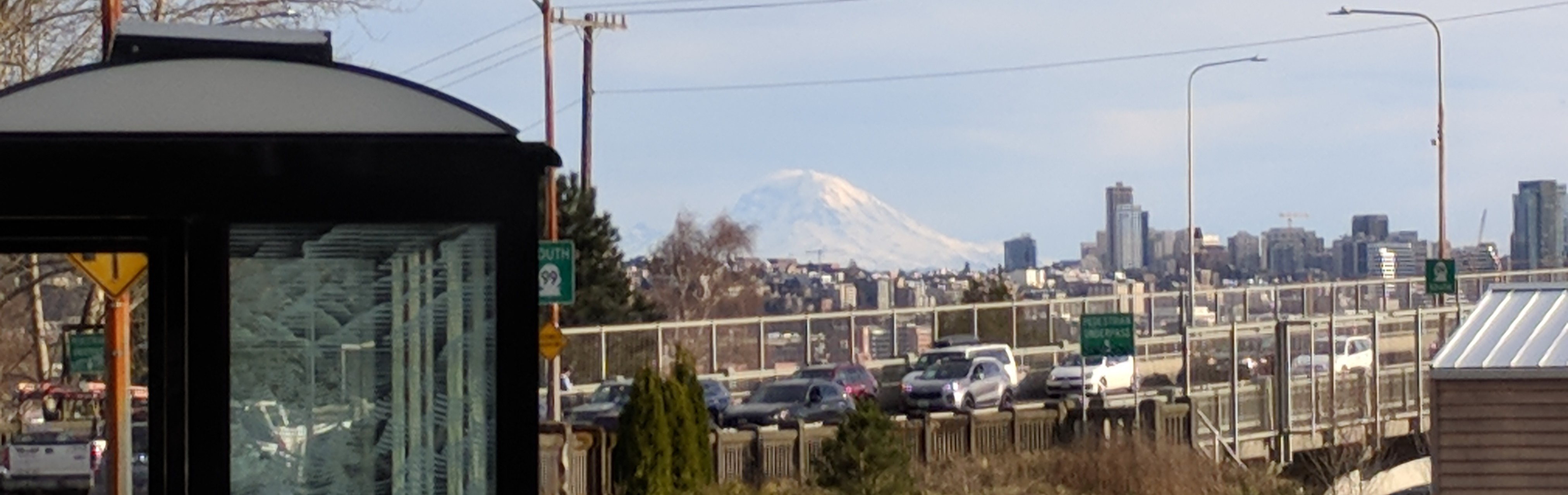
On this visit, suddenly, there it was. As if someone had dropped a great big mountain out of the sky.
Here’s Mt Rainier, seen from the bridge on Aurora Ave N in Fremont, Seattle:
The Fremont Troll lurks under the same bridge. I posted a couple of picturesof the troll and the underneath of the bridge.
Mt Rainer lies 87 kilometres south east of Seattle. It’s an active volcano. Although it’s currently dormant, it’s considered one of the 16 most dangerous in the world because of the large amount of damage an eruption would cause to living creatures and property.
Word of the day
On-premise is the word of the day, used in phrases like “on-premise software/services,” to compare such services with those in the cloud. “On-premise” is a malapropism for “on-premises”. The question is whether the malapropism is now in sufficient common use for us to start using it without feeling uncomfortable. The TC, bless her cotton socks, still feels uncomfortable with such use of “on premise” or “on-premise”.
Here’s what the TC says:
I first read the term “on-premise software” about 5 years ago. I was completely flummoxed. “What? Is this software that’s offered under the assumption I’ve accepted some premise or other? Where’s that premise written?” Now, 5 years is a long time in the tech world, but perhaps not outside our industry. As a tech writer, I want to avoid giving people that unpleasant brain-bump of “that breaks my language parser”. What’s the harm in getting it right, and saying “on premises”? I guess someone else’s answer may be: the docs sound old and fuddy-duddy.
The book I’m in
The Hunter’s Oath, by Jason Dean. A good, fast read with action hero James Bishop. The hero is a little like Jack Reacher, only meaner.





























 Travelling Worm