Me and the TC (read about us) are on the road again. During our Outback adventures, we’ve met several other travellers. Not least are the Emus.
Tracks in the red dirt alert you to their presence:
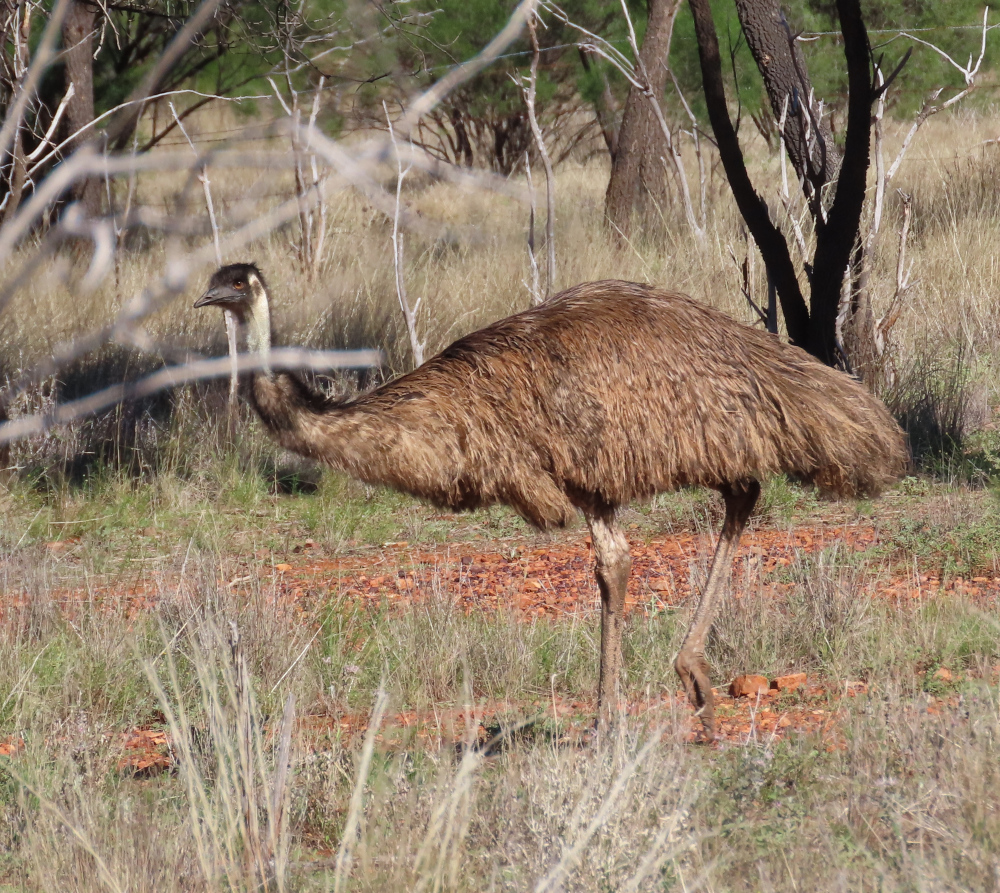
These birds can run at a speed of 50 km per hour (30 miles per hour). We had proof of that when a bird charged out of the bush, ran behind one of the cars in our convoy, hugging the bumper so that the driver had no idea it was there, then spun around the car and dashed in front of it. Luckily, bird and driver avoided a collision.
From an Emu’s point of view, it seems that cars are either play things or creatures that need to be challenged. This bird is most likely considering a dash onto the highway:
Emus are the second-largest bird in the world. They’re nearly 6 feet tall (1.9 metres). That’s a lot bigger than yours truly.
The next encounter is too close for comfort, methinks, but the TC (bless her cotton socks), was keen to get the shot:
This is the blog of Mark Wordsworm, the travelling worm. I’m a 40-year-old bookmark (give or take a few years) and I proudly boast my own Hallmark serial number, 95 HBM 80-1. You’ll probably want to read all about me and my Travelling Companion (the TC).
Today’s travel notes
Me and the TC drove the historic Bridle Track and the scenic Root Hog Road this weekend with a group of friends. We camped overnight at Mary Flynn Reserve on the Bridle Track.
The book I’m in
Ten Days in A Mad-House, by Nellie Bly. A somewhat horrifying true tale of a reporter in 1887, who had herself checked into an asylum for the insane and wrote a book about her experiences.
Travel tips
You need a four-wheel drive vehicle to follow the tracks mentioned in this post. If you decide not to camp nor to stop at the various reserves along the way, you can drive the Bridle Track in two to three hours.
The photos
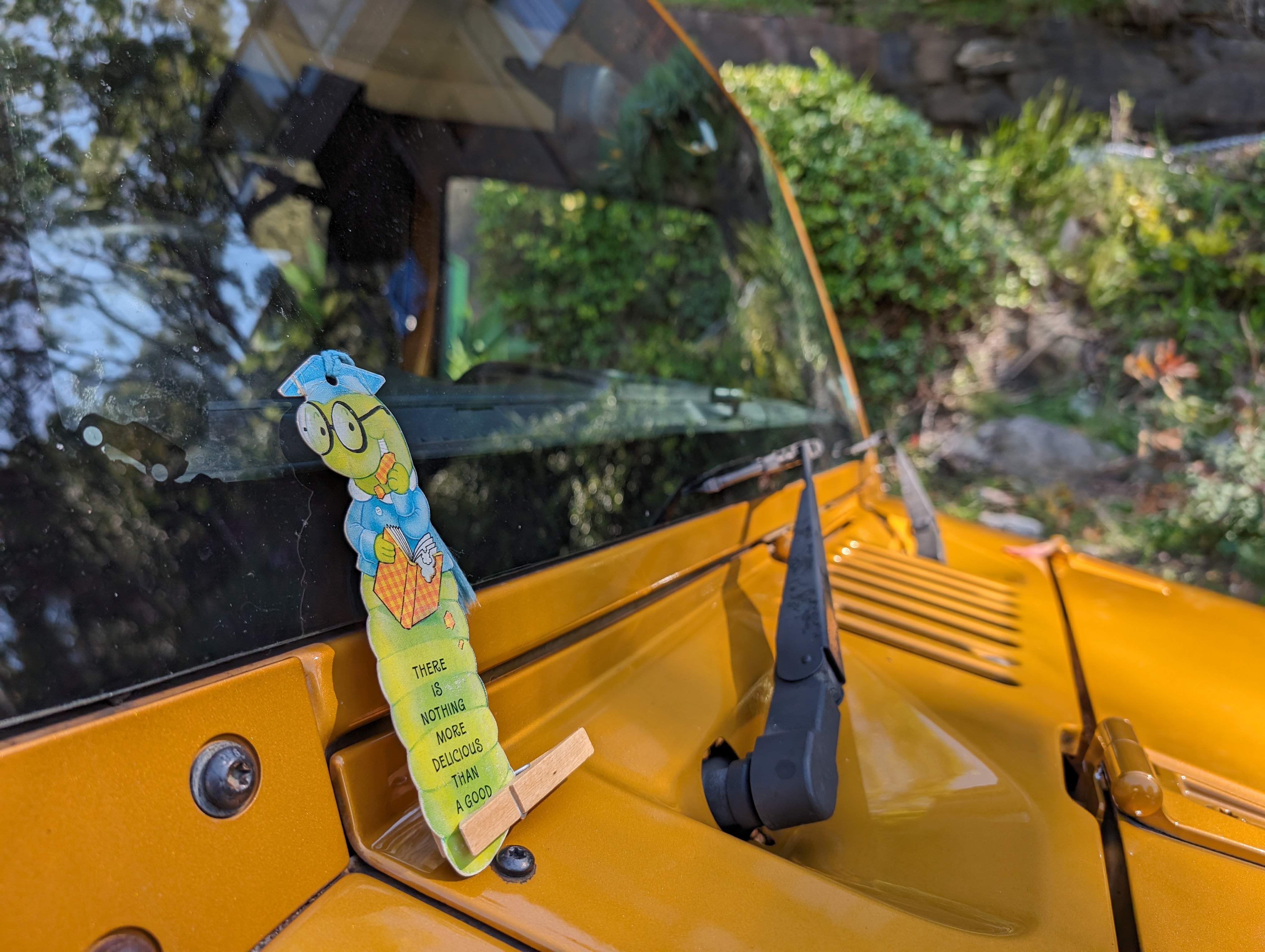
Me with Janet the Jeep and Peg:
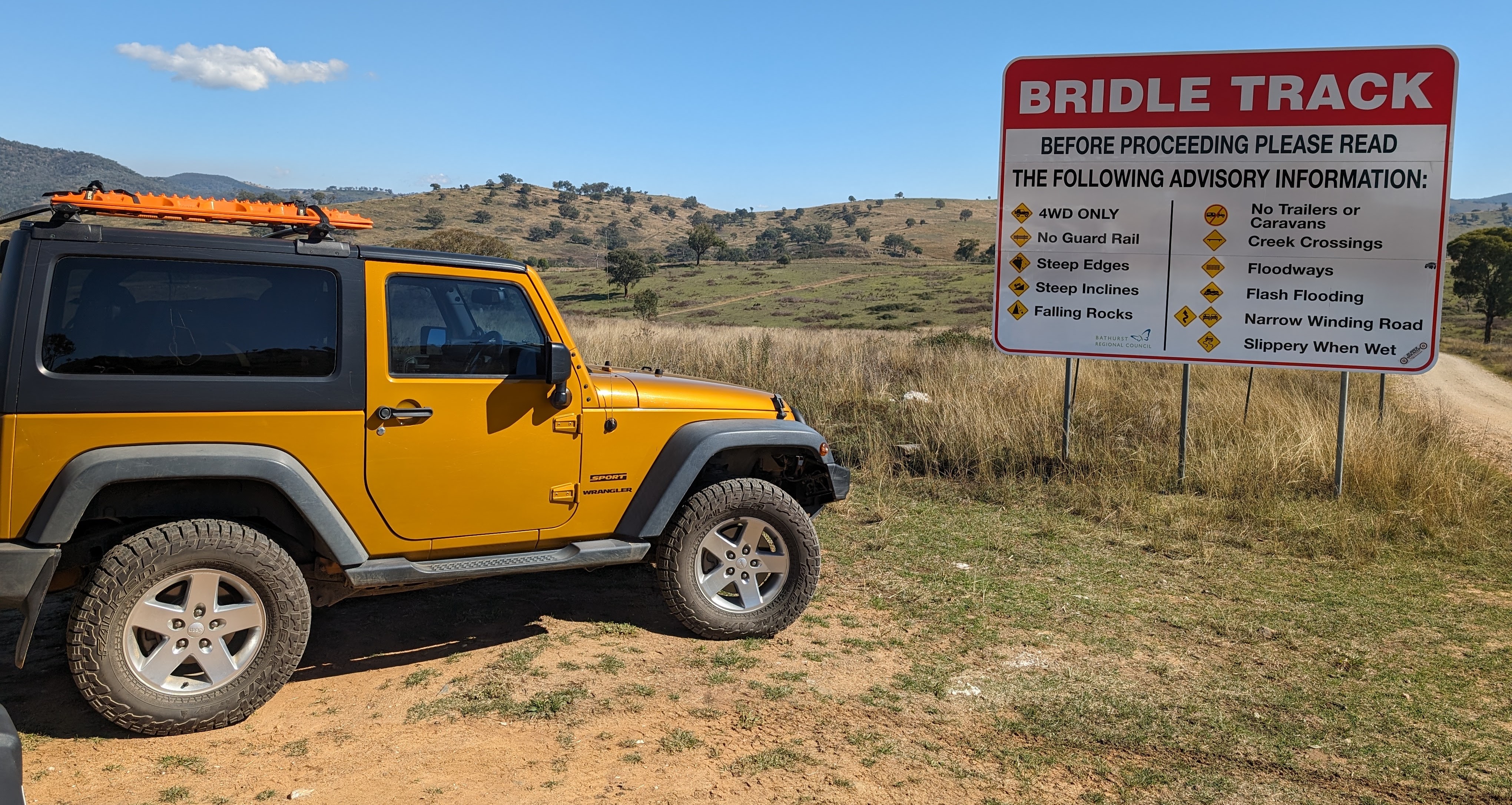
Introducing the newest member of our merry menagerie: Janet the Jeep. She’s a 2014 Jeep JK Wrangler, manual transmission, with a 3.6 litre, 6-cylinder petrol engine. She has two side doors rather than four, and is known as a shortie because of her short wheel base. Unlike yours truly, Janet is not built for speed but she’s plucky and strong. More like Peg, in fact.
A keen-eyed reader might notice the little Jeep icon on the windscreen next to this worm. Janet is cute, and she knows it.
At the start of the Bridle Track, a sign explains the need for a 4WD vehicle and due care:
Most of the track is a well-graded dirt road. In some sections, there’s a high rocky wall on one side and a steep drop-off on the other. In this section, the road curved through a rocky bluff:
In years gone by, one specific section of the Bridle Track was very narrow and slippery: the infamous Monaghan’s Bluff. NSW state has since built a bypass, though a sign still greets you as you enter the area:
The Bridle Track was built in the early 1800s, to give gold miners and settlers a route from Bathurst to Hill End. Bathurst is now a thriving regional city and Hill End is a small town that welcomes visitors interested in the history of the area.
Right on the side of the Bridle Track is an abandoned mine shaft. The brave can walk into it. The TC, bless her cotton socks, counts herself as one of the brave. She found that she could stand, with head slightly bowed, in the tunnel:
We camped at the beautiful Mary Flynn Reserve. This view shows part of the campground and surrounding area, taken from the Bridle Track before descending into the valley:
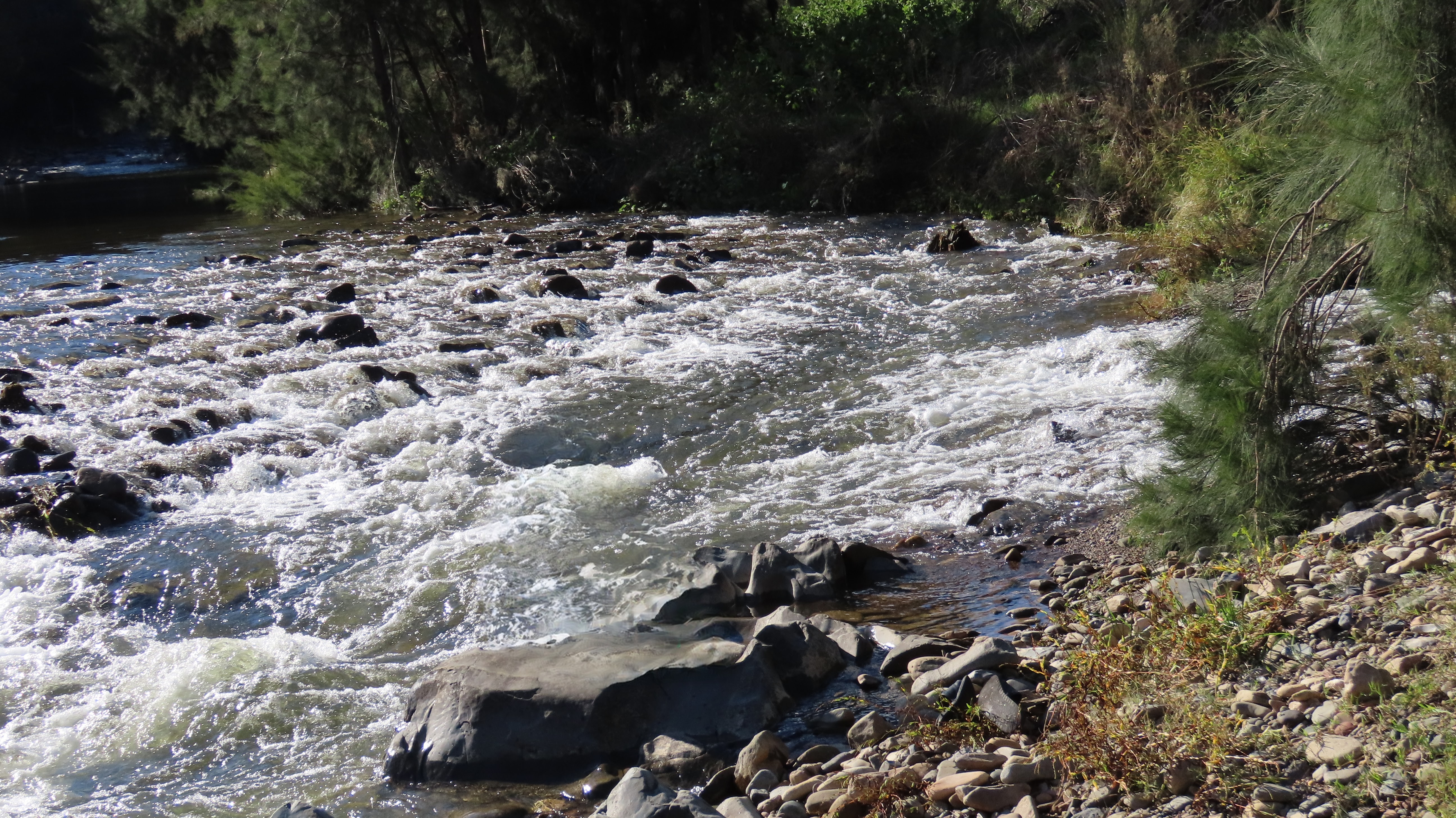
The Turon River flows past the campsite:
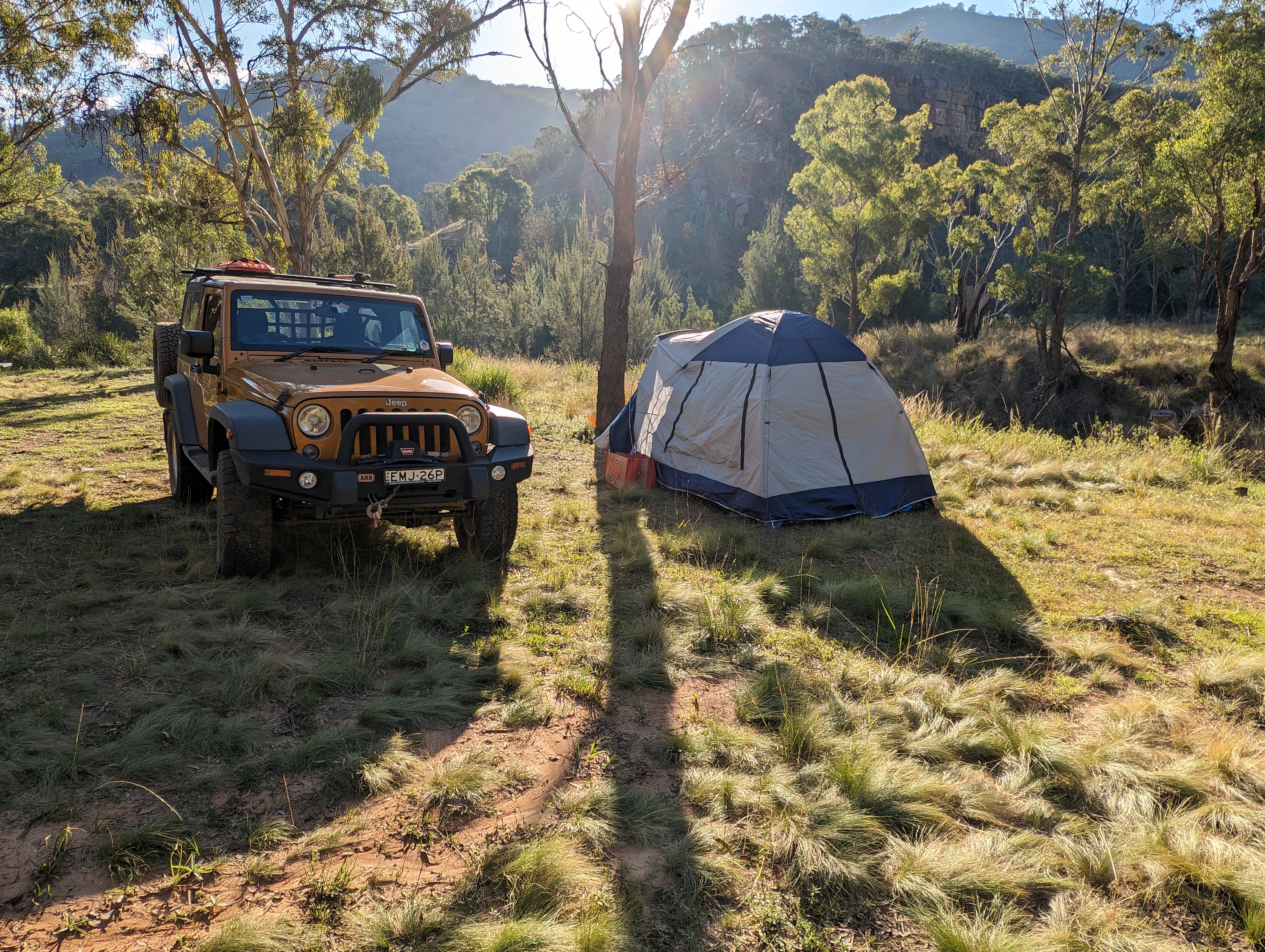
As the sun goes down, Janet stands guard over the TC’s tent:
A rainbow campfire, thanks to minerals added by one of the campers:
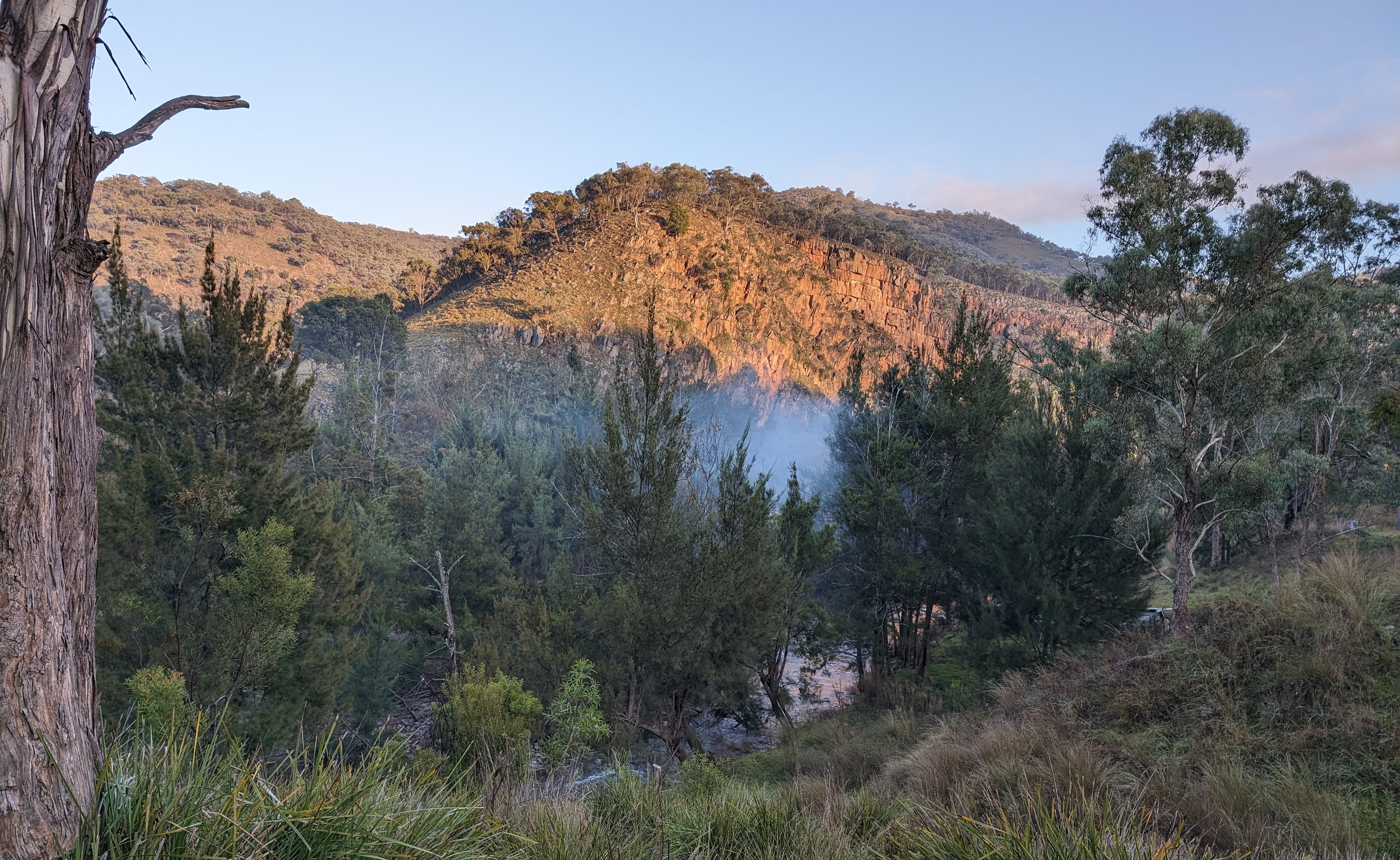
In the chill of the early morning (it was 6° Centigrade), the sun warms up the rocks on the opposite side of the river, while neighbours get their campfire going down below:
After packing up our camp, we drove back along the Bridle Track to Root Hog Crossing. This is a crossing of the Macquarie River, at the junction of the Bridle Track and Root Hog Road. The river level was on the high side (measured at about 1 metre at the Rock Forest station), and there was a reasonably strong current. Janet says that it’s the strongest current she’s tackled to date:
Thanks to our friend Matt for making the video.
Before doing a trip like this, the TC does plenty of research. She checks the river levels over a couple of weeks, to see what the river’s doing. She also monitors the fire warnings and weather forecasts. On reaching the river crossing, if it looks a bit high or strong current, she’d walk into it first. If you can’t walk the current, then the car can’t take it either. For this crossing, luckily there was a group of three cars doing the crossing when we arrived. We watched them, and judged it safe for our vehicles.
Root Hog Road is the road of views:
The next couple of photos are from a previous trip, when we traversed Root Hog Road in the opposite direction. A couple of motorbikes passed us when we stopped to take in the view:
Another road sign advised due caution:
Also from our previous trip, this video shows the last part of Root Hog Road as it drops towards the Macquarie River at the junction of Root Hog Road and the Bridle Track. The crossing is to the right, but we turned to the left to take a look at the river and campground:
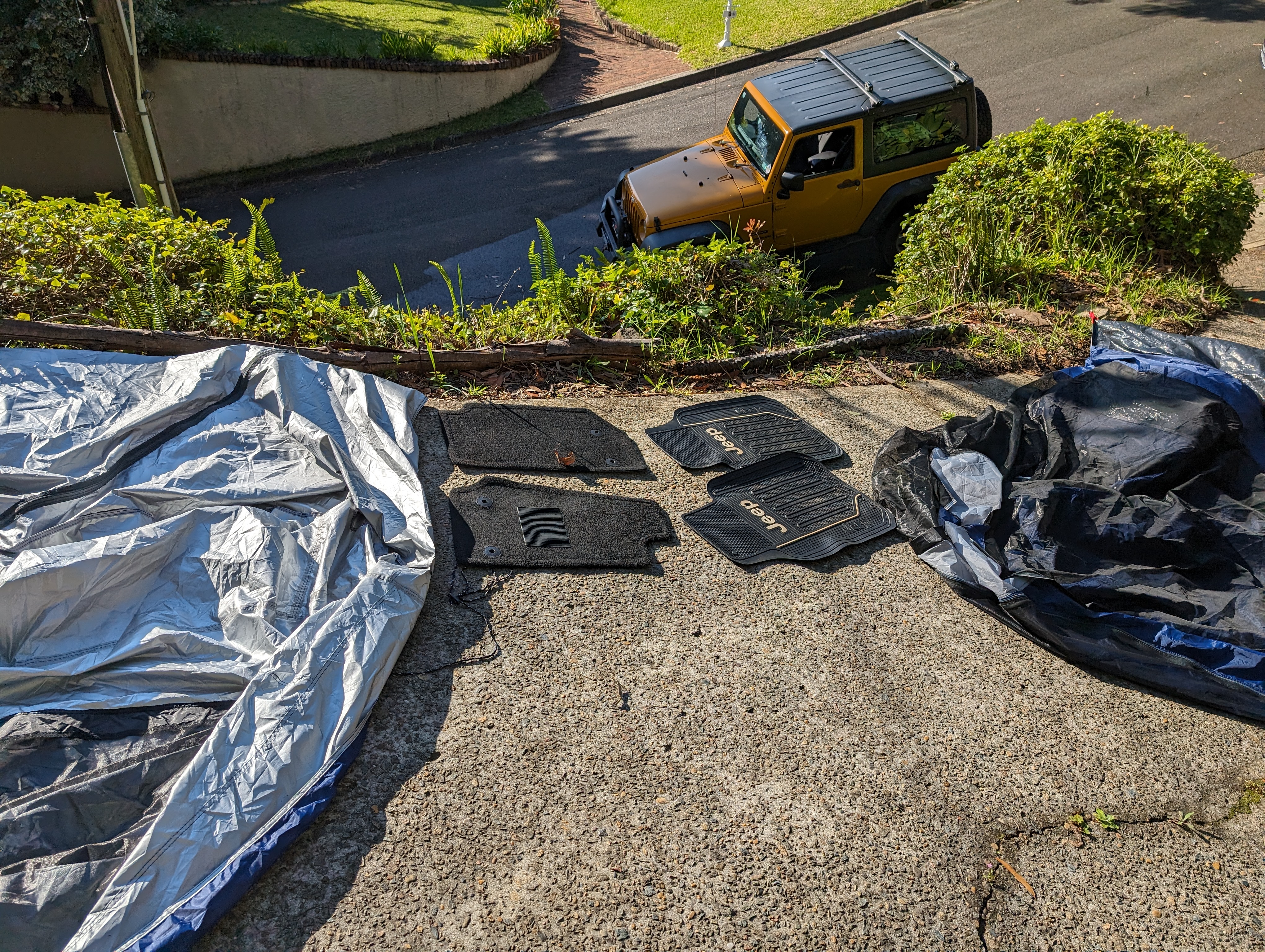
Cleanup on the day after this week’s trip. Janet got her carpets wet in the Root Hog Crossing, and her paintwork was dusty. The tent was damp from the morning dew:
This is the blog of Mark Wordsworm, the travelling worm. I’m a 40-year-old bookmark (give or take a few years) and I proudly boast my own Hallmark serial number, 95 HBM 80-1. You’ll probably want to read all about me and my Travelling Companion (the TC).
Today’s travel notes
Me and the TC spent a couple of days this week strolling the streets of Dublin. Read on to soak up some of the atmosphere of the city.
The book I’m in
Darknet, by Matthew Maher. A rollicking tale of murder and mayhem in the world of high tech.
Travel tips
A hop-on hop-off bus tour is a good option on a rainy day.
The photos
Me taking the DoDublin Hop On Hop Off bus tour:
In the background is the River Liffey, which runs through Dublin. Spanning the river is the Grattan Bridge, built in 1874. It’s named after Daniel Grattan, one of the founders of the Irish Parliament.
This worm enjoyed the warning from our tour guide, Adam, at the start of the trip: “Just a health and safety message before we start: if you see me jumping up and running off the bus, you should probably follow me.”
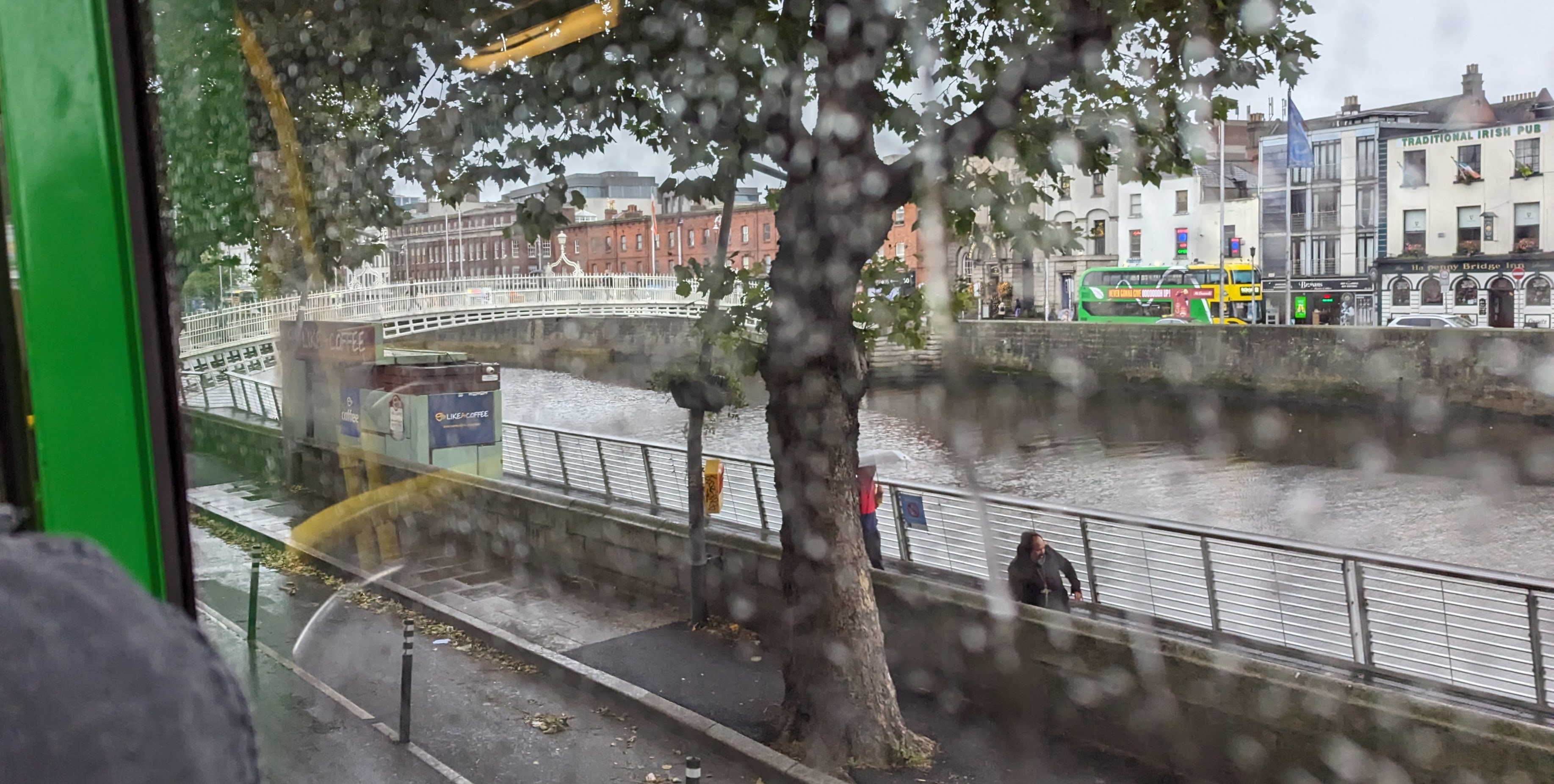
Next up is the Ha’penny Bridge, probably the best-known of the Dublin bridges. It was constructed in 1816 and is for pedestrians only. Its official name is the Liffey Bridge, but it’s commonly known as Ha’penny Bridge due to the toll of half a penny (a ha’penny) that was originally charged for crossing the bridge:
This view shows the steps at the start of the bridge:
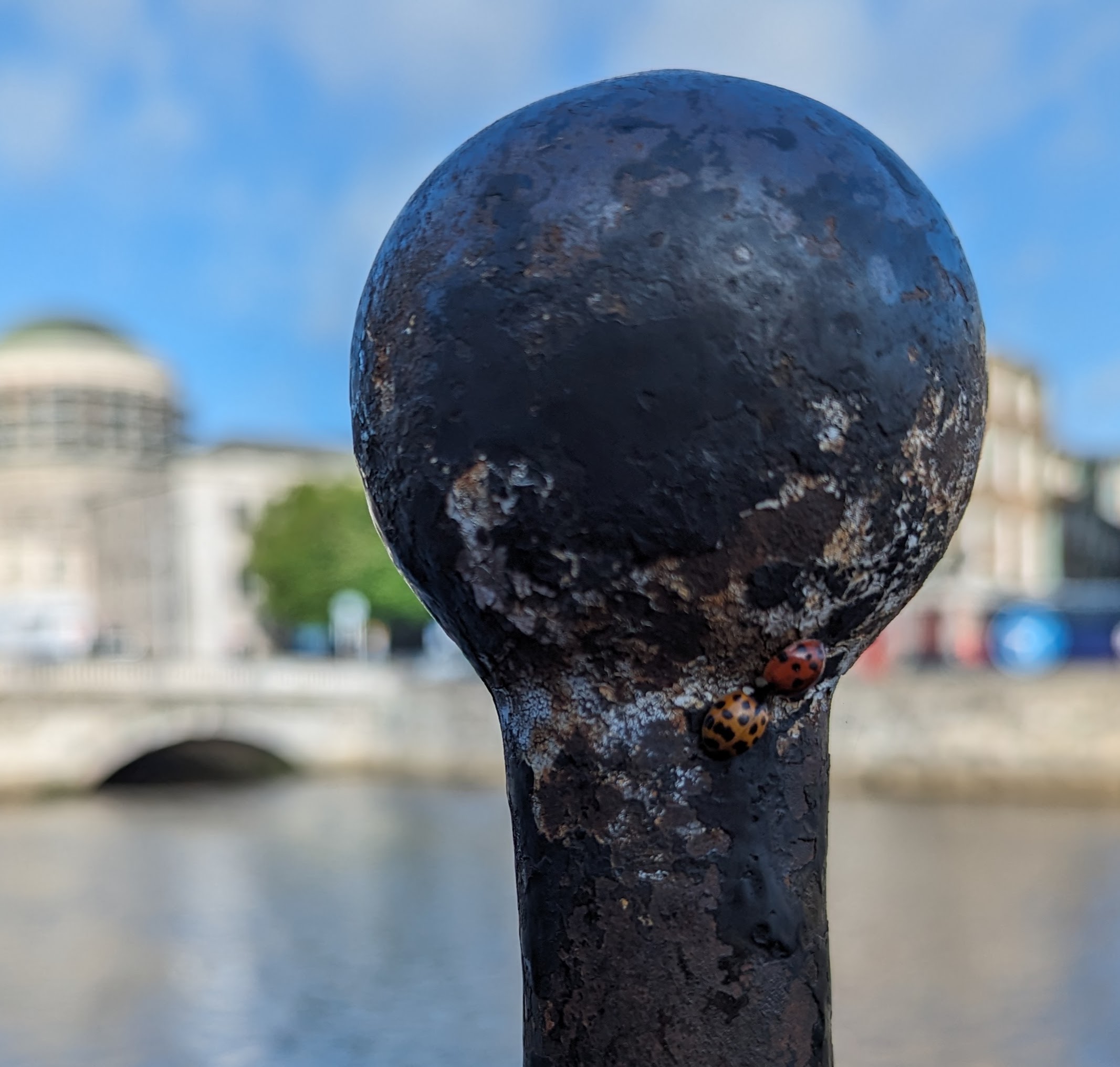
One of our days in Dublin was wet and grey. The other was bright and sunny. Strolling along the Liffey, we noticed that quite a few of the mooring posts had one or two ladybirds in residence. They were always huddled just below the curve of the rounded top of the post. Perhaps they were waiting for a ride:
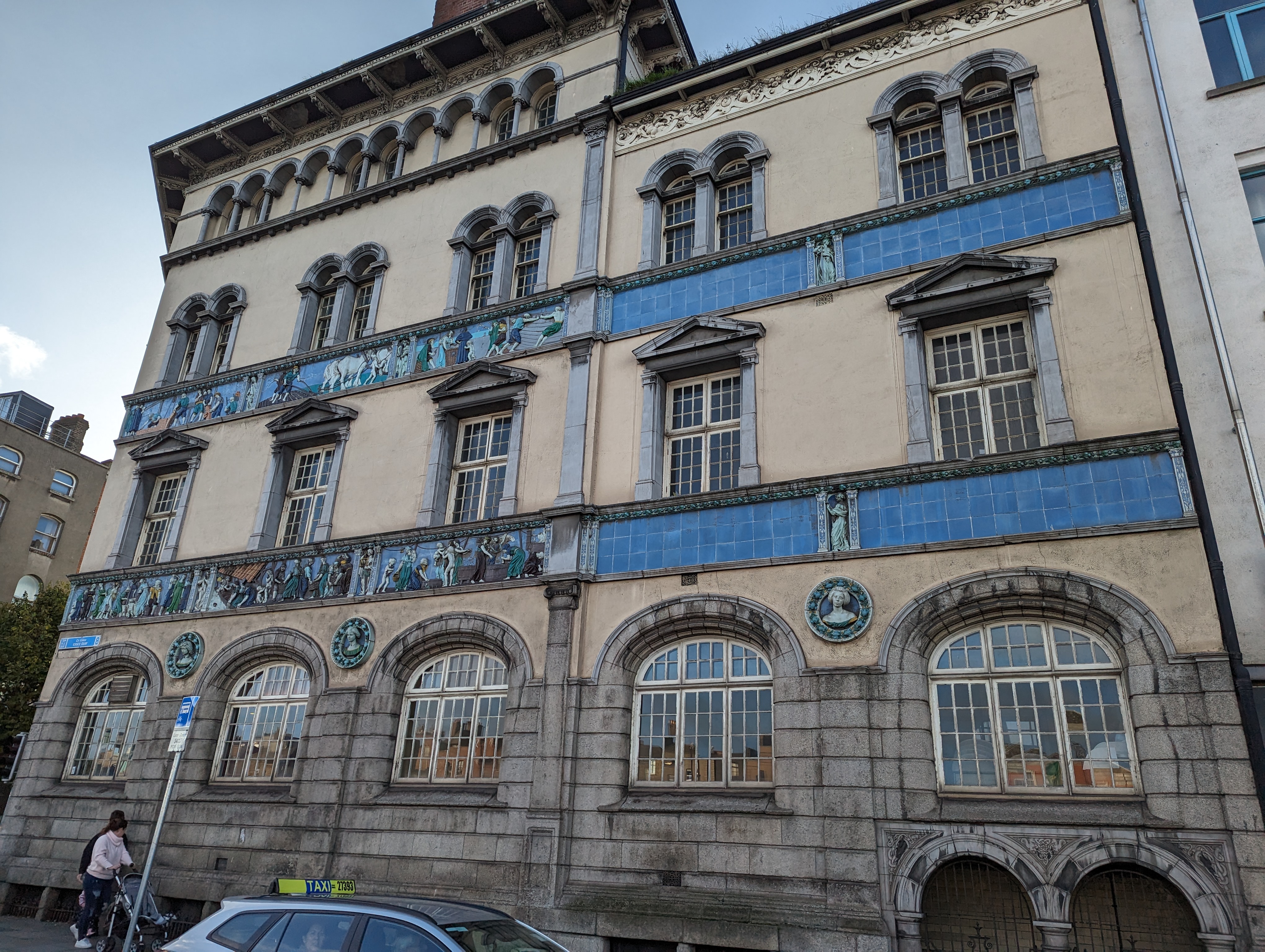
A striking sight on the river bank in the district of Temple Bar is the Sunlight Chambers building. The panels of colourful, raised figures depict the story of soap. The building was commissioned and built by the company Lever Brothers (now Unilever) in 1900-1910, and named after their best-selling product: Sunlight Soap:
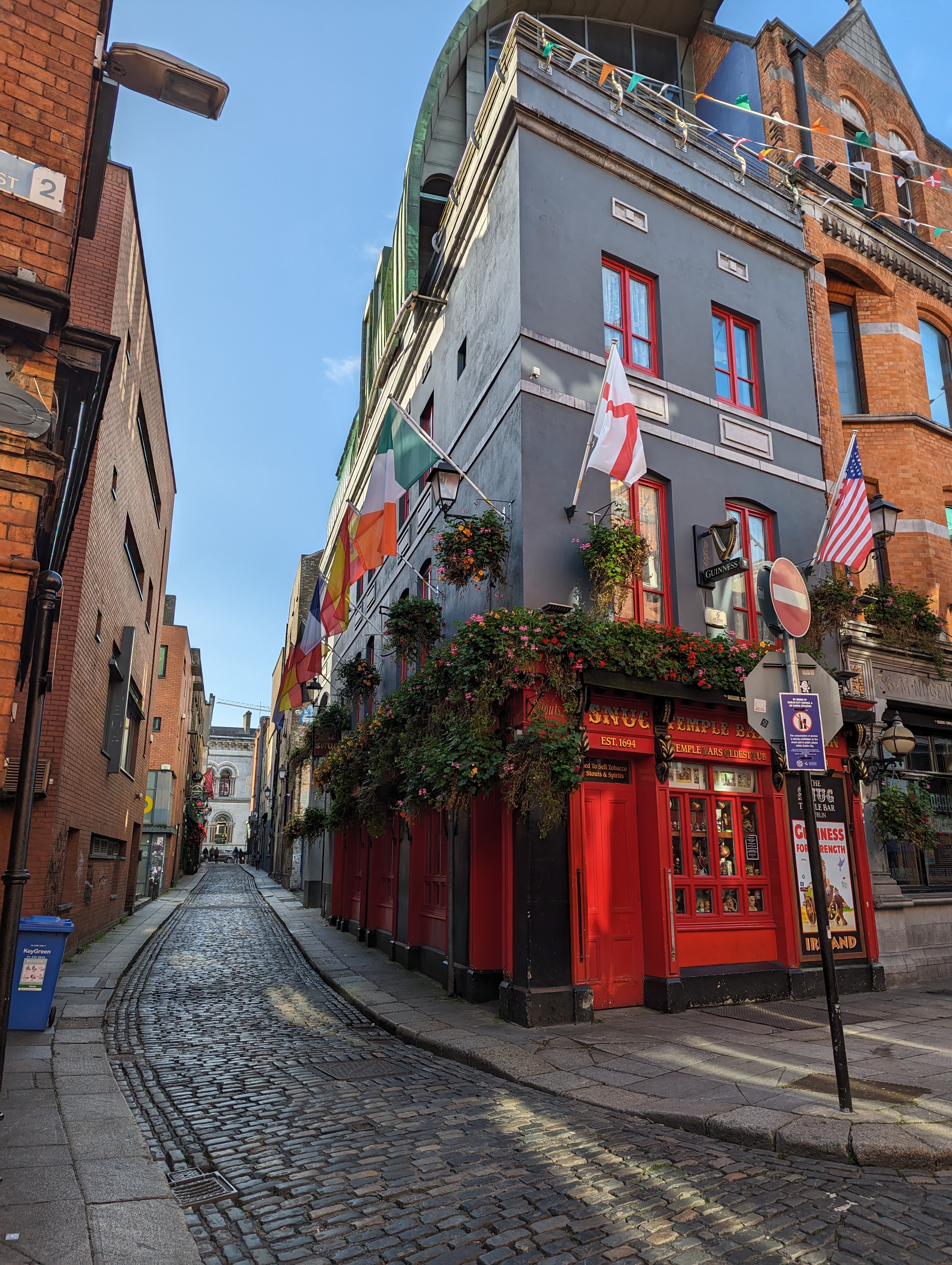
The Snug claims to be the oldest pub in Temple Bar:
The AIB Bank building in Dame Street was designed by Thomas Deane and built in the 1870s:
Ireland’s longest-running pen speciality shop, Pen Corner, opened its doors in 1927 and closed in May 2022. You can still see the shop front at the corner of College Green and Trinity Street:
Continuing with the writing theme, here’s a street outside a school in the area of Portobello, where the traffic posts have been converted to pencils:
The next building that caught the TC’s eye is number 2 Palace Street in Temple Bar, built around 1771. It used to be owned by the Sick and Indigent Roomkeepers Society, which is Dublin’s oldest surviving charity. The building is now owned by the Dublin Corporation, and is protected under a preservation order:
This lovely artwork is in a small park near Dublin Castle. The park is a memorial given by the people of Flanders in remembrance of the Irishmen who gave their lives for the freedom and independence of Belgium in the war of 1914-1918:
Here’s a general street scene in the area of Portobello. One of the buildings proclaims, “We <heart> Dublin”:
This is the blog of Mark Wordsworm, the travelling worm. I’m a 40-year-old bookmark (give or take a few years) and I proudly boast my own Hallmark serial number, 95 HBM 80-1. You’ll probably want to read all about me and my Travelling Companion (the TC).
Today’s travel notes
Me and the TC spent a couple of days in Dublin this week. In addition to our encounter in the park, in which Oscar Wilde got a new green carnation, we cruised around Dublin Castle and a couple of cathedrals. The TC had a go at translating some Latin, which led to predictably humorous results. And I coined a new phrase: whimsy-driven sightseeing.
The book I’m in
Darknet, by Matthew Maher. A rollicking tale of murder and mayhem in the world of high tech.
Travel tips
Instead of trying to see all the sights, it can be more enjoyable to stroll around and look at whatever catches your eye. I’m coining a new phrase to describe that way of being a tourist: Whimsy-driven sightseeing.
Recommended restaurants
Cornucopia Wholefoods Restaurant, Wicklow Street, Dublin. The bakery goods are delicious. In particular, the TC went “Mmmmm” over the gluten-free banana bread. The coffee is probably worth passing up on, though.
The photos
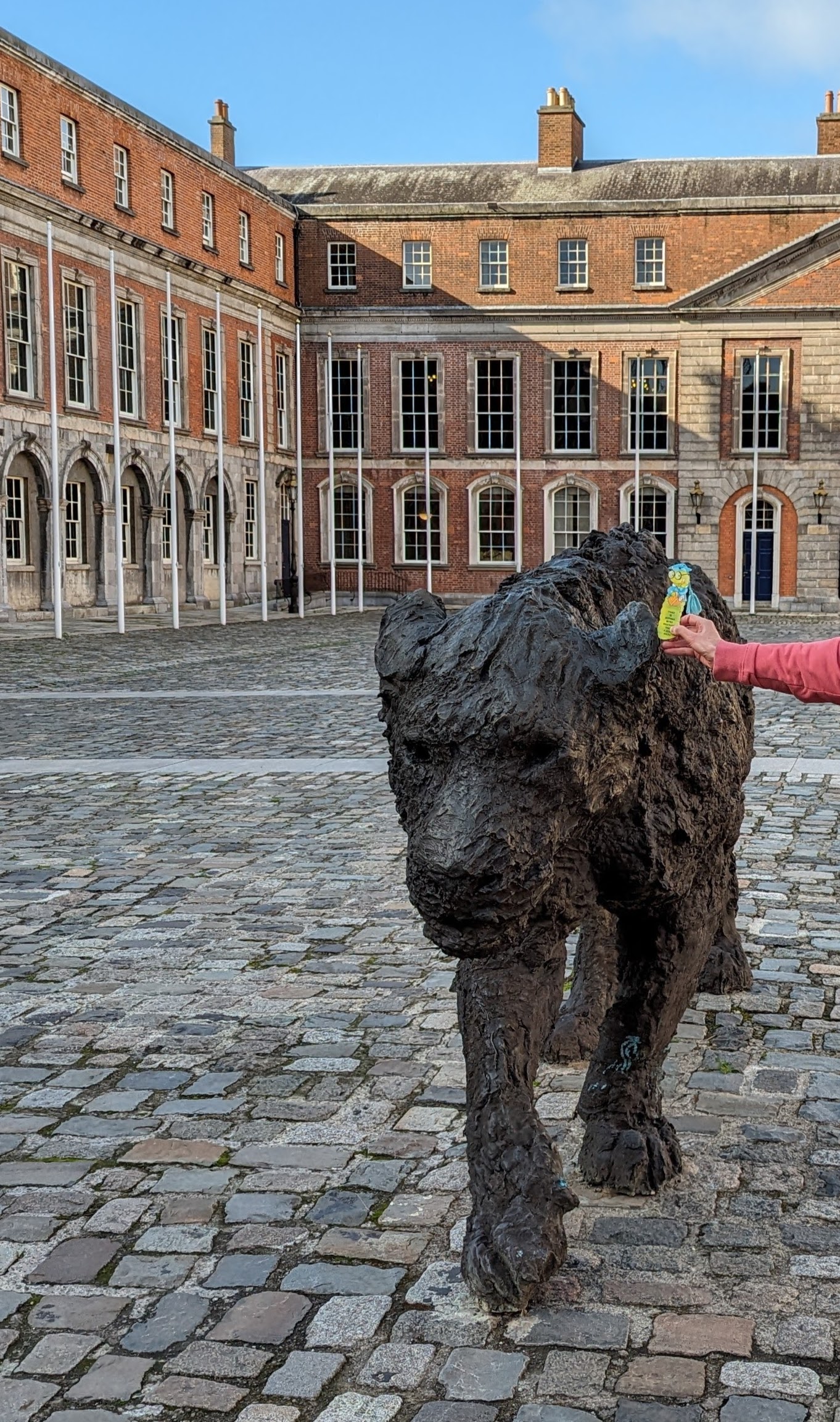
Me with Leonessa in the courtyard of Dublin Castle:
Leonessa is a bronze sculpture of a lioness by contemporary artist Davide Rivalta.
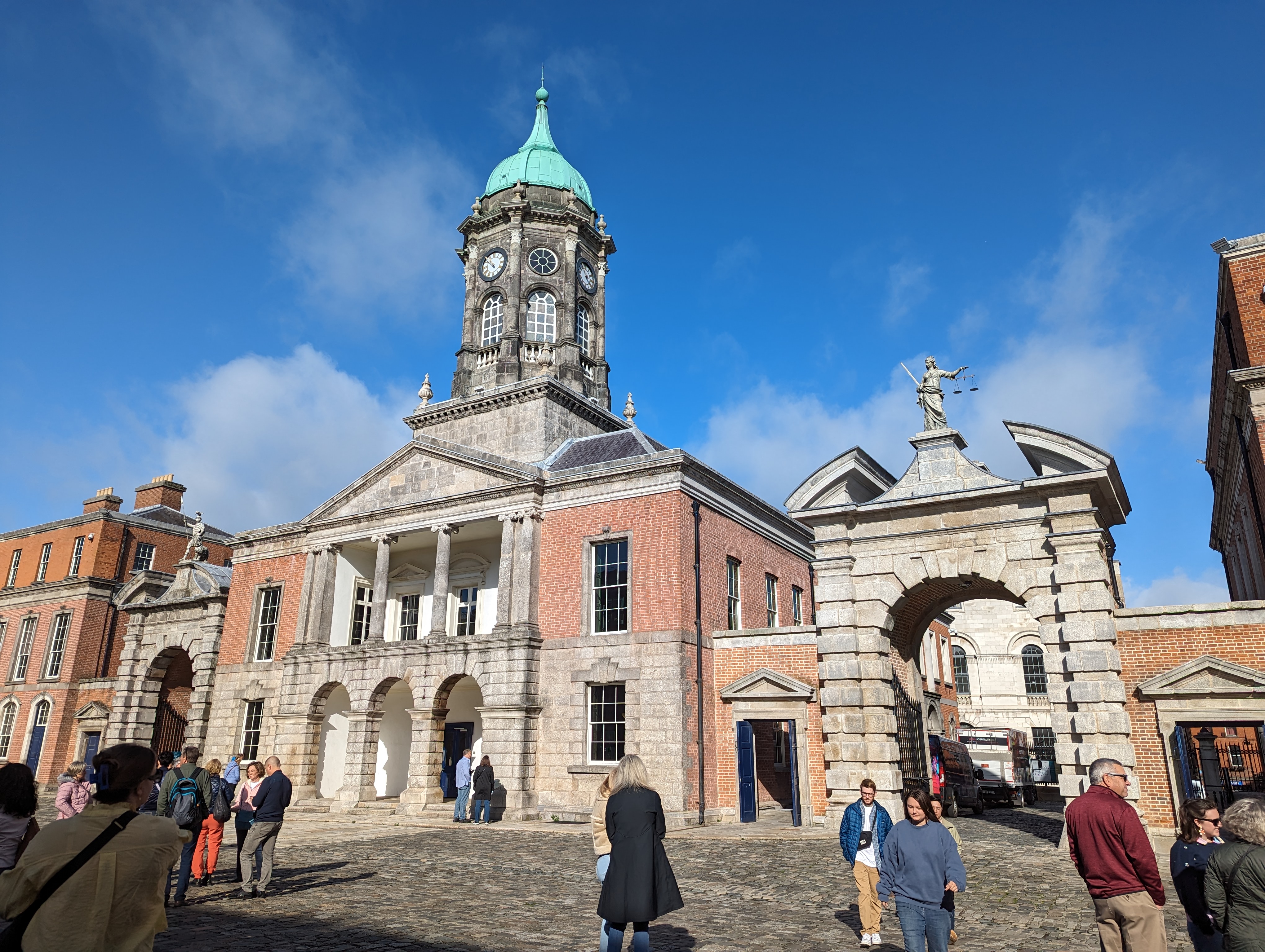
From on high, another lion peers down into the courtyard. It accompanies the soldier above the further archway in this picture:
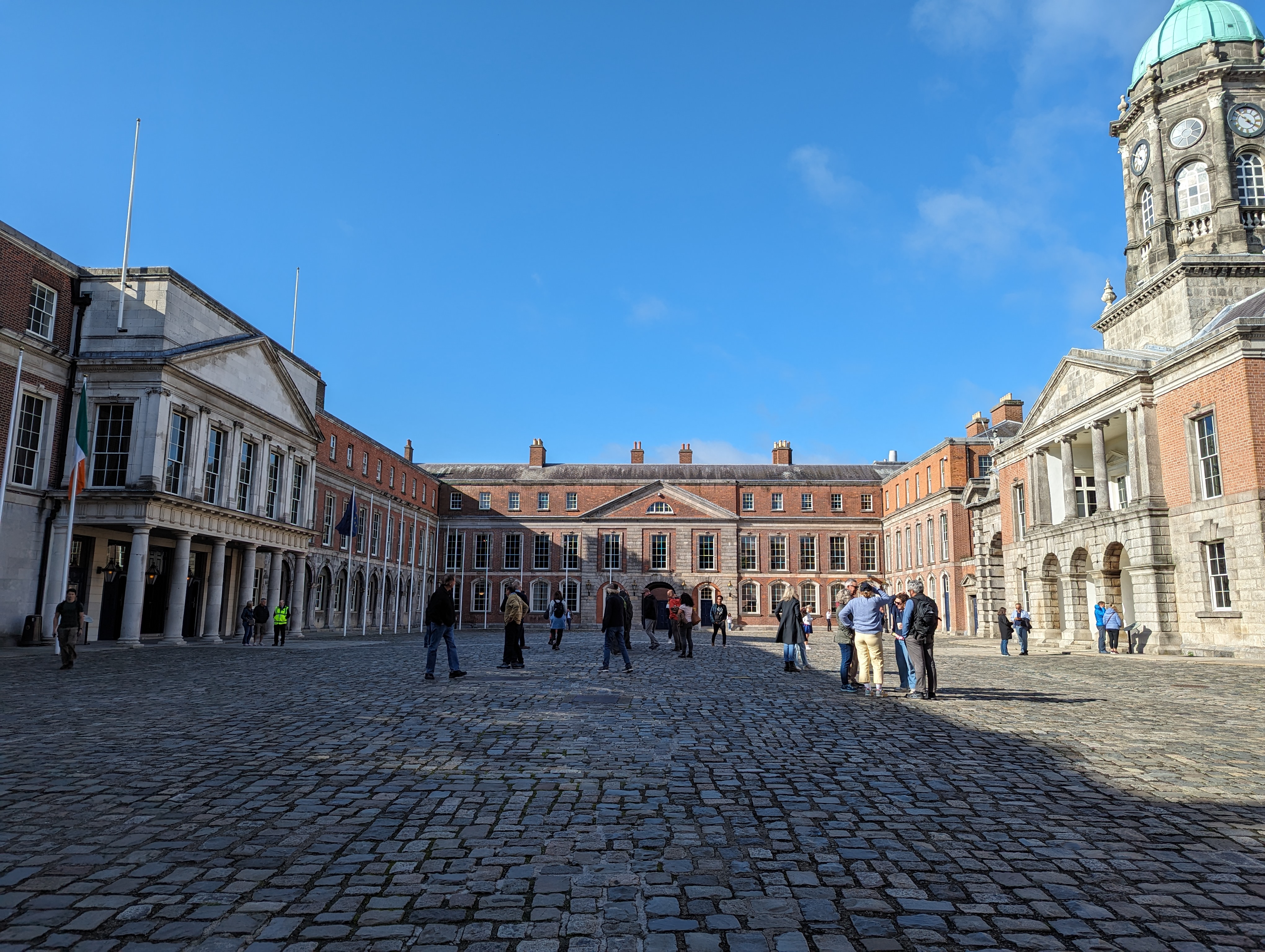
Stepping back, the full grandeur of the castle courtyard becomes visible:
This shot shows the outside wall of the castle and the Chapel Royal on the left:
On the right of the above picture are three archways. The middle one leads into the courtyard. In a room above this archway, Dublin Castle was formally handed over by the last English Lord Lieutenant of Ireland to the Provisional Government of Ireland, led by Michael Collins, on 16 January 1922.
The other side of the Chapel Royal:
Moving away from the castle, you might find yourself drawn to Christ Church Cathedral. This ancient and lovely building was founded in approximately 1030 by the Norse King of Dublin, a Viking with the romantic name of Sitriuc Silkenbeard.
Here’s a front view of Christ Church Cathedral:
If you follow the green bus down through the archway, you can examine the other side of the cathedral, which is equally striking:
Stroll a few blocks south down Patrick Street, and you’ll come across St Patrick’s Park and St Patrick’s Cathedral:
Evidently the tomb of Jonathan Swift, author of Gulliver’s Travels, lies in the nave of the church.
It’s believed that, in the fifth century AD, St Patrick baptised the first Irish Christians in a well situated where the cathedral park now lies. The first church was built on the site to commemorate the event.
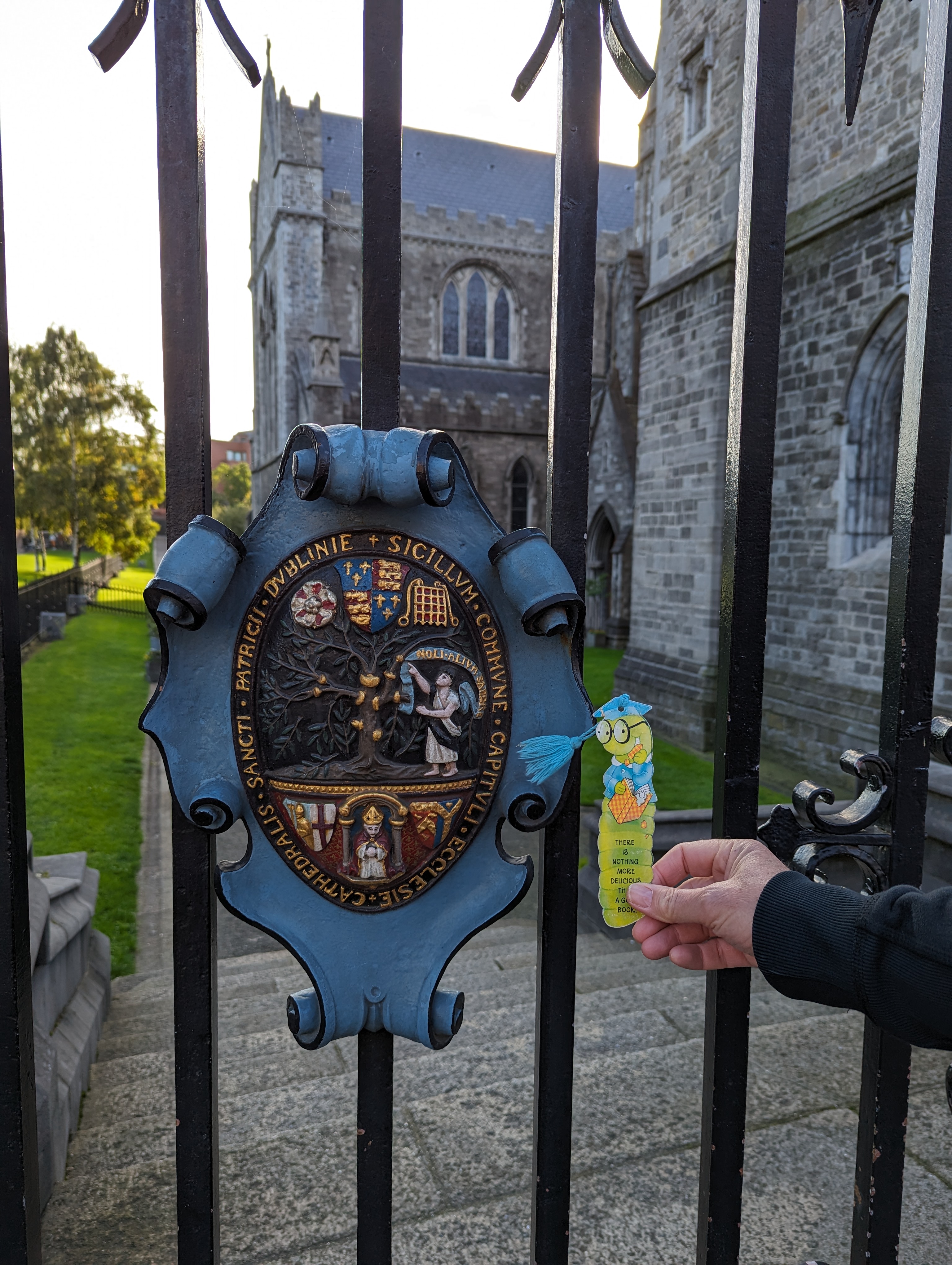
Me with the coat of arms outside St Patrick’s Cathedral:
The TC, bless her cotton socks, had a go at translating the Latin on the coat of arms.
First she tackled the wording on the light blue banner. Her initial reading was this:
noli allium sapere
Which translates to:
don’t taste the garlic
Ha! Actually, it’s “noli altum sapere“, which means “don’t be too wise“, or “don’t be high-minded“.
Now for the longer bit:
sigillum commune capituli ecclesie cathedralis sancti patricii dublinie
Translation:
the common seal of the chapter of the cathedral church of saint patrick in dublin
This is the blog of Mark Wordsworm, the travelling worm. I’m a 40-year-old bookmark (give or take a few years) and I proudly boast my own Hallmark serial number, 95 HBM 80-1. You’ll probably want to read all about me and my Travelling Companion (the TC).
Today’s travel notes
Me and the TC came across a couple of statues of Oscar Wilde in Dublin. To our delight, one of them was accompanied by its original sculptor, Danny Osborne. He was drilling into the statue’s hand! Read on for the story.
The book I’m in
Darknet, by Matthew Maher. A rollicking tale of murder and mayhem in the world of high tech.
Travel tips
Take a walk in the park, even in the rain. You never know who you’ll meet or what you’ll see.
The photos
Sculptor Danny Osborne repairing his statue of Oscar Wilde in Merrion Square Park, Dublin:
It was a wet and grey day in Dublin today. Nevertheless, me and the TC took a walk in the park. To our surprise, this fellow climbed up a ladder behind the sculpture of Oscar Wilde and started drilling into the statue’s hand. The TC, ever fearless in pursuit of knowledge, asked him if he was the original artist. He said yes, and added that he was replacing the green carnation that was broken a few years ago.
The sculpture, erected in 1997, is magnificent and eye-catching. It emphasizes the beauty of stone, much loved by Wilde himself. The large base is made of quartz from the Wicklow Mountains which lie outside Dublin. The jacket is carved from green jade, the head and hands from white jade, the collar and cuffs from pink thulite, and the trousers, shoes, and socks from blue and black granite.
The statue originally held a bronze carnation in its right hand. Presumably the bronze would turn green with the passage of time. We were lucky enough to encounter the artist doing the necessary repairs to replace the carnation.
Back in Oscar’s time, a green carnation was a symbol of the queer community. In 1892, he made the artificially-coloured flower famous by wearing one on his lapel and encouraging his friends to do the same. Whenever anyone asked what the green carnation meant, Oscar would imply mystery and slight danger. There are rumours that he did this to generate publicity for his new play, Lady Windermere’s Fan.
The statue provoked some controversy at the time of its unveiling. Seen from another angle, Oscar does look a little debauched and careless:
However, this worm finds the work intriguing and engaging.
Me with another version of Oscar, just across the way from the park. This one is right outside the playwright’s home:
This is the blog of Mark Wordsworm, the travelling worm. I’m a 40-year-old bookmark (give or take a few years) and I proudly boast my own Hallmark serial number, 95 HBM 80-1. You’ll probably want to read all about me and my Travelling Companion (the TC).
Today’s travel notes
Me and the TC were in the area of Killarney in County Kerry, Ireland, a couple of days ago. We visited Torc Waterfall and Ladies View.
The book I’m in
Darknet, by Matthew Maher. A rollicking tale of murder and mayhem in the world of high tech.
Travel tips
Turn off the tech to enjoy the natural beauty. But the tech is useful in getting you to the right spot!
The photos
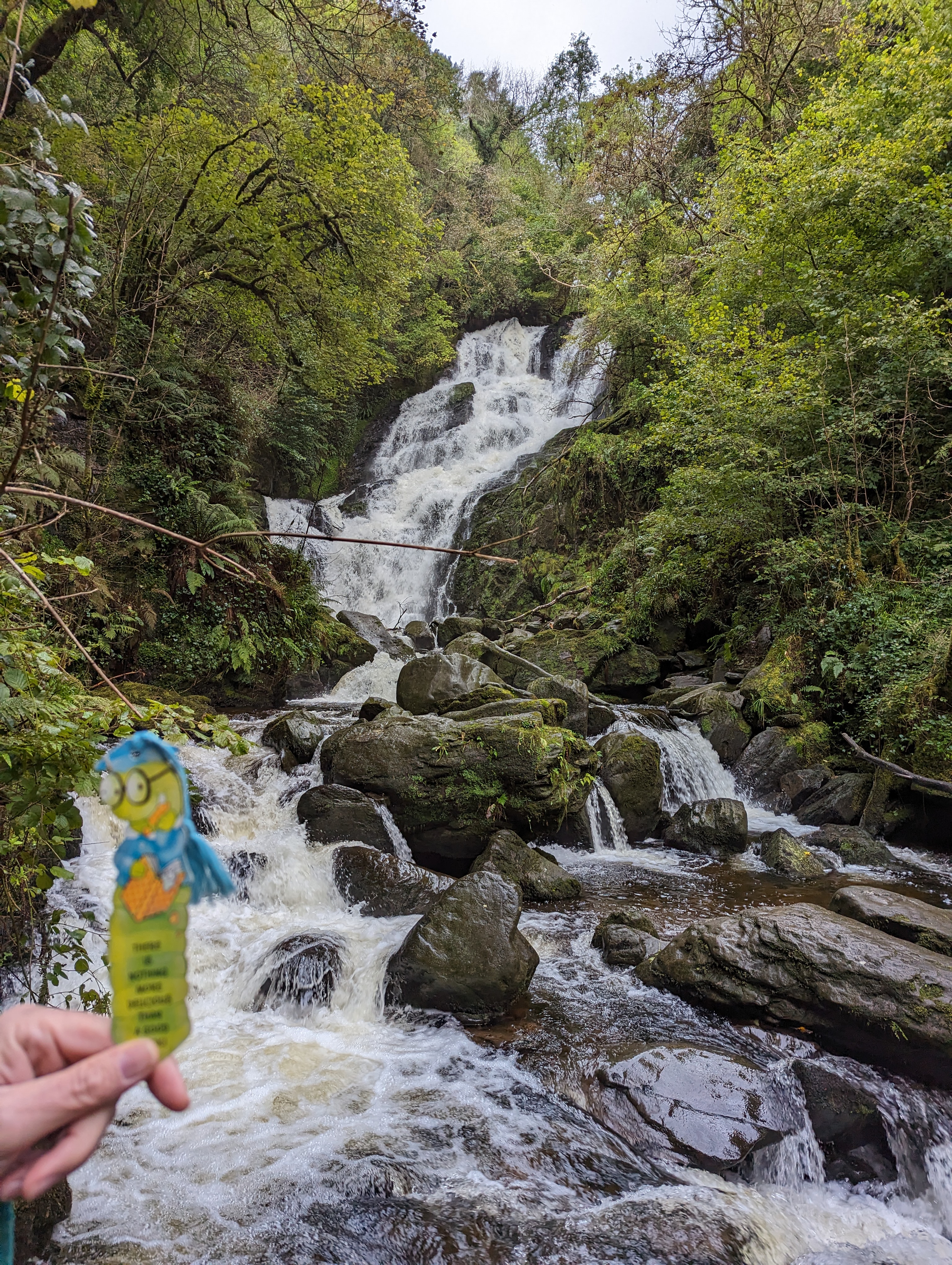
Me at Torc Waterfall:
For an immersive experience (as the high tech folks say these days), watch this video of the waterfall:
The waterfall is a very short walk from the carpark: approximately 200 metres.
Green is the colour of the walk:
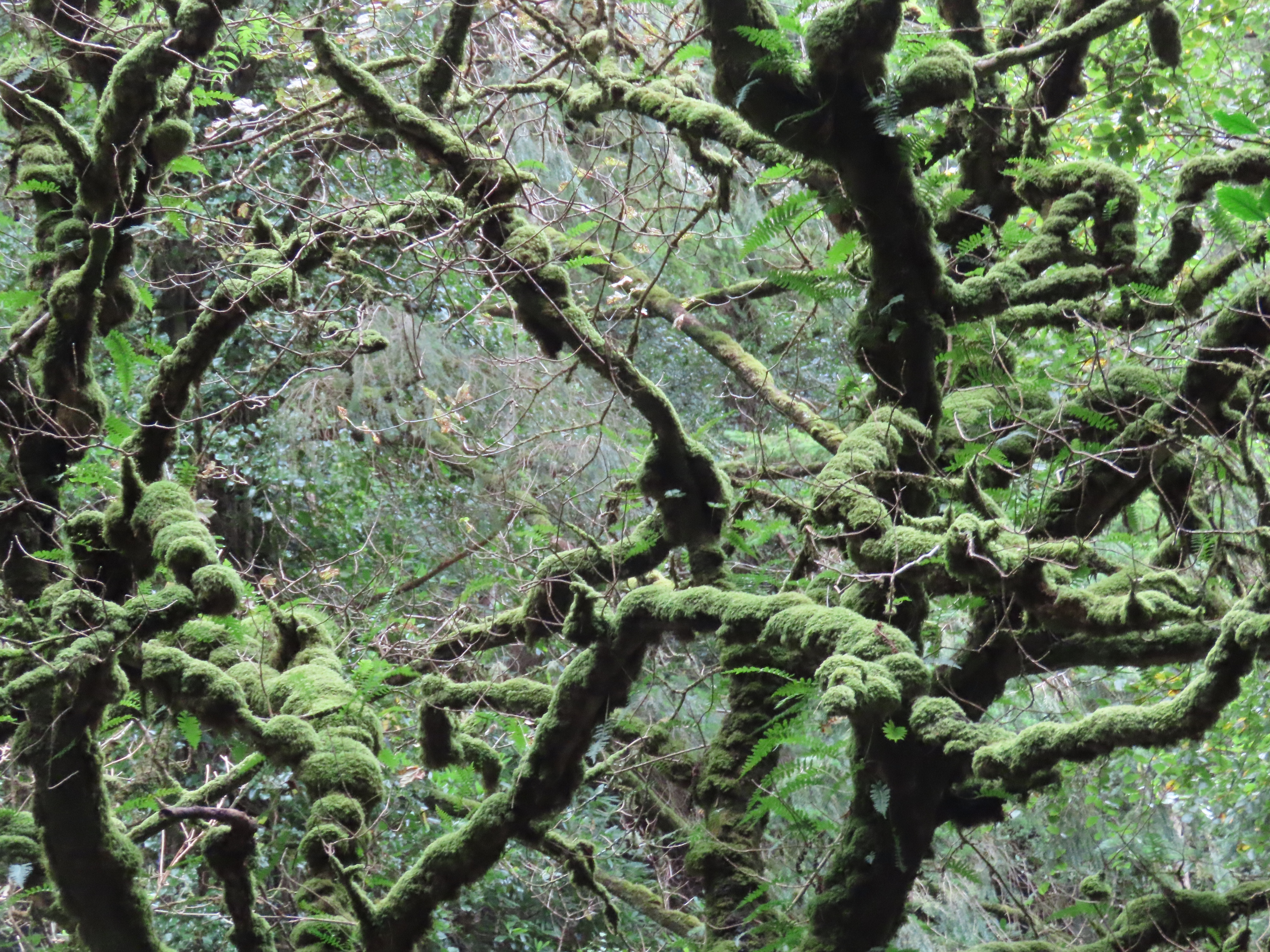
High on the branches of the forest, moss glows in the gentle light:
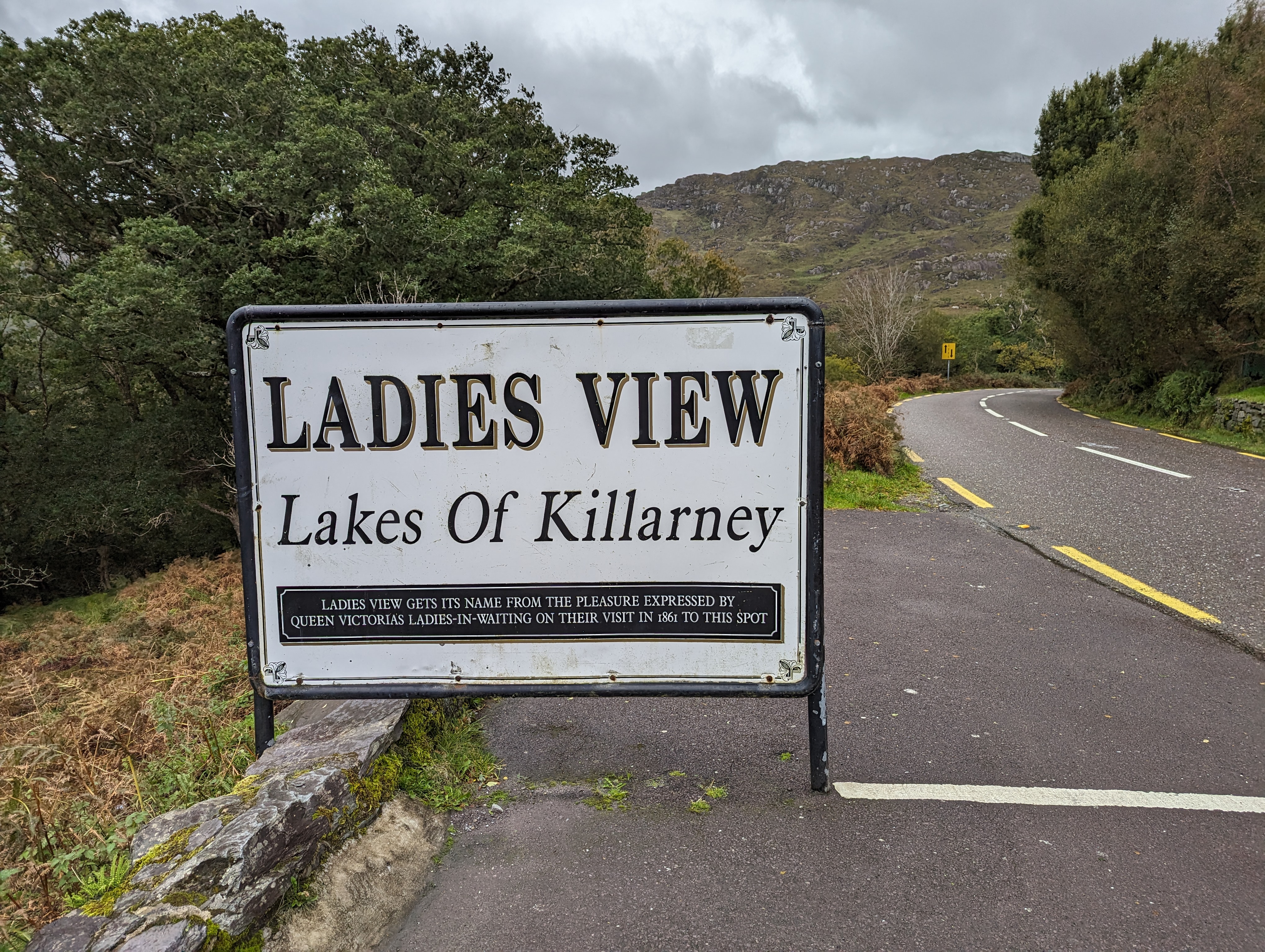
Our next stop was Ladies View, a lookout point over the lakes of Killarney:
The name “Ladies View” comes from the popularity of the lookout among Queen Victoria’s ladies in waiting during the royal visit to Killarney in 1861.
Here’s another shot of the lakes, sans yours truly:
Thus spake the notice board:
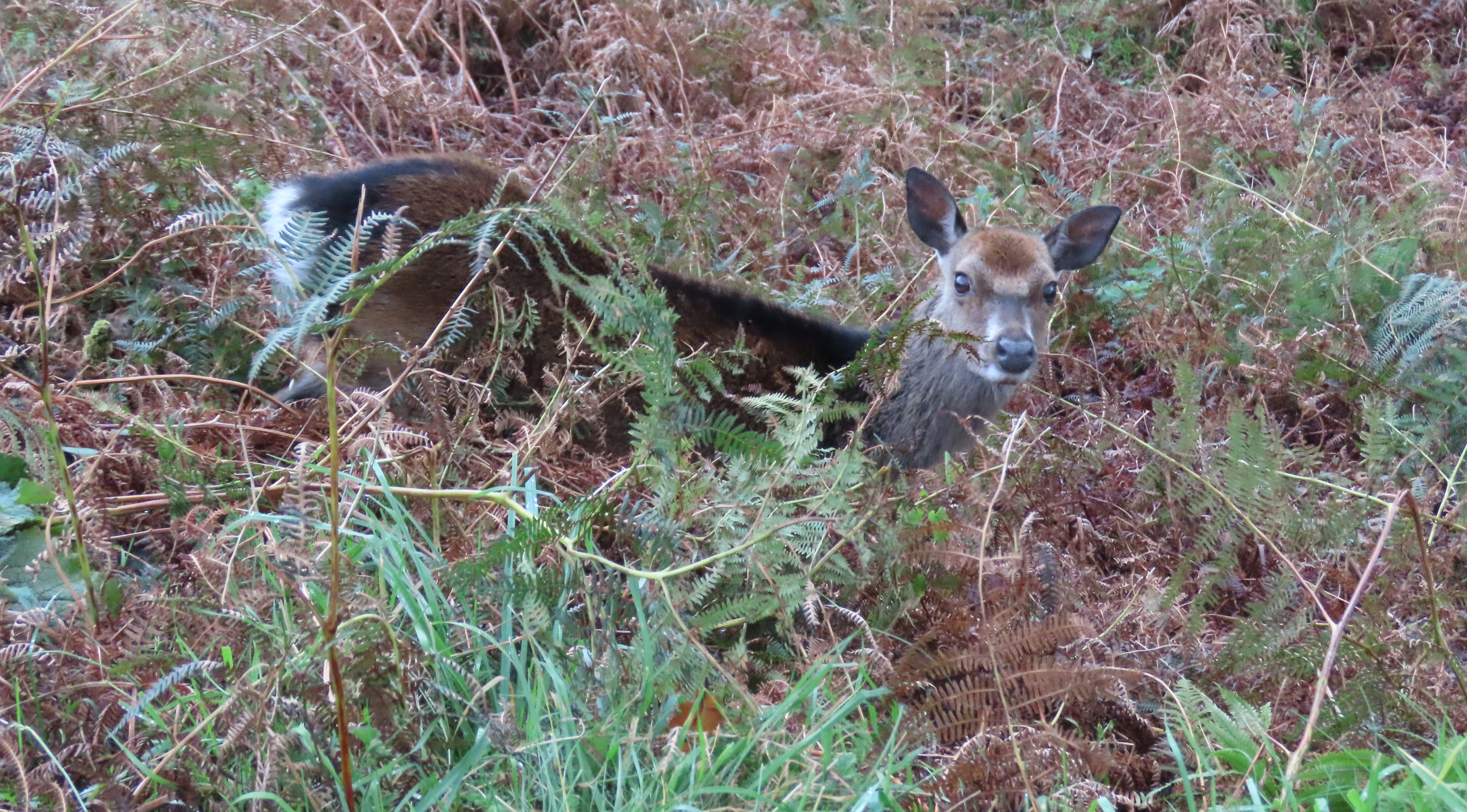
The ground drops away quite steeply at the edge of the road. The TC peered over the lip and came eye to eye with a deer quietly browsing:
This is the blog of Mark Wordsworm, the travelling worm. I’m a 40-year-old bookmark (give or take a few years) and I proudly boast my own Hallmark serial number, 95 HBM 80-1. You’ll probably want to read all about me and my Travelling Companion (the TC).
Today’s travel notes
Me and the TC are currently riding out Storm Agnes on the west coast of Ireland. This worm is taking the opportunity to write up some travel notes. My first Irish post was about Blennerville and the mystery of Robert Emmet’s grave. Now I’m going to tell you about yesterday’s drive from Tralee to Dingle, taking the scenic route via Camp, Caherconree, and Inch Beach. We then took the route over Conor Pass back to Tralee.
The book I’m in
Darknet, by Matthew Maher. The TC started this book once before, and abandoned it because the writing style is a little naive and there are some typographical errors. However, the TC-once-removed has persuaded her to try it again. So far, this bookworm approves the choice.
Travel tips
Go mall is not a direction to the nearest shopping centre. It means go slowly.
The photos
Me in Tralee, sprouting a pair of pink wings. Relax, dear reader, they’re not real. My metamorphosis is some way off yet:
The town of Tralee is a good place to stay if you’re planning to spend a couple of days exploring Ireland’s west coast. We’re lodged just outside the town, near the village of Blennerville. From there, we set out one fine afternoon to see part of the Dingle peninsula.
We branched off from the main thoroughfare (N86) at Camp and took the Caherconree scenic route. This is a gorgeous, single-track road through the mountains. Tumbling rivers and sure-footed sheep lined the way:
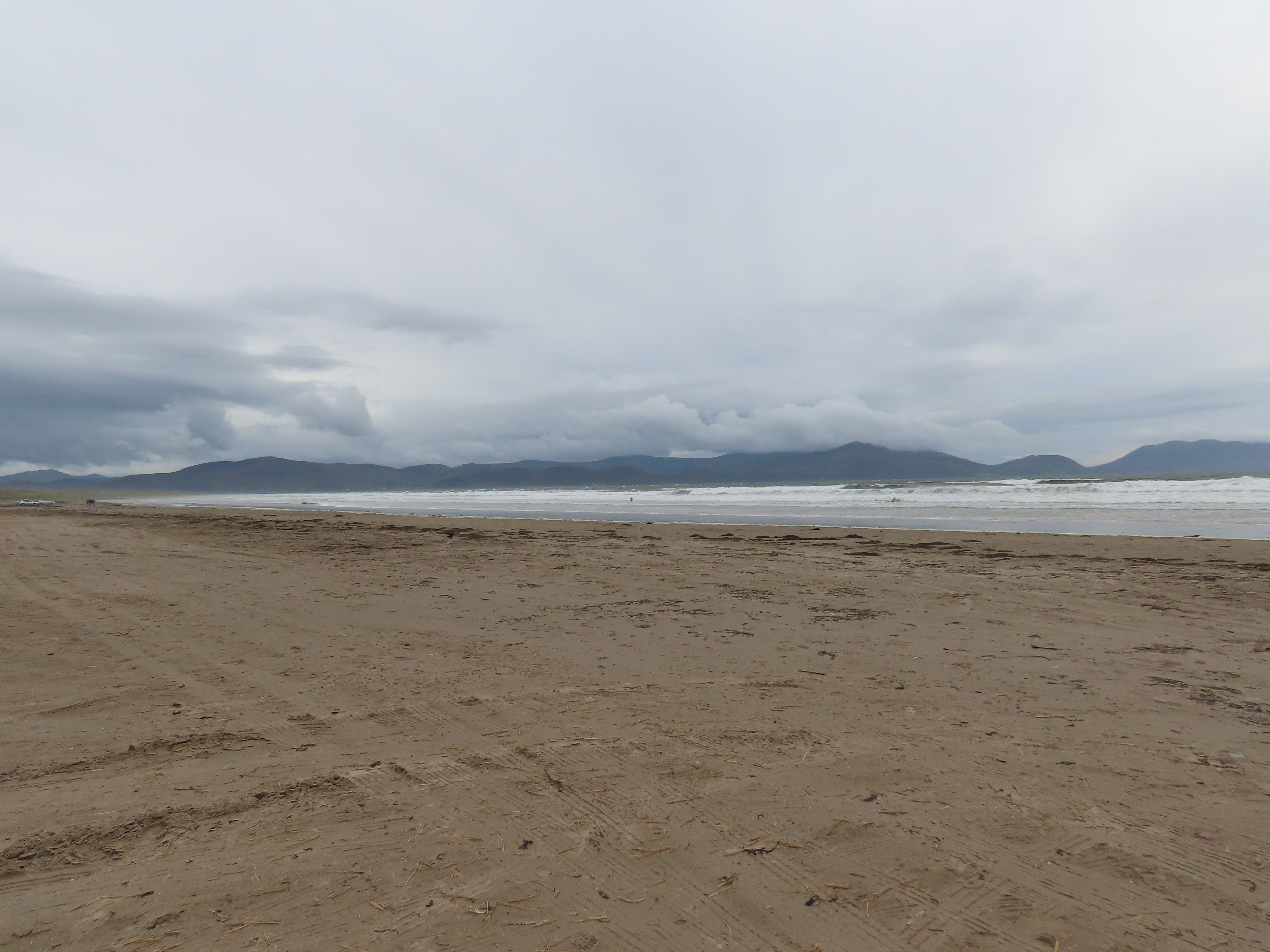
Upon reaching the southern coast of the Dingle peninsula, we headed towards Inch Beach. The TC, bless her cotton socks, had harboured romantic notions of dipping her toes into frilly waves on a golden shore cooled by a playful breeze. Instead, we encountered a somewhat fierce beach with a banshee wind and but two hardy souls venturing into the salty surf:
Dingle is a pretty sea-side town:
Signs and names come in Irish and English:
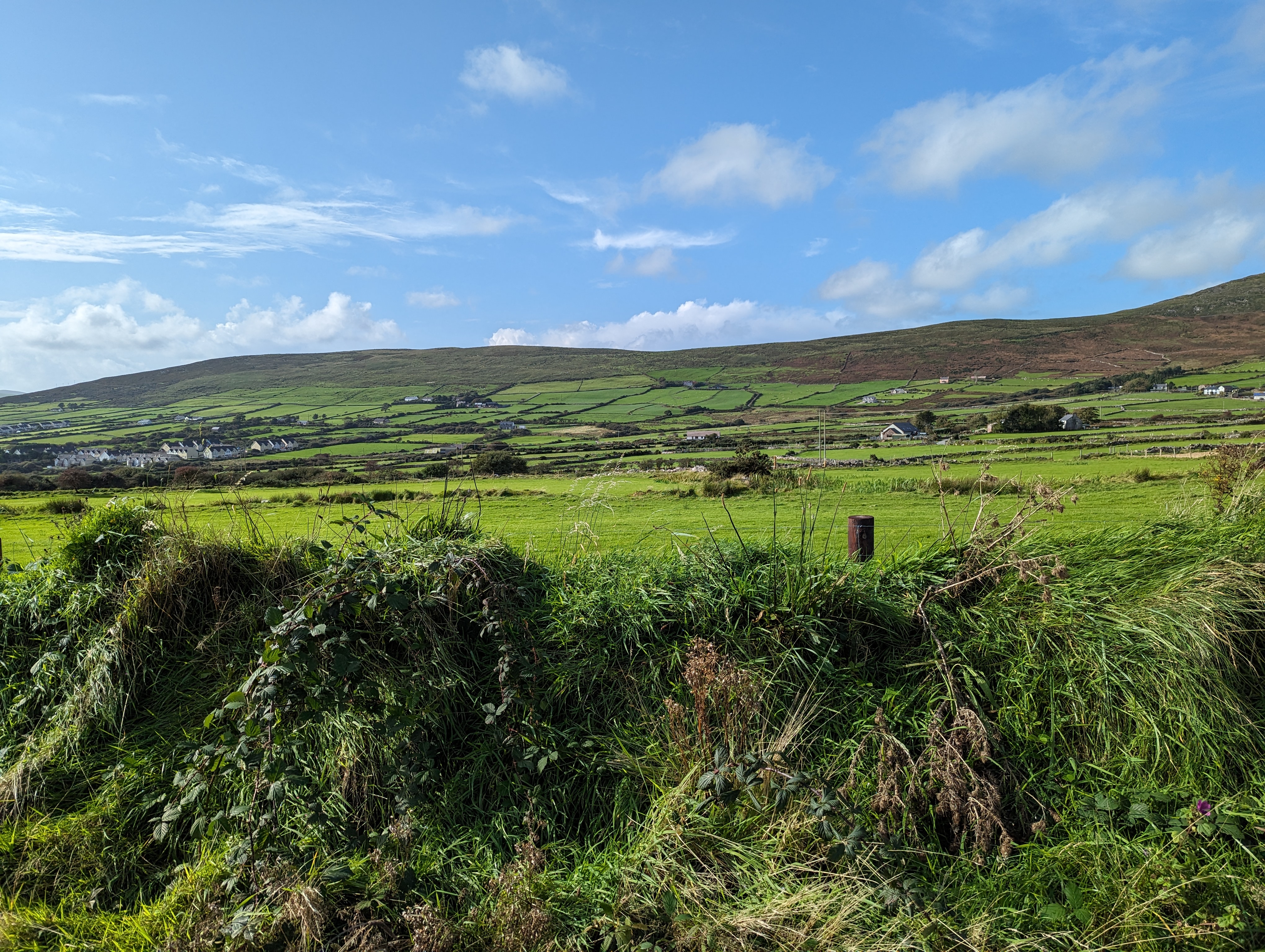
Leaving Dingle, the road heads through green fields and hedgerows:
Little wonder that Ireland is named the Emerald Isle. The theme of green runs through hill and vale:
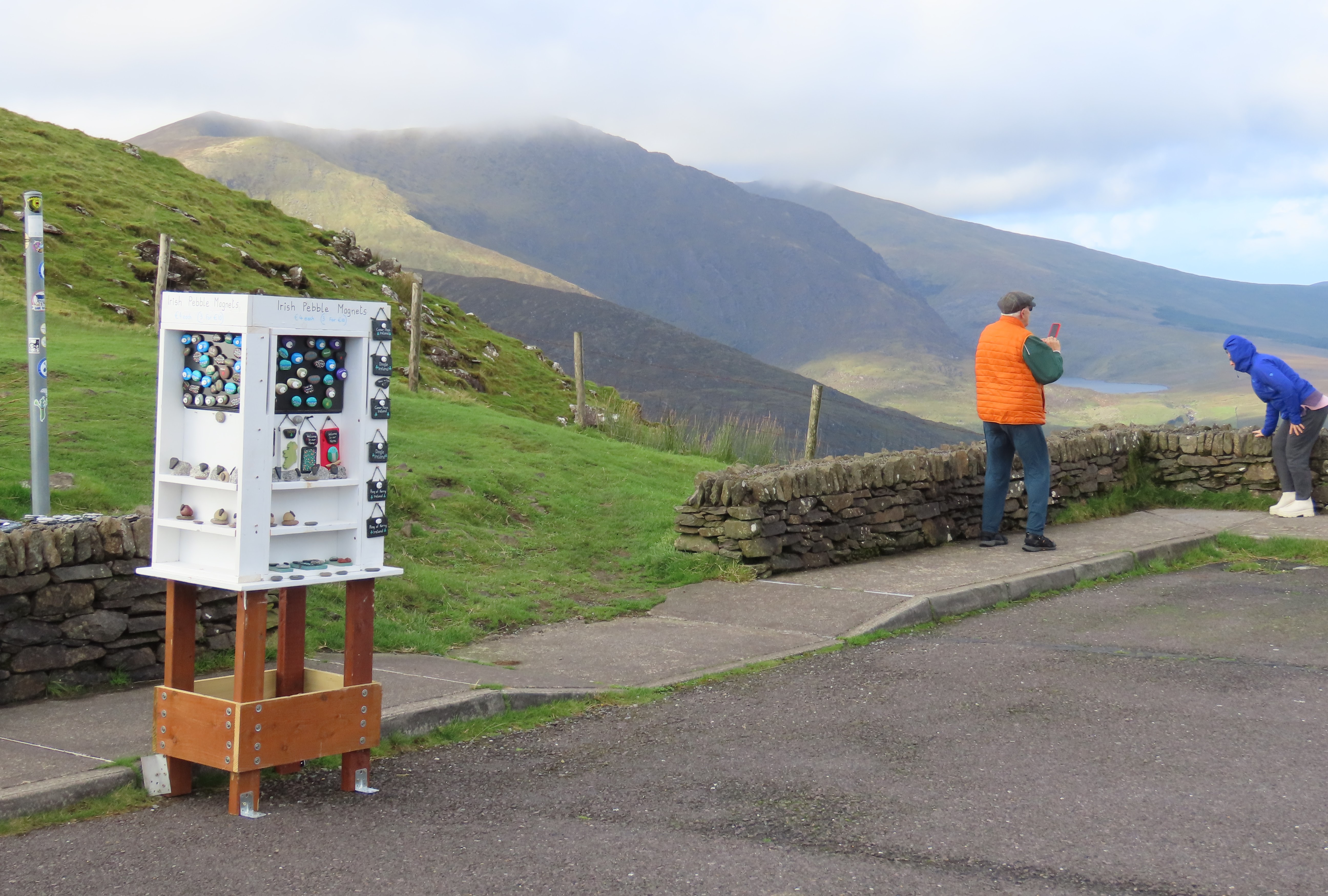
We made our way up to Conor Pass. At 1,496 feet (about 455 metres), this is one of the highest paved passes in Ireland. The views occasioned the necessary ooohs and aaahs from the TC:
More of those sure-footed sheep braved the drop at the top of Conor Pass:
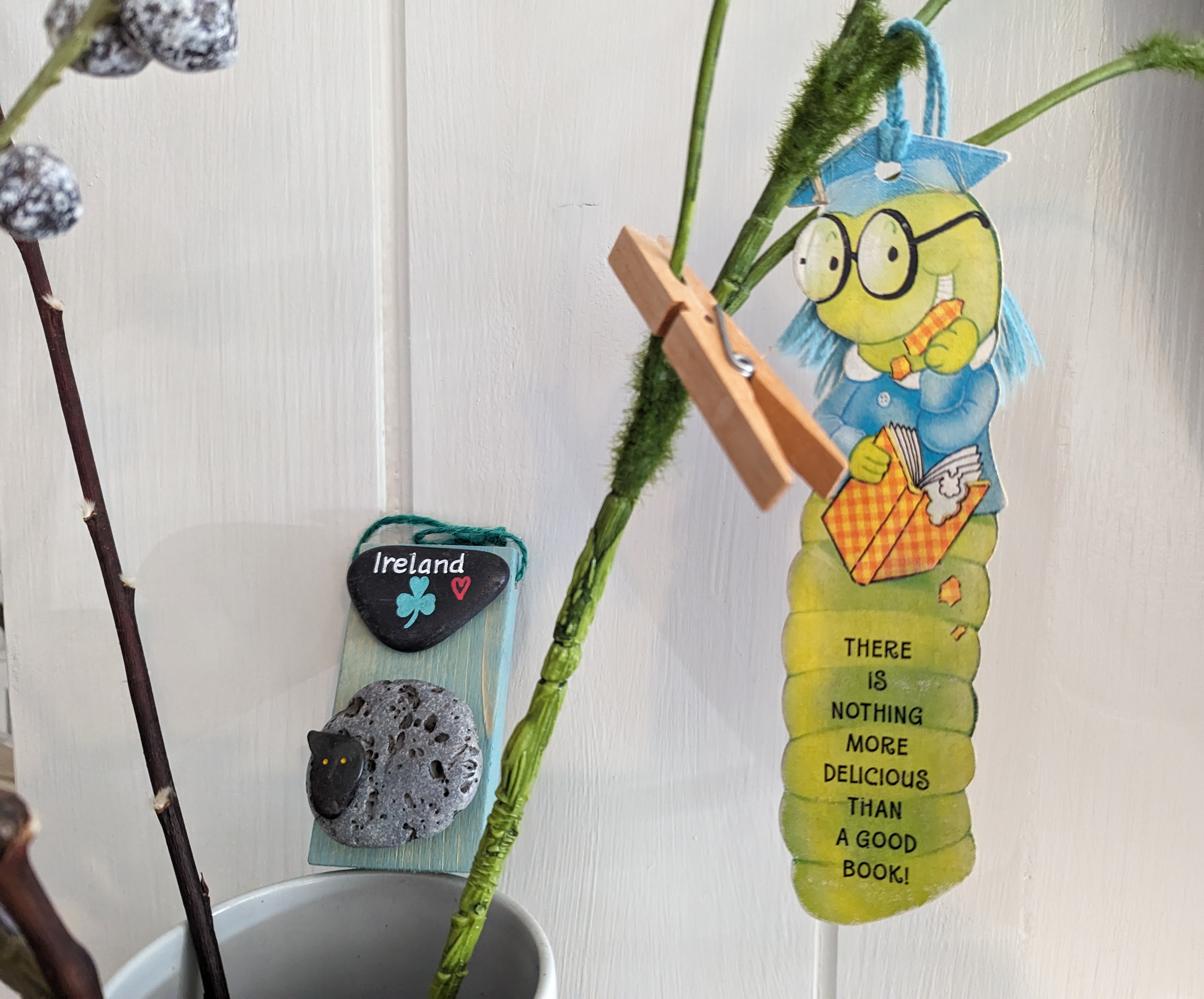
As a memento of these dauntless hill-trotters, the TC invited Sherbet the Sheep to join our flock of travelling companions.
Sherbet’s first home was this booth at the top of Conor Pass:
Peg was delighted to welcome Sherbet to the fold, once I’d assuaged Peg’s jealous streak by letting her be in the forefront of the shot (without, of course, mentioning who’d be in focus):
This is the blog of Mark Wordsworm, the travelling worm. I’m a 40-year-old bookmark (give or take a few years) and I proudly boast my own Hallmark serial number, 95 HBM 80-1. You’ll probably want to read all about me and my Travelling Companion (the TC).
Today’s travel notes
Me and the TC are lodged close to the village of Blennerville on the west coast of Ireland. Let me spin you a yarn of happenstance and mystery concerning the romantic Irish hero Robert Emmet, his burial place, and one of his present-day family members.
The book I’m in
Stormswift, by Madeleine Brent. This author writes adventure stories about young heroines dragging themselves out of impossible situations by dint of courage, strength, and hard-won skills. Despite the dire subject matter, the novels are curiously calming.
Travel tips
Don’t go looking, and you will find.
The photos
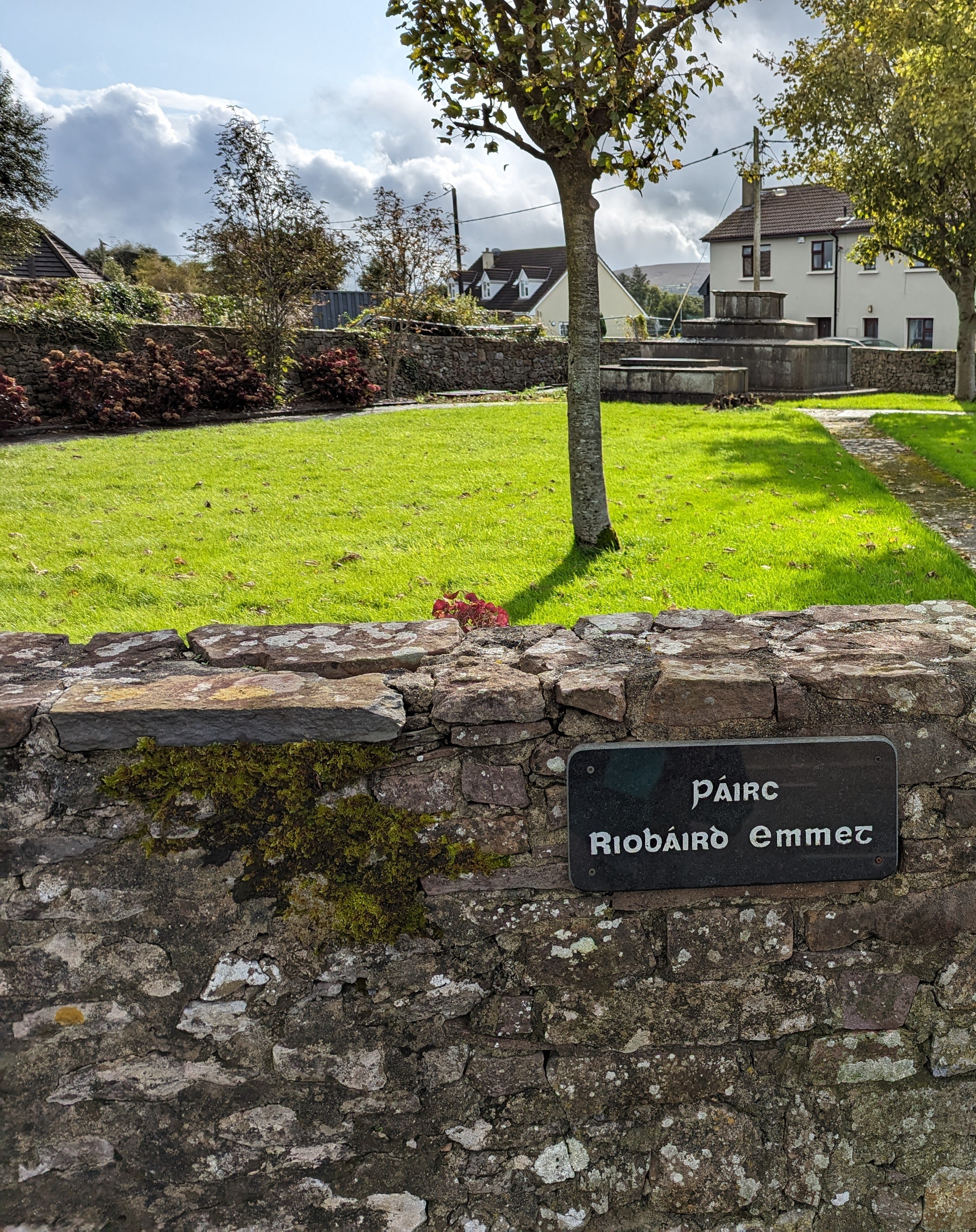
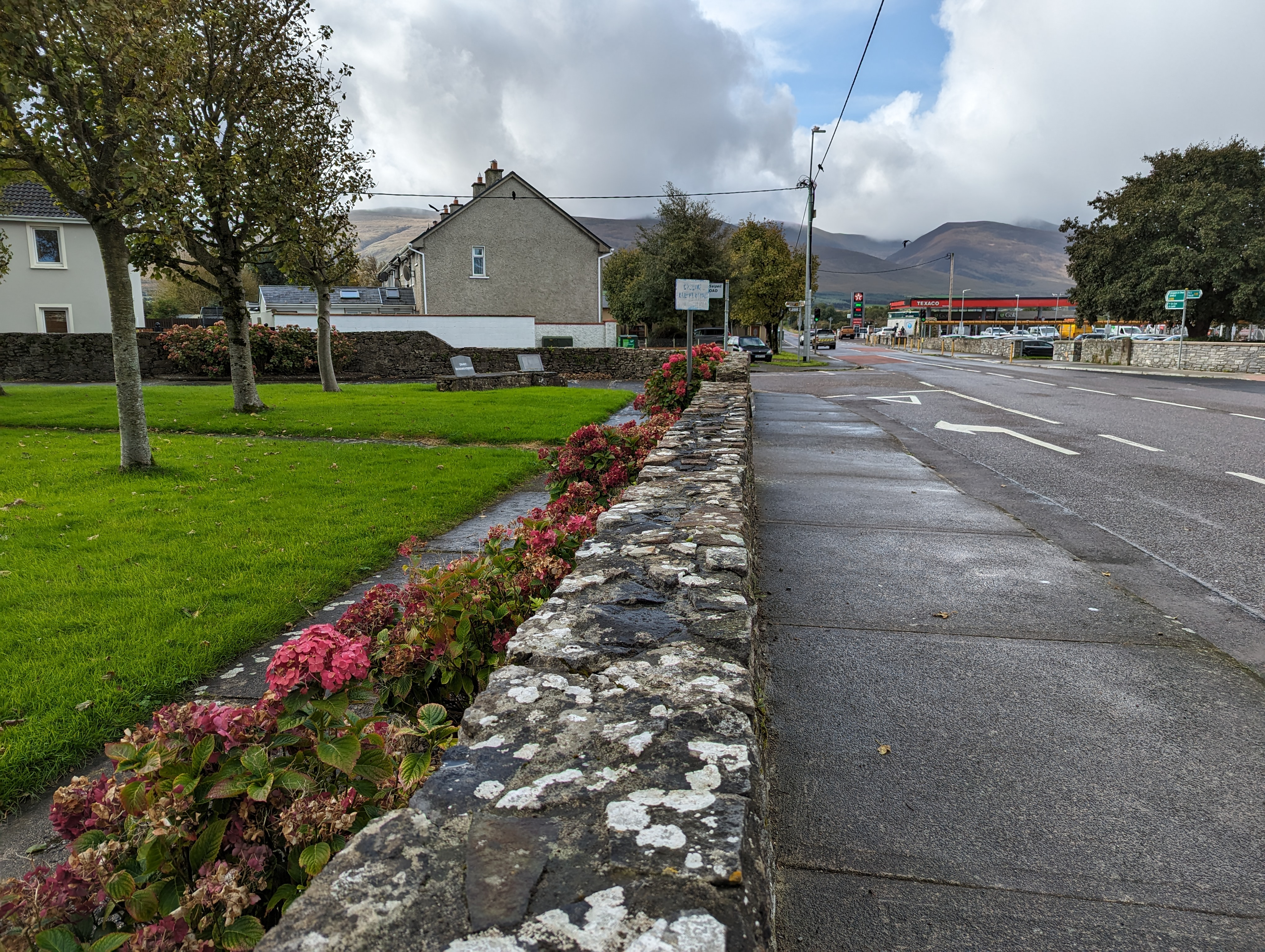
While taking a constitutional stroll in the area of Blennervile with me and the TC, the TC’s partner stopped short in his tracks and stared at a notice on the wall of a small park. The notice said, Páirc Riobáird Emmet. The park was dedicated to Robert Emmet, known in Ireland as “The Patriot”.
At this point in my story, it’s necessary to take a step back and explain a few things. The TC’s parter, henceforth to be called the TC-once-removed, has down the years heard tales from his mother of his familial connection to one Robert Emmet. The latter is an Irish hero from the days of the 1803 rebellion against British rule. Emmet inspired and led the uprising, which didn’t go well. Emmet was later tried for high treason, found guilty, and alas executed.
Back to our stroll on this fateful day. We had no plans to research the history of Robert Emmet. Indeed, we had no idea that we found ourselves in a place of significance with respect to that history. In addition, our decision to take a walk that morning, and indeed to take that particular route, was entirely random.
So, when the TC-once-removed saw the notice declaring a park dedicated to his forebear, he was flabbergasted. And not a little delighted.
Robert Emmet was hanged in Dublin in September 1803. The hangman then removed Emmet’s head and showed it to the people, saying “This is the head of a traitor, Robert Emmet”.
This worm promised you a mystery, and here it comes. What happened to Robert Emmet’s body? The remains were first taken to Newgate Prison and then back to Kilmainham Gaol in Dublin. He was then buried in Bully’s Acre, a public cemetry in Dublin. However, it’s widely believed that his body was removed secretly and buried elsewhere. But where?
Páirc Riobáird Emmet in Blennerville is but one of several places that claim to be the hero’s final resting place. Emmet is a descendant of the Blennerhassett family. Blennerville village was once the Blennerhassett estate village. According to local tradition, Robert Emmet was laid to rest in an unmarked grave under the back porch of St Anne’s Church, which once stood where the park is now located. The church was demolished in 1930.
Over the years, many people have searched unsuccessfully for the hero’s body. Robert Emmet’s supporters have a saying: “Do not look for him. His grave is Ireland”.
Leaving Páirc Riobáird Emmet behind us:
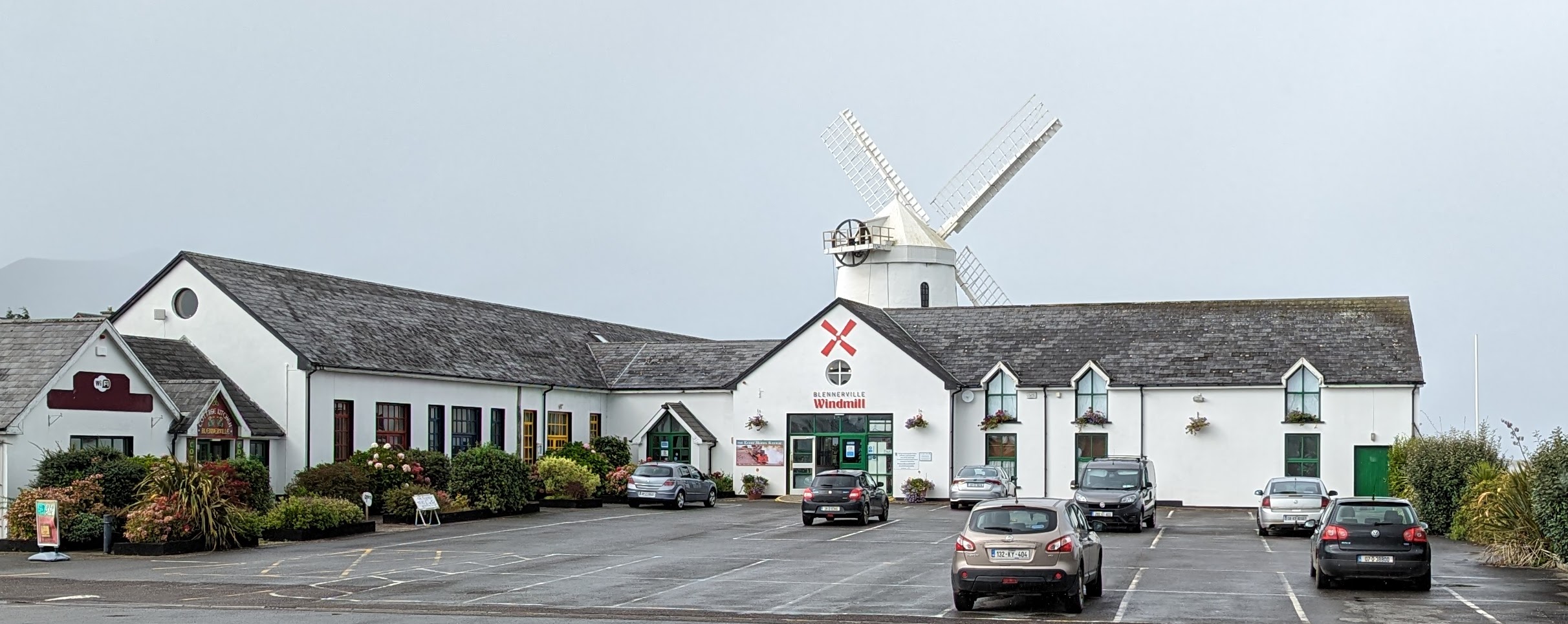
We strolled further along the road to Blennerville and came across the windmill:
Greys on greys, and a splotch of yellow from a person dressed for the weather:
Just beyond the windmill is Blennerville Bridge, with its views of the River Lee and the flats as the river opens into the Atlantic Ocean. The inclement weather provided us with a rainbow:
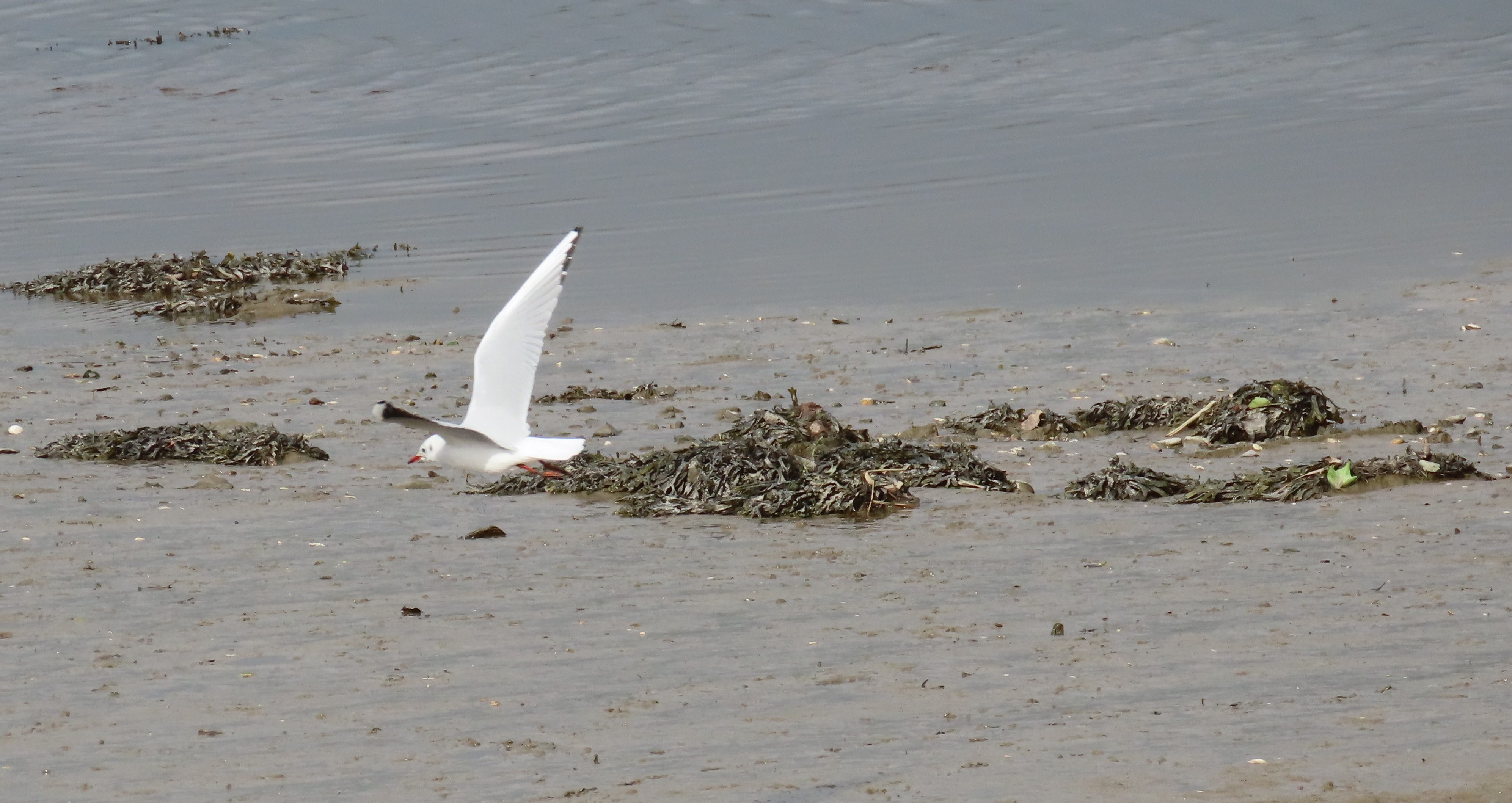
Jonathan was there:
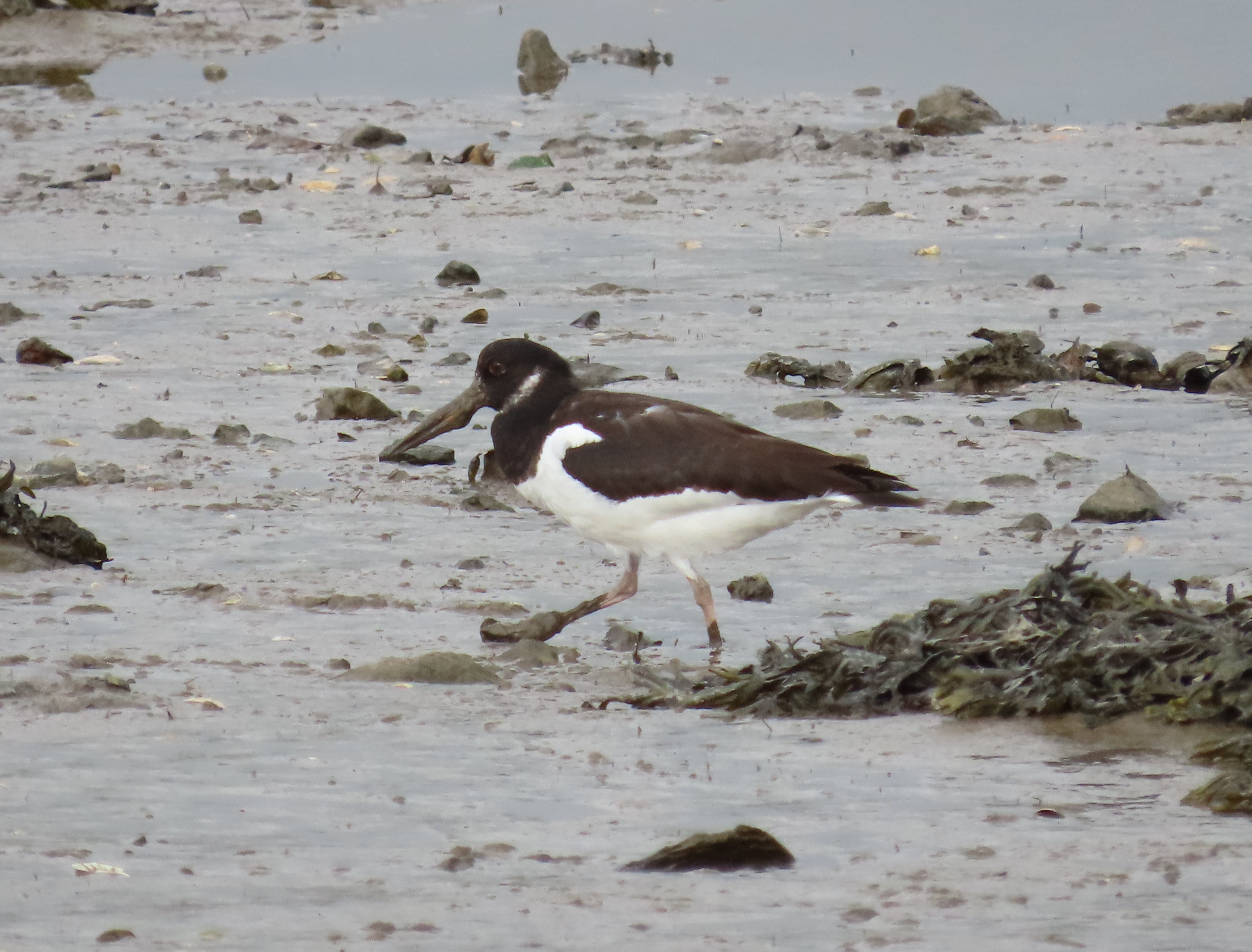
Jonathan had brought a couple of mates to explore the flats: an Oystercatcher with a muddy beak:
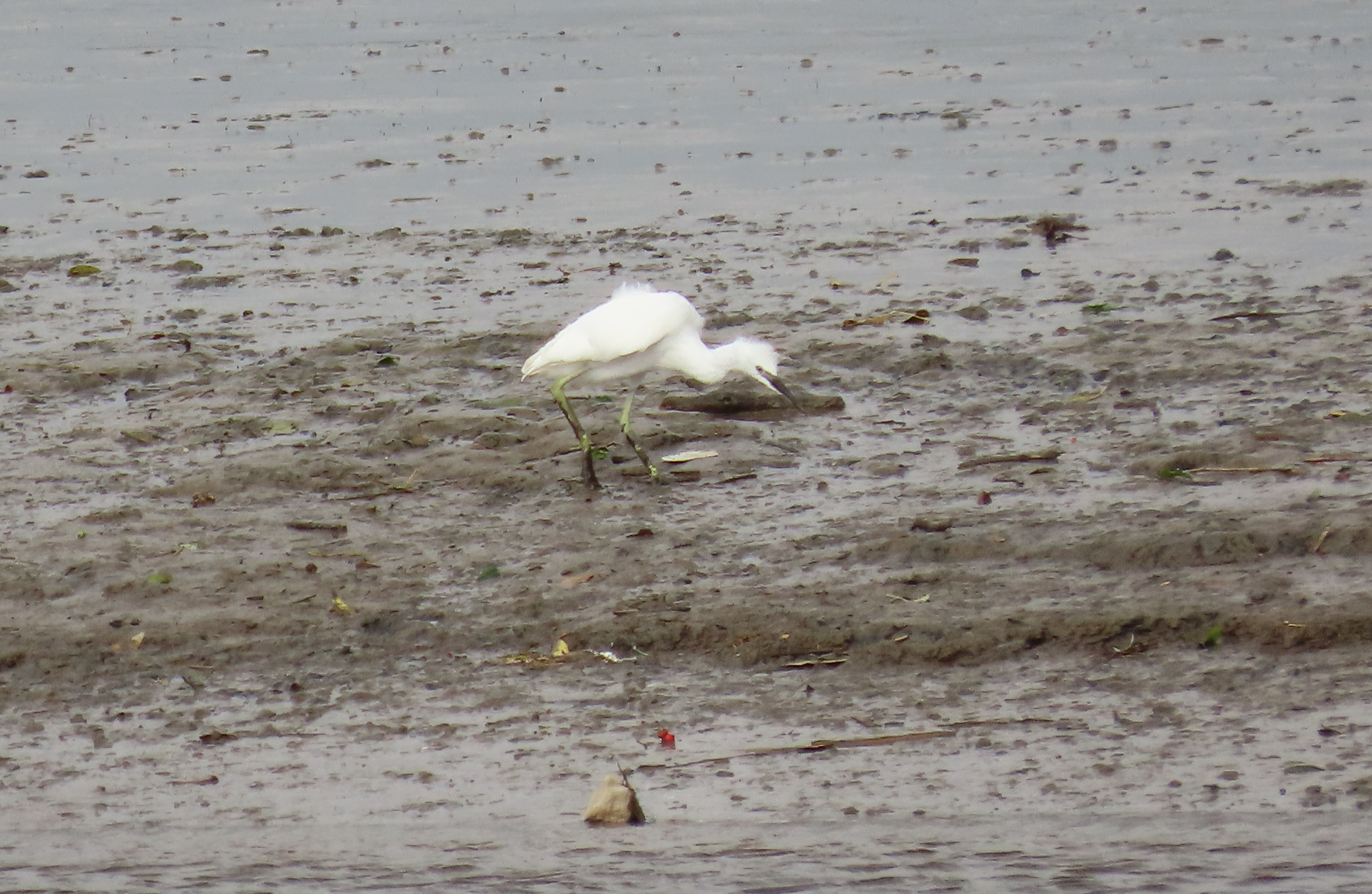
A young Little Blue Heron with green legs:
Heading off with a definite purpose in mind:
On that note, we continued our stroll. Here’s a scene from one of the streets in Blennerville:
This is the blog of Mark Wordsworm, the travelling worm. I’m a 36-year-old bookmark (give or take a few years) and I proudly boast my own Hallmark serial number, 95 HBM 80-1. You’ll probably want to read all about me and my Travelling Companion (the TC).
Today’s travel notes
Me and the TC visited part of Hadrian’s Wall yesterday. The wall is more than 70 miles long, so we had to choose our viewing point. We chose Walltown Quarry, near the village of Greenhead in Northumberland. The beautiful countryside provided a spectacular backdrop for the remnants of the wall.
The book I’m in
Stormswift, by Madeleine Brent. This author writes adventure stories about young heroines dragging themselves out of impossible situations by dint of courage, strength, and hard-won skills. Despite the dire subject matter, the novels are curiously calming.
Travel tips
Drive the A68 through Northumberland and into Scotland. It’s one of the most beautiful drives in the world, passing through restful grey-stone villages and meandering over rolling green hills dotted with sheep and cattle.
The photos
Me and Peg on Hadrian’s Wall:
Devoted readers will no doubt remark on Peg’s re-appearance on this blog. She took a long break from travelling, but is now back in full force. Expect to see her holding up her end of the tale again in this and future posts!
This part of the wall stands atop a high cliff above the stone quarry at Walltown. Here’s a long shot of the cliff topped by the wall:
The path up to the cliff face is guarded by a fearsome ogre. This worm stayed tucked in the TC’s book while we crept by, managing to get past before the ogre emerged fully from its lair:
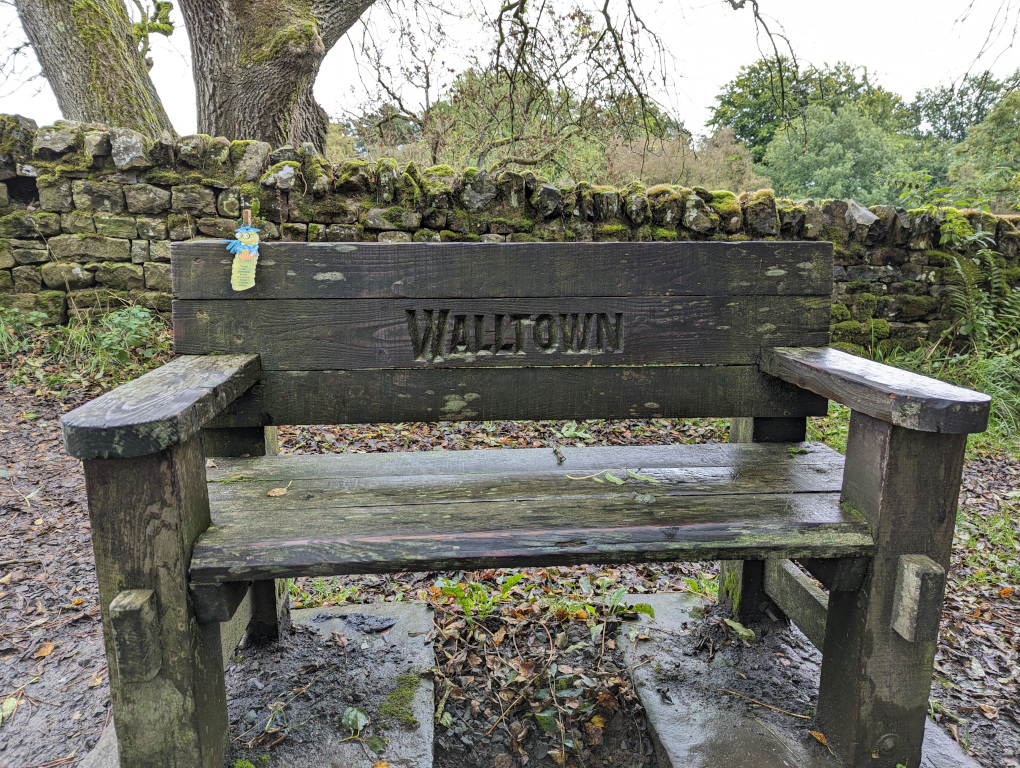
Once we’d safely passed the slumbering ogre, me and Peg took a breather on the Walltown bench before making the final ascent to Hadrian’s Wall:
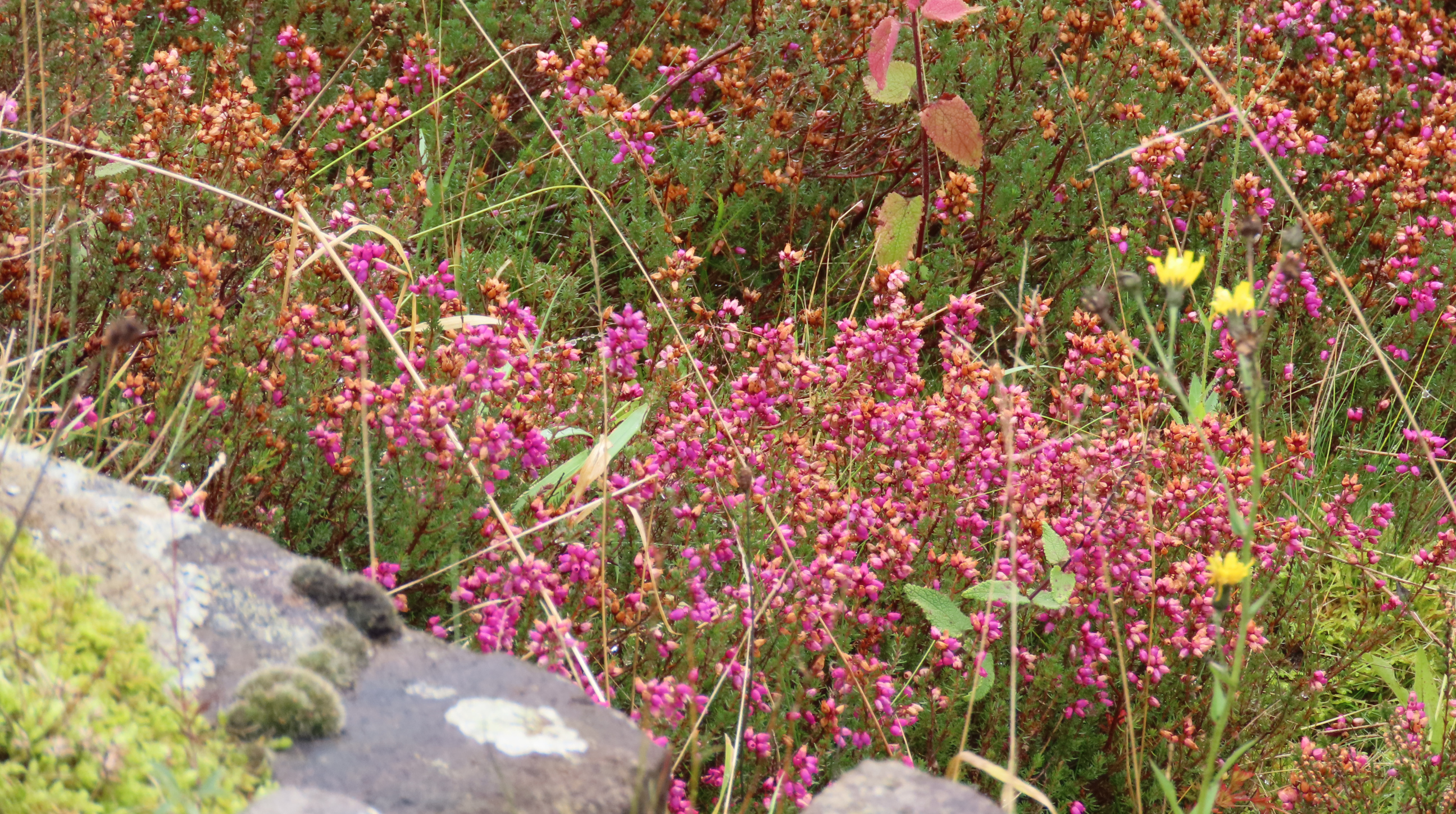
Wild flowers marked the route:
Drops from the recent rainfall sparkled on flower and leaf:
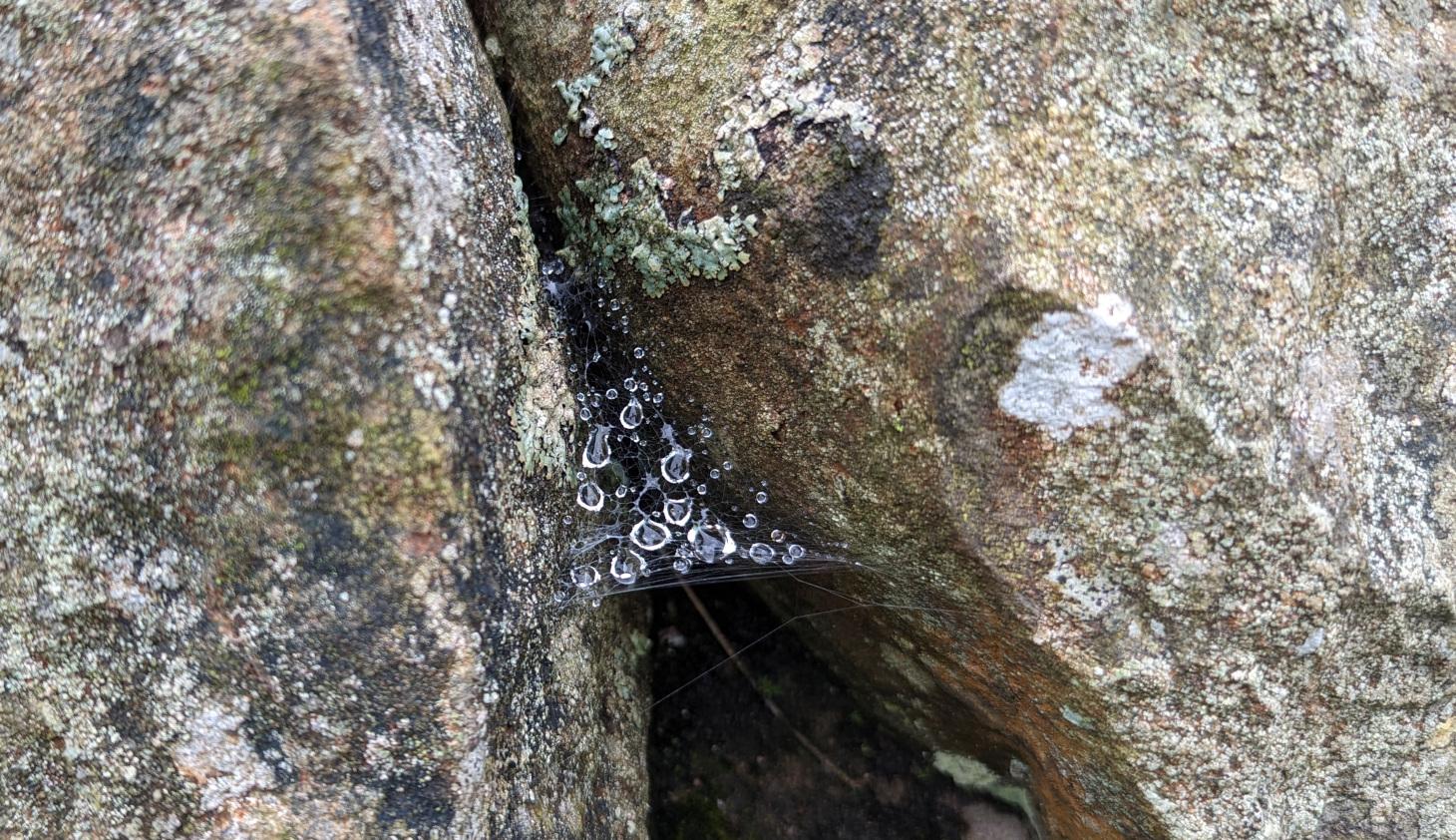
Raindrops decorated the spiderwebs too:
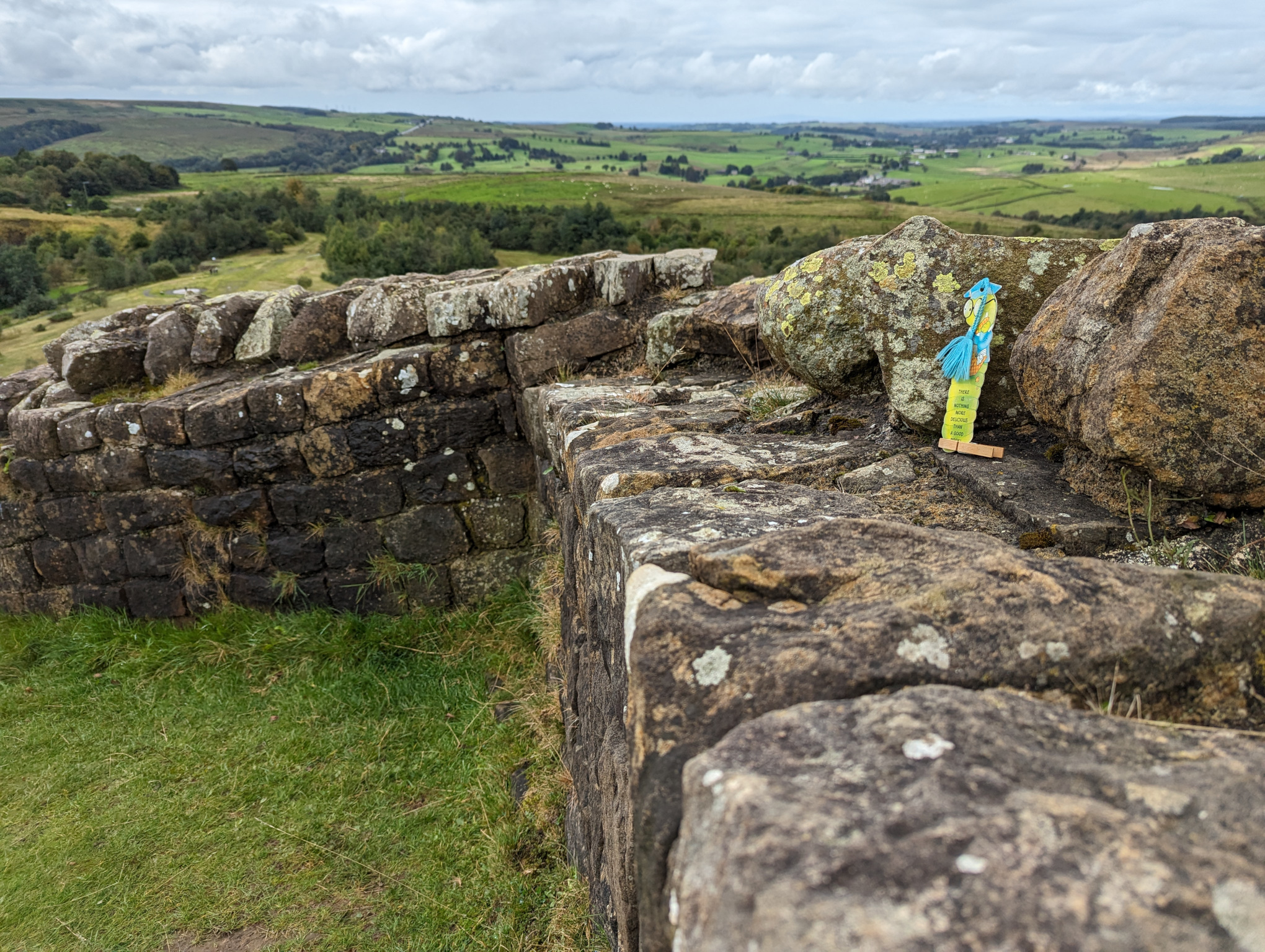
At the top of the cliff, Hadrian’s Wall runs over green velvet hills:
The wall was built by the Roman emperor Hadrian in the second century AD, to draw a line of defence between the south of Britain, controlled by Romans, and the unconquered area to the north, roamed by the fierce Scottish clans. The wall stretches across Britain, from Wallsend on the River Tyne in the east to Bowness-on-Solway in the west.
Adventurous souls took the high road:
This worm found a new friend, who goes by the name of Bluebell. She confided in me that some call her Wall Flower, but she discourages that name with all her might. Me and Bluebell at her home atop Hadrian’s Wall:
Wild flowers grab a handhold on the rocks near the wall:
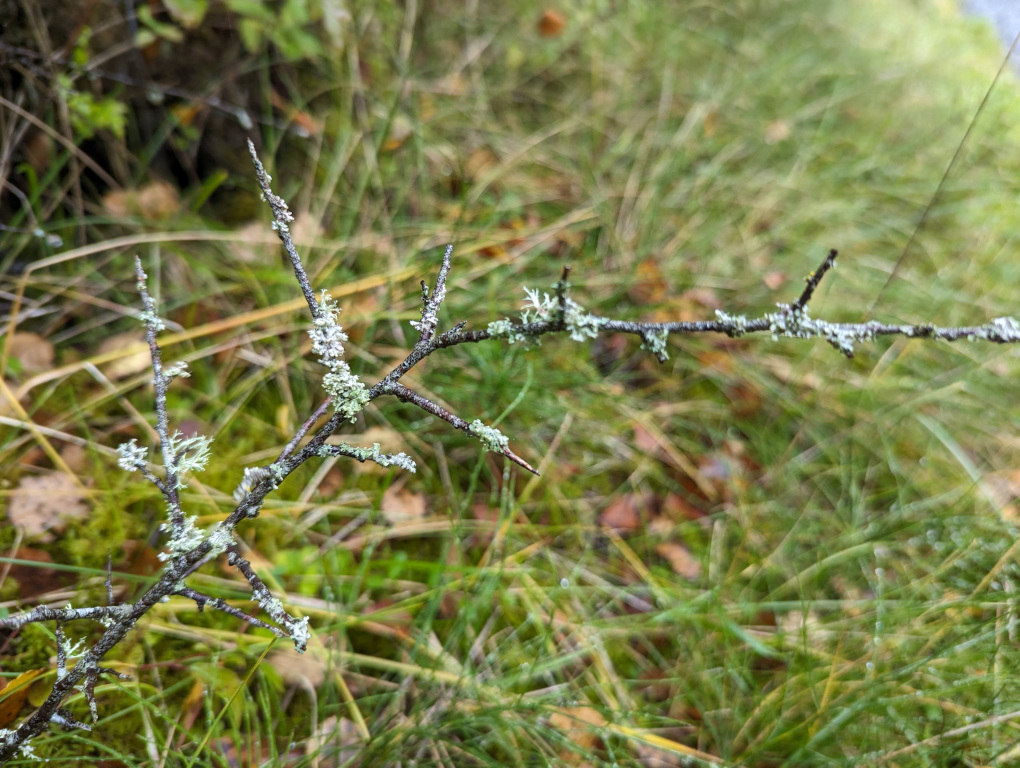
Lichen adorns the stones on the pathway back down the hill:
And drips off the branches of the plants:
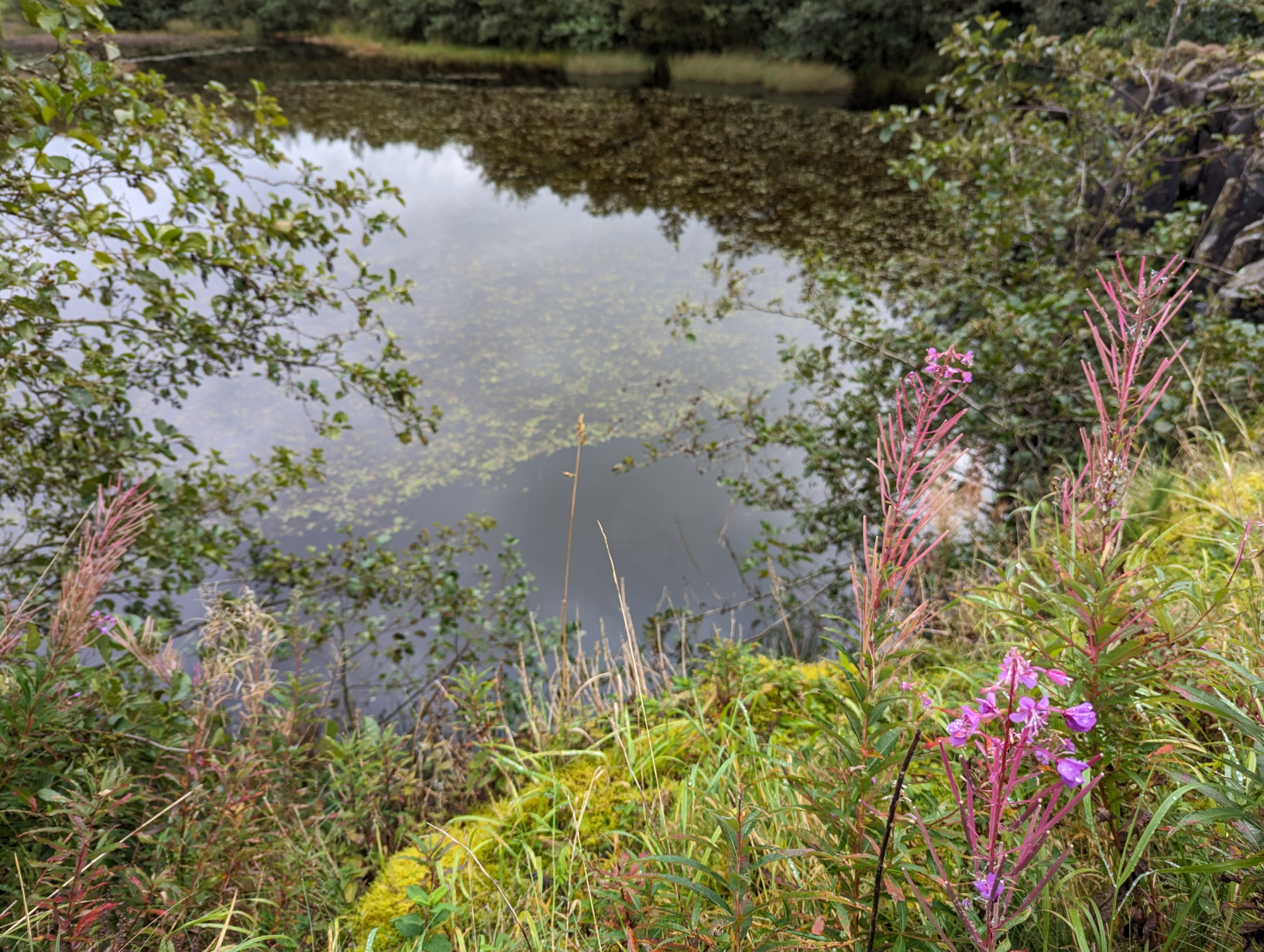
The Walltown Quarry Pond:
The stone dug out at Walltown Quarry was used primarily as chippings for surfacing roads. The quarry opened in 1876 and closed in 1976. After it closed, the land was filled in and landscaped to form the Walltown Country Park.
Here’s a parting shot of Hadrian’s Wall from across the quarry pond:
This is the blog of Mark Wordsworm, the travelling worm. I’m a 36-year-old bookmark (give or take a few years) and I proudly boast my own Hallmark serial number, 95 HBM 80-1. You’ll probably want to read all about me and my Travelling Companion (the TC).
Today’s travel notes
Me and the TC spent a few hours in Dunfermline this week. Dunfermline is a city in the county of Fife, Scotland, about three miles from the Firth of Forth. (This worm wrote about the bridges over the Firth of Forth in a previous post.)
The book I’m in
Imminent Peril, a Sasha McCandless adventure by Melissa F. Miller. The TC loves this series about a lawyer detective who attracts trouble and deals with it fearlessly.
Travel tips
Park as soon as you find a spot that’s close enough to your destination.
The photos
Looking across the rooftops to the Dunfirmline City Chambers:
Dunfirmline City Chambers was built in the late 1870s. It combines French, Gothic and Scots baronial architectural styles into a pleasing medley. The clock tower stands out as a feature of the town.
The clock caused a bit of drama in November 2022, when one of its hands became loose during strong winds. The town closed the roads around the tower until the clock was rendered safe.
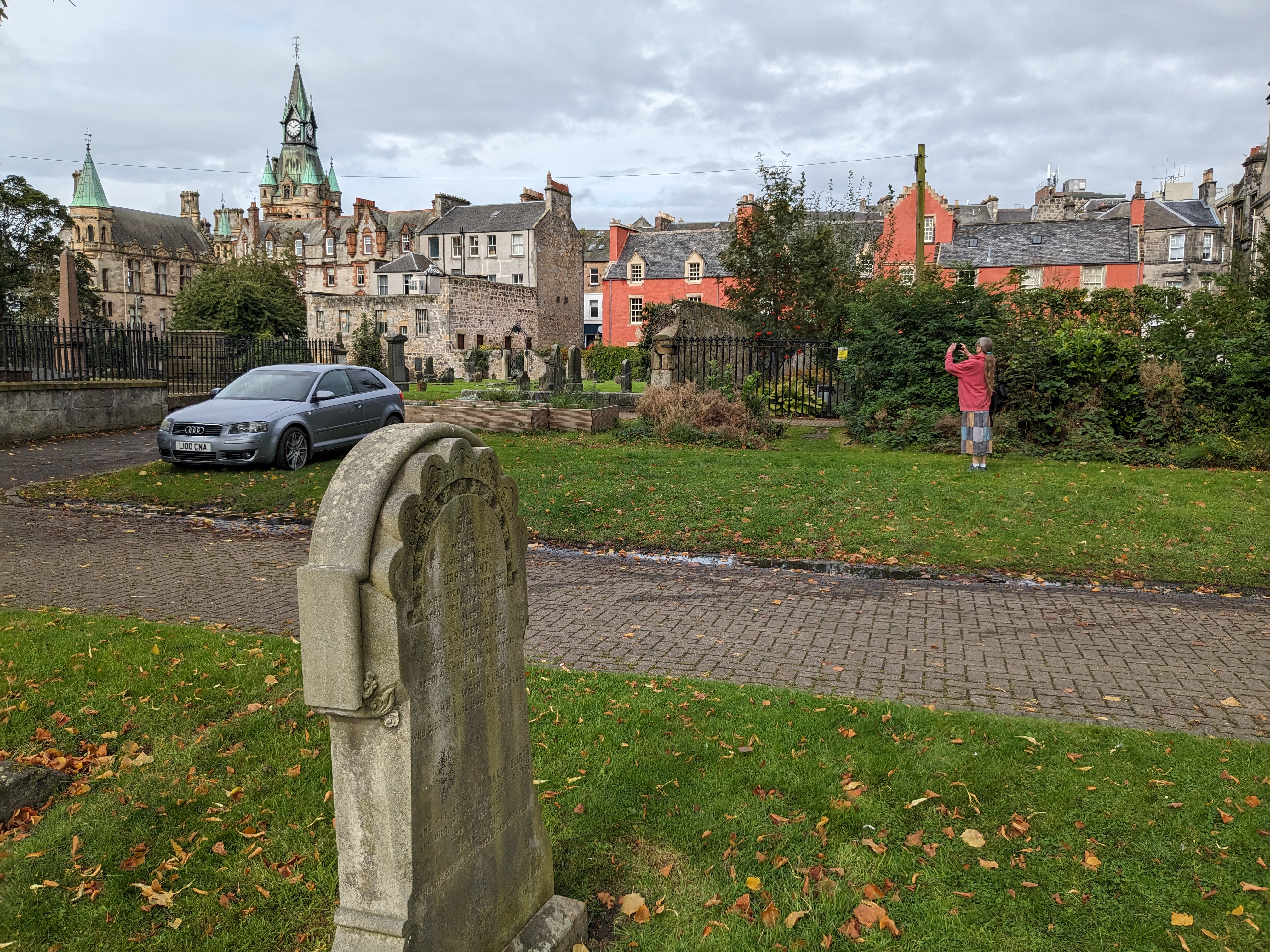
This picture shows the building from the other side of a nearby grave yard:
If you’re keen of eye, you might notice that the next picture shows a rare glimpse of the TC herself. It also includes a partial view of Abbot House, Dunfermline’s oldest house, known locally as the Pink Hoose:
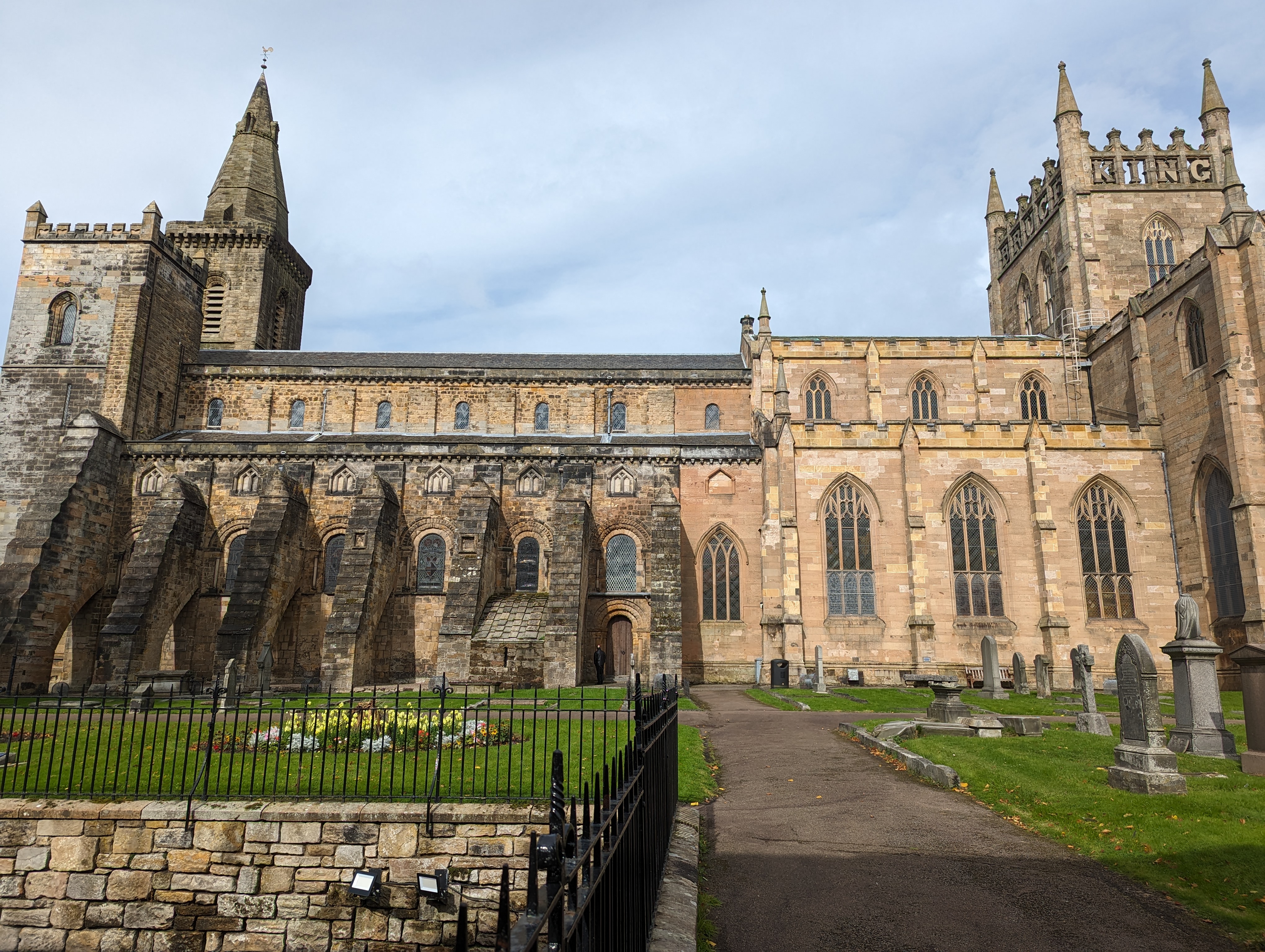
Dunfermline Abbey has been home to Christian worshippers for more than 1000 years:
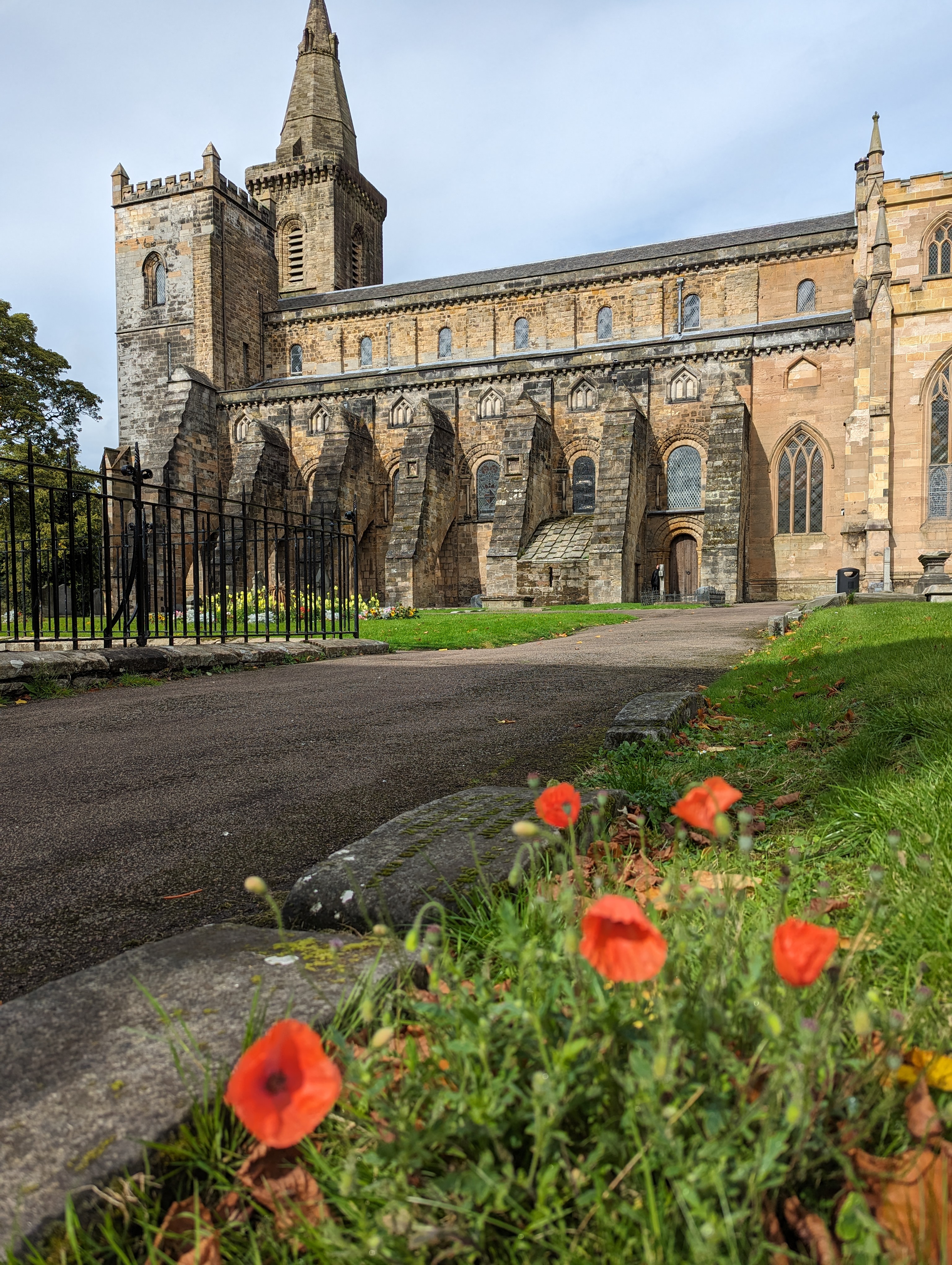
The building has two distinct halves. On the left of the picture (the western half) is the Benedictine Abbey, founded by Queen Margaret in the eleventh century. Margaret arrived in Dunfermline in 1068, following the defeat of the English at the Battle of Hastings in 1066. She married King Malcolm in 1070 and founded Dunfermline Abbey in 1072.
On the right (the eastern half) is the New Abbey Church, constructed in the early nineteenth century. Robert the Bruce is buried under this half of the church. The letters that you see in the balustrade of the square tower spell out “BRUCE KING”.
Here’s another view of the older part of the abbey:
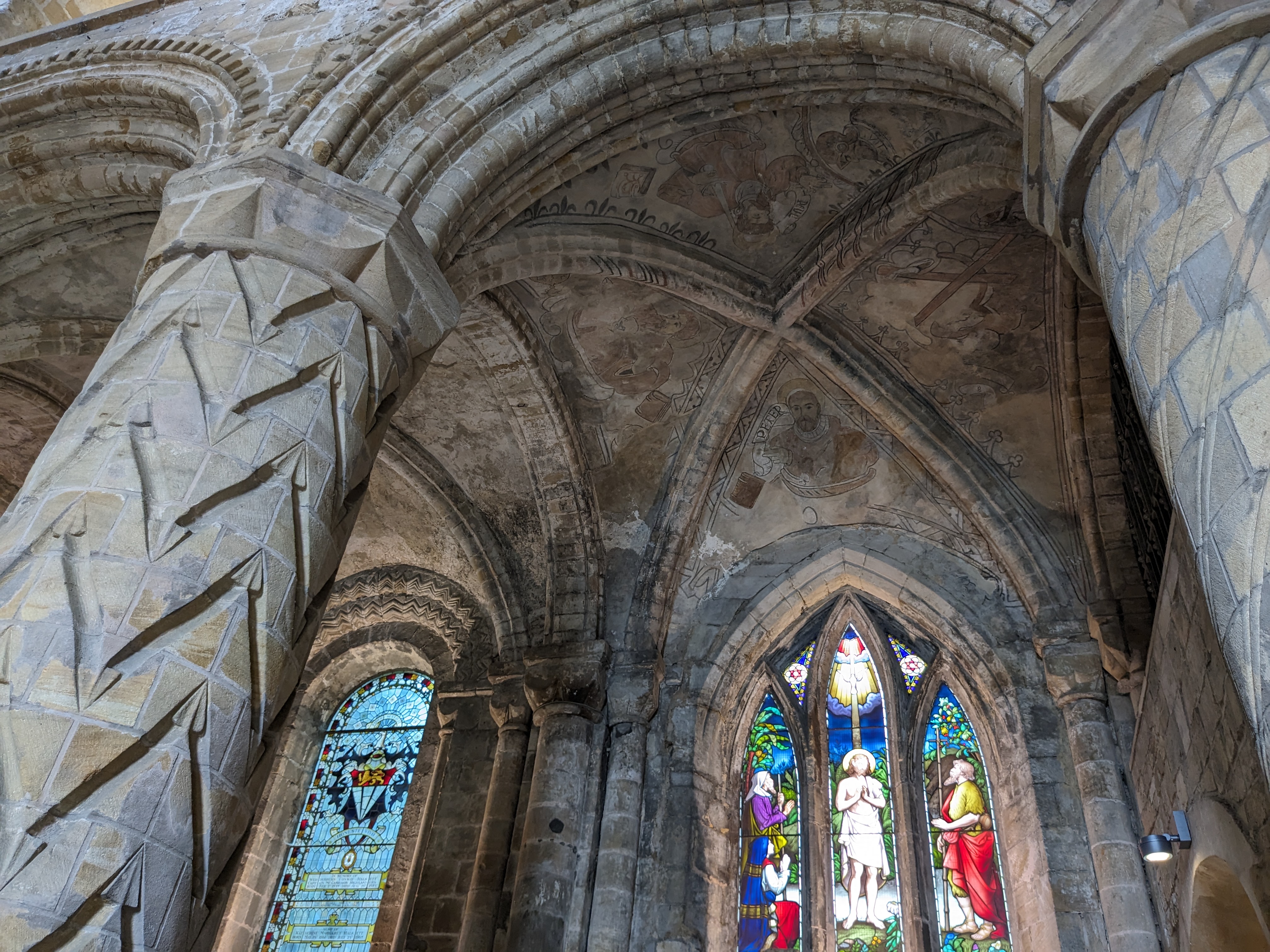
Inside the abbey, one of the arched ceilings still has the early frescoes of the apostles:
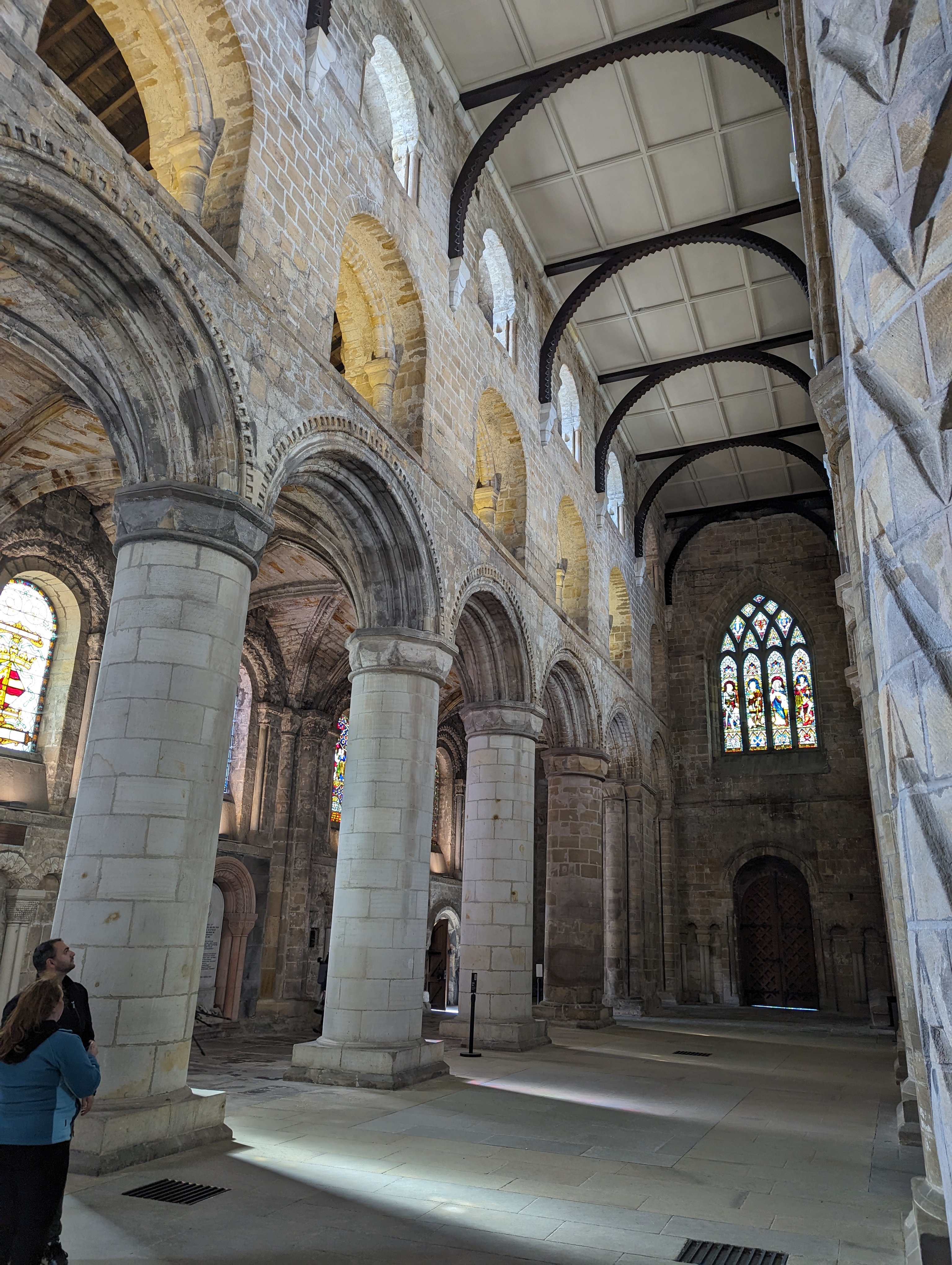
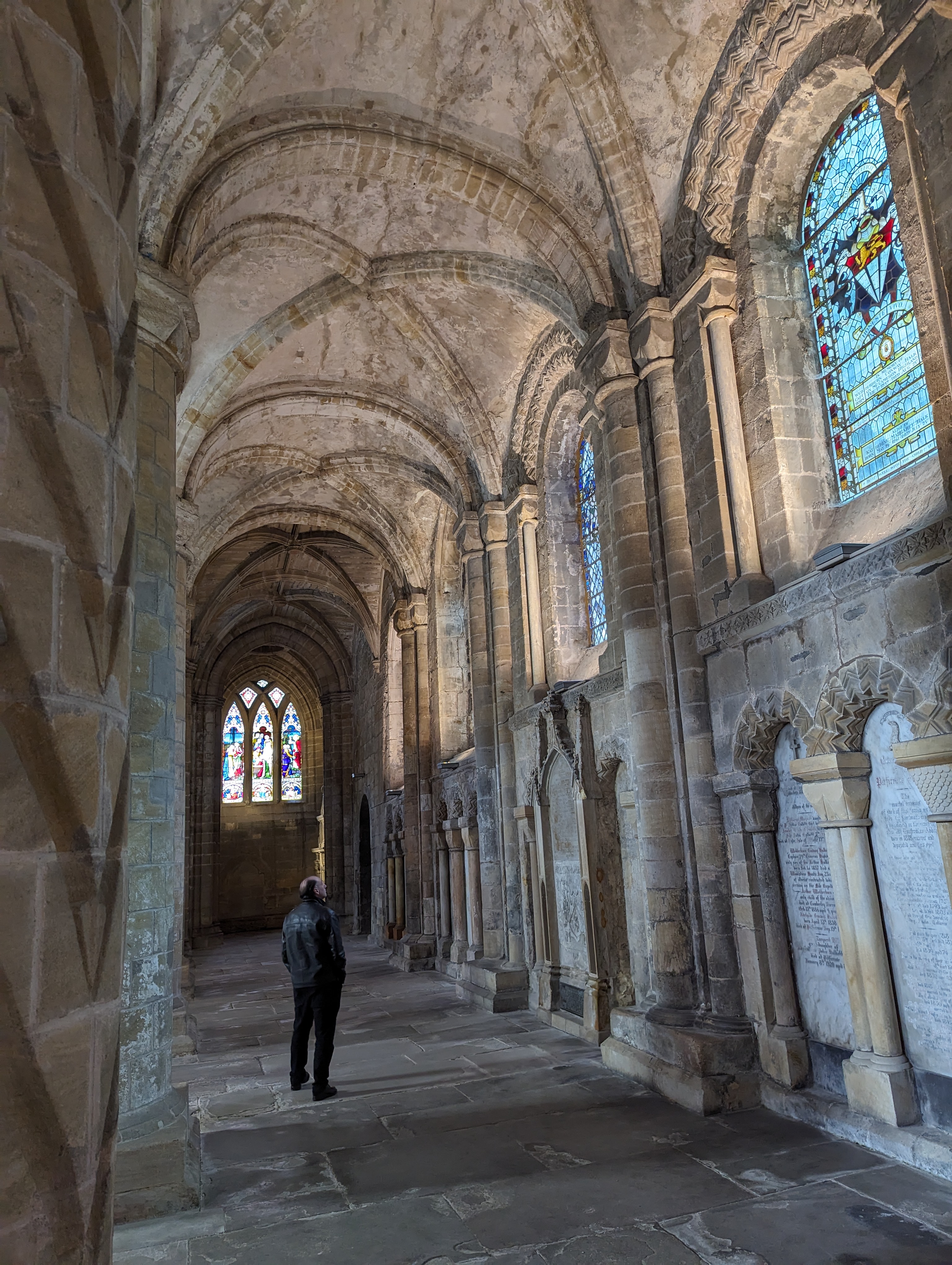
More scenes from inside the old abbey:
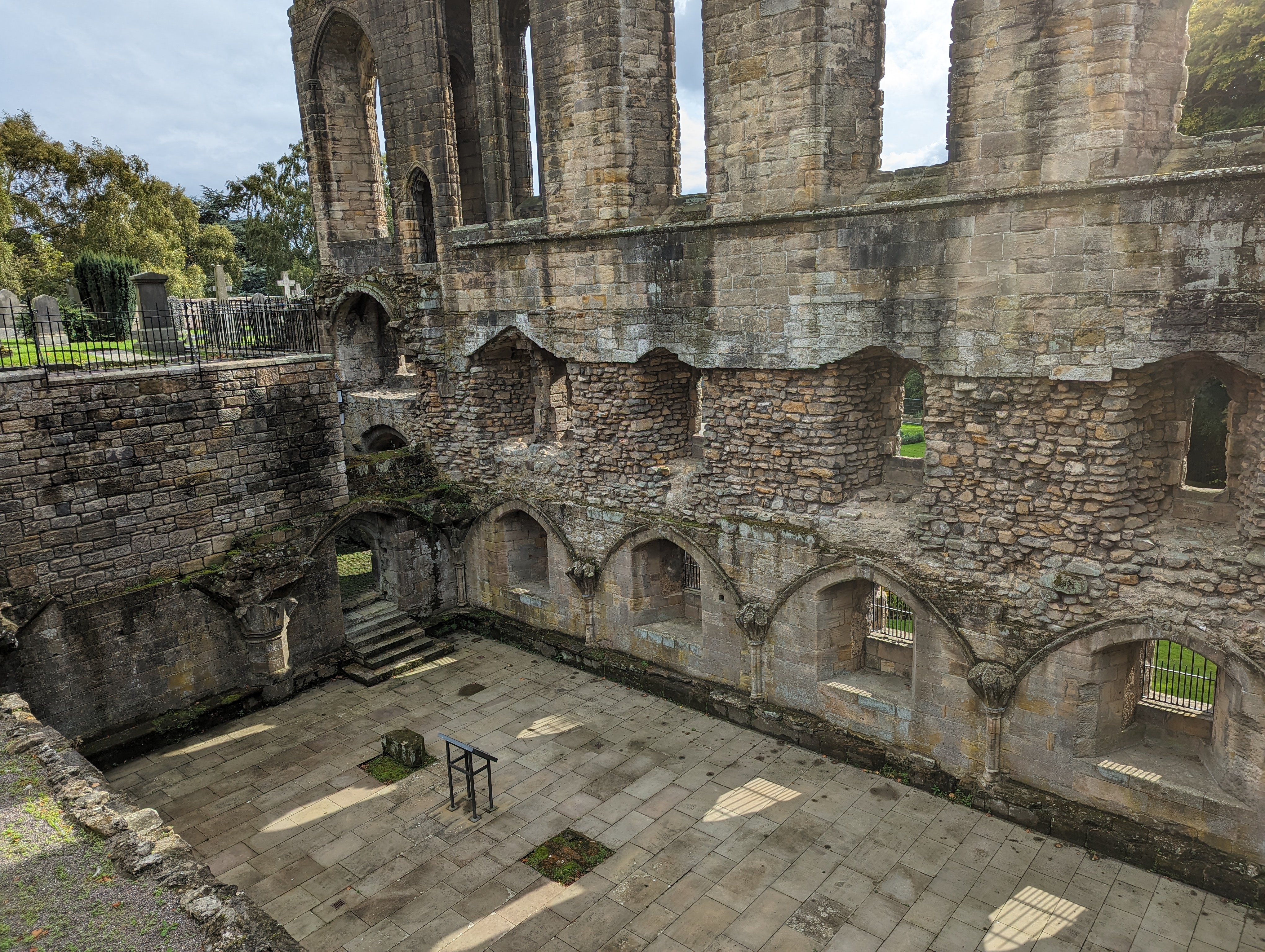
In the grounds of the abbey lie the ruins of the monastery that was built at around the same time as the old abbey, way back in the 1070s:





































 Travelling Worm