This is the blog of a 25-year-old bookmark. I proudly boast my own Hallmark serial number, 95 HBM 80-1. You’ll probably want to read all about me and my Travelling Companion (the TC) .
But I know you’re on tenterhooks waiting to hear about the sand. That’s what it’s all about, after all. Fraser Island is part of the “Great Sandy Region”, and the island itself is made almost entirely of sand. It is the largest sand island in the world. Its dune systems are 30,000 years old, which makes them among the oldest in the world. The brochures say there are 72 different colours of sand on the island.
This worm sat on most of them. Peg was there too, helping to keep me grounded when I was in danger of getting carried away by the sheer beauty of the scenery and, ah-hem, the wind.
Travel tip
People build sand castles on the beach. This makes for an interesting driving experience.
The book I’m in
Et si c’était vrai…, by Marc Levy.
The photos
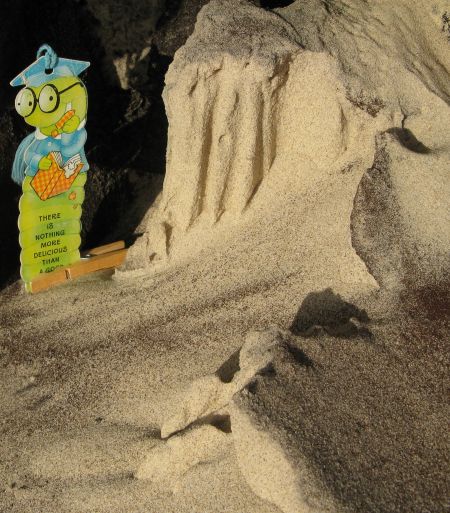
Me and Peg and some sand on Fraser Island:
Fraser Island – it's all about sand
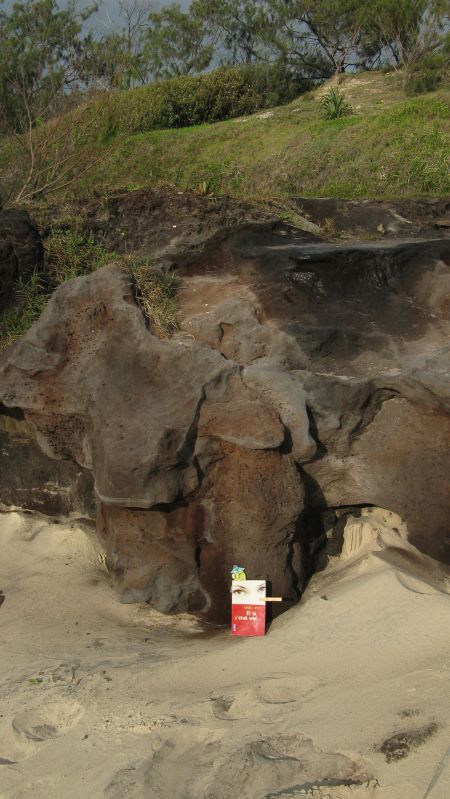
Even the dark stuff that looks like rock is actually sculpted sand:
Me examining a crab hole in the sand:
Fraser Island – it's all about sand
Patterns made by crabs in the sand:
A creek opening onto the beach:
Fraser Island – it's all about sand
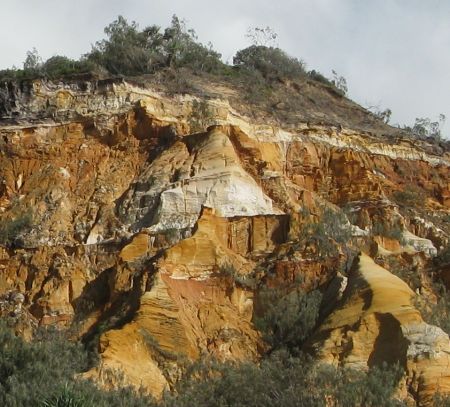
The Pinnacles, on Seventy-Five Mile Beach:
Fraser Island – it's all about sand
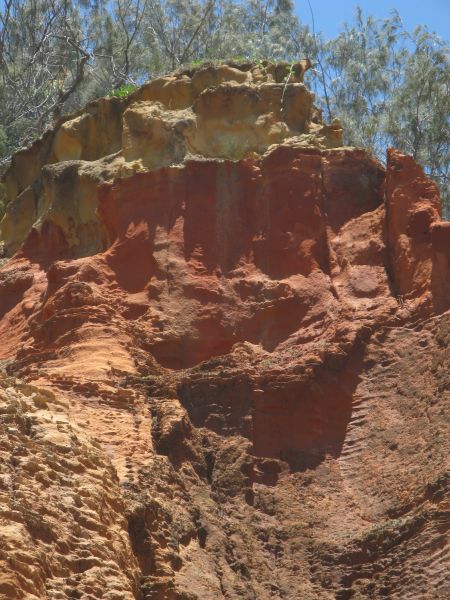
The Red Canyon, also on Seventy-Five Mile Beach:
Fraser Island – it's all about sand
One of the peaks in the Red Canyon:
Fraser Island – it's all about sand
Sand, footprints and shadow:
Want to know more about Fraser Island? Try my YouTube playlist. Stay tuned to this blog for more about the island’s lakes and creeks and creatures.
This is the blog of a 25-year-old bookmark. I proudly boast my own Hallmark serial number, 95 HBM 80-1. You’ll probably want to read all about me and my Travelling Companion (the TC) .
But what about the dangers of travelling to a prehistoric, unwired and 4×4-infested island made entirely of sand?
My impressions? Fraser Island is a softy, provided that you go prepared.
We were warned about snakes and sharks —- didn’t see any. We expected big spiders — saw only one, and dead at that. We did encounter dingoes, a dubious jellyfish, bugs that bite, and ninja pine cones.
Curiouser and curiouser
We also encountered confused people in car parks. Have you ever seen any of the episodes of Lost? If you have, alas poor you, but you’d recognise the feeling of tropical muggy not-quite-reality that pervades the island. Luckily, serendipity reigns there too, so it all works out in the end.
So you should expect strangers making weird requests. Here are some of the things people asked us:
In the car park at Lake McKenzie, in the middle of the forest in the middle of the island in the middle of nowhere: “Do you have a recharger I can borrow?” (She didn’t say what type of recharger she wanted, or where she would plug it in, or how long we would need to wait until whatever it was was recharged. The TC shook her head regretfully and backed away.)
On the beach at Eli Creek: “Can we borrow your car keys to start our car? We’ve lost our keys.” (Without much hope of success, the TC lent them the keys from our Land Rover Defender to start their Toyota. Guess what – it worked. What’s more, they then removed the keys and gave them back to the TC, and their Toyota kept on going. Everything keeps going right… Oops, nearly got trapped in a jingle there.)
In the car park at Lake McKenzie: “Can we have a lift to Kingfisher Bay?” The TC said that alas, we were going to Eurong, which is in exactly the opposite direction and on the east coast rather than the west coast. “OK. We go to Eurong.” (They were Swiss backpackers and had walked 40km the preceding day and night. They wound up at Central Station, expecting food and comfort, and found just a logging museum. So we took them to Eurong. They sat in the back of the Land Rover, everyone had a fun journey misunderstanding each other’s English, and they seemed quite happy to arrive in Eurong rather than Kingfisher Bay.)
Travel tip
Bug repellent is a wonderful thing. Roll-on works best.
The book I’m in
Et si c’était vrai…, by Marc Levy.
The photos
Me, Peg, a book and some sand (yes, it’s all sand) on Fraser Island:
Deadly pine cones and other dangers on Fraser Island
The TC and this dingo met up on Seventy-Five Mile Beach early one morning. They eyed each other and kept their distance as each went their own way. Typically, the TC is over the moon about this experience of wild life in the wild:
Deadly pine cones and other dangers on Fraser Island
The TC had to hop around a bit on the beach near Indian Head, to avoid standing on this jelly fish. Is it the deadly Irukandji jellyfish? Who knows. It was about the right size:
Deadly pine cones and other dangers on Fraser Island
The tide is a hazard for the unwary. The only feasible way to travel up and down the length of the island is on Seventy-Five Mile Beach. But parts of the beach are impassable for two hours either side of high tide. The TC had booked a ferry for 9 a.m. on the day of our departure, not realising that high tide was at 7:15 a.m. that day. Oops. So we were up at 4 a.m. and driving by 4:30.
Oh and, btw and fyi, you can’t drive in the dark either, for fear of running over sleeping campers or diving off a sand dune. It’s light at 4:30 a.m. I didn’t want ever to know that.
By 5 a.m. the TC knew we’d make it off the beach in time, so she stopped the car to take this photo. :
Deadly pine cones and other dangers on Fraser Island
Beware the tiny biting insects. They’re so small you hardly see them. They can sting you through your clothing, and the mark they leave is many times the size of the biter.
Deadly pine cones and other dangers on Fraser Island
Most deadly of all , beware the ninja pine cones:
Deadly pine cones and other dangers on Fraser Island
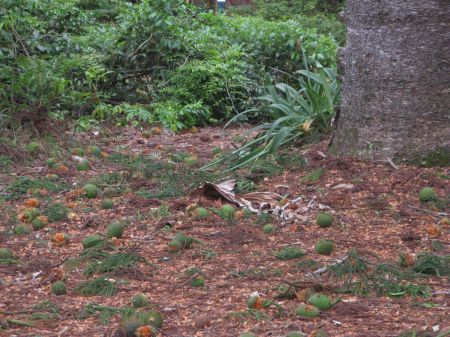
All good island stories have a ninja or two. While we were there, I heard four or five of the cones hit the ground with a resounding THUD. Don’t walk under a kauri pine, or a falling pine cone might render you a modern-day Rip Van Winkle. See the cones littering the ground:
Deadly pine cones and other dangers on Fraser Island
Here’s the culprit, fearsome indeed:
Deadly pine cones and other dangers on Fraser Island
You have been warned!
Want to know more about Fraser Island? Try my YouTube playlist. Stay tuned to this blog for more about the island’s lakes and creeks and creatures. And don’t forget, it’s all about the sand.
This is the blog of a 25-year-old bookmark. I proudly boast my own Hallmark serial number, 95 HBM 80-1. You’ll probably want to read all about me and my Travelling Companion (the TC) .
Today’s travel notes
Me and the TC have been on Fraser Island for a week. I told you about it in my last post: Fraser Island – prehistoric beauty. One of the fun things about a holiday on an island is getting there, and getting about once you’re there.
Fraser Island is a bit rough and ready. To get there, you must first find your way to Hervey Bay on the mainland, in Queensland, Australia. There’s a small airport, so we flew in by Virgin Blue Airlines from Sydney.
Next you need to hire a 4wd vehicle and put it on a barge for the short crossing to the island’s west coast. Then you start driving.
My impressions? 4wd travel is fun and gets you to places you’d not see otherwise.
Travel tip
Take your comfort zone with you, be it chocolate, coffee or a friend.
Recommended 4wd rental
Aussie Trax in Hervey Bay on the mainland.
The TC hired a Land Rover Defender. A good, sturdy, feel-the-ground, low-comfort but no-nonsense vehicle. Just what the TC ordered.
Aussie Trax also supplied useful information about driving on Fraser Island, maps and a suggested itinerary. The vehicle gave no trouble whatsoever, which indicates that it is well maintained. A great 4wd experience.
The book I’m in
Creation in Death, by J.D. Robb aka Nora Roberts.
Lieutenant Eve Dallas, New York cop, investigates a series of murders. A good read.
The photos
Me at the Maheno shipwreck, on the east coast of Fraser Island:
Getting about on Fraser Island
The Maheno got into trouble during a cyclone in 1935 and was beached a couple of days later. Luckily there were very few people on board, since the ship was on its way to being scrapped:
Getting about on Fraser Island
This is the Land Rover Defender we hired, on the barge crossing from River Heads to the island:
Getting about on Fraser Island
Here’s a rare shot of the TC, not too steady on her pins in this one. This is just because the ferry ride is a bit bumpy, she’d hasten to assure me:
Getting about on Fraser Island
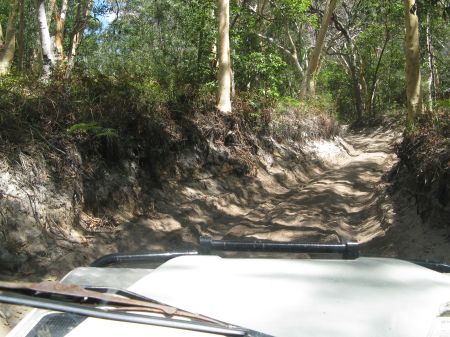
Driving on a sand road through the forest on Fraser Island. I have to take my hat off to the TC. She got right into the four-by-four driving thing. But I also have to add that it takes more guts to be a passenger than the driver:
Getting about on Fraser Island
We did get stuck a few times. But getting unstuck was quite easy, with some reversing and putting the vehicle into low range for the very soft sand.
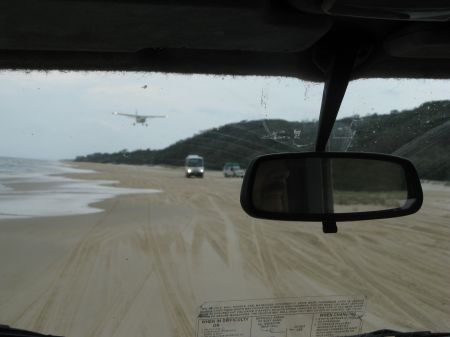
On the east coast of the island is Seventy-Five Mile Beach, also called the 4wd highway:
Getting about on Fraser Island
You’re apt to be chased by a small aeroplane, landing on or taking off from the same stretch of hard sand you’re driving on. Take a closer look at the shot above. Can’t see it? Here’s a zoomed-in section of the same photo:
Getting about on Fraser Island
Bus, plane and another 4×4 all comin’ at ya. That’s a mighty narrow strip of hard sand. Take a look through our windscreen:
Getting about on Fraser Island
Yup, sometimes I was glad I was cosily tucked into my book in the TC’s travel bag, along with Peg and the Trail Bars. But it all turned out well in the end:
Getting about on Fraser Island
Here’s a movie so that you can have a full-on virtual experience of driving a Land Rover Defender on Fraser Island. We’re heading east along Cornwells Break Road and driving onto the soft sand of Seventy-Five Mile Beach. You can hear the revs rise when the vehicle starts driving through the soft sand at the top of the beach:
The TC says that driving along Seventy Five Mile Beach is fun, beautiful and just a bit scary. The soft white sand squeals as you drive over it. The darker sand looks hard, but it may just be wet and slushy. The normal rules of the road apply, but not everyone follows them. You have to be aware of the tide and cannot drive on the beach at high tide or for two hours either side of it. There’s a movie of driving along the beach itself on my YouTube playlist.
Here’s a short movie of us driving over a washout on the beach. A washout is where a creek runs down over the beach into the sea:
Driving through the forest is different and even more fun. It really is all sand:
When the TC got back home and drove her little Holden Barina again, she described it as “freaky. I can’t feel the engine rumbling. Is it even running? The clutch is too smooth. And where’s the ground? I can’t feel it at all. It’s just wrong.” That’s the TC for you. Effusive at times, but at least you know where she’s at.
Want to know more about Fraser Island? Try my YouTube playlist for more videos. And stay tuned to this blog for more posts about the island’s lakes and creeks, its creatures and the deadly dangers you are sure to encounter. And, of course, it’s all about the sand.
This is the blog of a 25-year-old bookmark. I proudly boast my own Hallmark serial number, 95 HBM 80-1. You’ll probably want to read all about me and my Travelling Companion, and then follow my blog posts to share my experiences as bookmark and travelling worm.
I’ll keep it meaningful. Like a t-shirt.
Today’s travel notes
I have spent the last week on Fraser Island, off the coast of Queensland in Australia. Fraser Island is composed almost entirely of sand. At 125 km long and on average 15 kilometres wide, it is the largest sand island in the world. That is but one of the “I’m the xxx-est” claims this bit of land can make. It’s a destination worthy of a traveller of my calibre.
The island was named after a shipwreck victim, Eliza Fraser. That nugget of knowledge sets the scene for an eery and atmospheric journey. It’s a prehistoric place, with ancient plants and unearthly sand formations that have lasted for thousands of years. They seem to be standing up to the latest invasion of humans and 4wd vehicles remarkably well.
To get to the island, you need to fly to Hervey Bay on the mainland, hire a 4wd vehicle and put it on a ferry for the short crossing to the island’s west coast. Then you start driving.
My impressions? Remote enough to be away from the daily grind; not so remote that creature comforts are totally unobtainable. The TC does like her creature comforts.
This blog post is an introduction. Rest assured, I’ll write more about the dangers and delights of Fraser Island in upcoming posts.
Travel tip
Time and tide wait for no worm.
Recommended 4wd rental
Aussie Trax in Hervey Bay on the mainland.
The TC hired a Land Rover Defender. A good, sturdy, feel-the-ground, low-comfort but no-nonsense vehicle. Just what the TC ordered.
Recommended restaurant
Happy Valley restaurant. (That’s not its actual name.)
It’s the only eating place in Happy Valley. The food is reasonable and there’s a good variety. It’s a life saver for weary travellers who haven’t brought enough of their own food to the island.
Recommended accommodation
Sailfish on Fraser apartments in Happy Valley. Not cheap, but excellent value for money.
The book I’m in
The Tenth Circle, by Jodi Picoult.
A troubled book, its straight prose interspersed with comic-book passages which complement the story in the main text.
The photos
Me lurking with a fungus at Wanggoolba Creek, in the middle of the rainforest in the middle of the island in the middle of nowhere:
Fraser Island – prehistoric beauty
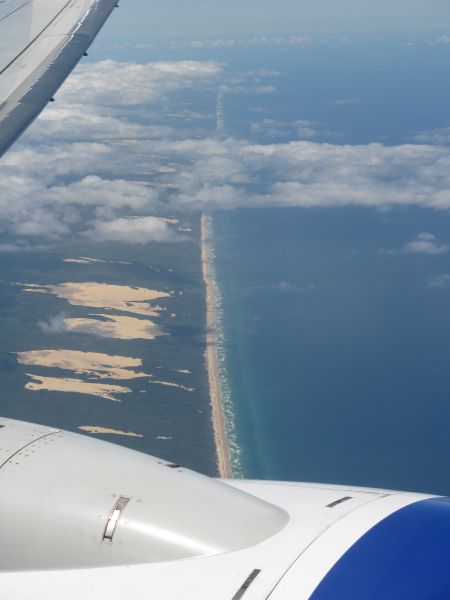
Here’s the west coast of Fraser Island, seen from the aeroplane. In the middle you can just make out the pier and the ferry mooring point at Kingfisher Bay:
Fraser Island – prehistoric beauty
This is Seventy-Five Mile Beach on the east coast of the island, also known as 4wd highway. Happy Valley is about half way up the beach, though you can’t see it in this view:
Fraser Island – prehistoric beauty
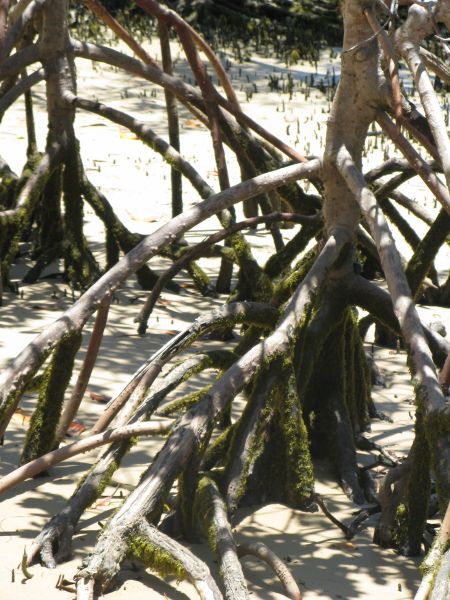
This is one of the weird swamp trees in Dundonga Creek, which opens up into the Great Sandy Strait between the island and the mainland:
Fraser Island – prehistoric beauty
Roots at Dundonga Creek offer a comfortable place to sit. Or perhaps they are reaching out to drag you into the quicksand:
Fraser Island – prehistoric beauty
Since the island is entirely of sand, you wouldn’t expect a dense rainforest or large trees. You’d be wrong. The interior is thickly wooded:
Fraser Island – prehistoric beauty
The forest feels decidedly prehistoric. Twilight rules. Lianas loom. You wouldn’t be surprised to see an Allosaurus eye peering down at you, or at least a young Harrison Ford:
Fraser Island – prehistoric beauty
The trees at Central Station are host to a number of large elkhorns and staghorns. These are epiphytes which grow on the trees. Central Station is, you guessed it, in the middle of the island. It was originally a logging station. Now it is a museum with a lot of information and no food for humans. The loggers introduced the elkhorns and staghorns into the area (they were not there originally) and now they happily reproduce themselves. They’re the big green fan-shaped things:
Fraser Island – prehistoric beauty
Here’s the centre of a staghorn (Platycerium superbum):
Fraser Island – prehistoric beauty
This dude (below) is a King Fern (Angiopteris evecta), an ancient and primitive giant fern. It has the largest fronds in the world. There’s another of those “I’m the best-est” claims which abound on the island. The branches and fronds are supported by the water that the plant has sucked up, not by the plant’s fibre. I overheard a guide saying that this particular plant is 1200 to 1500 years old. So that implies that Wanggoolba Creek has not dried up in all that time. Wanggoolba Creek is one of but a few locations where you can see one of these plants. The creek water is crystal clear below the fern, with white sand and faint green markings:
Fraser Island – prehistoric beauty
Now we’ve crossed over to the east coast of the island. You may think these trees are on rocks, but you’d be wrong again. That’s dark brown, sculpted sand:
Fraser Island – prehistoric beauty
Here are some tracks leading onto Seventy-Five Mile Beach:
Fraser Island – prehistoric beauty
The sand on Seventy-Five Mile Beach squeaks as you walk on it and squeals as you drive on it. This is an early morning view of the beach before the tide washes away the tyre marks:
Fraser Island – prehistoric beauty
The whole island, all sand, is anchored on two or three rocky outcrops. The main one is Indian Head, a looming promontory at the northern end of the island. Here is Indian Head, as seen from Middle Rocks (the other main anchor point for the island):
Fraser Island – prehistoric beauty
Indian Head itself offers toe-curling heights:
Fraser Island – prehistoric beauty
Now you’re looking northwards from Indian Head towards Middle Rocks:
Fraser Island – prehistoric beauty
This worm has a lot more to say about Fraser Island: the lakes and creeks, the creatures, the deadly dangers and the driving. And of course, it’s all about the sand. Make sure you’re sitting comfortably, and I’ll tell you more tomorrow.
This is the blog of a 25-year-old bookmark. I proudly boast my own Hallmark serial number, 95 HBM 80-1. You’ll probably want to read all about me and my Travelling Companion.
Today’s travel notes
Today I’ll give you a worm’s eye view of some insects the TC and I have come across lately. And, following up on my promise of two months ago (By the light of a gibbous moon), I’ll give you another peek into the ups and downs of this worm’s life.
Traveller’s tip
Beware anyone bearing gifts.
The book I’m in
The Laments, by George Hagen.
A funny, comfortable and uncomfortable book. Highly recommended by this worm, who participates but vicariously in the viciousness, vicissitudes and victories of life.
The photos
A word of warning to all my fans: An impending coup of bookmarkian proportions looms.
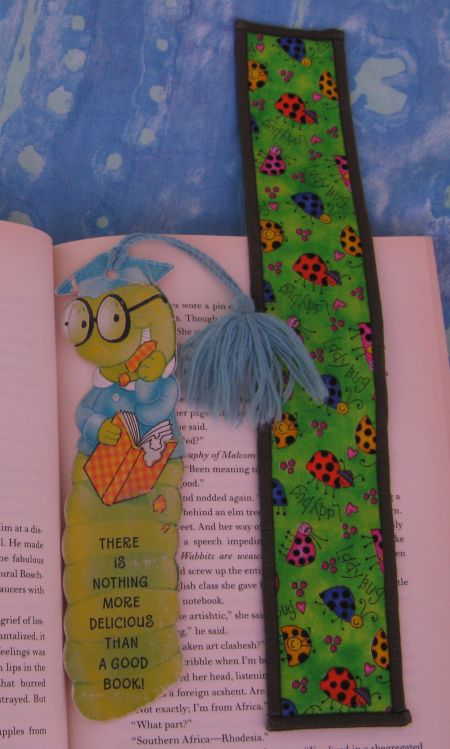
The book I’m in (The Laments, remember?) deals with the petty conspiracies of daily life and how the average worm triumphs almost willy-nilly. As so often happens, real life is imitating fiction and I’ve recently felt compelled to do some uncomfortable navel gazing. My own navel is nothing to be ashamed of, mark you. But a newer, smoother and shinier one has appeared on the scene. The Rival. She was a gift to the Travelling Companion, so no intended disloyalty on the TC’s part. Still, this worm is wondering what the future may hold.
Me and The Rival:
Insects and other low life in Sydney
Sure, The Rival is younger than me. Some might even says she’s better looking. Maybe she’s made of modern material. Into new technology. (She has leaden inserts, no less.) But does she have my style and experience? What can I do to make sure I get the best place in the best books? We can’t share a book, that’s for sure. It doesn’t work for me.
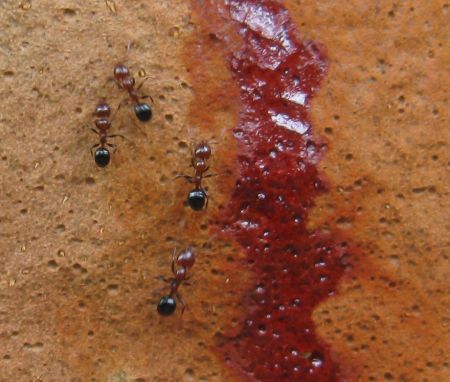
Let’s move on, for now. I promised you some insects. Here’s a shot of some flies and ants on a salmon-barked tree near Manly Dam.
Insects and other low life in Sydney
Can’t see them? I guess not everyone has the advantage of a worm’s eye view. So I’ve blown them up for you. Here are the ants:
Insects and other low life in Sydney
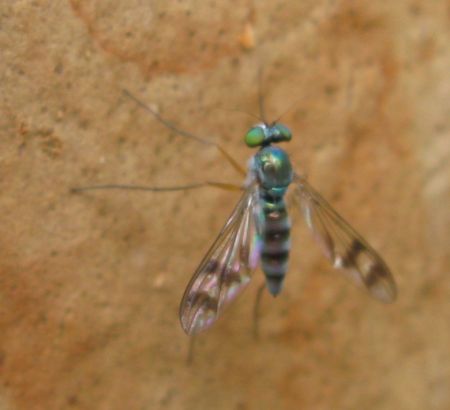
And here’s one of the flies. They’re very small and delicate, about the same size as the ants:
Insects and other low life in Sydney
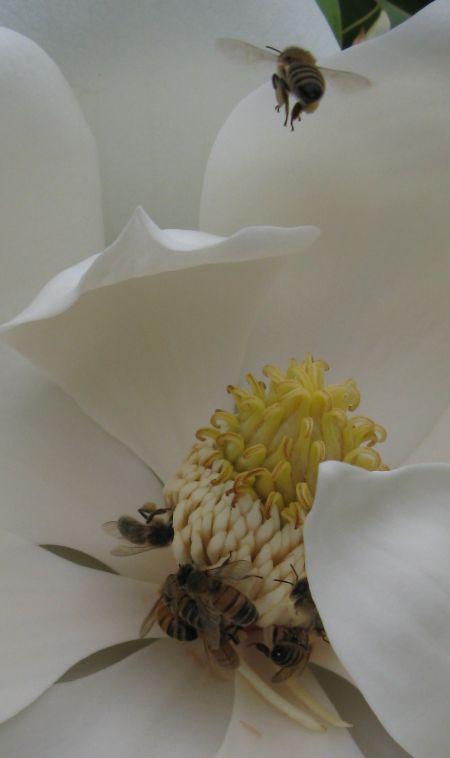
Here are some bees being busy in Manly:
Insects and other low life in Sydney
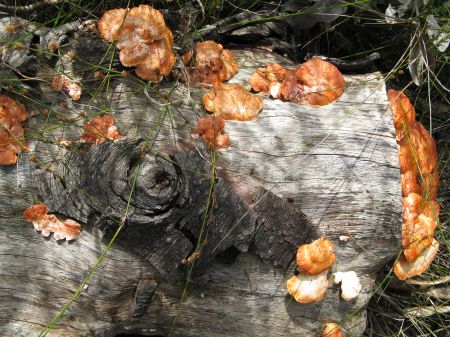
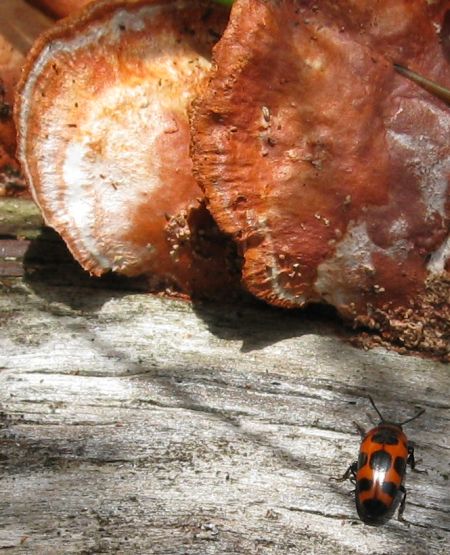
This is a fungus-covered tree stump near Manly Dam, patrolled by some red beetles:
Insects and other low life in Sydney
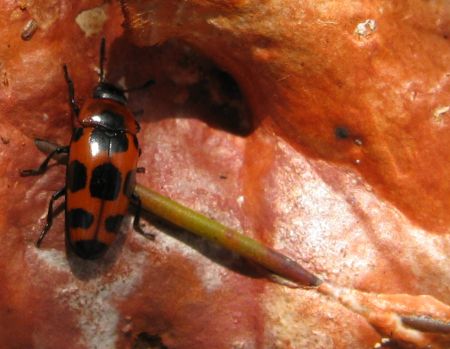
Here’s a closer view — a denizen of the bark scurrying for cover:
Insects and other low life in Sydney
This beetle probably thinks he’s camouflaged or something:
Insects and other low life in Sydney
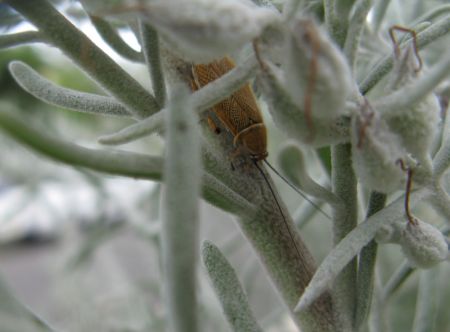
Here’s someone else hiding amongst the vegetation in Allambie:
Insects and other low life in Sydney
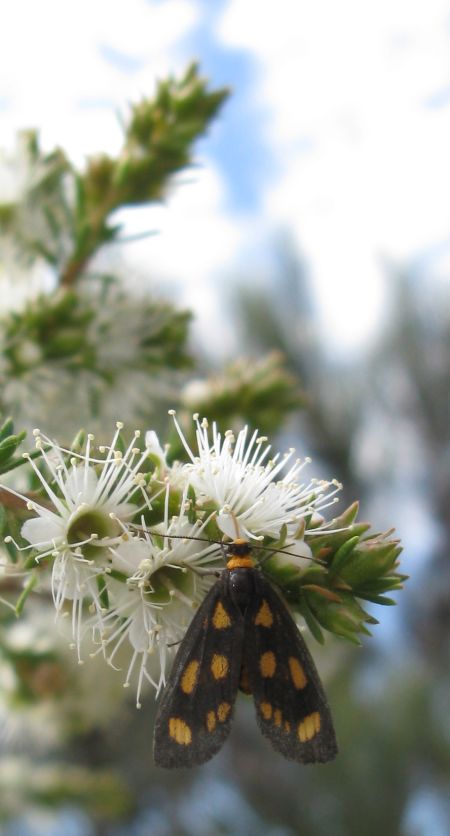
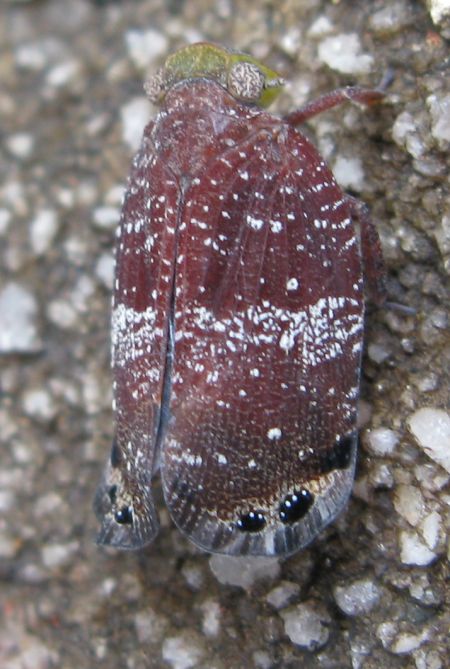
This moth or fly is small and moves quickly. They’re a common sight and quite attractive when they sit still long enough to be examined:
Insects and other low life in Sydney
I’ve shown you this creature before, but I’m a slave to her beauty. She’s a fly of some sort, I think, who was gadding around 40 Baskets a while ago. Like all the other creatures on this page, she’s small — less than a centimetre long:
Insects and other low life in Sydney
To round things off, here’s a rather fine specimen of a worm diving for cover:
Insects and other low life in Sydney
Getting back to the attempted coup looming over me: So, what’s your stand on the Battle of the Bookmarks? You’ll notice that The Rival has decked herself out with pictures of ladybirds. Only pictures, note, whereas I am the real thing.
Just to prove I’m into the new-fangled stuff too, here’s me on the iPhone:
This is the blog of a 25-year-old bookmark. I proudly boast my own Hallmark serial number, 95 HBM 80-1. You’ll probably want to read all about me and my Travelling Companion.
Today’s travel notes
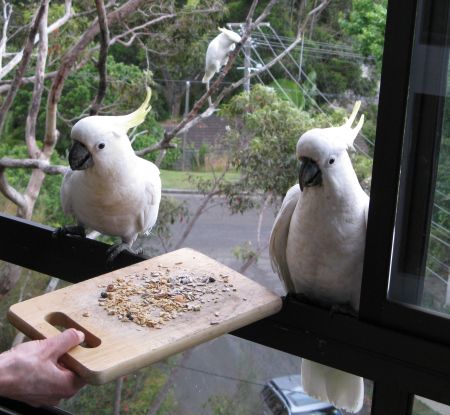
The cockatoos in the area have discovered the TC. For those who haven’t been following my blog, the TC is She with whom I travel. She is a soft touch for anything with ffeathers.
In the last week, the TC has been at home in the dying hours of the afternoon. A passing ffeathered ffiend happened to alight on the window sill and tilt its head in what some might call an appealing fashion. The TC rushed off to find some food that might satisfy the bird’s no doubt urgent hunger. Neither the bird nor the TC were experienced in the human-to-avian interface, so there was a bit of inept fumbling. But eventually mutual satisfaction was achieved.
Traveller’s tip
Never trust a bird, no matter how pretty.
The book I’m in
the Visitor, by Jane R Goodall.
Misty eeriness mixed with good solid detective work.
The photos
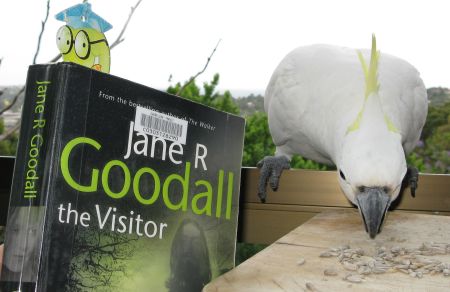
Me and a cockatoo. You’ll notice that I kept myself well shielded during the entire experience, using a good book as armour against the ffeathered ffiend:
Cockatoos in Sydney
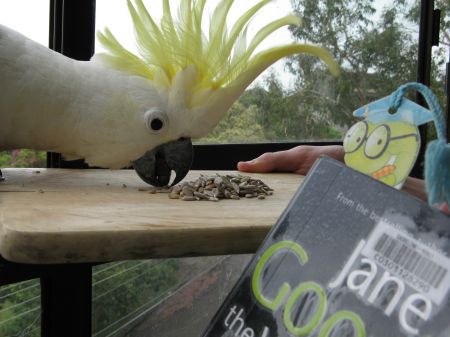
Even I succumbed to the temptation to get just a bit closer. Dude, that’s a big beak:
Cockatoos in Sydney
Are you wondering how Peg has been recently? She’s keeping it together. Her role in the bird-feeding episode was unglamorous but necessary and above all safe:
Cockatoos in Sydney
The other birds in the neighbourhood soon heard about the free food at the TC’s place:
Cockatoos in Sydney
Inevitably, there’s a movie version too. Here’s a cockatoo checking out the action. He’s standing on the roof, sticking his head upside down through the window and looking ineffably daft:
Here’s the ffeathered ffiend as yet not ffed, attempting to look cute and beguiling. His ffriend struts his stuff on the tree behind:
Here’s one bird eating, but looking a trifle uneasy because another is attempting to join the ffeast. You can hear the footsteps clicking on the roof, then bird number two clambers down the window and muscles in on the action:
Not seen enough yet? There’s more on this worm’s YouTube channel.
This is the blog of a 25-year-old bookmark. I proudly boast my own Hallmark serial number, 95 HBM 80-1.
Twenty-five years, and I don’t look a day older than one! Alas, I can’t say the same for my Travelling Companion. I spend most of my time inside a book (well, duh) while the TC sees the world. Read all about me and follow my blog posts to share my experiences as bookmark and travelling worm.
From time to time, I’ll say something meaningful. Like a t-shirt.
Today’s travel notes
Today we went for a stroll along the Spit to Manly Walk. It’s a ten-kilometre path which follows the shore line from Spit Bridge to Manly, near Sydney in Australia.
Of course, you don’t have to do all of it in one go. We didn’t. When you’re travelling with the TC, you can’t get very far without stopping to exclaim over the bird life. Occasionally she manages to trip over the odd snake or something a bit more interesting.
We started at 40 Baskets, near Balgowlah, and headed off towards Spit Bridge.
Traveller’s tip
Tread lightly, because you never know who’s under your shoe.
The book I’m in
Caravans, a novel of Afghanistan, by James A. Michener.
The photos
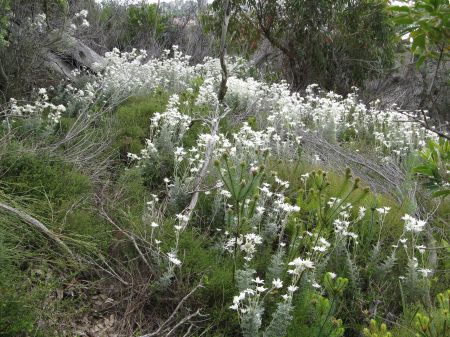
Let’s start with a bird’s eye view and move progressively to a much more interesting worm’s eye view. It’s spring in Sydney, and the Flannel Flowers are out in full force.
Do snakes have legs?
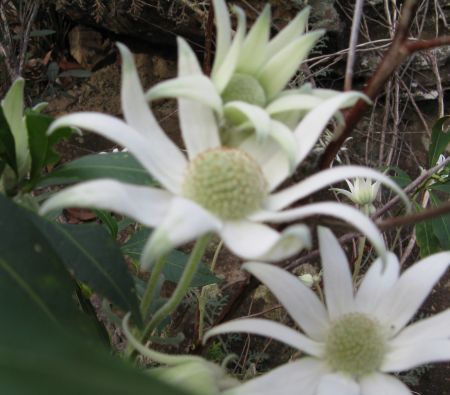
Here’s a closer view of a Flannel Flower:
Do snakes have legs?
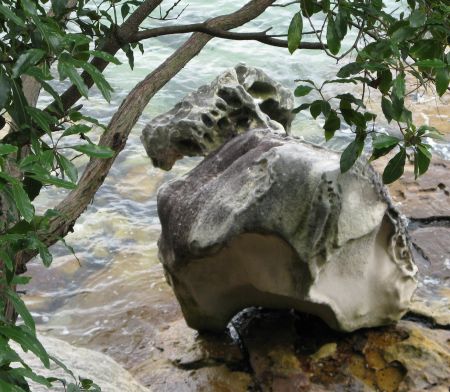
The Spit to Manly Walk runs along the coast, so you get the Australian bush all round you and the sea right there too. Most of the time, it’s a fairly tame view because you are in the harbour rather than on the ocean. Still, it has a quaint appeal.
Do snakes have legs?
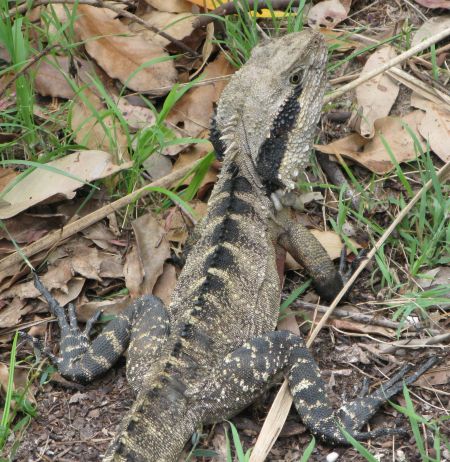
The Water Dragons are all over the place, looking at you askance and then scuttling away into the undergrowth. Here’s a rather unflattering view of one of them:
Do snakes have legs?
This one is about 80cm long and quite chubby. Here’s another shot of him:
Do snakes have legs?
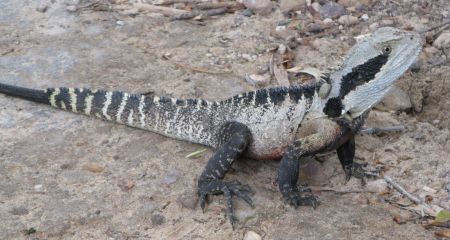
And here’s his altogether more sauve-looking cousin:
Do snakes have legs?
Now we get to the question in the title of this blog post:
Do snakes have legs?
Check out this lass:
Do snakes have legs?
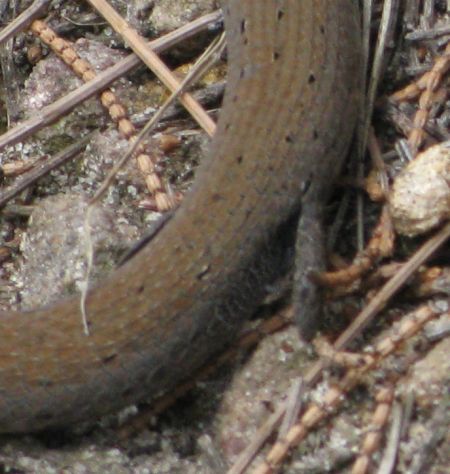
Is she a snake, or could she be a “legless lizard”, also known as Pygopodidae? Maybe she can even call herself Delma impar, one of the endangered ones? Take a closer look at her middle bit — there are little half-formed legs that move away from her body as she slithers along. She was not a fast mover, so the TC had ample time to take a photograph:
Do snakes have legs?
I’ve decided to call her Lizzie, for want of a better name. The TC narrowly avoided stepping on poor old Lizzie. I don’t know how she did avoid it, to be frank. She had her head in the trees, as usual, watching the birds and totally unaware of the far more interesting life that goes on at ground level. It’s lucky she has a worm like me as a travelling companion, or she’d miss out on all the important stuff.
If anyone knows what Lizzie is, let me know. She is quite short — less than a metre. Here’s a better look at her face:
Do snakes have legs?
Getting even more of a worm’s eye view, here’s a rather stunning little insect that was flitting about on the rocks on 40 Baskets beach:
Do snakes have legs?
This creature is less than a centimetre long. Tim P dropped a comment on my previous blog post, asking for more close-ups of the “intense detail apparent in tiny living things”. I know he was asking for more photographs of myself, being such a remarkable specimen of a worm, as well as of other small creatures. I promise to post some more of me soon. In the meantime, this one’s for you Tim.
Do snakes have legs?
Does anyone know what insect this is? It looks like a fly of some sort. Drop me a comment if you know anything about it.
I’ll skip the introductions today. If you don’t know me by now, you will never never…. Oo-oo-oo, I almost got trapped in some song lyrics there. Anyway, read my other blog posts or my About Me page if you’re curious about me. And who wouldn’t be?
Today’s travel notes
The Travelling Companion has been playing around in the garden recently, digging and uprooting and planting and generally getting muddy. I have observed her antics from the sidelines, stepping in to suggest the occasional photograph.
It’s struck me just how beautiful we worms are, and our lesser brethren too. So I’ve decided to treat you to some photographs and a movie of us.
Traveller’s tip
If you can’t travel far to find some beauty, try digging around in the dirt instead.
The book I’m in
Troy, Fall of Kings, by David & Stella Gemmell.
Yes, I am still in the same book as last week. The TC has been quite busy, so she has not done much reading. This is a good thing, because it’s a comfortable book.
The photos
Me and Peg in the garden with Dianella.
Centipedes and slugs in Sydney
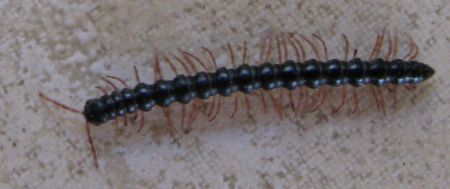
A centipede on a stone tile. This brave brother worm ventured into the Travelling Companion’s kitchen. He is just a common-or-garden centipede, perhaps a couple of centimetres long.
Centipedes and slugs in Sydney
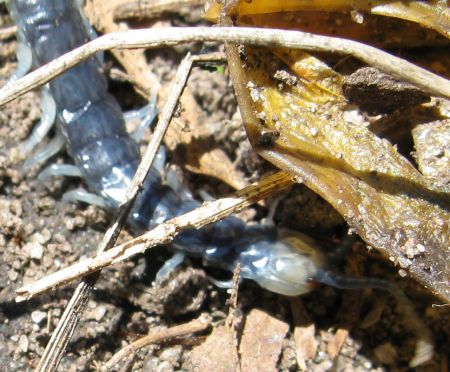
The next dude (below) is awe-inspiring. He is a blue centipede, dubbed Scolopendra by some. This one is about 5 centimetres long. Beware, not all worms are as friendly as me. Centipedes are predators, and they can bite humans too. He was safely hidden in the soil amongst the roots of some Agapanthus plants, until he was so rudely uprooted. Here is a good view of his back end at bottom left, with his head disappearing into a hole at top right:
Centipedes and slugs in Sydney
He moves fast, this dude, and the TC had trouble getting a good shot. Below is her attempt to capture his head. You can just make out the lighter blue head and the two darker blue antennae at bottom right of this picture:
Centipedes and slugs in Sydney
And here’s a video. Alas, the TC did not excel in the making of this movie, but it’s a good laugh as well as giving you some idea of the beauty of the worm. The TC says she didn’t know the video was on, and she was trying to take a still photo. Hah!
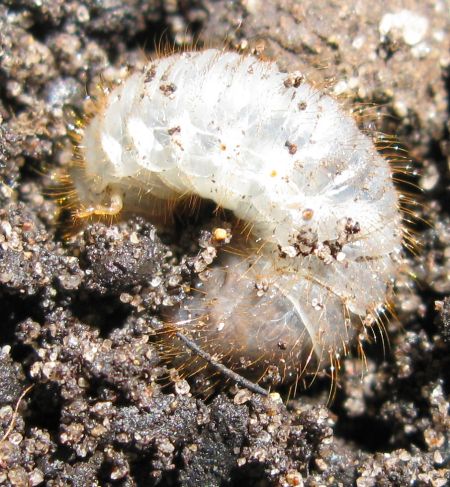
Here’s sister slug, aka a tiger slug, a spotted leopard slug and a great grey slug. So many names for such an unassuming creature. I’m making her an honorary worm for this blog post:
This is the blog of a 25-year-old bookmark. I proudly boast my own Hallmark serial number, 95 HBM 80-1.
Twenty-five years, and I don’t look a day older than one! Alas, I can’t say the same for my Travelling Companion. I spend most of my time inside a book (well, duh) while the TC sees the world. Read all about me and follow my blog posts to share my experiences as bookmark and travelling worm.
From time to time, I’ll say something meaningful. Like a t-shirt.
Today’s travel notes
The Travelling Companion has been rather sedentary recently, so I’ve been crawling through her photo albums again. I came across some pictures of Holland and some scraps of a letter that she wrote about her encounters with dikes.
This letter is twenty years old, written in April 1988. I thought you would enjoy a bit of ancient history 🙂
We drove along a very impressive dike, which separates the Markermeer from the IJsselmeer. The dike is 29 km long. It is quite lovely to see the open water on each side of the road, with yachts and water-birds dotted all over. A large area east of the Markermeer is reclaimed land, called a polder. There was a plan to reclaim the entire Markermeer, so the dike was built to allow the land to be drained. But evidently they have decided not to do that just yet. One reason why they need more land is that the airport Schiphol is too busy. So they planned to build another one where the water is at present.
North-west of Amsterdam is another polder, eight metres below sea level. There is a canal connecting Amsterdam to the North Sea, and the water in the canal is at sea level. So the canal is well above the level of the roads! It is a very odd experience to see a ship sailing by above you.
A tall tale
Many people have heard the uplifting story of brave little Hans, a Dutch boy who saved his country by sticking his thumb in hole in a dike, to plug an incipient leak. It’s a ridiculous story, really, when you see the size of the dikes.
When the TC was in the Netherlands, she mentioned the tale to a Dutch friend, fully expecting him to acknowledge it as a piece of native folklore. He looked faintly amused and said that he had heard the story but thought it was probably English or American, because no Nederlander would come up with something so silly.
Traveller’s tip
Don’t believe everything they tell you.
The book I’m in
RESTful Web Services, by Leonard Richardson & Sam Ruby.
Technically tranquil.
The photos
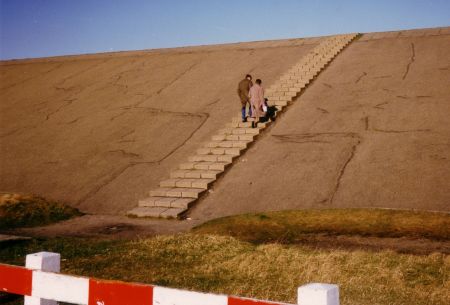
Climbing up a dike, somewhere in the Netherlands:
Dikes in Holland
Due to a lamentable lack of labelling (notice the skilful alliteration) I can’t tell you exactly where the TC was when she snapped these shots, except that she was in Holland and on a dike.
To be precise, I can’t even be certain that she was in Holland itself. This may be one of the other provinces of the Netherlands, such as Zeeland.
The view from the top of the dike:
Dikes in Holland
If anyone recognises the dike, or the storm surge barriers in the distance, let me know.
This is the blog of a 25-year-old bookmark. I proudly boast my own Hallmark serial number, 95 HBM 80-1.
Twenty-five years, and I don’t look a day older than one! Alas, I can’t say the same for my Travelling Companion. I spend most of my time inside a book (well, duh) while the TC sees the world. Read all about me and follow my blog posts to share my experiences as bookmark and travelling worm.
From time to time, I’ll say something meaningful. Like a t-shirt.
Today’s travel notes
Noisy creatures, birds. The Travelling Companion has been up and about, recording the dawn chorus in Sydney’s Northern Beaches. She also found a rather garrulous magpie in Curl Curl. I’ve put some videos on my YouTube site and also posted them below.
There are no photographs of me this time. Sorry to disappoint. I try to avoid appearing in the same space as a bird. On one occasion I did get perilously close to Jonathan, a seagull. There are some pictures to prove it in my blogpost about Surfers Paradise.
Traveller’s tip
The early worm catches the birdsong.
The book I’m in
Cry No More, by Linda Howard.
Linda writes really comfortable books.
The videos
The sun is still below the horizon in Sydney’s Northern Beaches. I don’t know the name of the first bird you’ll hear. Then there’s a raven’s mournful cry and a butcherbird’s yodel:
It’s a bit lighter now. The kookaburras are always naively cheerful this early in the morning. The currawongs chime in, and then the rosellas utter their first chirps of the day:
Here’s the sunrise, pretty enough if you like that sort of thing, with the rosellas still chirping and squawking away (they do that most of the day, I’ve noticed):
A magpie might draw a laugh and a bit of grudging admiration with his performance in this video. The hissing in the background is the sea at Curl Curl:






























 Travelling Worm