Travelling Worm

A bookworm's travelogue

Category: new south wales

  • Big Bogan at Nyngan

    This is the blog of Mark Wordsworm, the travelling worm. I’m a 40-year-old bookmark (give or take a few years) and I proudly boast my own Hallmark serial number, 95 HBM 80-1. You’ll probably want to read all about me and my Travelling Companion (the TC).

    Today’s travel notes

    Me and the TC continue our Outback adventures. Our first overnight stop, after a long day of driving, was Nyngan. This is a little Australian town with a big heart. In the middle of the town is a large steel statue of a fisherman, fondly dubbed the Big Bogan. There are layers of meaning behind the word bogan. Read on to know more about the statue, the name, and the town.

    The book I’m in

    The Book of Eve, by Meg Clothier. Ancient intrigue and engaging characters. This worm is about a third of the way through the book, and is thoroughly enjoying it.

    Travel tips

    Take the time to stop at little towns along the way. There’s a story at every town.

    Recommended accommodation

    Nyngan Riverside Tourist Park. It’s a well-kept camp ground that has place for tents and trailers, and also offers stand-alone cabins for hire.

    The photos

    Me with the Big Bogan and his dog, Rusty:

    The town of Nyngan lies in the Bogan Shire council in western New South Wales. With a population of around 1,900 people, Nyngan is a small town with a big heart.

    The Big Bogan statue was erected in 2015, to give the town a tourist attraction and to honour the history of the area. The dog, Rusty, was added in 2022. The Big Bogan is made of steel and is nearly 6 metres high:
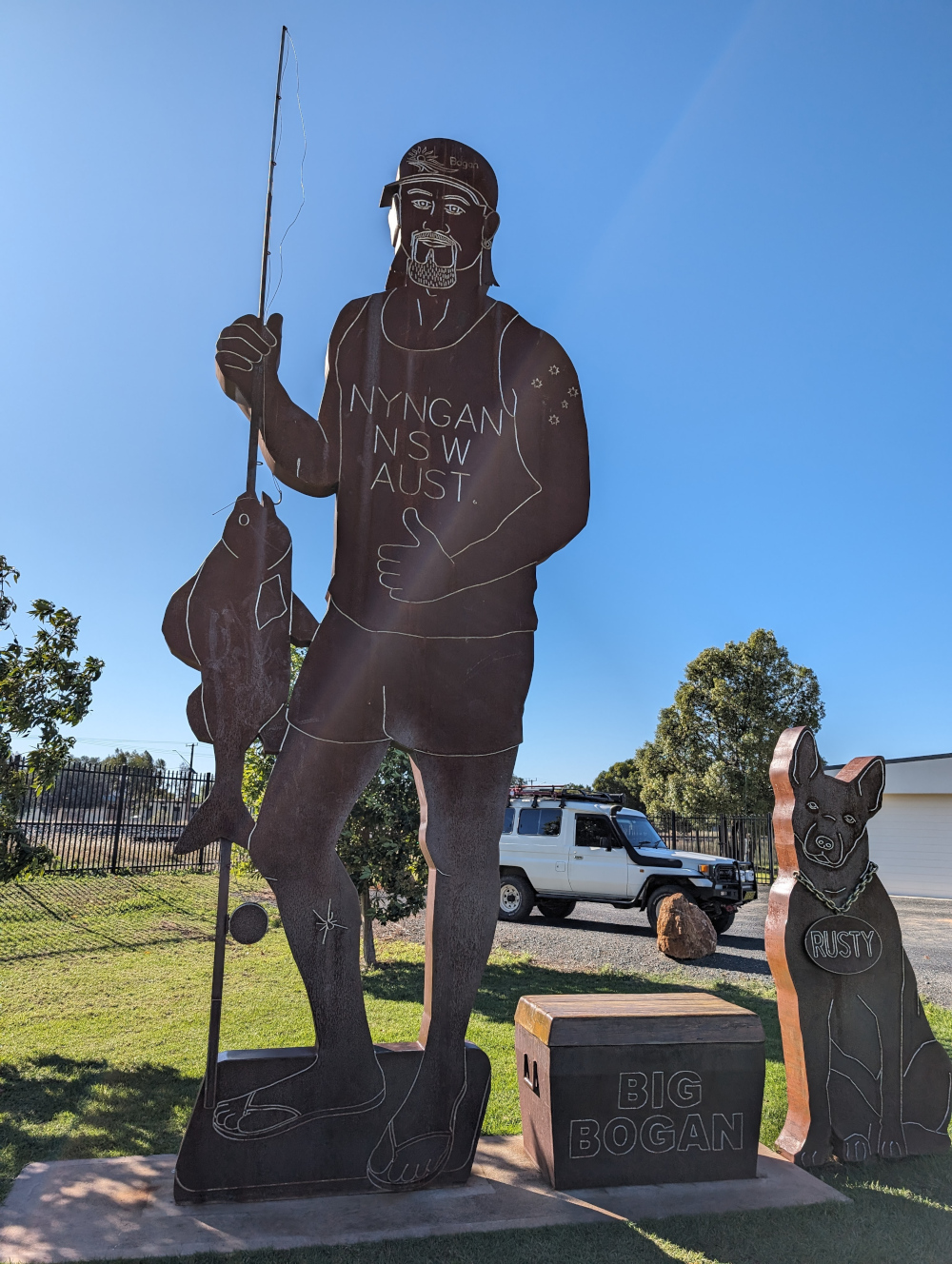
    On the statue are various decorations, including a large spider on its leg and the Southern Cross star formation on its arm. Between the man and the dog rests an esky (an Australian word for a cooler).

    What does the word bogan mean, a faithful reader might wonder, and where did it come from? There are numerous stories about the word and its origins. Your trusty Wordsworm likes to tell it like this: The word bogan has acquired an unfortunate meaning over recent years. It’s used to refer to country people, along the lines of country bumpkin or redneck. However, the original meaning of the word in the Aboriginal Wiradjuri language is “birthplace of a great man”.

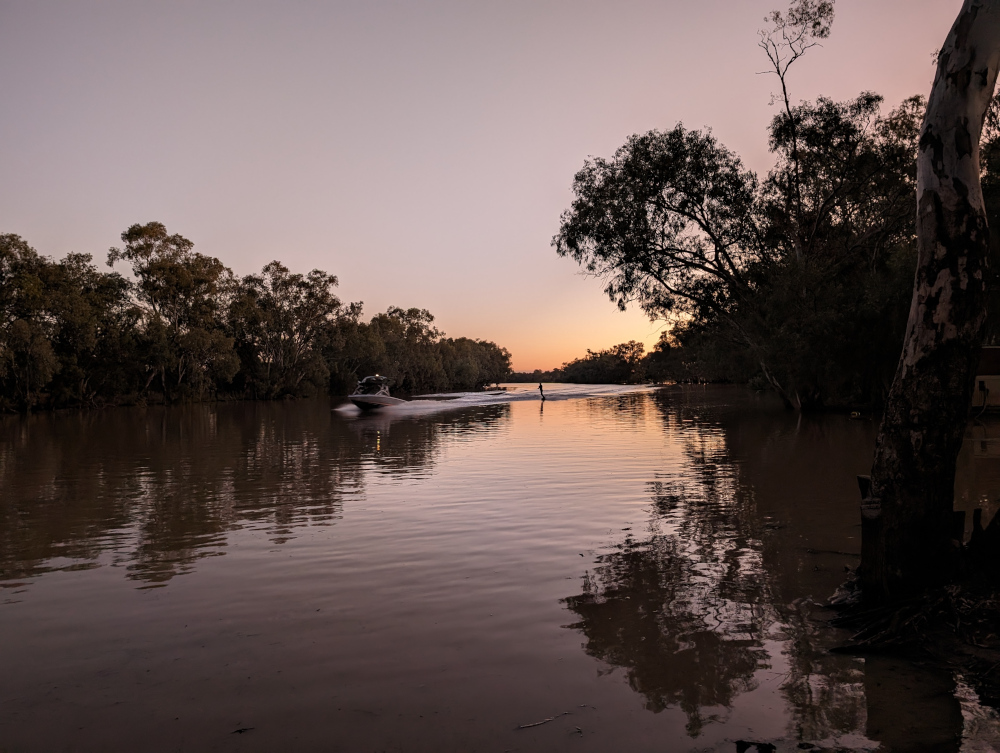
    Through the town of Nyngan runs the Bogan River, on its way from the Harvey Ranges to join the Darling River. The TC snapped this photo in the early evening, at the Riverside Tourist Park where we spent the night:
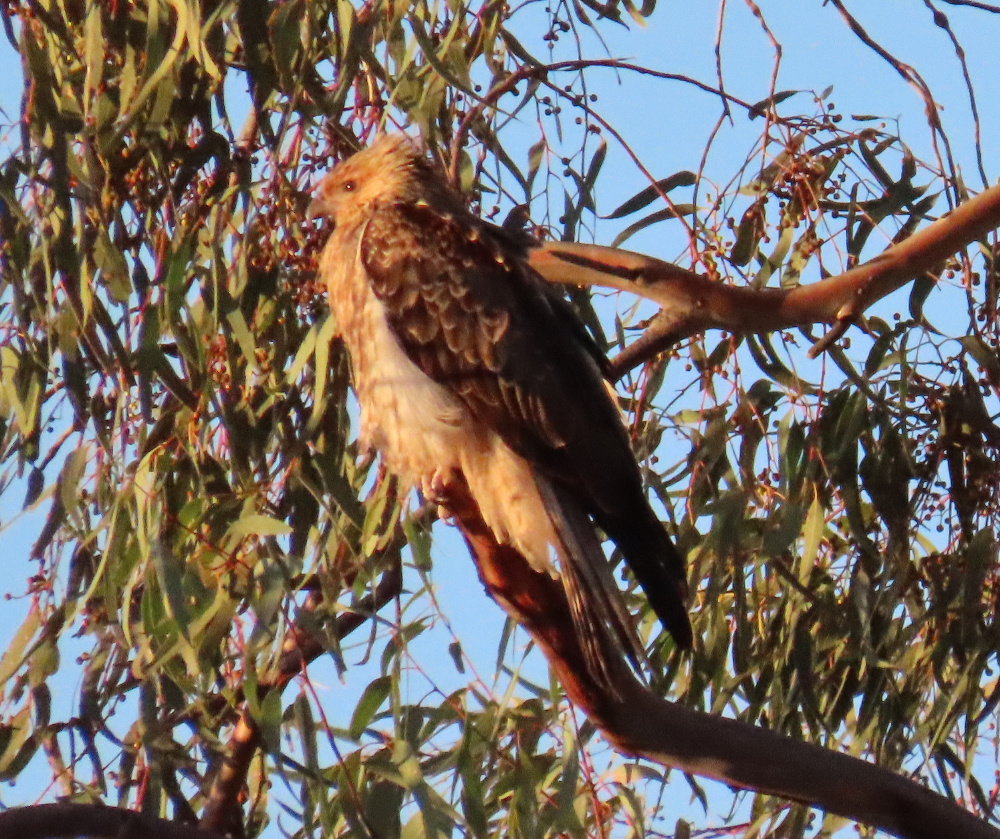
    Early the next morning, a fearsome raptor surveyed its territory from the river bank. Needless to say, yours truly, Wordsworm, stayed out of sight. There’s no place like a good book, especially when danger looms:
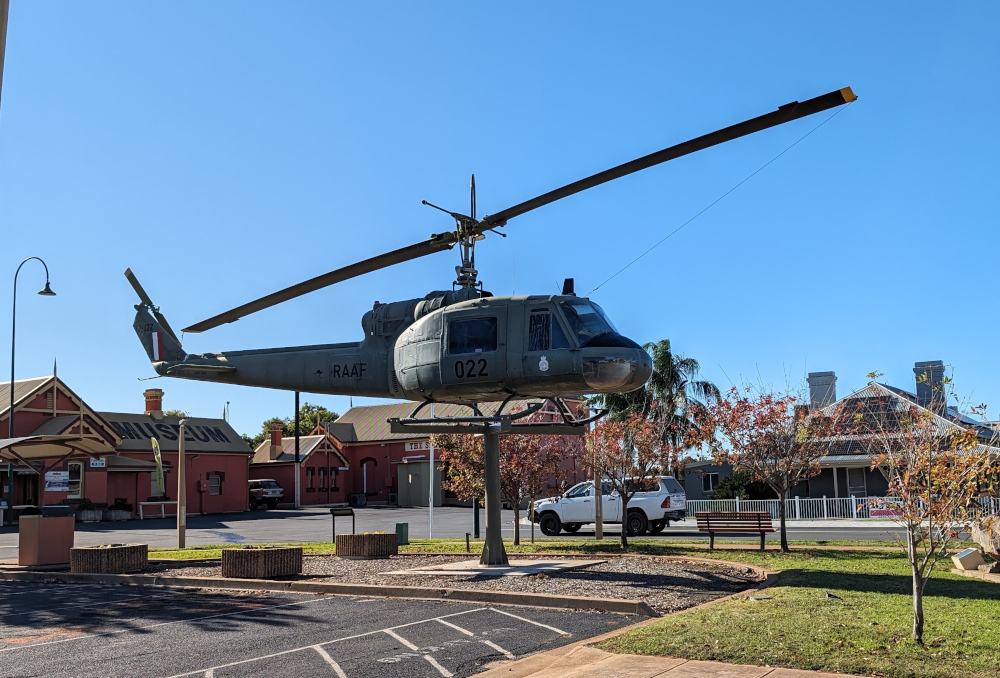
    In 1990, Nyngan was devastated by the worst flooding since the settlement of the town. Almost all residents had to be airlifted to safety. To commemorate the rescue, an Army helicopter stands on a pole outside the railway station:
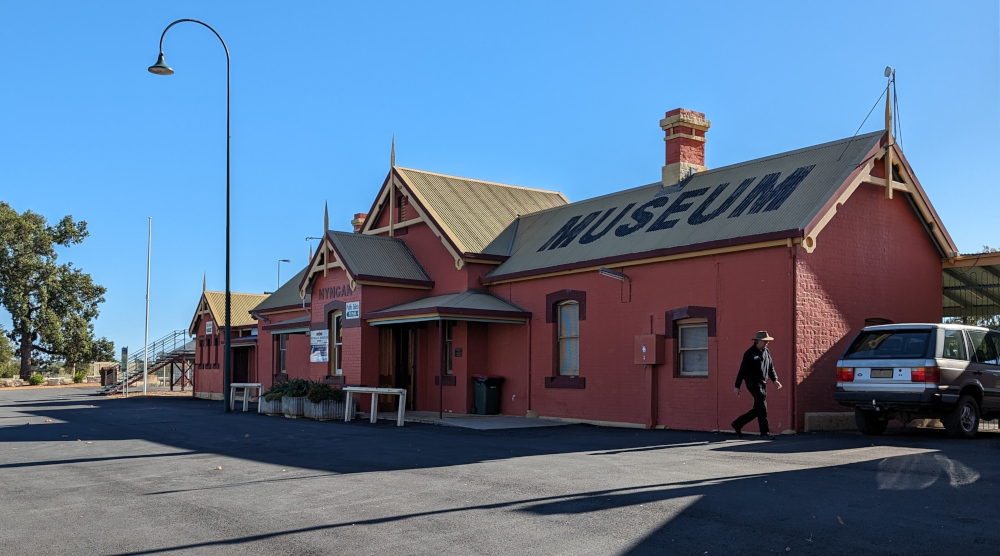
    The railway station itself has been converted into a museum:
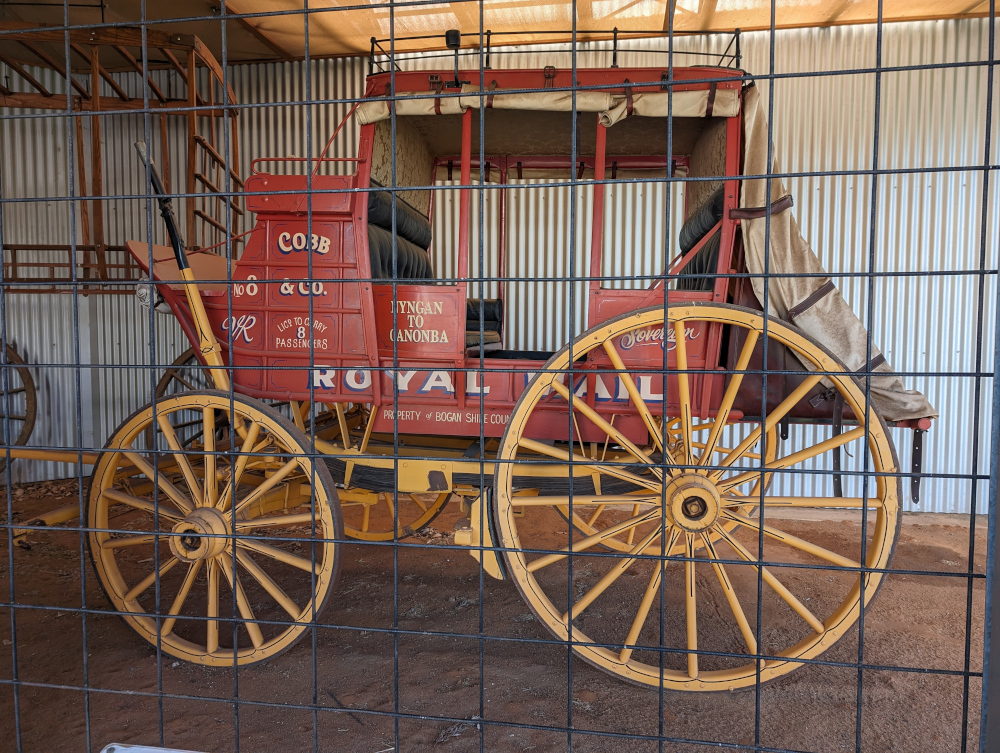
    Outside the museum stands a replica of an old Royal Mail coach that used to travel between Bathurst and Bourke. Imagine traversing the Australian Outback in a horse-drawn vehicle like this:
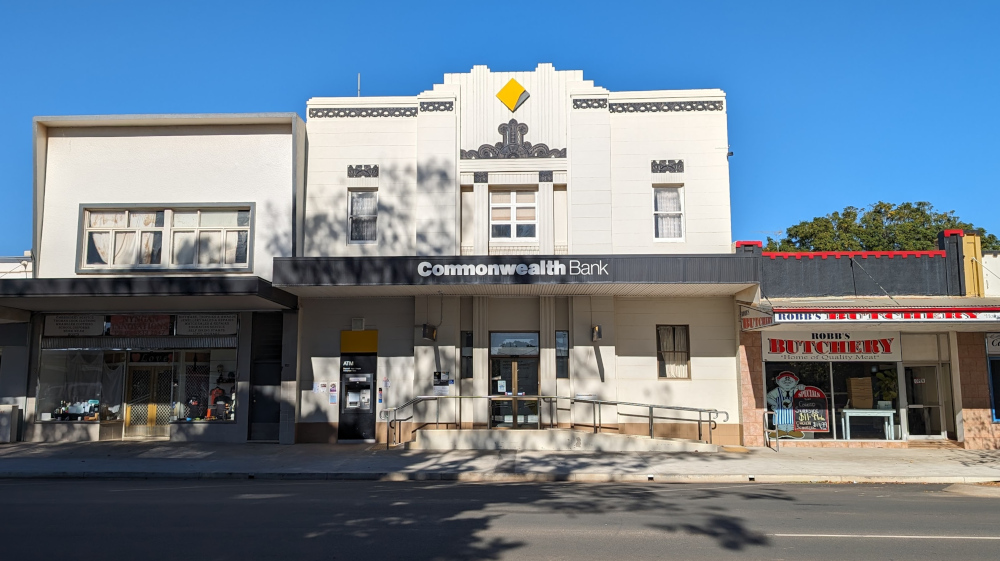
    The Commonwealth Bank building in Nyngan was built sometime between the First and Second World Wars. The building was designed by E.H. Henderson, who was Chief Architect of the Commonwealth of Australia from 1929-1939. He designed many of the Commonwealth Banks buildings in Australia:
    Our Outback adventures continue. Until my next post…

    That’s all for today, folks.

  • Water tower art at Nevertire and Warren

    This is the blog of Mark Wordsworm, the travelling worm. I’m a 40-year-old bookmark (give or take a few years) and I proudly boast my own Hallmark serial number, 95 HBM 80-1. You’ll probably want to read all about me and my Travelling Companion (the TC).

    Today’s travel notes

    Me and the TC are heading west, into the Australian Outback. On our first day, signs beside the road welcomed us to the Blue Mountains, the Inner West, and then the Great Outback. We took an interesting route, inadvertently stumbling across part of the Australian silo art trail. Along the way, we encountered our first road trains and found some cotton.

    The book I’m in

    The Book of Eve, by Meg Clothier. Ancient intrigue and engaging characters. This worm is about a third of the way through the book, and is thoroughly enjoying it.

    Travel tips

    Be off the roads before dark, if you can. There are no lights in the Outback, and the kangaroos like to cross the road in the dark.

    The photos

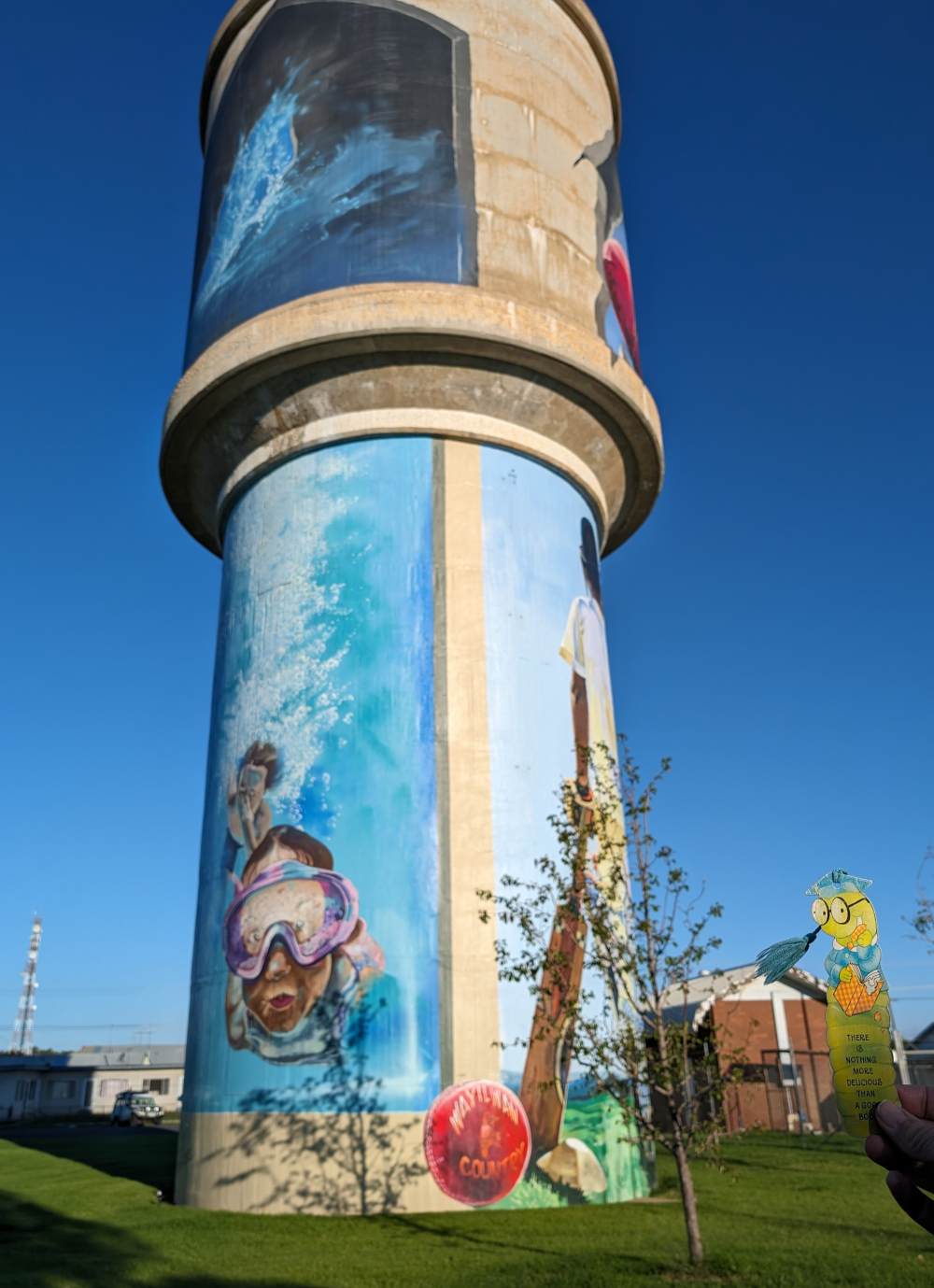
    Me at the water tower in Warren, New South Wales:

    Warren is a small town in the middle of a thriving agricultural area: sheep and wool, wheat, and cotton.

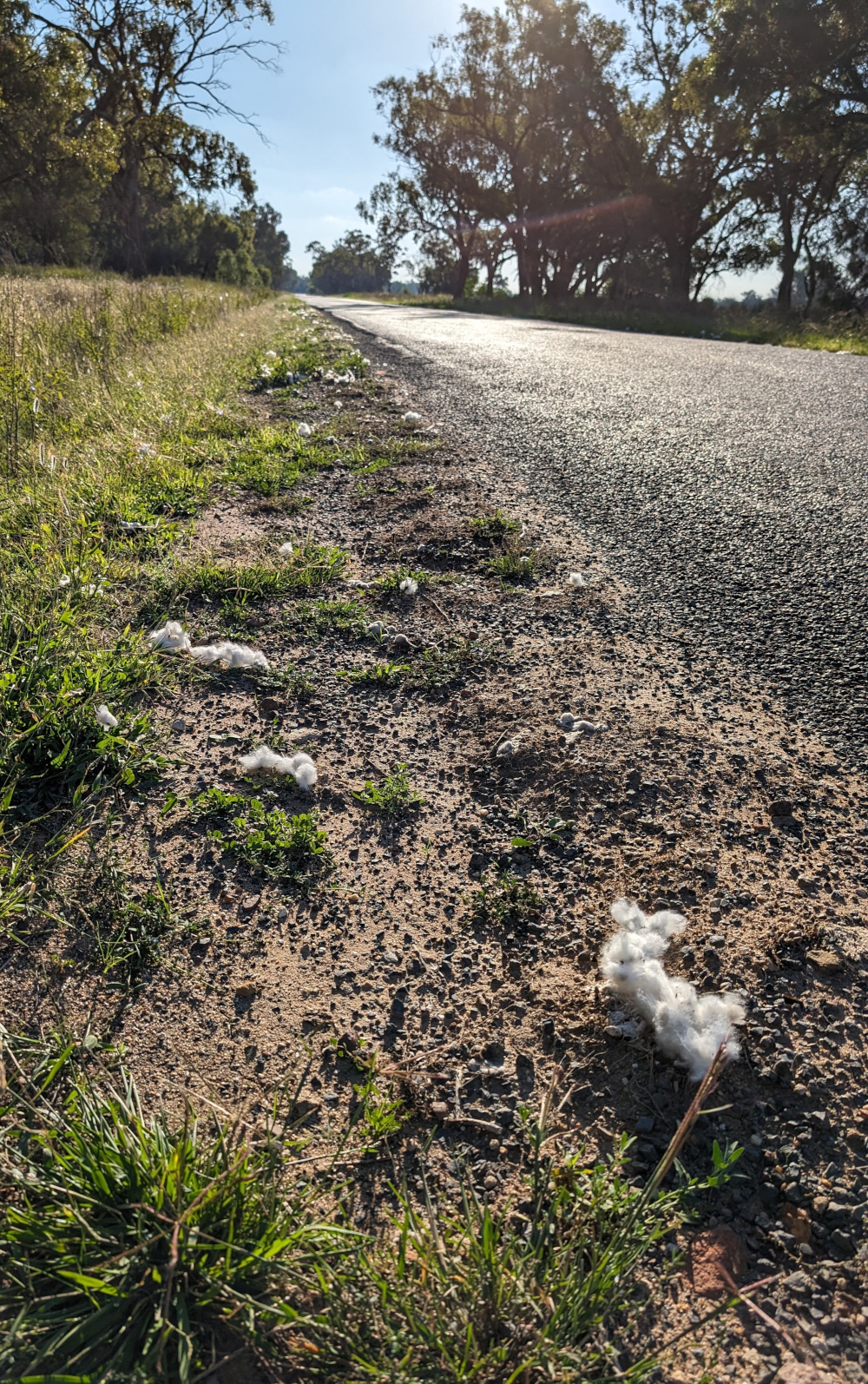
    In fact, the road to Warren is lined with cotton:

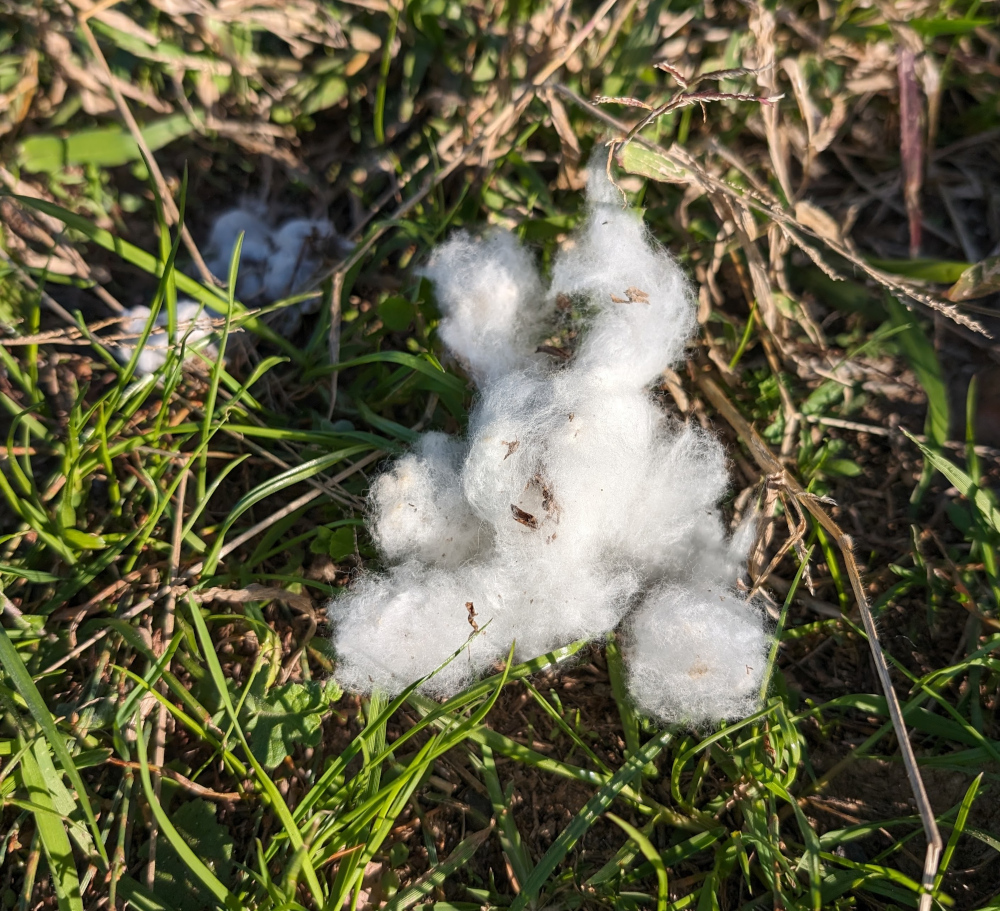
    It’s white and fluffy, just as you’d expect cotton puffs to be:

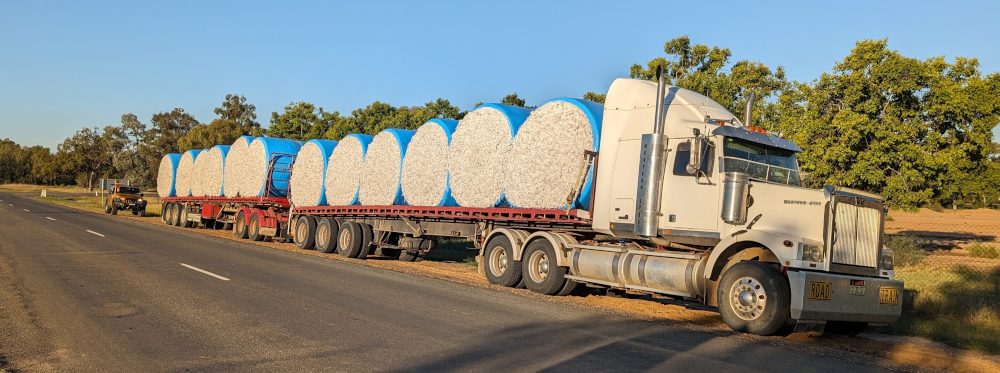
    We encountered our first road trains, the infamously long and fast semi-trucks that transport produce around Australia. Notice the warning boards on the front (and back) of the truck, announcing that it’s a road train. Notice also the length (this is all one truck) and the size in comparison to Janet the Jeep behind the truck:

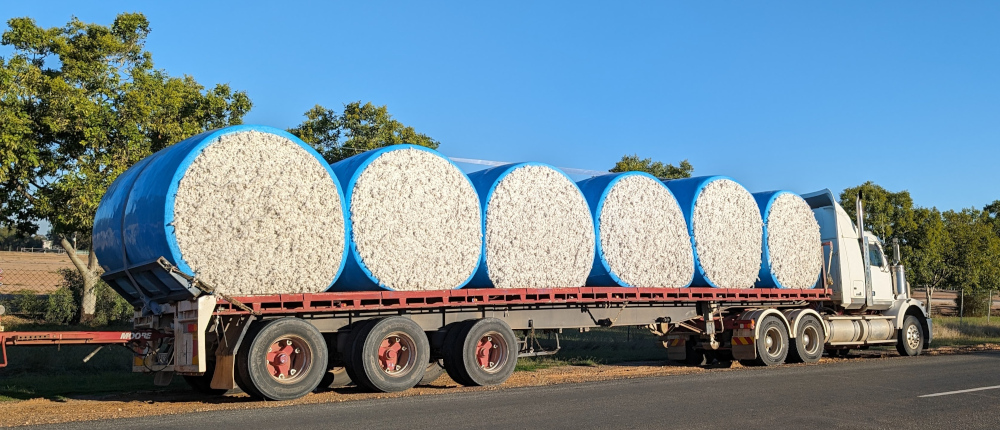
    In this case, the produce was, you guessed it, cotton:

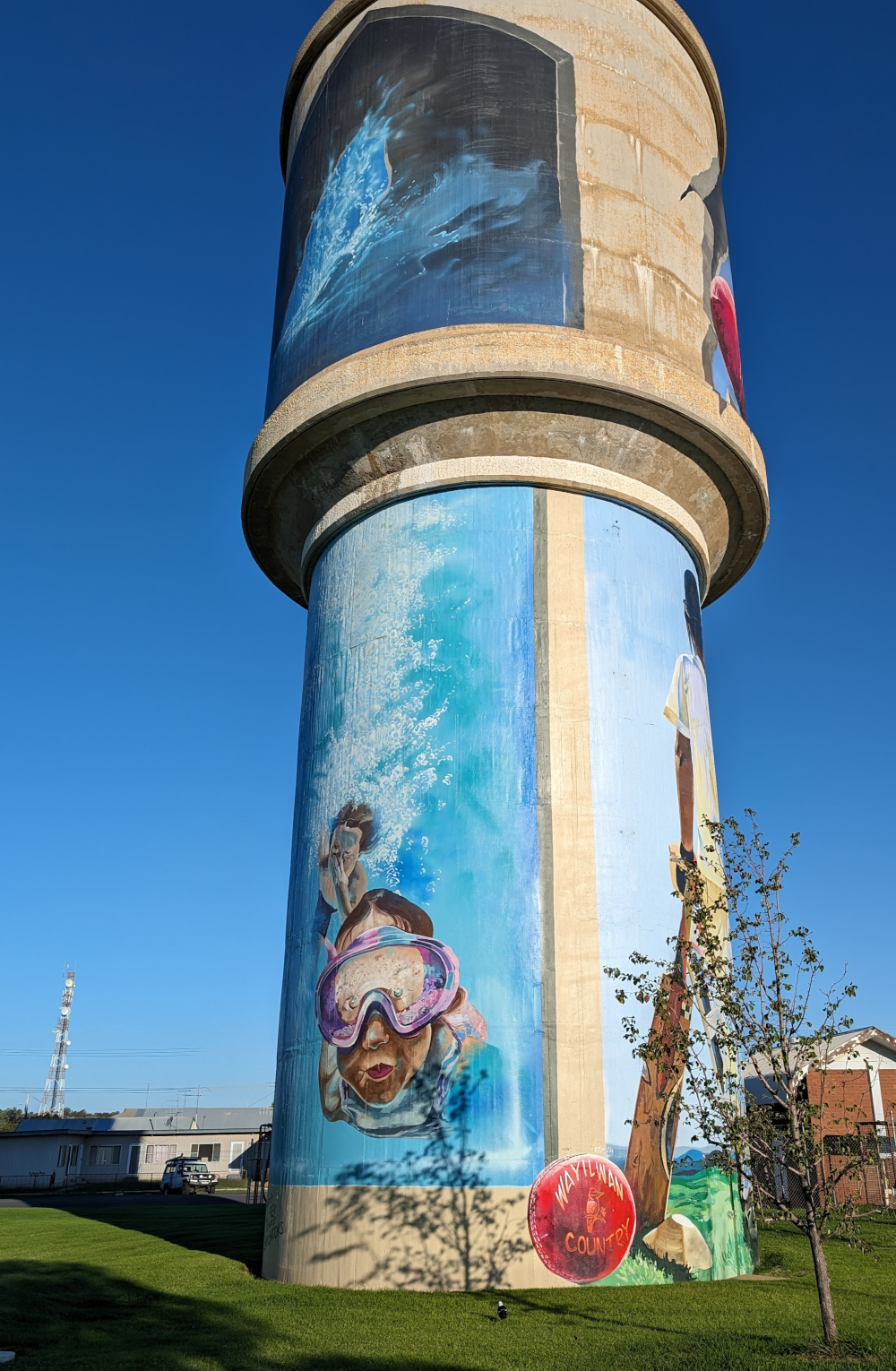
    At Warren, we found our first water tower art. The tower was erected in 1939, and the artwork was added in 2021. The concept design was by Sam Brooks. The work was painted by Bastian Allfrey.

    Maggie posed in front of the tower for scale:

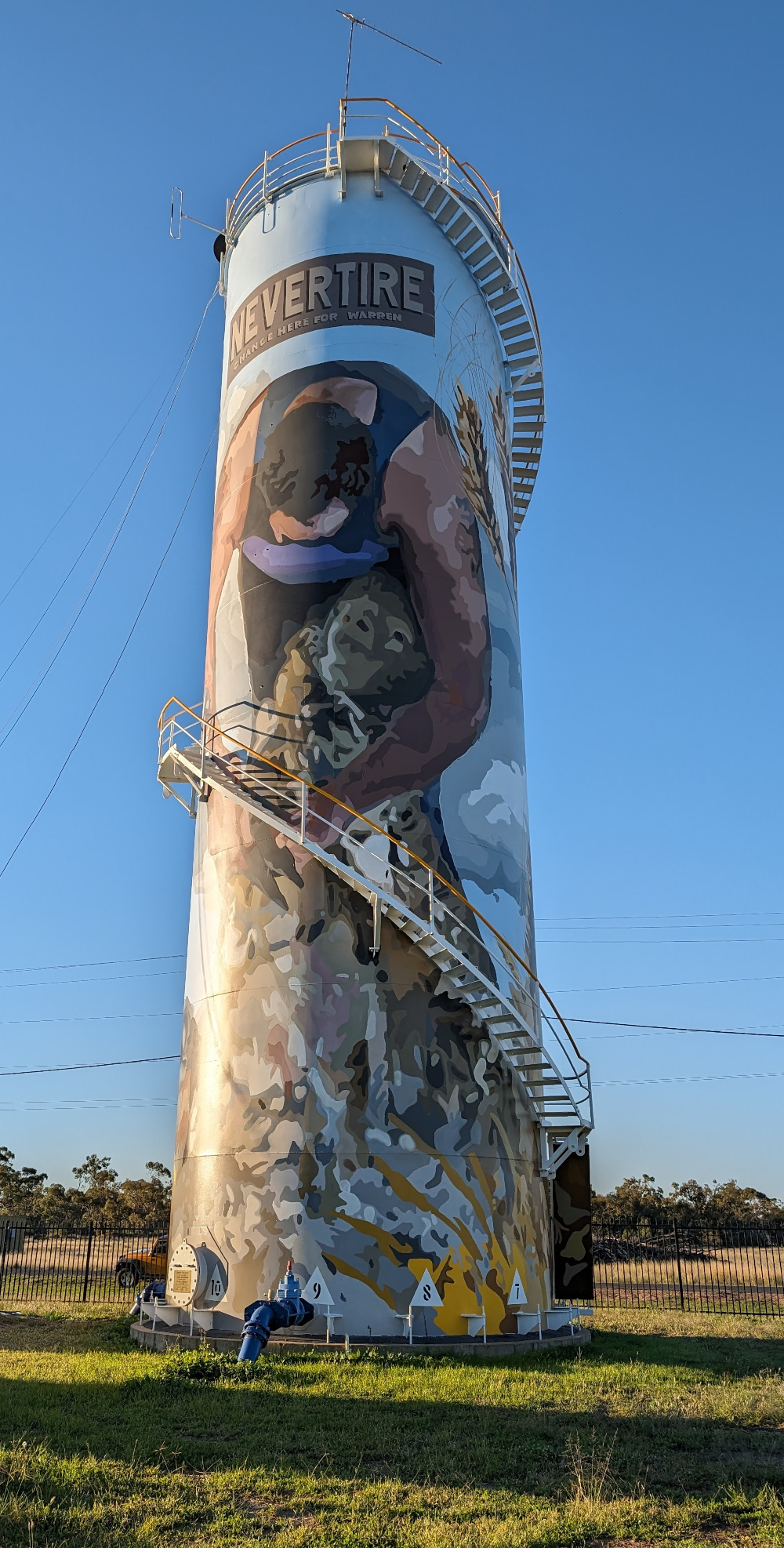
    Nevertire is one of those Australian towns with an amazing name. The town’s water tower depicts the agricultural activities of the area. First, sheep shearing:

    The artwork was completed in 2022 by Artist Bastian Allfrey. Another side of the tower shows wheat:

    And, this worm’s favourite, cotton:

    A posse of kangaroos kept an eye on the TC as she took the photos:

    I’ll post more of our Outback adventures. In the meantime…


  • Bridle Track and Root Hog Road

    This is the blog of Mark Wordsworm, the travelling worm. I’m a 40-year-old bookmark (give or take a few years) and I proudly boast my own Hallmark serial number, 95 HBM 80-1. You’ll probably want to read all about me and my Travelling Companion (the TC).

    Today’s travel notes

    Me and the TC drove the historic Bridle Track and the scenic Root Hog Road this weekend with a group of friends. We camped overnight at Mary Flynn Reserve on the Bridle Track.

    The book I’m in

    Ten Days in A Mad-House, by Nellie Bly. A somewhat horrifying true tale of a reporter in 1887, who had herself checked into an asylum for the insane and wrote a book about her experiences.

    Travel tips

    You need a four-wheel drive vehicle to follow the tracks mentioned in this post. If you decide not to camp nor to stop at the various reserves along the way, you can drive the Bridle Track in two to three hours.

    The photos

    Me with Janet the Jeep and Peg:

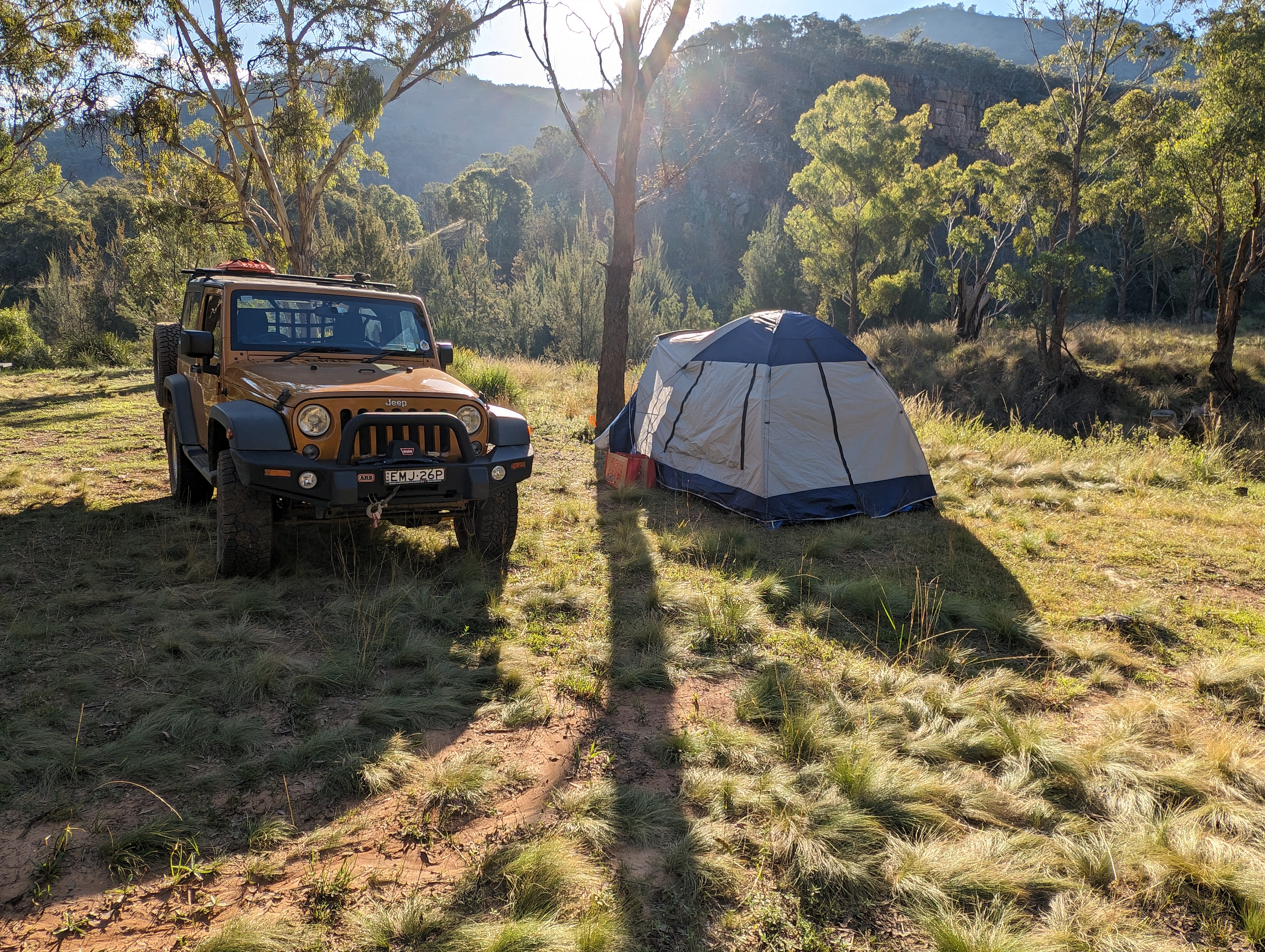
    Introducing the newest member of our merry menagerie: Janet the Jeep. She’s a 2014 Jeep JK Wrangler, manual transmission, with a 3.6 litre, 6-cylinder petrol engine. She has two side doors rather than four, and is known as a shortie because of her short wheel base. Unlike yours truly, Janet is not built for speed but she’s plucky and strong. More like Peg, in fact.

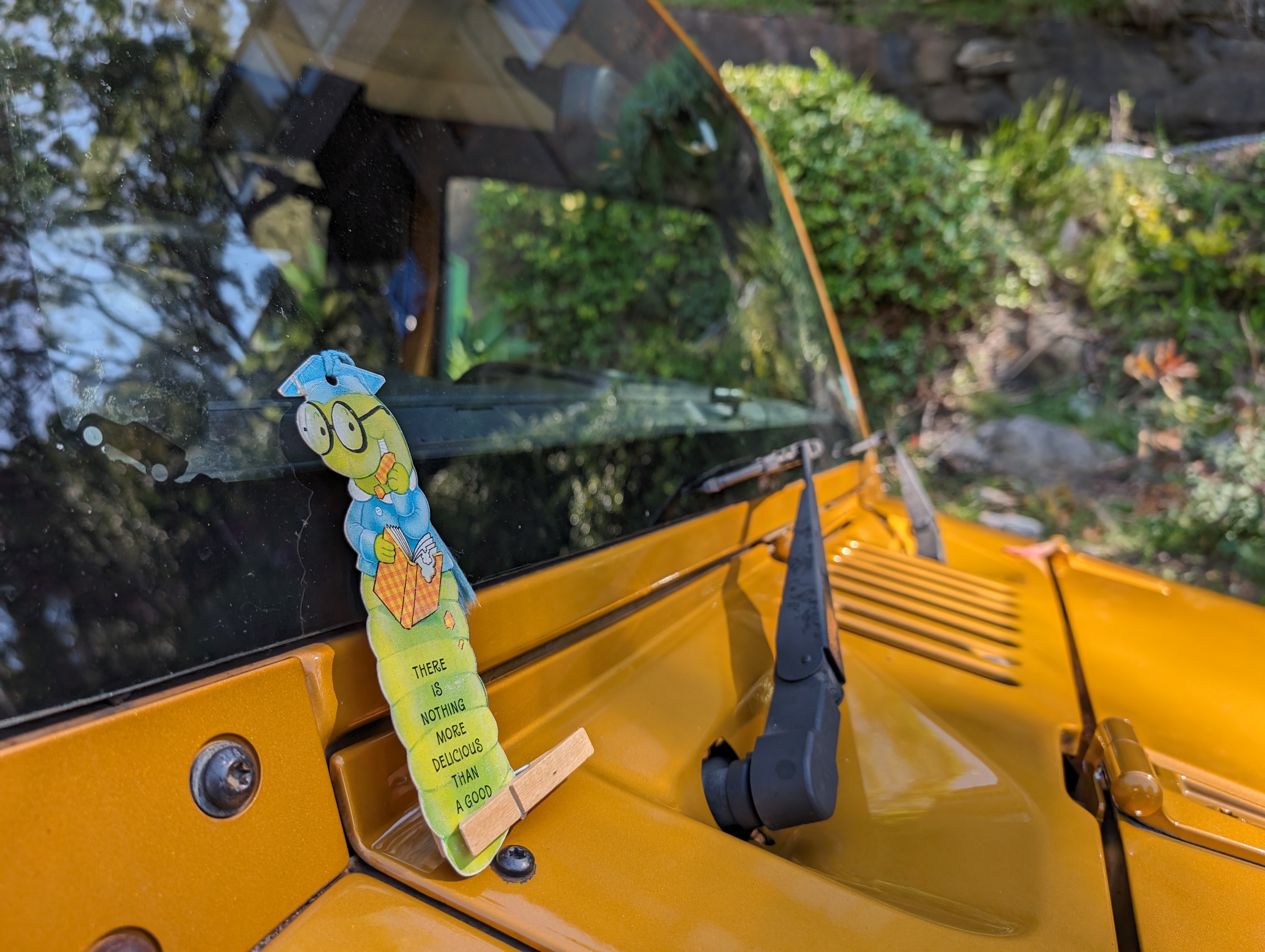
    A keen-eyed reader might notice the little Jeep icon on the windscreen next to this worm. Janet is cute, and she knows it.

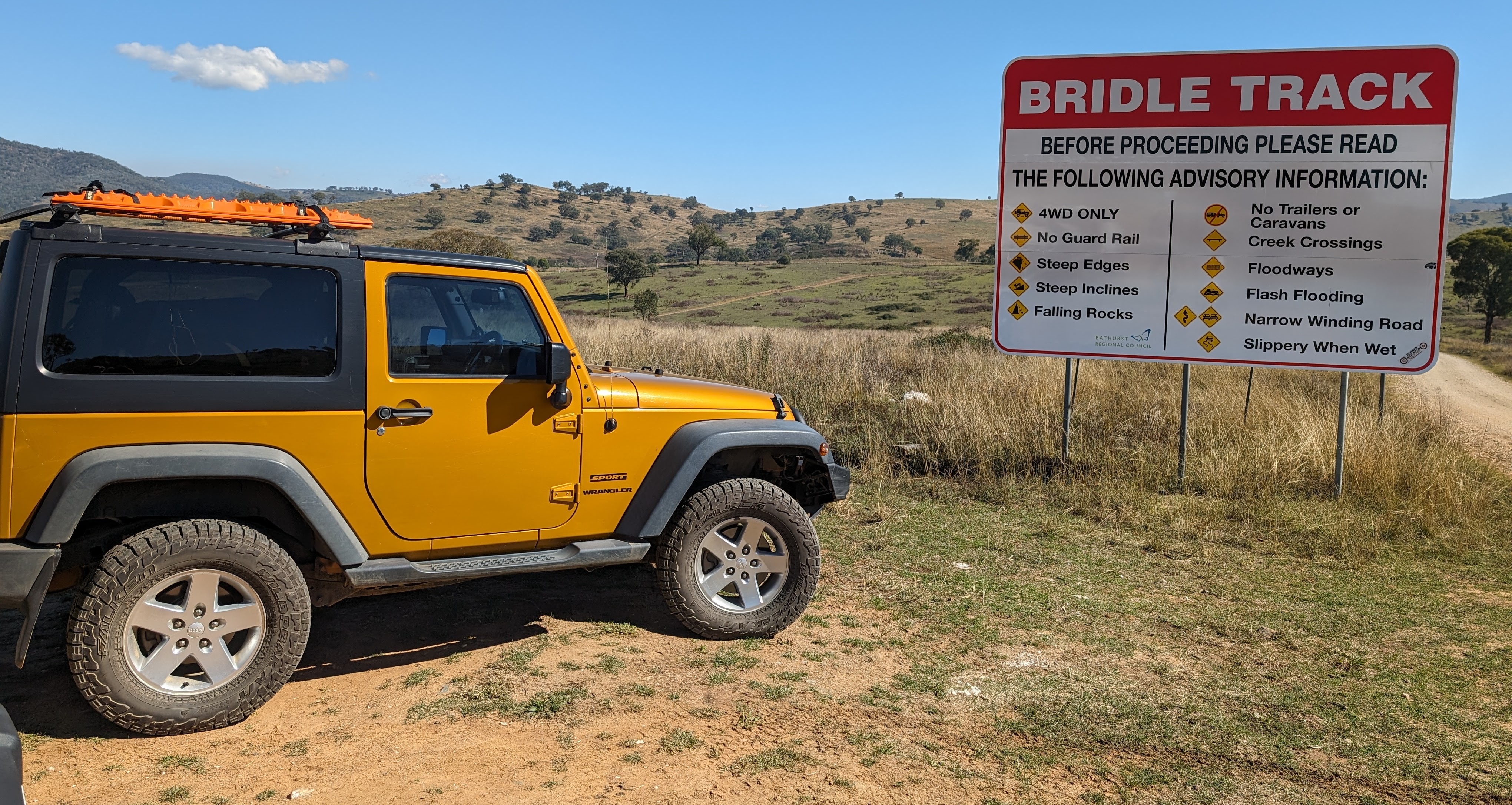
    At the start of the Bridle Track, a sign explains the need for a 4WD vehicle and due care:

    Most of the track is a well-graded dirt road. In some sections, there’s a high rocky wall on one side and a steep drop-off on the other. In this section, the road curved through a rocky bluff:

    In years gone by, one specific section of the Bridle Track was very narrow and slippery: the infamous Monaghan’s Bluff. NSW state has since built a bypass, though a sign still greets you as you enter the area:

    The Bridle Track was built in the early 1800s, to give gold miners and settlers a route from Bathurst to Hill End. Bathurst is now a thriving regional city and Hill End is a small town that welcomes visitors interested in the history of the area.

    Right on the side of the Bridle Track is an abandoned mine shaft. The brave can walk into it. The TC, bless her cotton socks, counts herself as one of the brave. She found that she could stand, with head slightly bowed, in the tunnel:

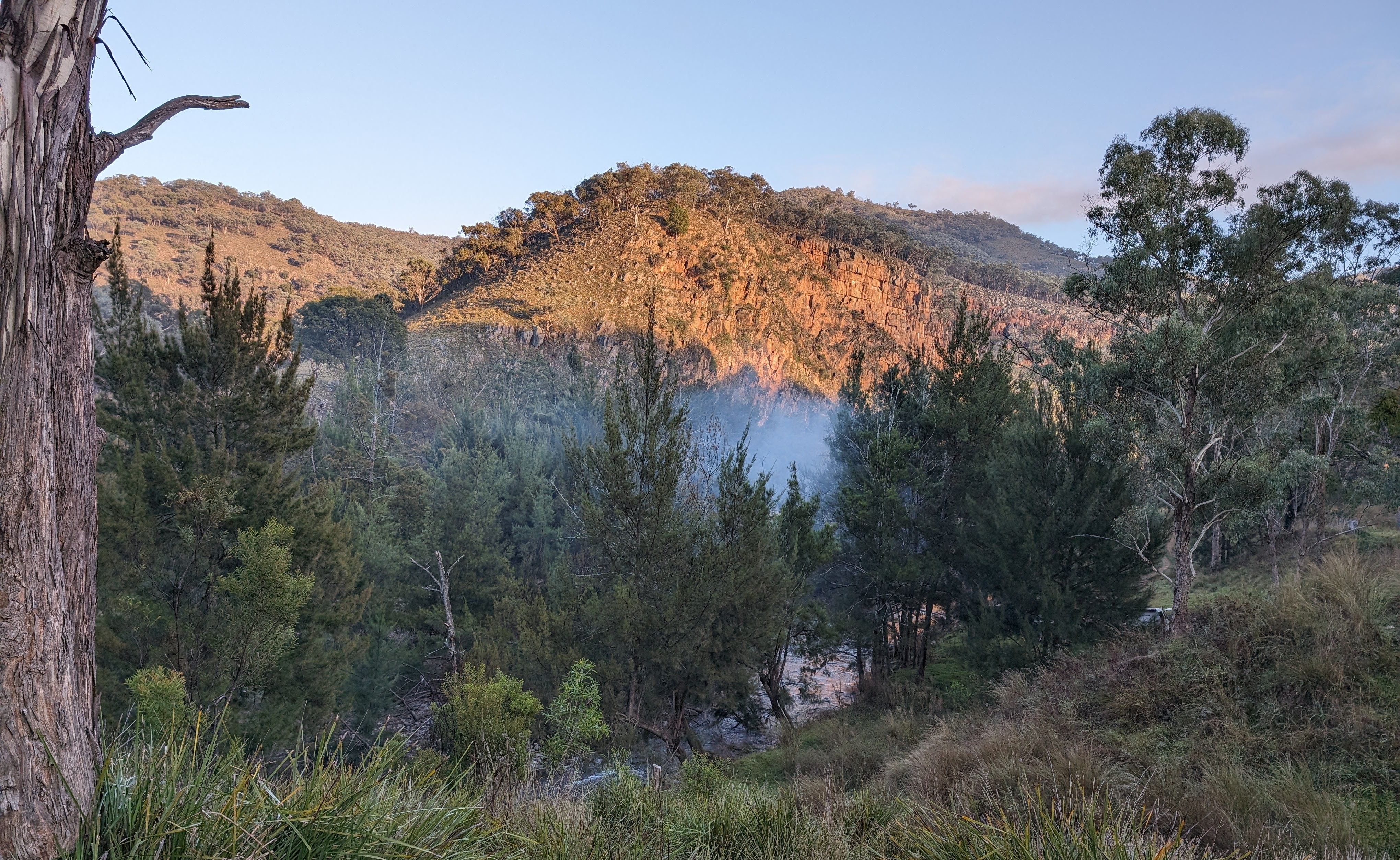
    We camped at the beautiful Mary Flynn Reserve. This view shows part of the campground and surrounding area, taken from the Bridle Track before descending into the valley:

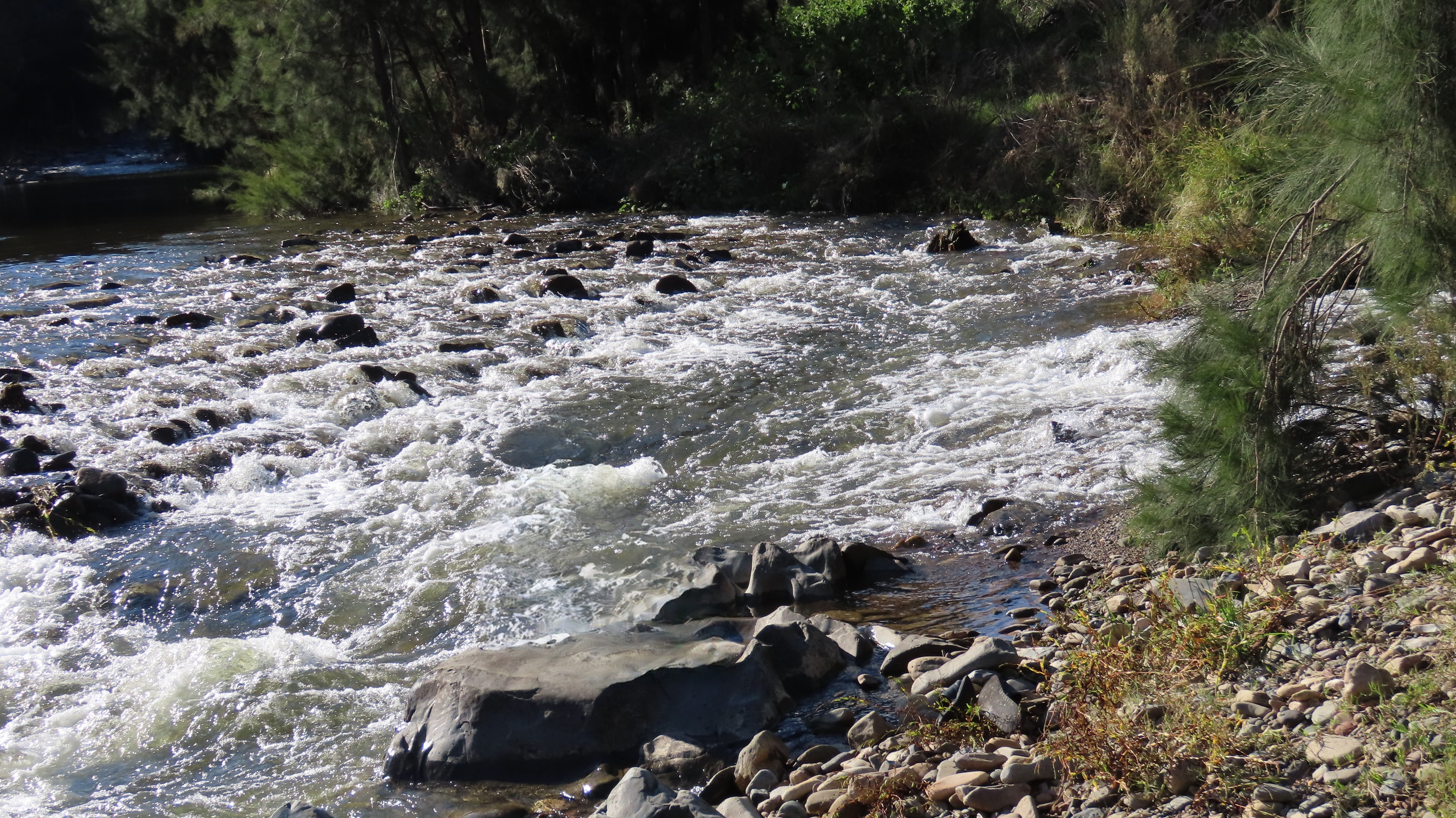
    The Turon River flows past the campsite:

    As the sun goes down, Janet stands guard over the TC’s tent:

    A rainbow campfire, thanks to minerals added by one of the campers:

    In the chill of the early morning (it was 6° Centigrade), the sun warms up the rocks on the opposite side of the river, while neighbours get their campfire going down below:

    After packing up our camp, we drove back along the Bridle Track to Root Hog Crossing. This is a crossing of the Macquarie River, at the junction of the Bridle Track and Root Hog Road. The river level was on the high side (measured at about 1 metre at the Rock Forest station), and there was a reasonably strong current. Janet says that it’s the strongest current she’s tackled to date:

    Thanks to our friend Matt for making the video.

    Before doing a trip like this, the TC does plenty of research. She checks the river levels over a couple of weeks, to see what the river’s doing. She also monitors the fire warnings and weather forecasts. On reaching the river crossing, if it looks a bit high or strong current, she’d walk into it first. If you can’t walk the current, then the car can’t take it either. For this crossing, luckily there was a group of three cars doing the crossing when we arrived. We watched them, and judged it safe for our vehicles.

    Root Hog Road is the road of views:

    The next couple of photos are from a previous trip, when we traversed Root Hog Road in the opposite direction. A couple of motorbikes passed us when we stopped to take in the view:

    Another road sign advised due caution:

    Also from our previous trip, this video shows the last part of Root Hog Road as it drops towards the Macquarie River at the junction of Root Hog Road and the Bridle Track. The crossing is to the right, but we turned to the left to take a look at the river and campground:

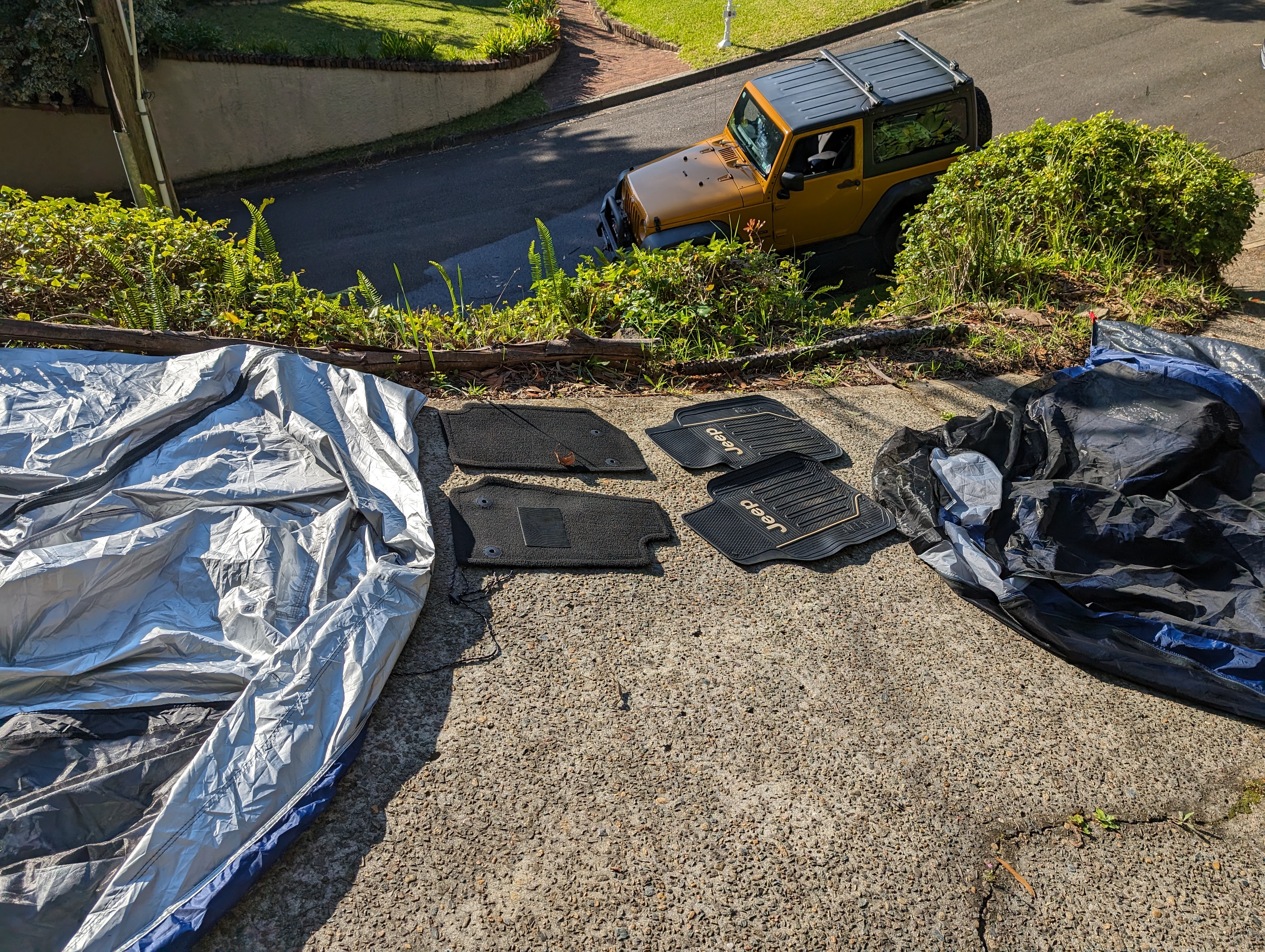
    Cleanup on the day after this week’s trip. Janet got her carpets wet in the Root Hog Crossing, and her paintwork was dusty. The tent was damp from the morning dew:

    If you’re interested in doing this trip yourself, you can find out more about the Bridle Track on the NSW information site.


  • Kurri Kurri Kookaburra and murals

    This is the blog of Mark Wordsworm, the travelling worm. I’m a 36-year-old bookmark (give or take a few years) and I proudly boast my own Hallmark serial number, 95 HBM 80-1. You’ll probably want to read all about me and my Travelling Companion (the TC).

    Today’s travel notes

    A couple of weeks ago, this worm visited the little town of Kurri Kurri. It’s an intriguing place, springing from a history of coal mining and now re-imagining itself as an artists haven.

    If you’re anything like the TC, bless her cotton socks, you’ll be asking, “Why two words?” Why is the town not called just “Kurri”? Towns and cities in Australia often have names that repeat the same word twice. The pattern comes from the Aboriginal languages that repeat a word to emphasize or strengthen the meaning of the word. In the local Minyung language, “kurri-kurri” means “the beginning” or “the first”.

    The book I’m in

    The Ones We Choose, by Julie Clark. A tale of genetics, romance, and tangled lives. Highly recommended.

    The photos

    Me with the Kurri Kurri Kookaburra:

    This Kookaburra is huge. If it were alive, I’d be taking shelter rather than posing in full view of that eye and that beak. Instead, I was happy to let the bird photo bomb me, as it’s a sculpture.

    In fact, this bird is a little like myself in that the representation is more magnificent than the original form.

    Here’s another view of the Kurri Kurri Kookaburra. The artist is one Chris Fussell. The sculpture was erected in 2009:

    Not far away from the big bird is the Kurri Kurri hotel, first opened in 1904. It’s a typical Australian hotel, in that its primary business is as a pub and restaurant, not accommodation. (The word “hotel” traps many a weary, unwary traveller just arrived in Oz.) It’s a lovely old building, with wrap-around verandas and frilly cast-iron railings:

    On a wall to the right of the hotel in the above picture is one of the murals that the town has recently become known for.

    More paintings liven up a utilitarian building in the town centre:

    The next mural fits right in with the business whose wall it adorns:

    If you look closely at the above mural (the one on the right), you’ll spot a Kookaburra on a pile of tyres. There are more than 60 murals in and around Kurri Kurri. Rumour has it that every mural includes a Kookaburra somewhere.

    Some of the wall decorations are of a bleaker nature, though still artistically and historically interesting:

    That’s all for today, folks.

  • Newcastle, New South Wales

    This is the blog of Mark Wordsworm, the travelling worm. I’m a 36-year-old bookmark (give or take a few years) and I proudly boast my own Hallmark serial number, 95 HBM 80-1. You’ll probably want to read all about me and my Travelling Companion (the TC).

    Today’s travel notes

    This week marked my first visit to Newcastle, famed as the largest coal-exporting city in the world. Now, dear reader, you’d be justified in thinking that I’m talking about the Newcastle in north-east England. Nay, not so, this Newcastle is on the eastern coast of New South Wales, Australia.

    I greatly enjoyed my short visit to this harbour city, and my pleasant encounters with Novocastrians.

    The book I’m in

    Tragaron’s Daughter, by Madeleine Brent. A well-written, fast-moving romance and thriller combined.

    Recommended restaurant

    One Penny Black, 196 Hunter St, Newcastle. Highly recommended. Friendly service. Tasty fresh food in good quantity.

    The photos

    Me in front of the pavilion of the Newcastle Ocean Baths, a grand Art Deco building from the 1920s:

    In the above photo, I’m on the southern side of the pavilion. Take a stroll with me around the building. Go slowly now — I may have more legs than you, but they’re shorter than yours.

    The pavilion and baths were to be closed for renovation just three days after our visit. This worm felt privileged to see them in their current state, and hopes to see the renovated version soon. A somewhat whimsical sign under the pavilion predicted the upcoming upheaval:

    Behind the pavilion are the baths themselves, open to the sea and sky, with tiered seating at one end:

    Behind the tiered seating hides an intriguing little dome, complete with an intriguing little internal staircase:

    The next picture shows the pavilion again, viewed from the northern side this time:

    Moving south from the baths, you can stroll along Newcastle beach, bounded by a terraced headland:

    Moving inland, you’ll probably encounter tram or two. Big brother, in shape at least, to yours truly:

    This worm steered clear of lurking Corellas. Crafty characters they are, with one eye always open for a tasty morsel:

    The streets of Newcastle are well worth a wander, for their varied architecture:

    This building is a good advertisement for the architectural offices that inhabit it:

    To end on a slightly political note, I’ll share this photo demonstrating nuclear free sentiments. No doubt the statement expressed here is in response to a recent state government announcement that Newcastle is one of three sites under consideration for a nuclear submarine base:

    That’s all for today, folks.

  • Harlequin bugs on NSW Central Coast

    This is the blog of Mark Wordsworm, the travelling worm. I’m a 25-year-old bookmark (I haven’t aged at all since I first wrote this introduction) and I proudly boast my own Hallmark serial number, 95 HBM 80-1. You’ll probably want to read all about me and my Travelling Companion (the TC).

    Today’s travel notes

    Me and the TC spent a couple of days on the Central Coast of New South Wales, Australia. This was a while ago. Now I’m on another trip to somewhere else, and thus finding the time to publish some words.

    My impressions? Restful prettiness with enough history and natural beauty to occupy the mind.

    Word of the day

    Bug is the word of the day.  According to the Australian Museum, bugs and beetles are different groups of creatures. They have different mouthparts (beetles chew, bugs don’t),  different lifecycles (beetles undergo a complete metamorphosis from larval stage, bugs don’t), different food choices (beetles eat solids, bugs don’t), and different wings (beetles have two pairs, bugs don’t).

    This worm concludes there’s a lot that beetles do and bugs don’t. Never mind, the bugs in this post are pretty. At least they have that going for them.

    Travel tip

    Look before you sit. The colourful bugs pictured below were roaming around on a park bench. A careless sitter would have squished them.

    The book I’m in

    Infinity Born, by Douglas E. Richards. Artificial intelligence runs wild in this action-packed, thought-provoking book.

    The photos

    Me and the rising sun, at the window of the Crowne Plaza hotel in Terrigal:

    These two bugs roamed around a park bench. Luckily the TC spotted them before sitting down. I think they’re Hibiscus Harlequin Bugs. Almost as attractive as your faithful bookworm!

    The bugs are reasonably large, certainly much bigger than a ladybird. For scale, the TC put her finger next to them on the park bench:

    Methinks they’re in love, or one of them is. Play the video to see how one follows the other, occasionally bumping into it by mistake or perhaps on purpose:

    Now for a complete change of subject, just because I can. Contrary to appearances, this is not a monster’s gullet. It’s a hollow tree trunk:

    That’s all for today, folks.


  • Wentworth Falls and Valley of the Waters, Leura

    This is the blog of Mark Wordsworm, the travelling worm. I’m a 25-year-old bookmark and can proudly boast my own Hallmark serial number, 95 HBM 80-1. You’ll probably want to read all about me and my Travelling Companion (the TC).

    Today’s travel notes

    The TC recently spent a couple of days in Leura, a town in the Blue Mountains near Sydney. I was there too, but I spent my time cosily buried in a book. The TC, brave soul that she is, went on a four-hour hike from Leura to Wentworth Falls and back. The walk is 6 to 7 kilometres in distance, with a vertical drop and ascent of 200 metres.

    My impressions? To judge by the TC’s glowing face and weary limbs, this was a walk and a half. She loved it, and had sore muscles for days afterwards.

    The book I’m in

    Jupiter War, by Neal Asher.

    Travel tip

    When walking in the Blue Mountains, take plenty of water and some food. Although your intention may be to stay out only a couple of hours, weather can change and mishaps can happen.

    Recommended accommodation

    Fairmont Resort, 1 Sublime Point Rd, Leura NSW 2780. Comfort, warmth, and friendliness.

    The photos

    Looking out over the Blue Mountains from the Fairmont Resort in Leura. This is where the four-hour walk started. Early in the morning, the valley is filled with mist:

    Leura, Blue Mountains

    On the way to Wentworth Falls, the path takes you up and down, through forest-filled glens, under overhanging rocks, along cliff faces:

    Walk to Wentworth Falls

    The views are stunning:

    On the way to Wentworth Falls

    At the top of Wentworth Falls, the ground just ends. The water falls over the edge:

    At the top of Wentworth Falls

    Wentworth Falls, seen from the bottom:

    Wentworth Falls

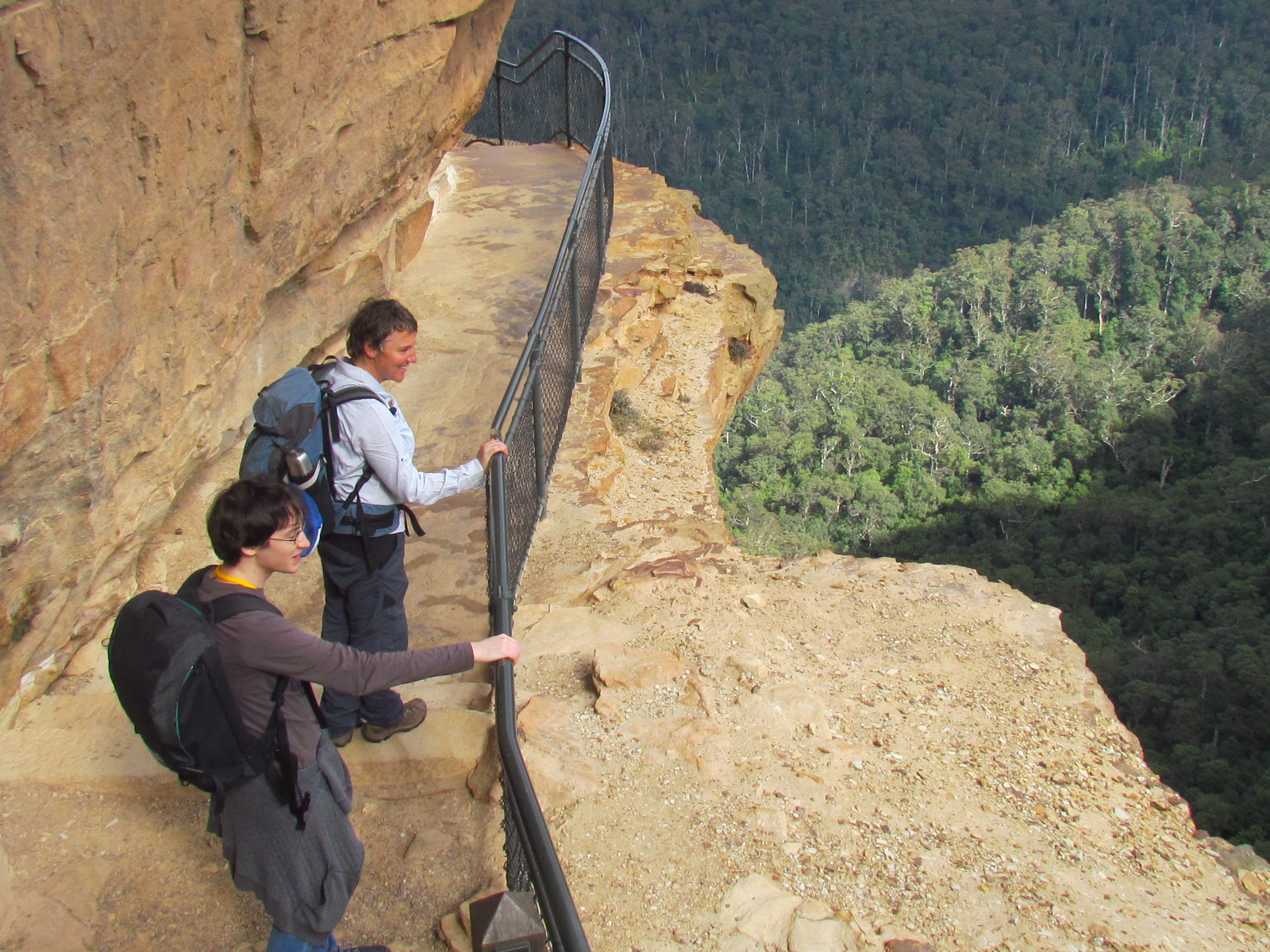
    To get down there, you can take the National Pass, a spectacular cliff-face path of metal and rock:

    National Pass, Wentworth Falls

    Cockatoos frolic around the falls:

    Cockatoo at Wentworth Falls

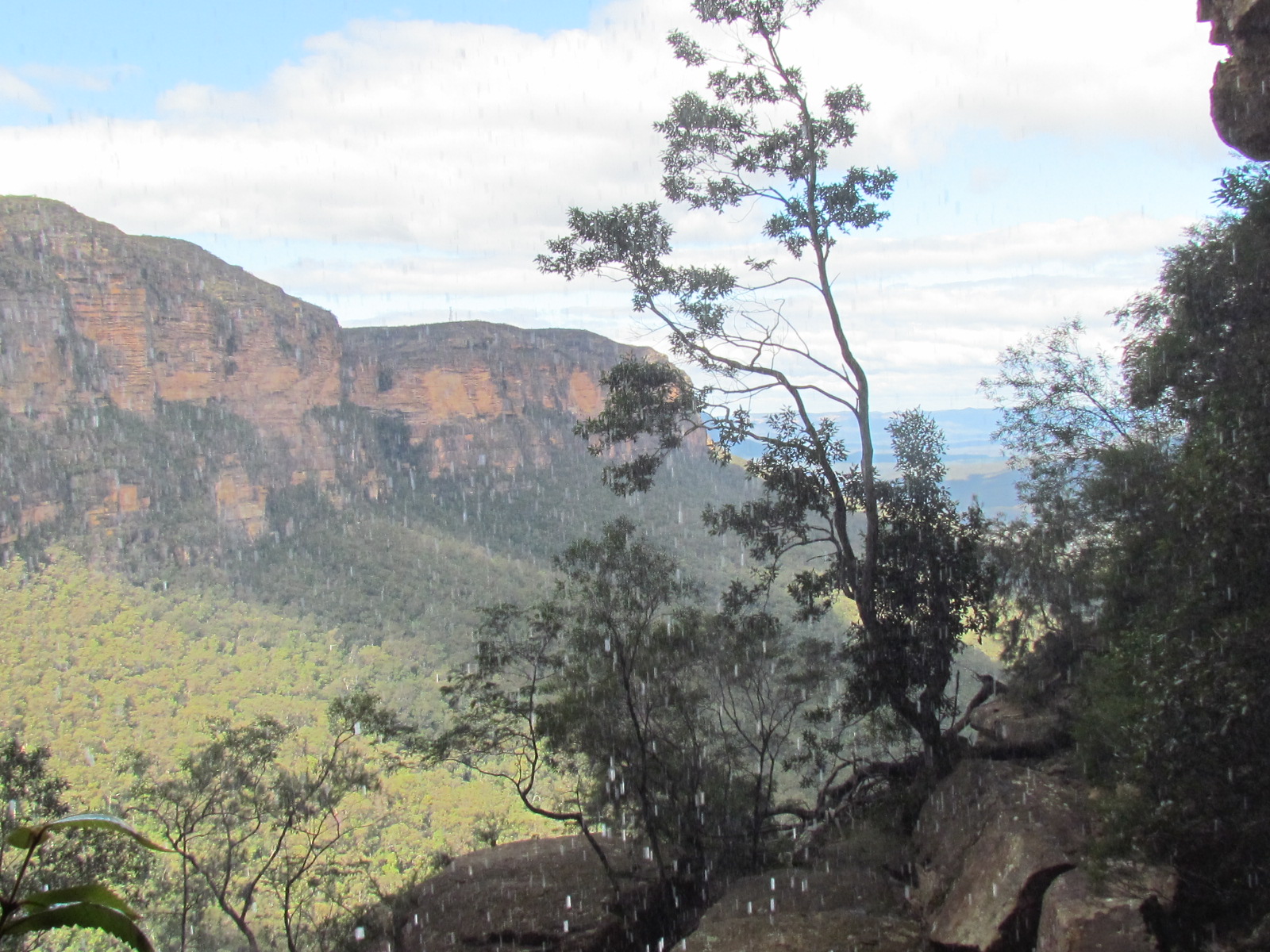
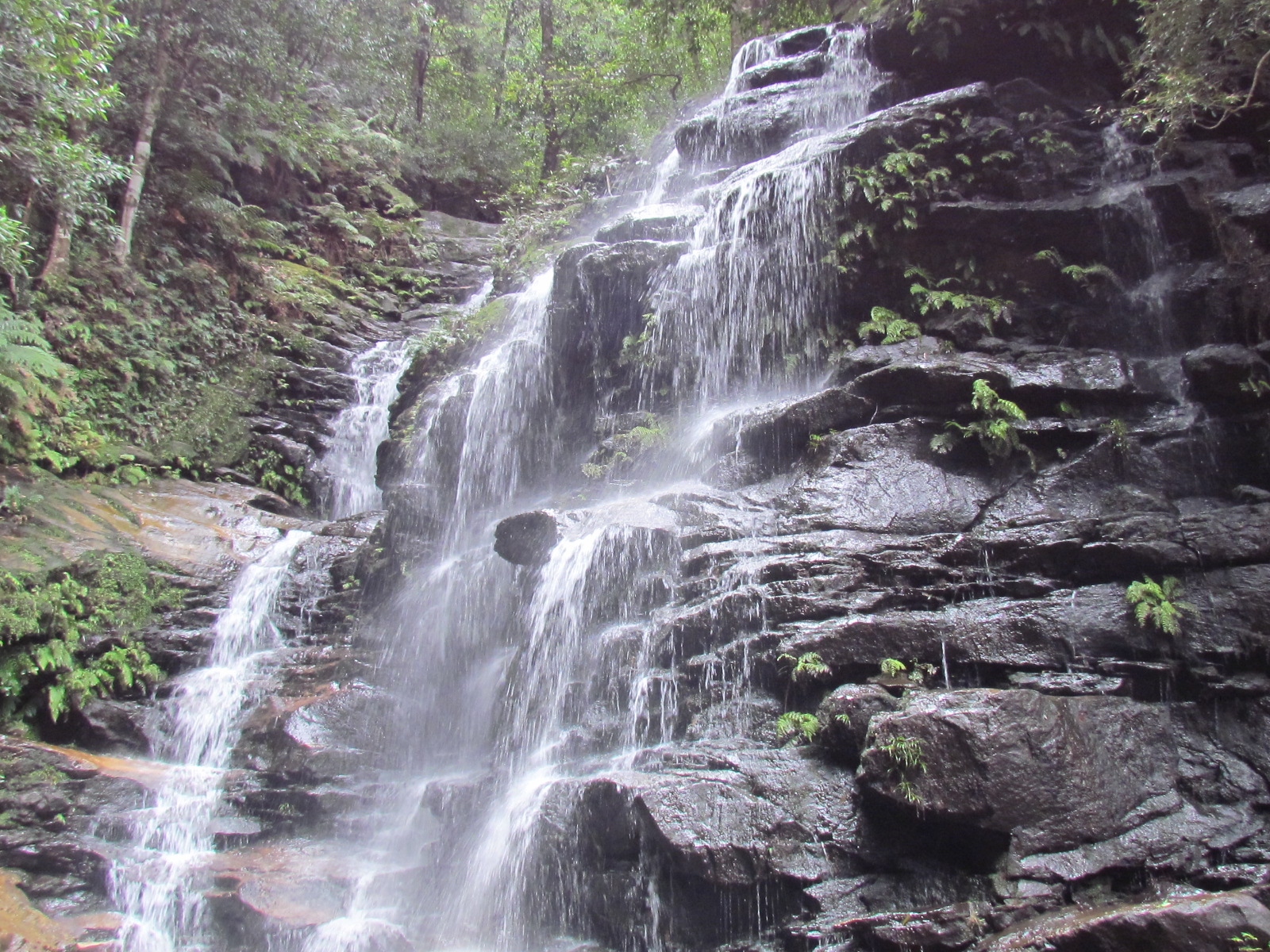
    On the loop back to Leura, the TC’s group walked through the Valley of the Waters. This is a gorgeous walk, with waterfalls and hanging gardens and spectacular views. This shot is taken from behind the curtain of water that drops off the cliffs:

    Valley of the Waters, Blue Mountains

    Here’s a short video taken from behind the same waterfall:

    The Cascades are a silver shower of water on black rock:

    The Cascades, Valley of the Waters

    That’s all for today, folks.


  • Cockatoo Island in Sydney

    This is the blog of Mark Wordsworm, the travelling worm. I’m a 25-year-old bookmark and can proudly boast my own Hallmark serial number, 95 HBM 80-1. You’ll probably want to read all about me and my Travelling Companion (the TC).

    Today’s travel notes

    Me and the TC spent yesterday afternoon on Cockatoo Island on the Parramatta River, immediately inland of Sydney harbour. It’s a forlorn place, strewn with gravel and history.

    My impressions? Sandstone, sheds and seagulls.

    The book I’m in

    Gidget, by Frederick Kohner. An engaging tale of a teenage surfer, written 1957. Clever use of language and style to carry along a simple story with tons of atmosphere.

    Travel tip

    When travelling to Cockatoo Island, take sunscreen and something to tie back your hair. (That is, if you have lots of it, as the TC does.)

    The photos

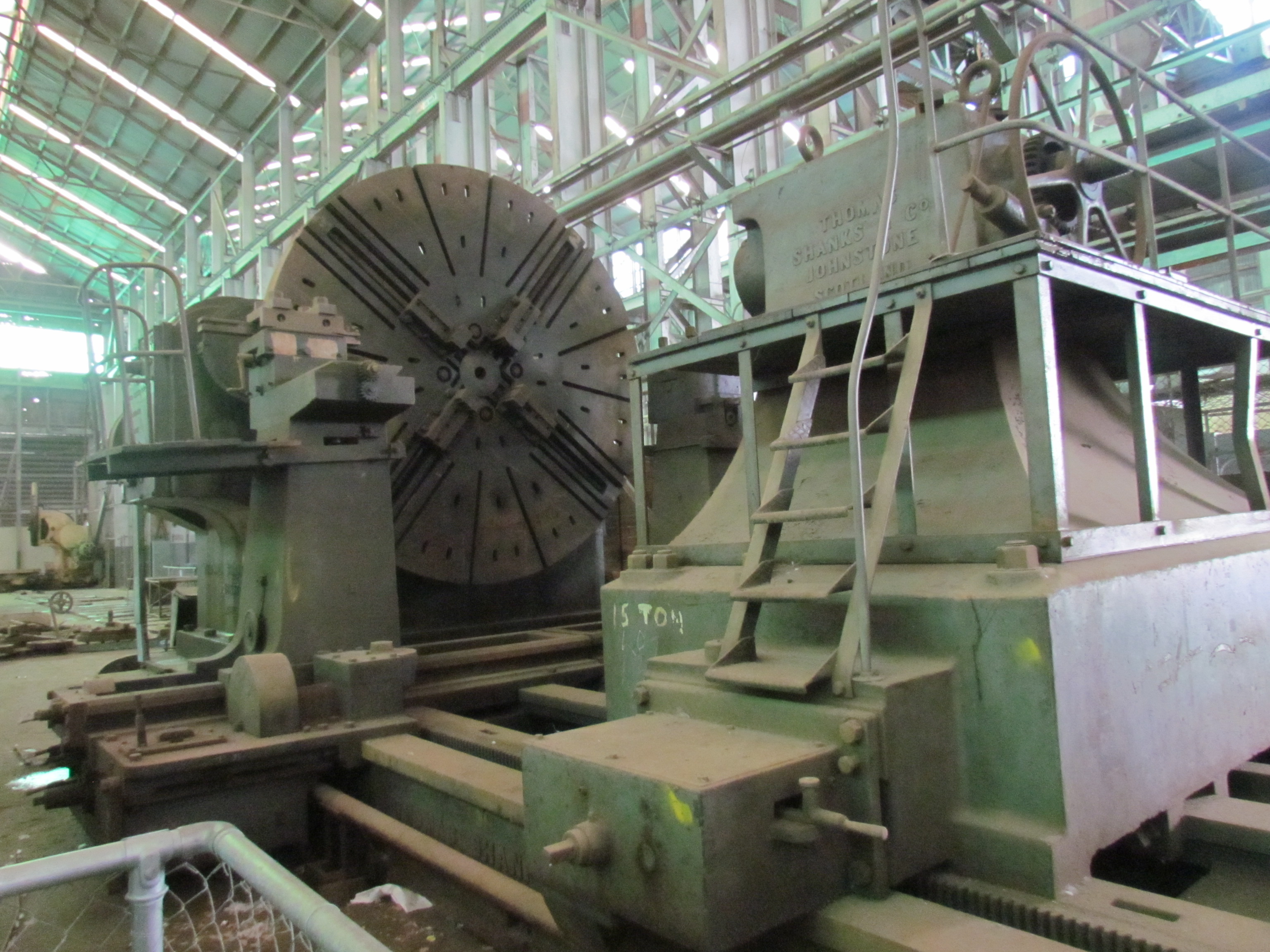
    Me on a metal lathe in the industrial area of Cockatoo Island:

    Cockatoo Island

    Cockatoo Island, as seen on Google Maps:

    Image created by Google Static Maps API: https://maps.googleapis.com/maps/api/staticmap?center=-33.8475896,151.1720669&zoom=16&size=470x352&maptype=satellite

    The Aboriginal name for the island is Wareamah. The Aboriginal people of the area used to come to the island to fish.  But there was no fresh water, so they didn’t live there permanently. In 1839 a governor of New South Wales decided the island was an ideal place to house prisoners and put them to work quarrying sandstone and building prison and military barracks and official residences.

    The entrance to the island from the ferry wharf:

    Cockatoo Island

    Walking into the industrial area:

    Cockatoo Island

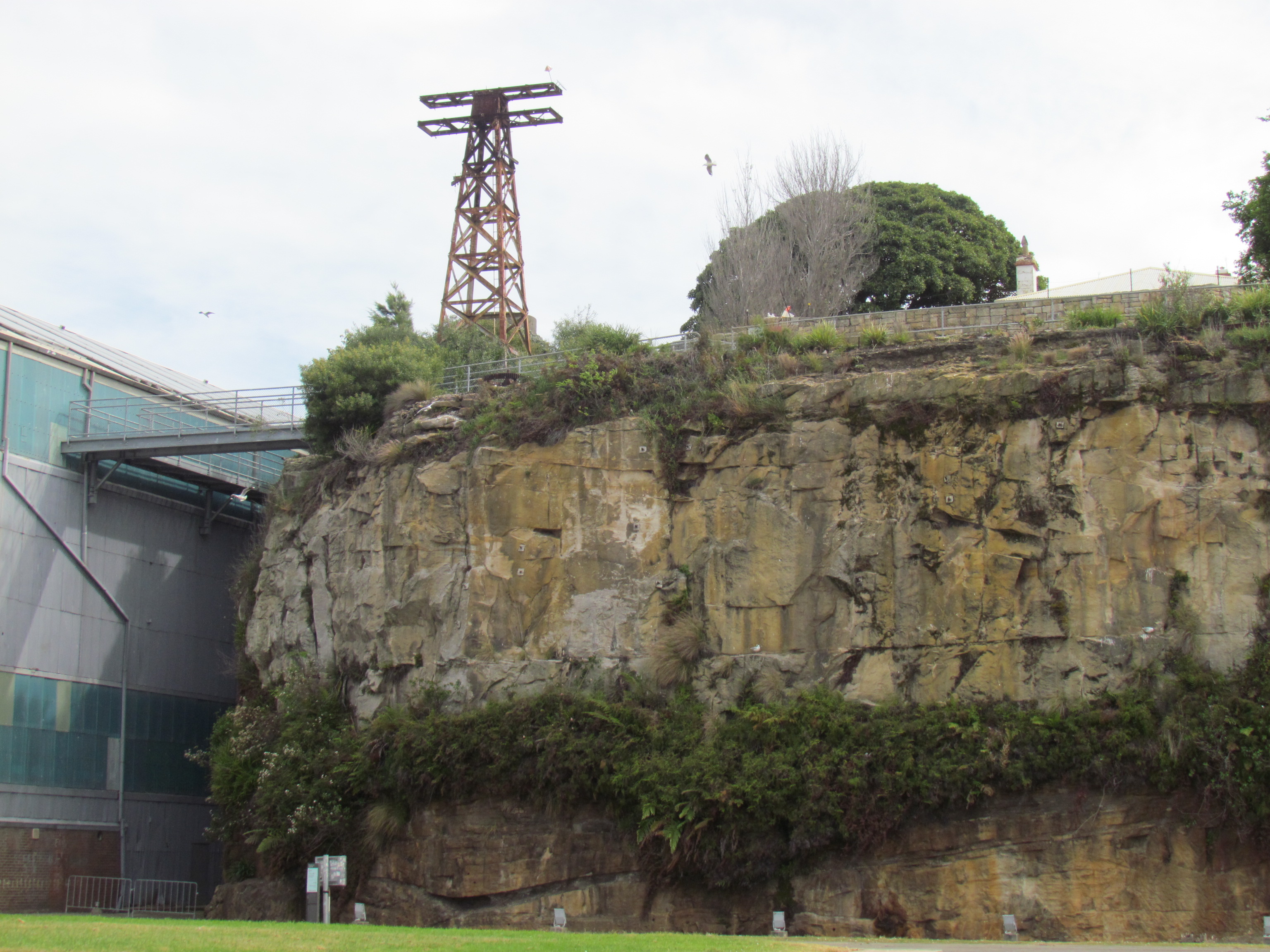
    An impressive sandstone cliff on the right as you walk in, which has survived the extensive quarrying:

    Cockatoo Island

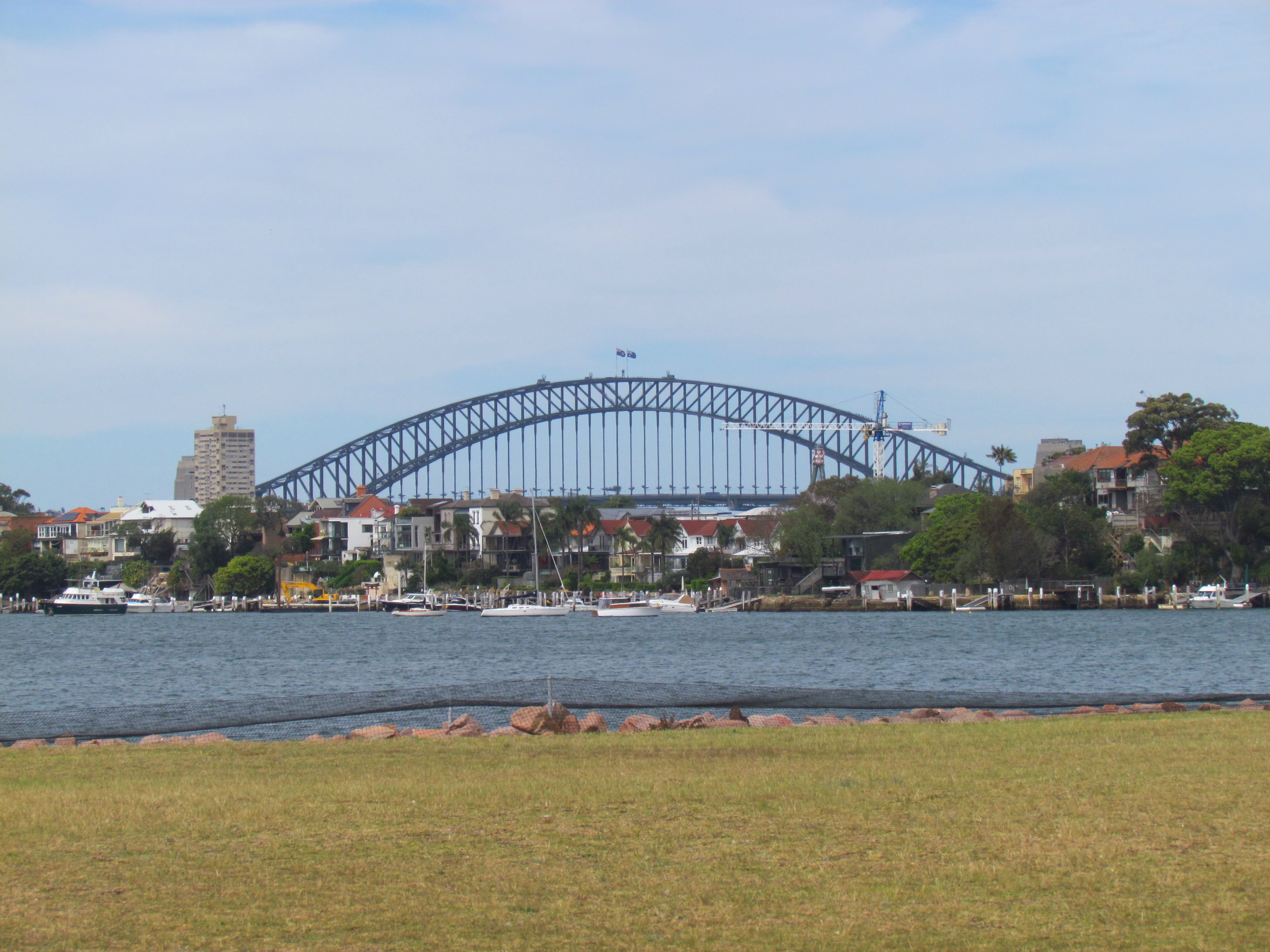
    A view of Sydney Harbour Bridge from the island:

    Cockatoo Island

    In the late 1800s and early 1900s, the island became a major ship-building site, playing a large part in ship construction and repair during World War II. Its use as a dockyard and construction facility for ships and submarines continued until 1992.

    Inside a huge ship-building shed on the island:

    Cockatoo Island

    The magnificent machinery made this worm feel small and insignificant:

    Cockatoo Island

    More machinery:

    Cockatoo Island

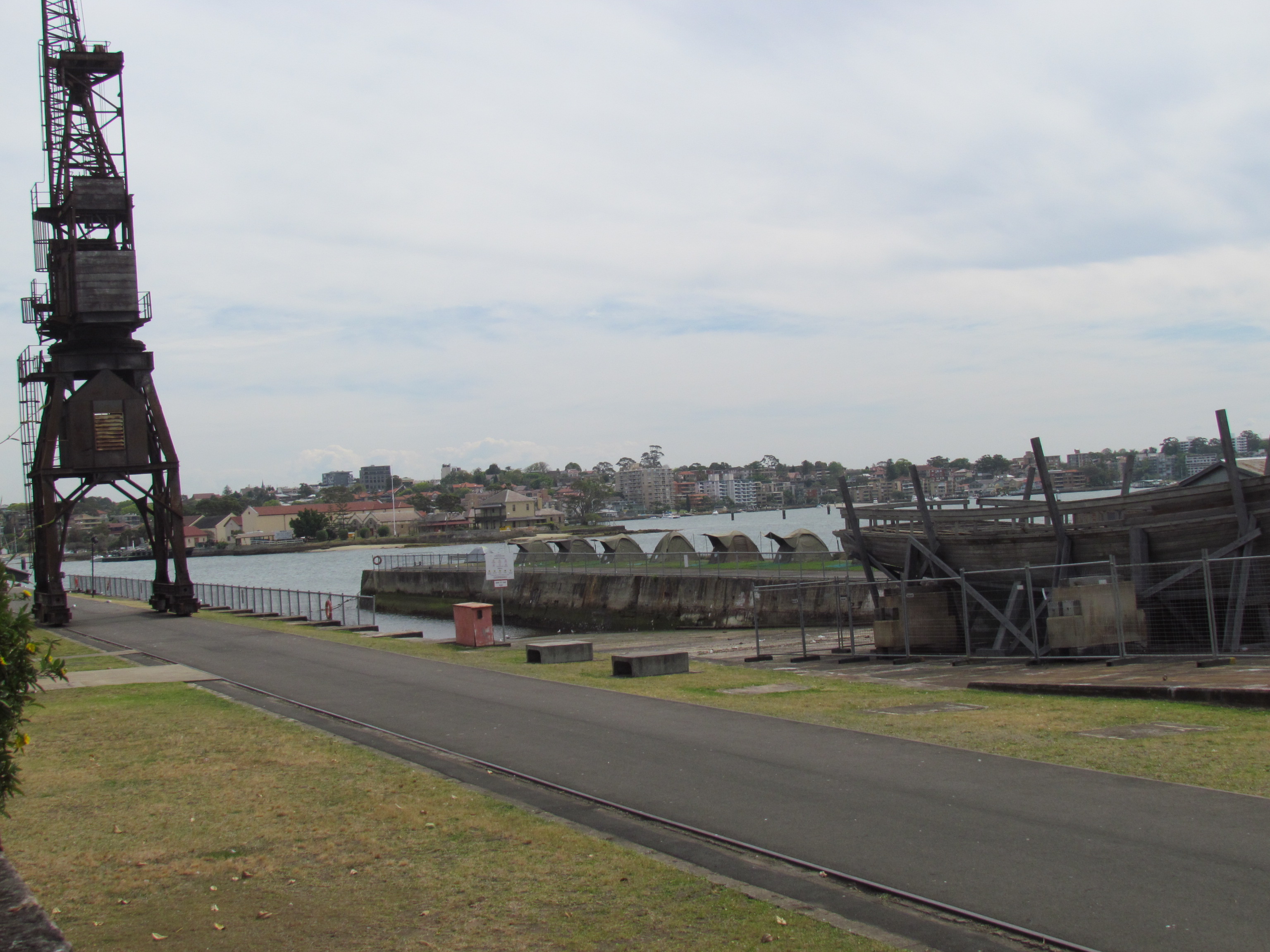
    A giant crane stands guard over the Parramatta River:

    Cockatoo Island

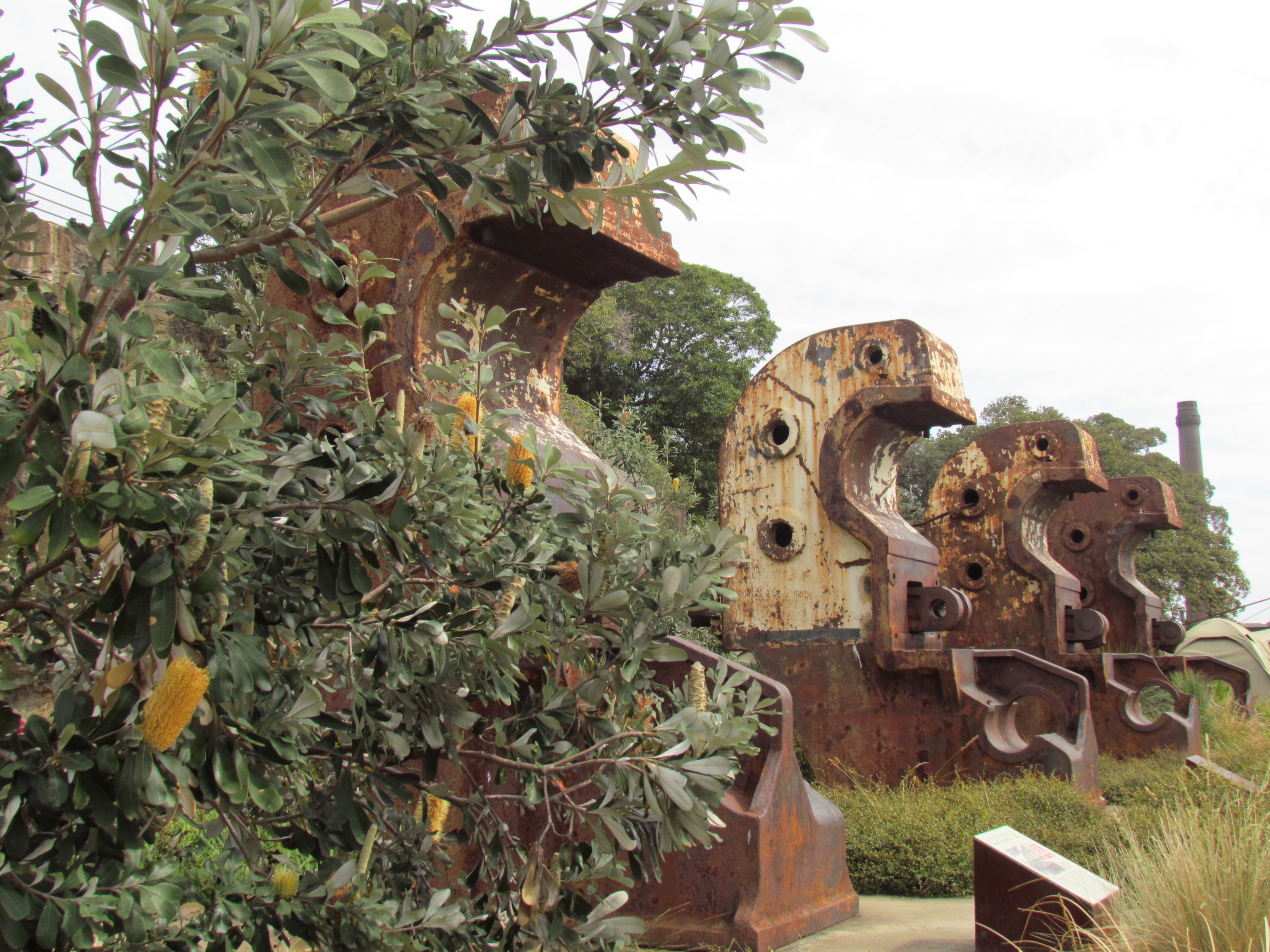
    These imposing beam benders are the remains of a hydraulically-powered plate-bending machine from the 1920s, used to bend metal plates up to 9 metres long and one inch thick for ship building:

    Cockatoo Island

    Below is one of the slipways used to launch ships after construction. Film buffs note: The ark at the top of the slipway was created for and used in the film “Unbroken”, directed by Angelina Jolie and filmed on the island last year:

    Cockatoo Island

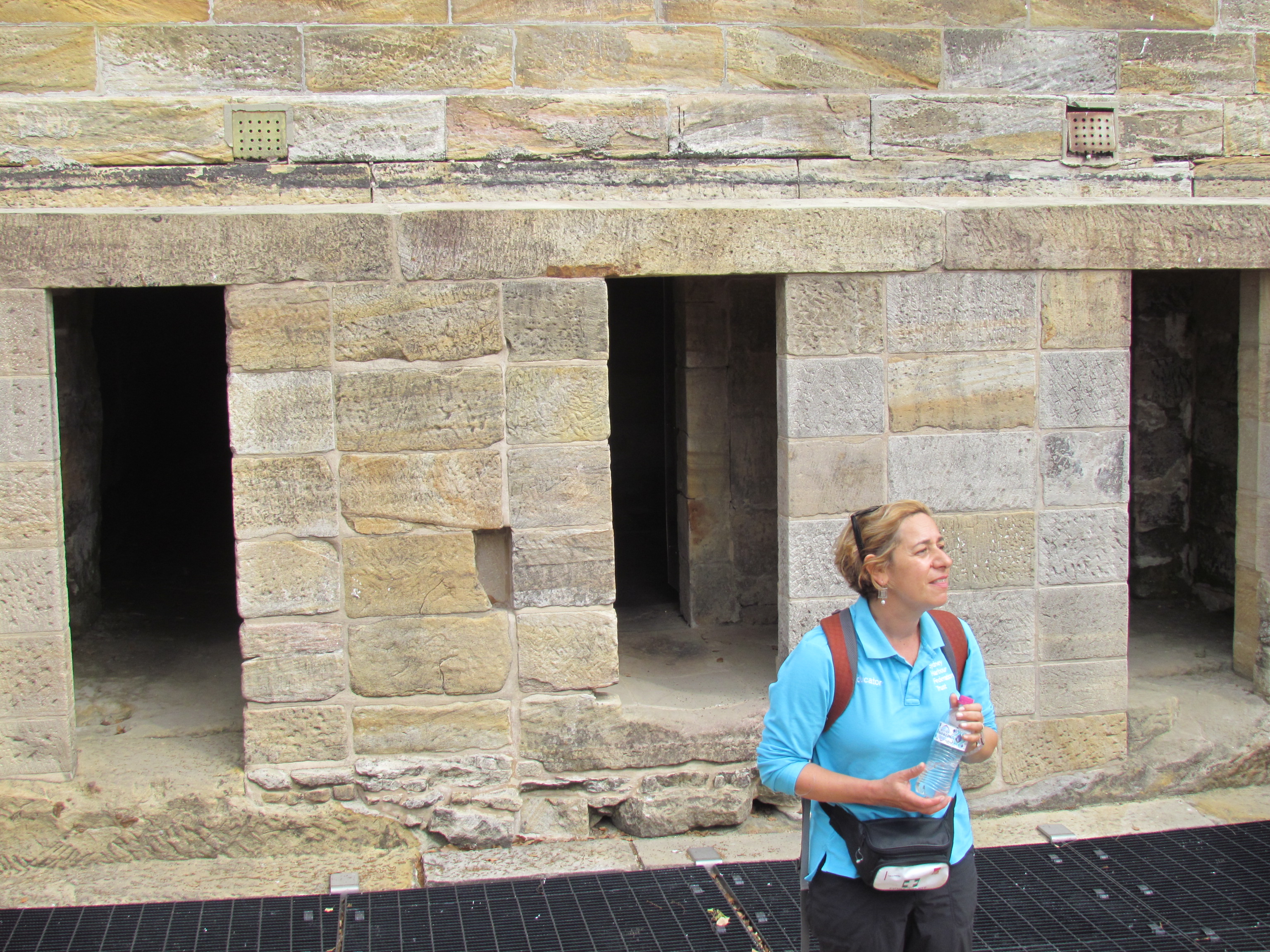
    The solitary confinement cells on the island, opened to visitors only last week, and introduced with great enthusiasm by our charming guide:

    Cockatoo Island

    Inside the left-most solitary-confinement cell:

    Cockatoo Island

    A tunnel cut through the sandstone, built in 1912, and used as an air-raid shelter during WWII:

    Cockatoo Island

    A view through the window of the now roofless military guardhouse:

    Cockatoo Island

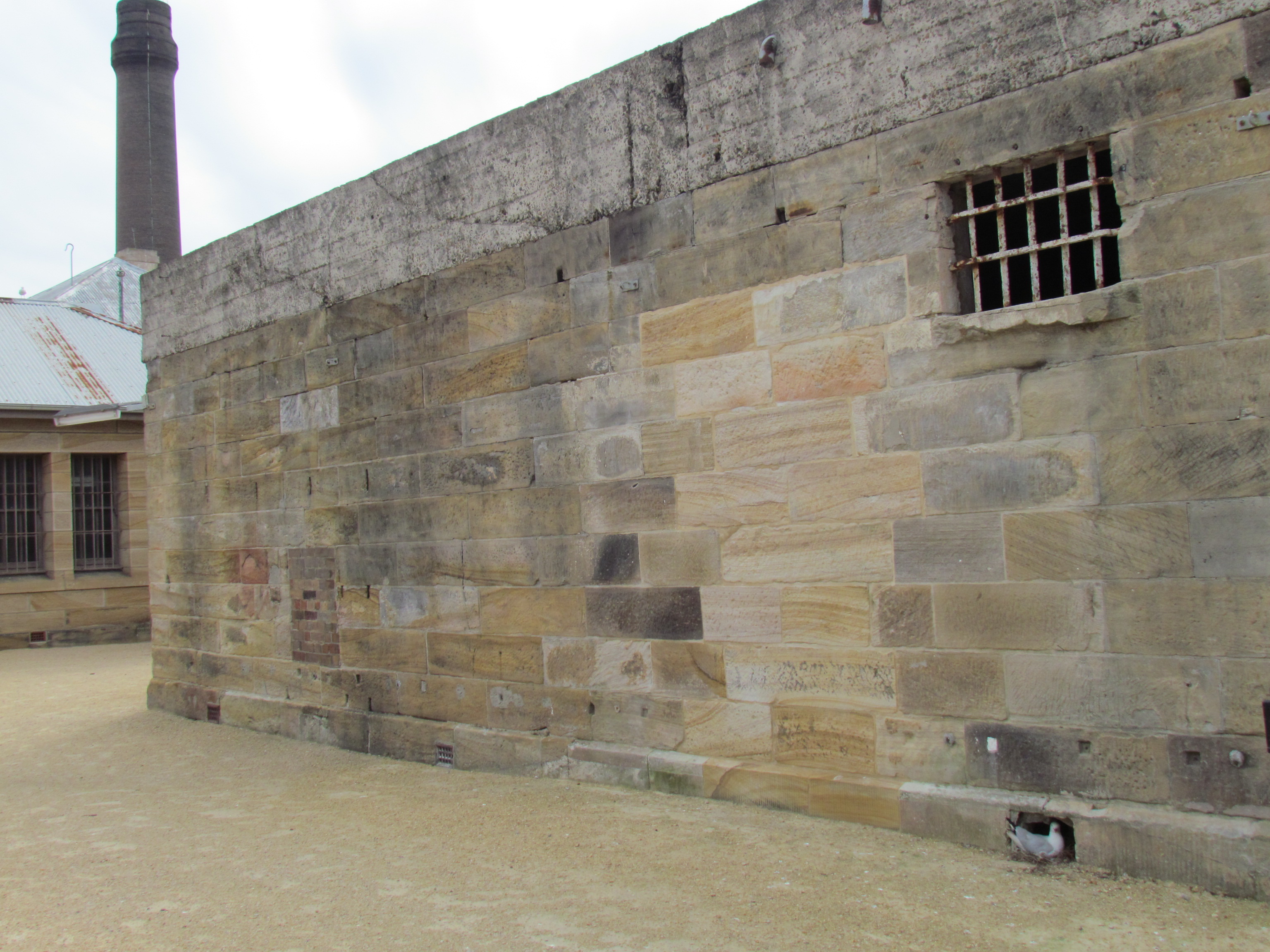
    Below is the prison barracks, built in 1839. The convicts themselves quarried the sandstone and erected the buildings. Our guide told us that each man had a specific style when hewing sandstone. You can still see the marks in the stone used in the buildings on the island. At the end of each day, the overseers could tally each man’s work just by looking at the distinctive cuts in the stone:

    Cockatoo Island

    Notice the seagull nesting at the bottom of the building in the above photo? Pro tip from a wary worm: You don’t need to worry about cockatoos on the island. They all left when people cut down the trees to make room for the convicts. So now the seagulls reign supreme. Go Jonathan! Be afraid, be very afraid. As our guide said, the chicks are cute but the parents are not.

    Cockatoo Island

    Inside the barracks:

    Cockatoo Island

    A window to freedom:

    Cockatoo Island

    That’s all for today, dudes.


  • Is this a worm or a fungus – in Sydney, Australia

    The TC (my Travelling Companion) spotted this weird and wonderful creature on the Wild Flower Walk at Manly Dam Reserve near Sydney, Australia. We’re intrigued. Is it a worm, or some type of fungus, or something else entirely?

    It’s quite long, perhaps 10 to 12 centimetres – compare it with the gum tree leaves also visible in the photo. It’s red with pale cream extrusions at the edges. It’s attached to the vertical face of a step. It didn’t move, even when the TC prodded it gently with a stick.

    At first the TC thought it was a fungus. But looking more closely at the photos, we’re leaning towards some kind of worm.

    Worm or fungus?

    Here is is again, from a slightly different angle. You can probably enlarge the image by clicking it, or by right-clicking and opening the image in the browser.

    Worm or fungus?

    If you have any ideas about what it may be, please add a comment to this post!


  • A line of Processionary Caterpillars in Sydney, Australia

    This is the blog of Mark Wordsworm, the travelling worm. I’m a 25-year-old bookmark and can proudly boast my own Hallmark serial number, 95 HBM 80-1. You’ll probably want to read all about me and my Travelling Companion (the TC).

    A line of caterpillars, following each other nose to tail – have you ever seen the like? These Processionary Caterpillars were on their way to find food one morning when the TC spotted them. She seemed especially delighted that they numbered 42. We worms are wondrous folk.

    The caterpillars are the larvae of the Bag-Shelter Moth, so called because they build themselves a little bag of silk to hide in. Their scientific name is Ochrogaster lunifer. The little hairs on the caterpillars can cause skin irritation, so be wary of getting too close.

    A line of Processionary Caterpillars seen from afar:

    Caterpillars-in-Line-ManlyDam-20April2014 020_trun

    Getting closer:

    Caterpillars-in-Line-ManlyDam-20April2014 017_reduced

    And closer:

    Caterpillars-in-Line-ManlyDam-20April2014 012_reduced