This is the blog of Mark Wordsworm, the travelling worm. I’m a 25-year-old bookmark and can proudly boast my own Hallmark serial number, 95 HBM 80-1. You’ll probably want to read all about me and my Travelling Companion (the TC) .
Today’s travel notes
Queenstown, the action capital of the world. That’s what our guide told us during one of the many activities and adventures that me and the TC have tackled in the last few days. Queenstown, on the South Island of New Zealand, is a pretty little town with lots to offer for a few days of fun and action.
My impressions? Sunlight glowing on tawny hills. Cloud shadows gliding across a turquoise lake. People flying through treetops, skimming over water, scooting along the shore and jumping off anything that doesn’t move. It’s all happening.
Travel tip
Ziptrek. Just do it.
Recommended accommodation
Pounamu Apartments.
The book I’m in
Bad Luck and Trouble, by Lee Child. Jack Reacher gets together with some old buddies from his army unit. It’s like having a number of Reachers all in one book.
The photos
Me and Mary Moa:
The TC offering me to the last surviving Moa
In the centre of Queenstown stands the last remaining Moa bird. Mary. Naturally, the TC attempted to feed me to the giant bird. Mary Moa declined with due disdain:
Mary Moa's suspicious eye
Queenstown is beautiful. A lake runs through it:
Queenstown seen from Skipper's Saddle
At the bottom of Lake Wakatipu a giant’s heart pumps. That’s the reason why the water surges one way and then the other, regular as clockwork every fifteen minutes, causing a twenty centimetre rise in the level of the lake on each shore in turn. The seiche, they call it. There’s no scientific explanation for the phenomenon yet, so the story of the giant’s heart is as good as any other.
Lake Wakatipu, Queenstown
Jonathan was there too:
Jonathan on the shore of Lake Wakatipu
We zoomed along the shores of Lake Wakatipu on Segways:
Zooming along with Segway on Q
We zipped through the treetops on flying fox cables:
Flying fox tour of the treetops with Ziptrek
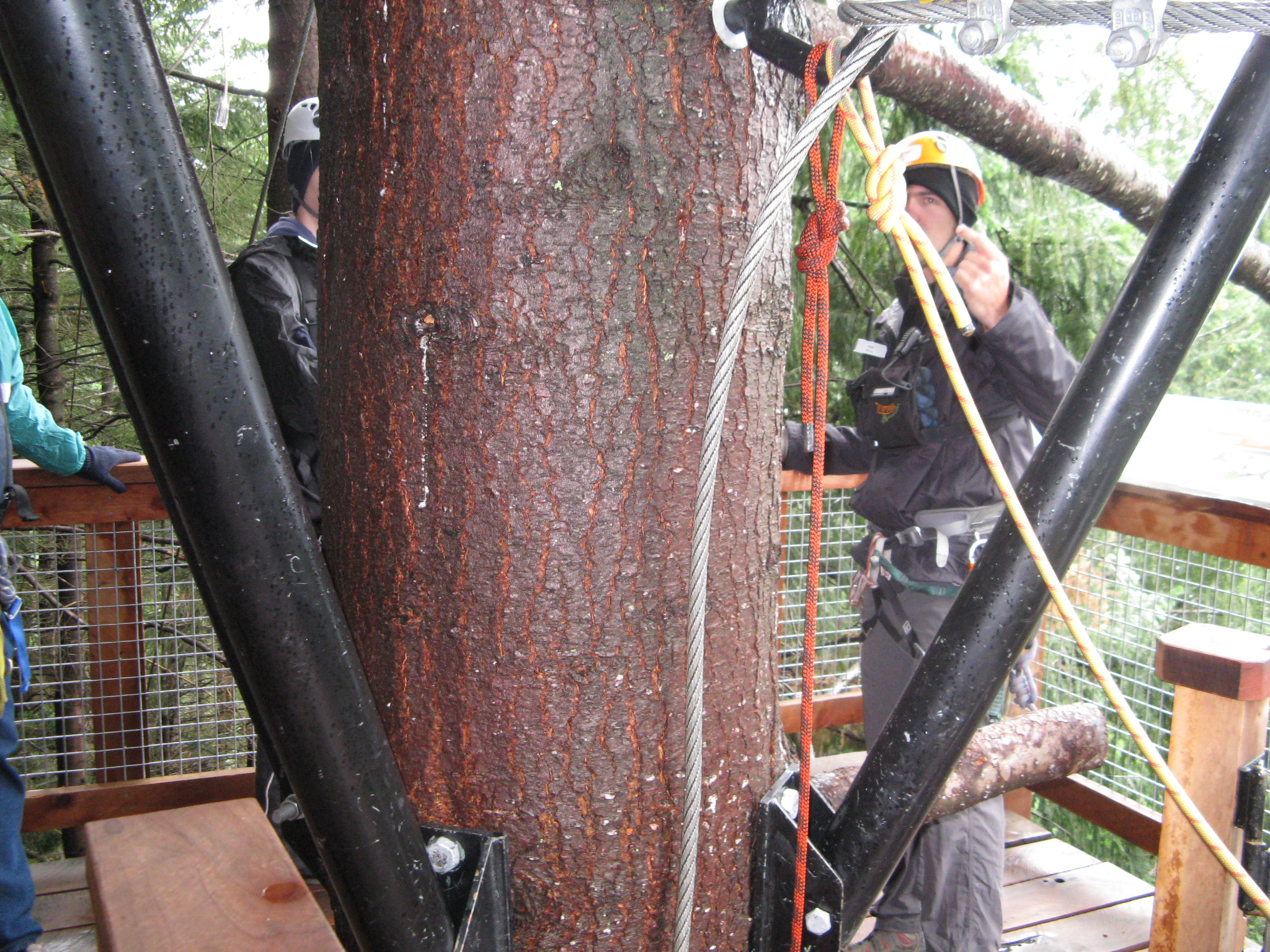
The flying fox tour is run by Ziptrek. If you’re ever in Queenstown, do it. The cables and platforms are attached to trees like this:
Cables and platforms built into Douglas fir trees
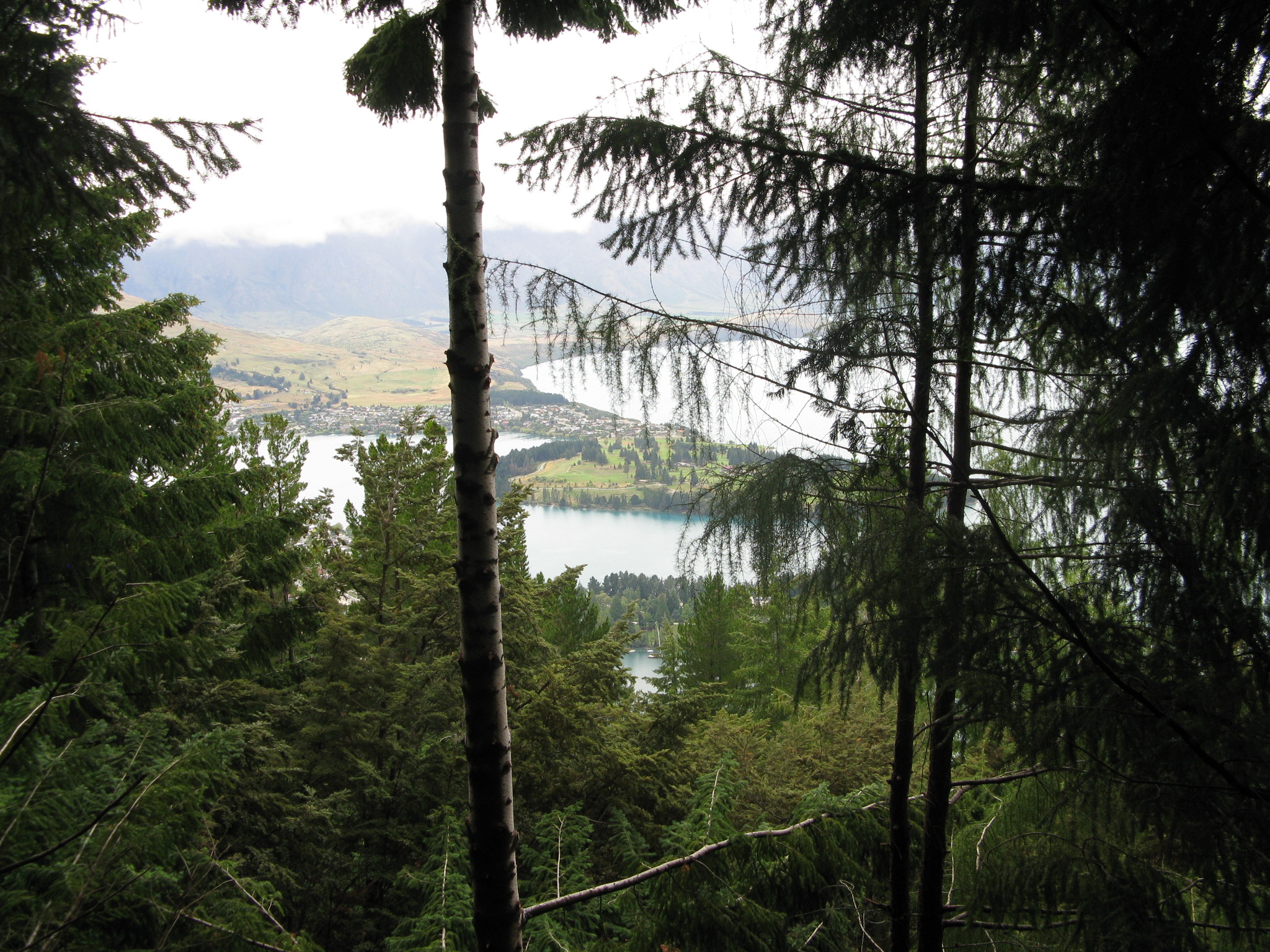
If you have the time, or the nerve, to look while zipping through the treetops, this is the view you’ll see:
View from the treetops
We panned for gold on the famous Arrow River:
Gold panning equipment
Sifting out all the pebbles and white sand:
Panning for gold
That’s the gold, right there! See it?
A speck of gold
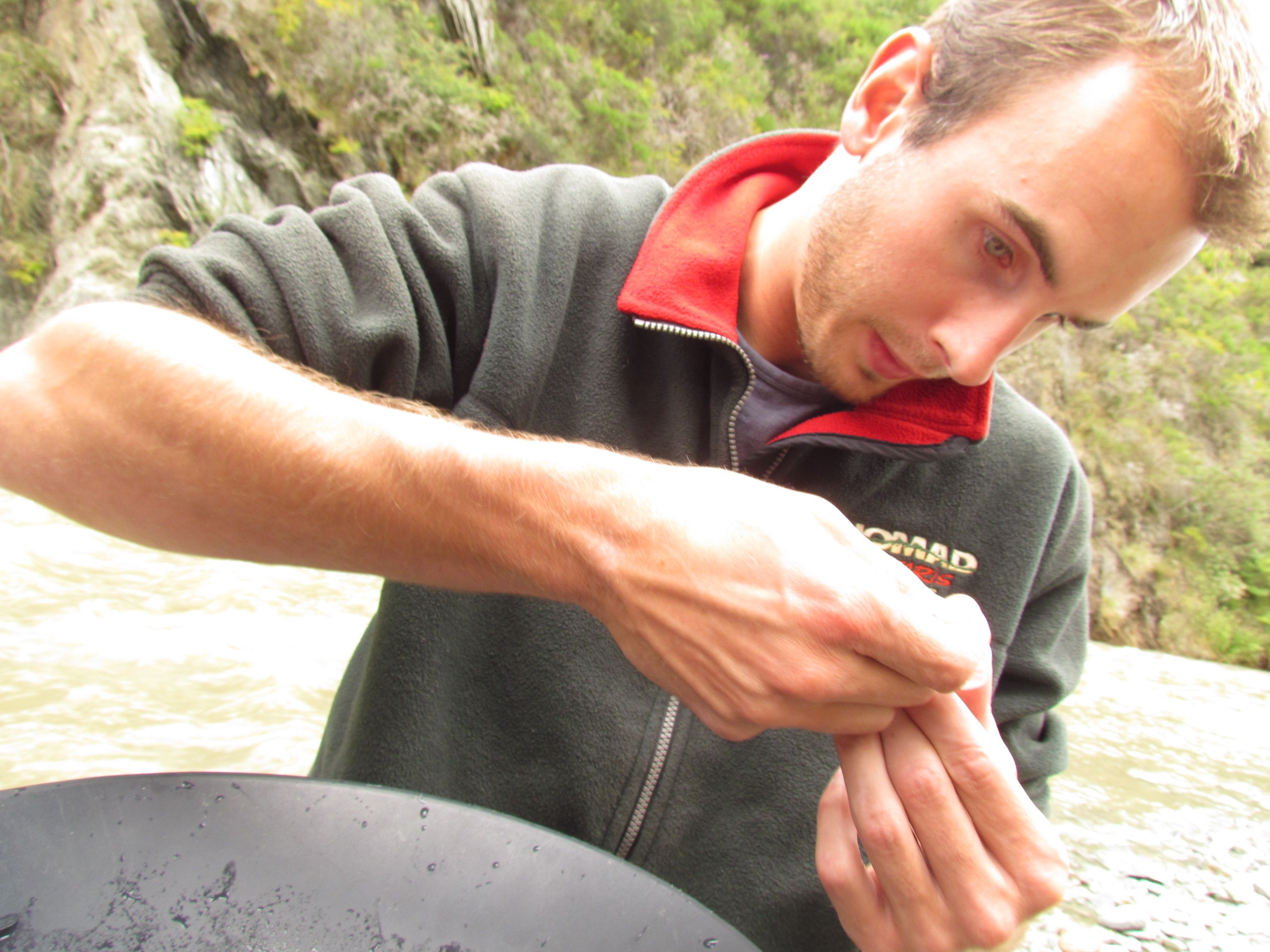
Poke the gold to make it stick to your finger:
Get the gold onto your fingertip
There it is. No, really:
Goldfinger
Add it to the rest of your stash. Carefully:
Collecting the gold
You’re rich:
Gold gold gold
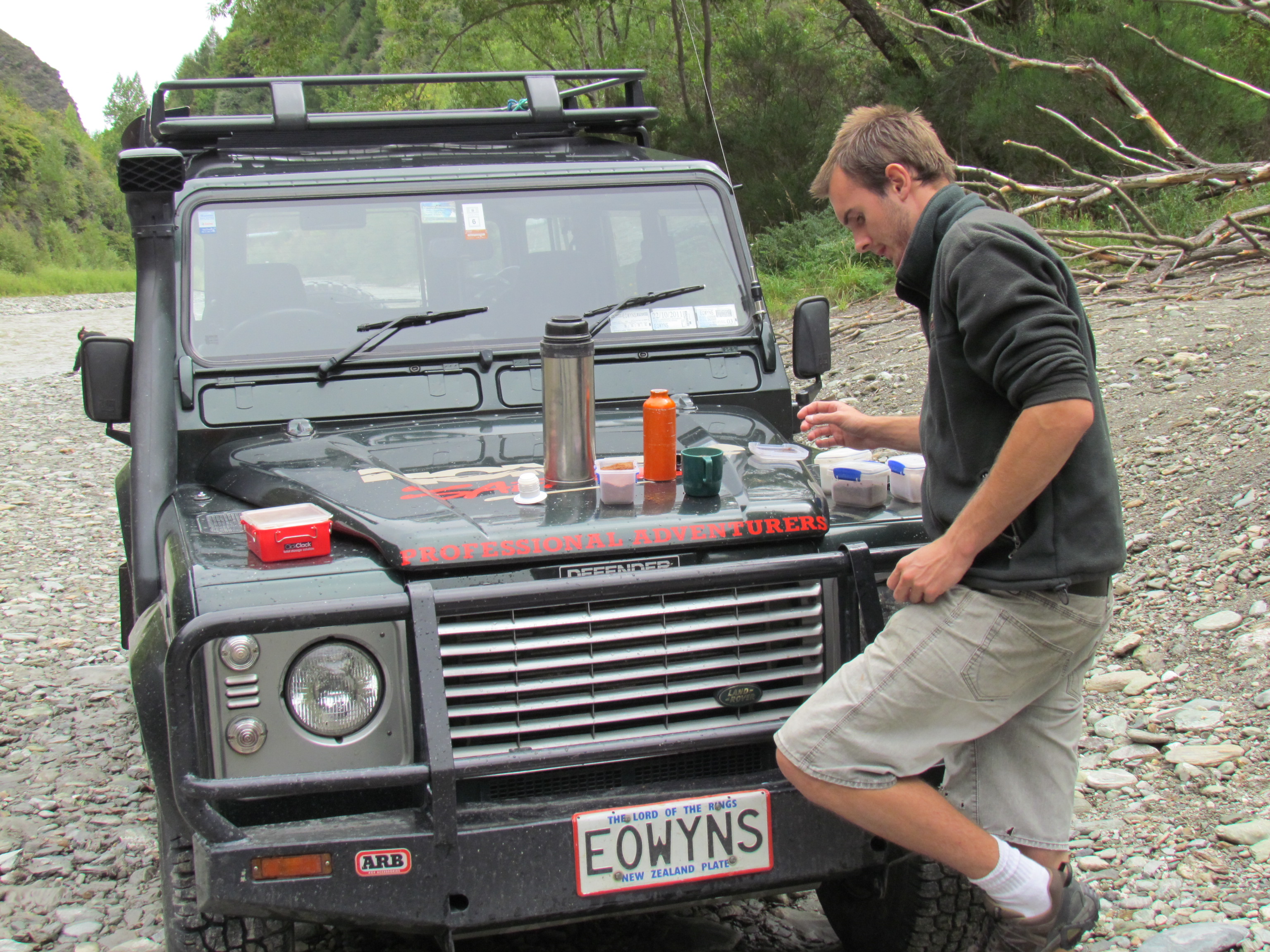
To celebrate our new found wealth, we enjoyed a high tea:
High tea on the Land Rover bonnet
Then we drove down the seventh most dangerous road in the world, into Skipper’s Canyon. This worm survived to tell the tale! I’ll post a video of the drive, just as soon as I can get it loaded onto YouTube. Motel broadband is not all its cracked up to be. This worm is sure you’re all waiting on tenterhooks. Ah, the suspense!
This is the blog of Mark Wordsworm, the travelling worm. I’m a 25-year-old bookmark and can proudly boast my own Hallmark serial number, 95 HBM 80-1. You’ll probably want to read all about me and my Travelling Companion (the TC) .
Today’s travel notes
Me and the TC are in Te Anau on the South Island of New Zealand, and this worm has just had a rare treat. We went to visit a colony of worms! In fact, a whole boatload of people crossed a lake and clambered through narrow caves and over rushing torrents, just to visit a colony of worms. I was tempted to set up shop and boast my own prowess as a fellow worm. The TC persuaded me that she could not do without me, so here I am, back in a small motel room, writing up my glowing (ahem) praise of the Te Anau glow worms.
My impressions? Lots of eye candy and a very professionally presented tour. Go Real Journeys tour operators.
Travel tip
Not much happens in Te Anau. It’s just a place to go to other places from.
Recommended accommodation
Amber Court Motel, on Quintin Street in Te Anau. Friendly service, clean and close to the action.
The book I’m in
Bad Luck and Trouble, by Lee Child. Jack Reacher gets together with some old buddies from his army unit. It’s like having a number of Reachers all in one book.
The photos
Me glowing bright on the floor of a New Zealand Beech forest. Some mushrooms and berries were there too:
The glowing travelling worm
On the way into Te Anau, this road sign tickled the TC’s sense of humour (she’s a technical writer, you know):
Signpost in Te Anau
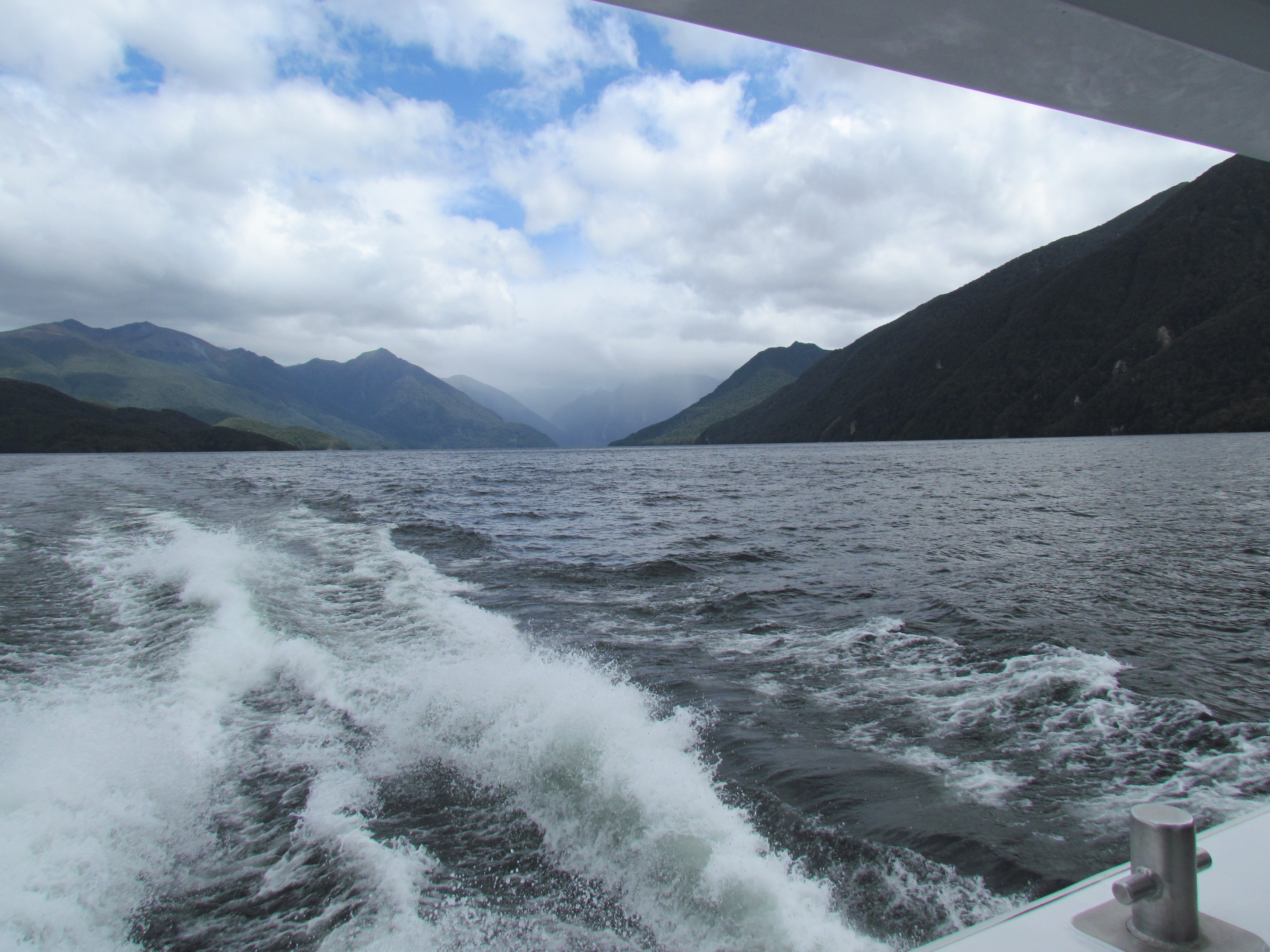
Heading off on the boat across Lake Te Anau:
Touches of Tolkien, heading off across Te Anau lake
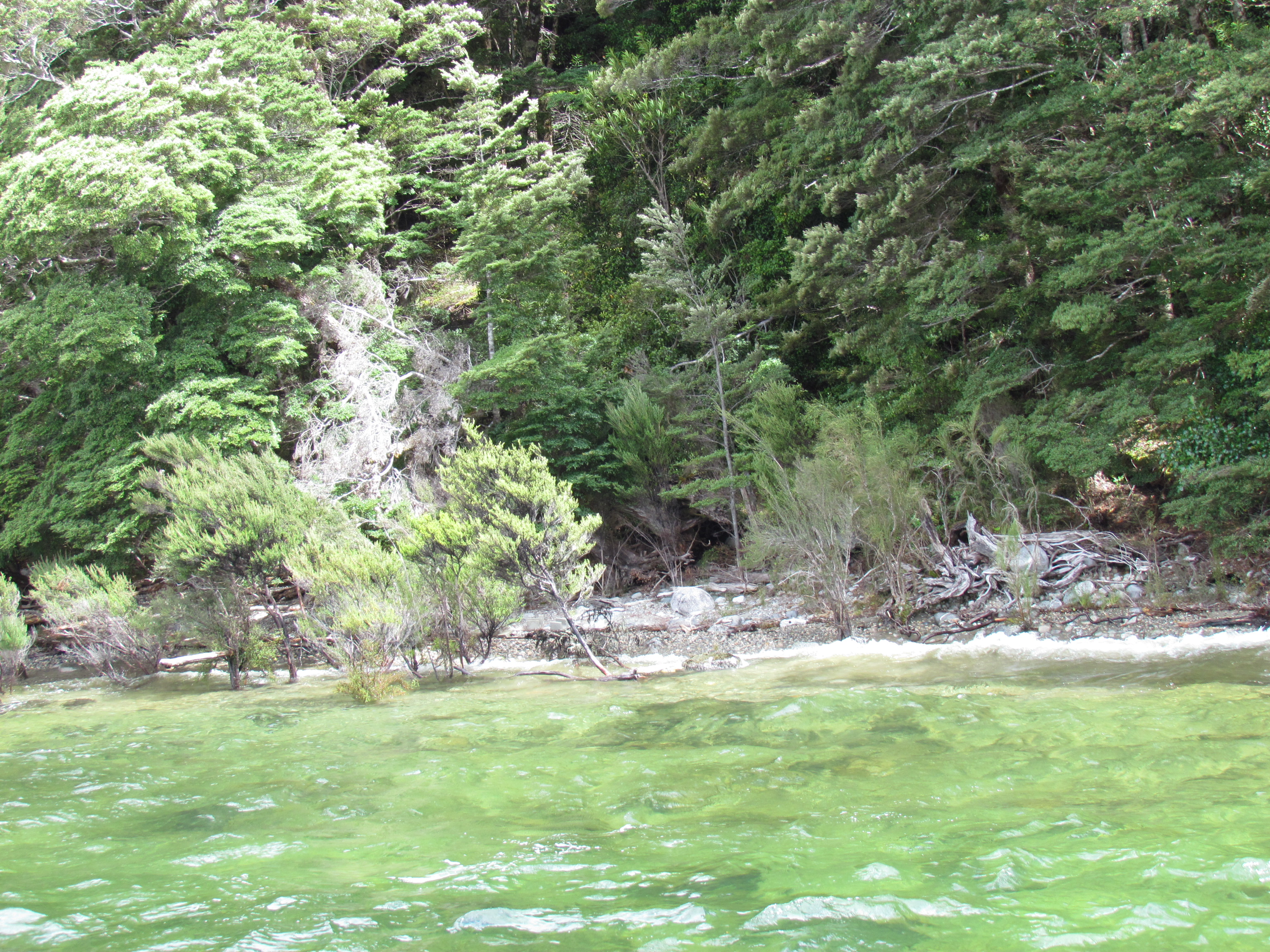
Reaching the shores where the glow worms have set up camp:
Native Beech forest meets lake
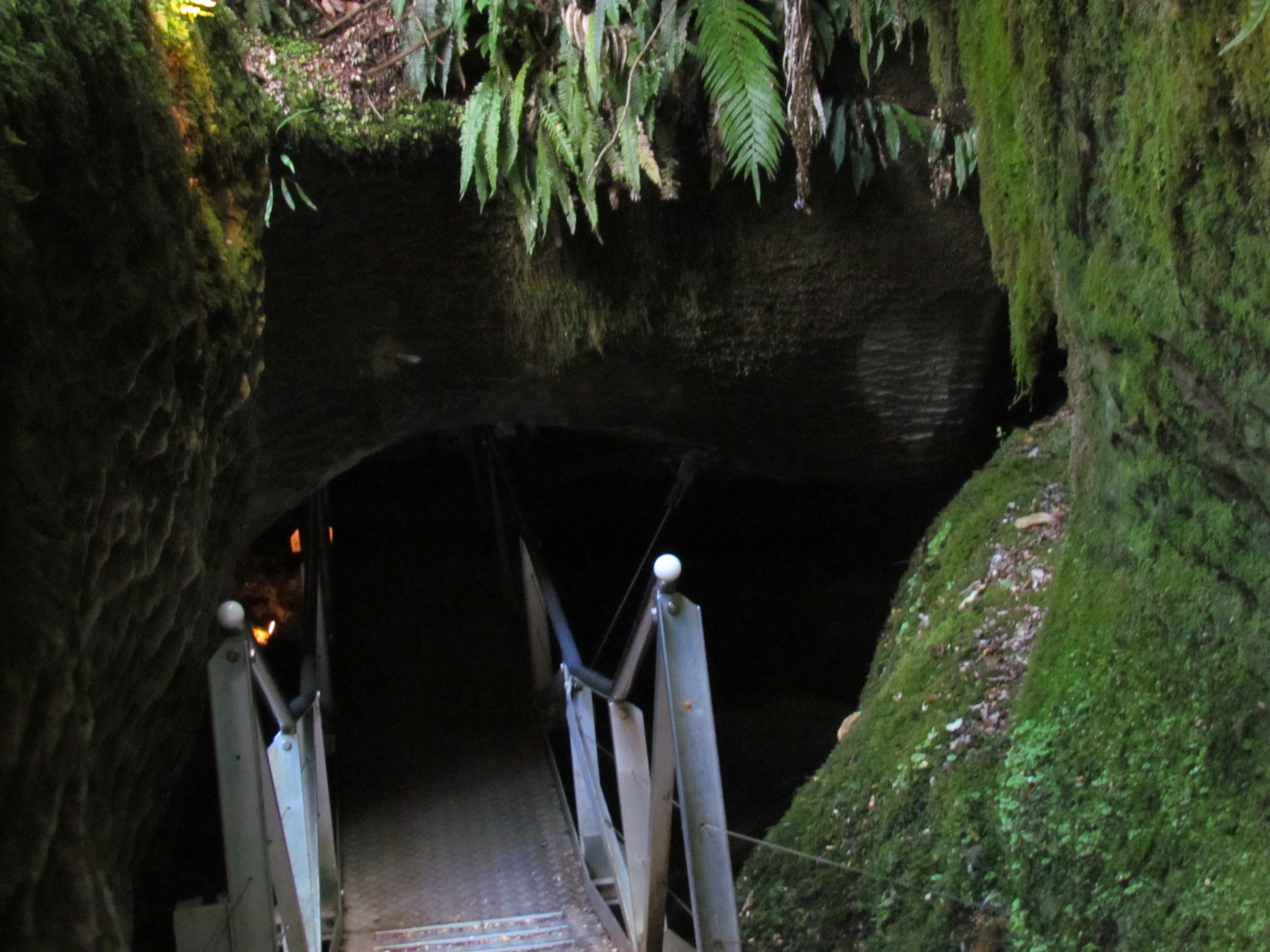
The glow worms are deep inside a series of caves carved by a rushing stream. The word “Te Anau” means something like “cave with swirling water” in ancient Maori. When Europeans first came to New Zealand, in the late nineteenth century, they had no idea these caves existed. Evidently they only found them in 1948. This is the entrance to the caves:
Entrance to the glow worm caves
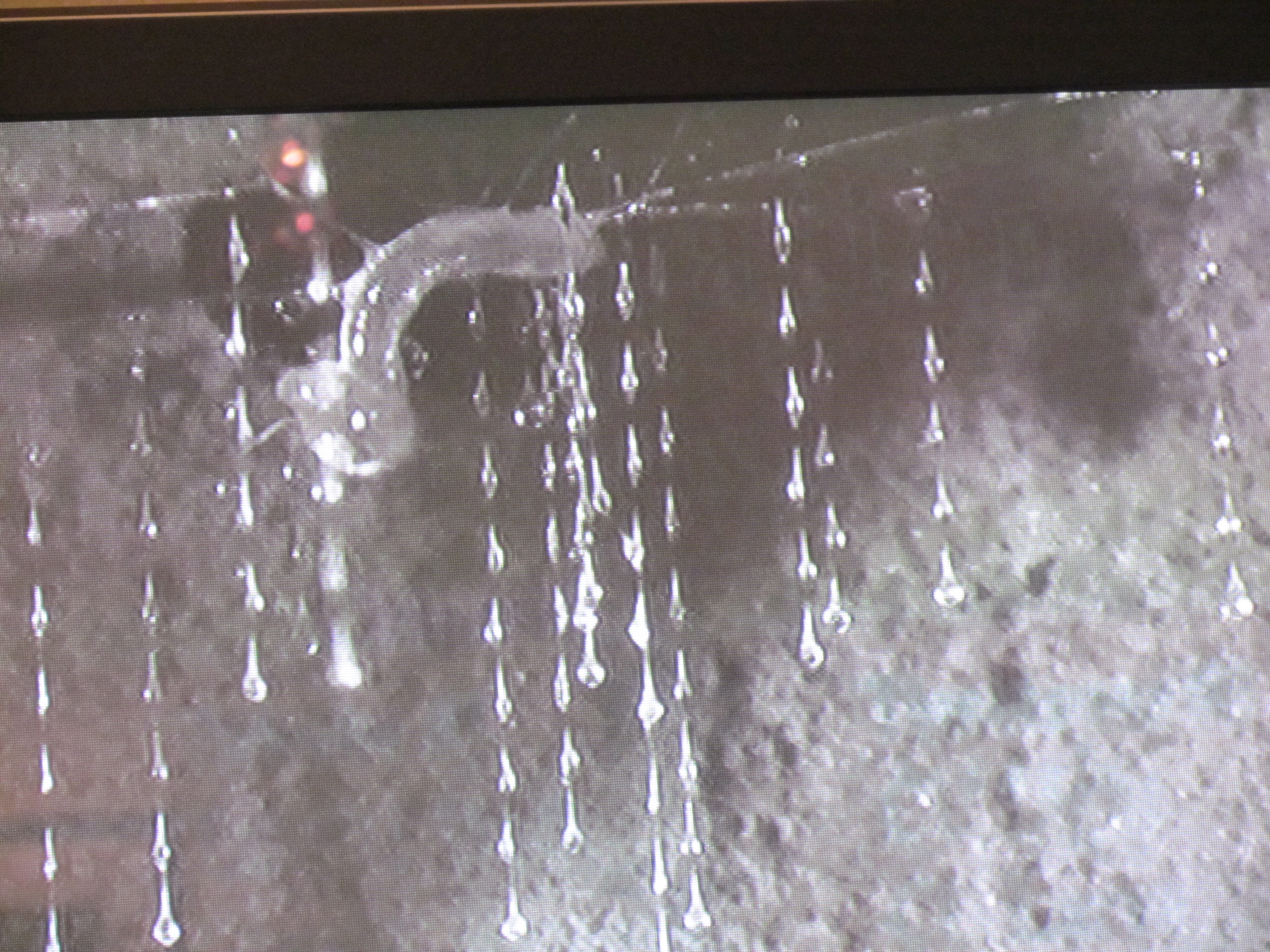
We did not take any photos inside the caves. That would disturb the worms and spoil the experience for the other people on the tour too. Instead, the TC snapped some pictures of the explanatory video that the tour company, Real Journeys, showed us. This is an infrared image of a glow worm setting up its fishing lines to catch insects for food:
Infrared image of glow worm and its fishing lines, by Real Journeys
Here’s another glow worm:
A glow worm, by Real Journeys
Travelling through the caves and grotto is eery and beautiful. You sit in a small boat (twelve passengers only) and the guide pulls you along via guide ropes. It’s pitch black, except for the patterns, swirls and patches of bright dots above your head. The water roars all round you. Every now and then you sense another boat passing close by, or a lighter patch of rock just above your head. The boat bumps into the rock. The water roars. Worms glow. Drips drop.
At one stage, I happen to know, the TC grabbed a nearby hand to pull herself back into reality.
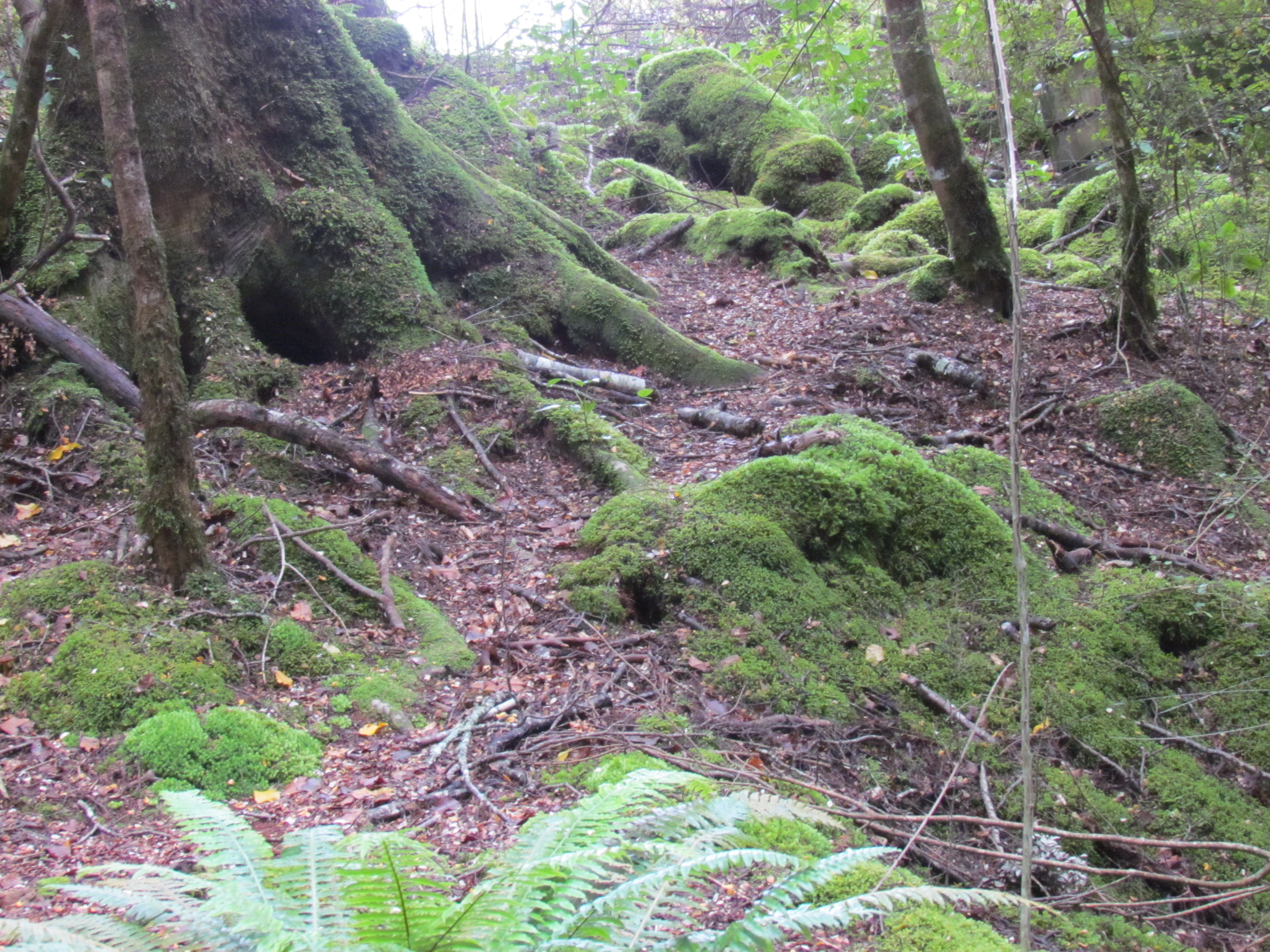
Back outside, the Beech forest is velvety:
A velvety cover of moss
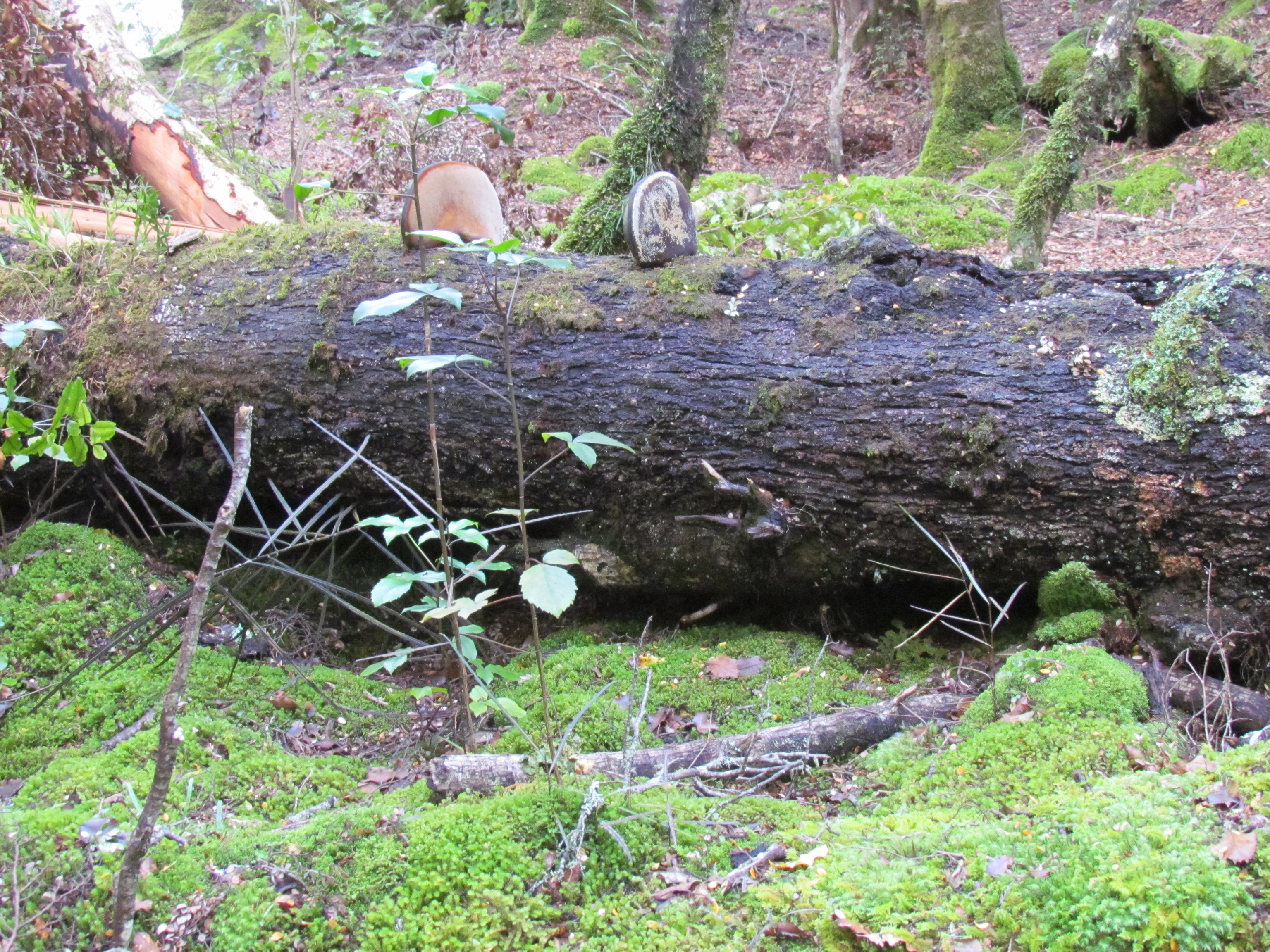
It’s weird too. Look at the fungus on this fallen tree:
Fungus on a fallen tree in the Beech forest outside the glow worm cave
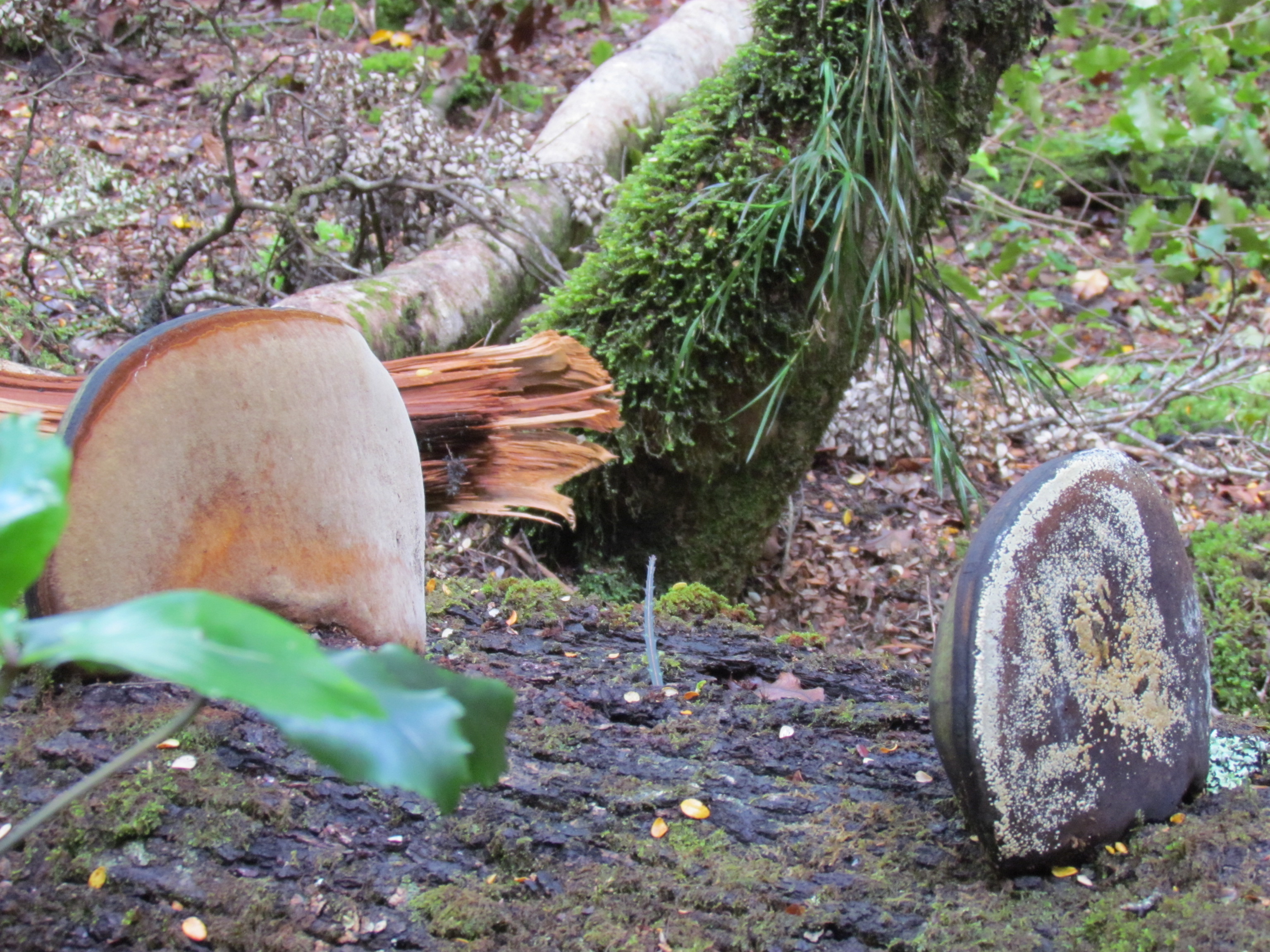
A closer look:
A closer look at the fungus
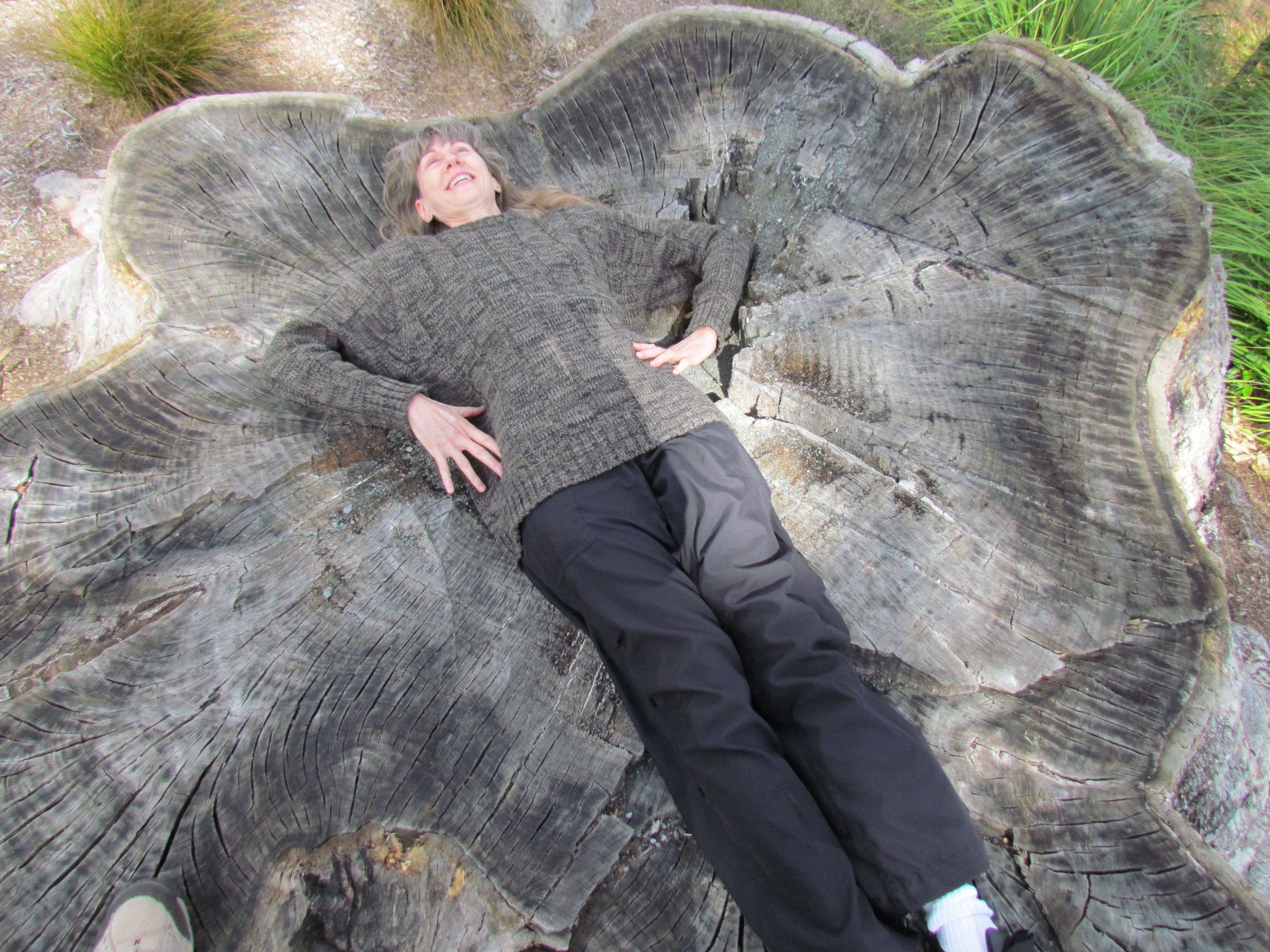
Back in Te Anau after a fast boat ride across the lake, the TC spotted a huge tree stump that had an interesting shape. I don’t think she had quite succeeded in pulling herself back to reality yet, because she decided that if she lay down on the stump, she and the stump would look just like a butterfly. So she did it:
The TC and a tree stump combining to form a butterfly
Silly TC. Only worms like me and the glow worms can grow wings.
This is the blog of Mark Wordsworm, the travelling worm. I’m a 25-year-old bookmark and can proudly boast my own Hallmark serial number, 95 HBM 80-1. You’ll probably want to read all about me and my Travelling Companion (the TC) .
Today’s travel notes
Me and the TC have not been doing much travelling recently. You may have noticed the dearth of posts from this worm. What have we been up to, you may well ask?
The TC has acquired a new toy, somewhat unimaginatively named the Canon PowerShot SX30 IS. We call it the SuperZoom. It’s a point-and-shoot digital camera, with a 35-times zoom lens, going from 4.3 mm wide angle to 150.5 mm telephoto. The equivalent in 35 mm terms is 24 mm to 840 mm.
Have your eyes glazed over already? Do you feel the sudden urge to rush off into the traffic or jump over a cliff, or find some other way to put the zing back into life? Now you have the tiniest idea of what things have been like chez TC recently.
The TC ummed and ahhed for months before buying the SuperZoom. She consulted DSLR experts, read reviews and agonised over the choice. Go for a DSLR with quality “glass” (that’s a lens, folks) and total control over all aspects of the photo, but requiring a number of lenses that are expensive, cumbersome and finicky. Or go for a point-and-shoot with a single zoom lens, possibly compromising on the quality of the picture because a one-size-fits-all solution is often a compromise.
Then Canon produced the SX30 IS at around the same time as the TC decided against a DSLR. Decision made, and in the process the TC had learned a whole lot about just why the DSLR enthusiasts were worried that the SX30 IS might yield disappointing results.
F-stops and apertures, exposure times and ISO speeds, bracketing and exposure bias, focal length, depth of field… It’s fascinating stuff. Especially when you realise that most of the terminology and skills were developed to suit photography done with 35mm film, and that folks now just kind of morph the same terminology into the digital world, where it kind of works. Yes, fascinating stuff. So the TC tells me.
My impressions? For a details-oriented person like the TC, this photography lark looks to be an interesting occupation. From the point of view of those around her? Well, it keeps her out of our hair!
Travel tip
When travelling with a camera, or a camera-wielding TC, be prepared to stop and shoot at a moment’s notice.
The book I’m in
How to Do Everything: Digital Camera, by Dave Johnson. This is an excellent book for anyone wanting to learn about photography and digital cameras.
This worm had a narrow escape recently. I was spending some time in a DK book on photography that the TC took a violent dislike to. Ask her about it, then duck!
The photos
Me with Peg and a piece of bark that’s recently fallen from a Sydney Red Gum tree:
F-stops and focus and zooms, oh my!
F-stop: f/4
Exposure time: 1/125 sec
ISO speed: ISO-80
Exposure bias: -1 step
Focal length: 4 mm
Max aperture: 2.875
Metering mode: Pattern
Flash: No flash, compulsory
The TC has discovered that the camera and Windows both store a number of interesting facts about how the picture was taken. To keep her happy, I’ve copied the details below each photograph in this post. She’s been experimenting with the options available in the camera’s various modes. Even thought it’s a point-and-shoot, it offers an impressive flexibility for those who care to click and flick various buttons, wheels and knobs.
A jumble of bark at the base of a Scribbly Gum:
F-stops and focus and zooms, oh my!
F-stop: f/4
Exposure time: 1/50 sec
ISO speed: ISO-400
Exposure bias: 0 step
Focal length: 11 mm
Max aperture: 4
Metering mode: Pattern
Flash: No flash, compulsory
That looks like a secret code on some ancient rolled parchments, doesn’t it? Actually, it’s the work of grubs living in the bark of the tree.
The trunk of a Scribbly Gum:
F-stops and focus and zooms, oh my!
F-stop: f/4.5
Exposure time: 1/40 sec
ISO speed: ISO-100
Exposure bias: -1 step
Focal length: 18 mm
Max aperture: 4.34375
Metering mode: Pattern
Flash: No flash, compulsory
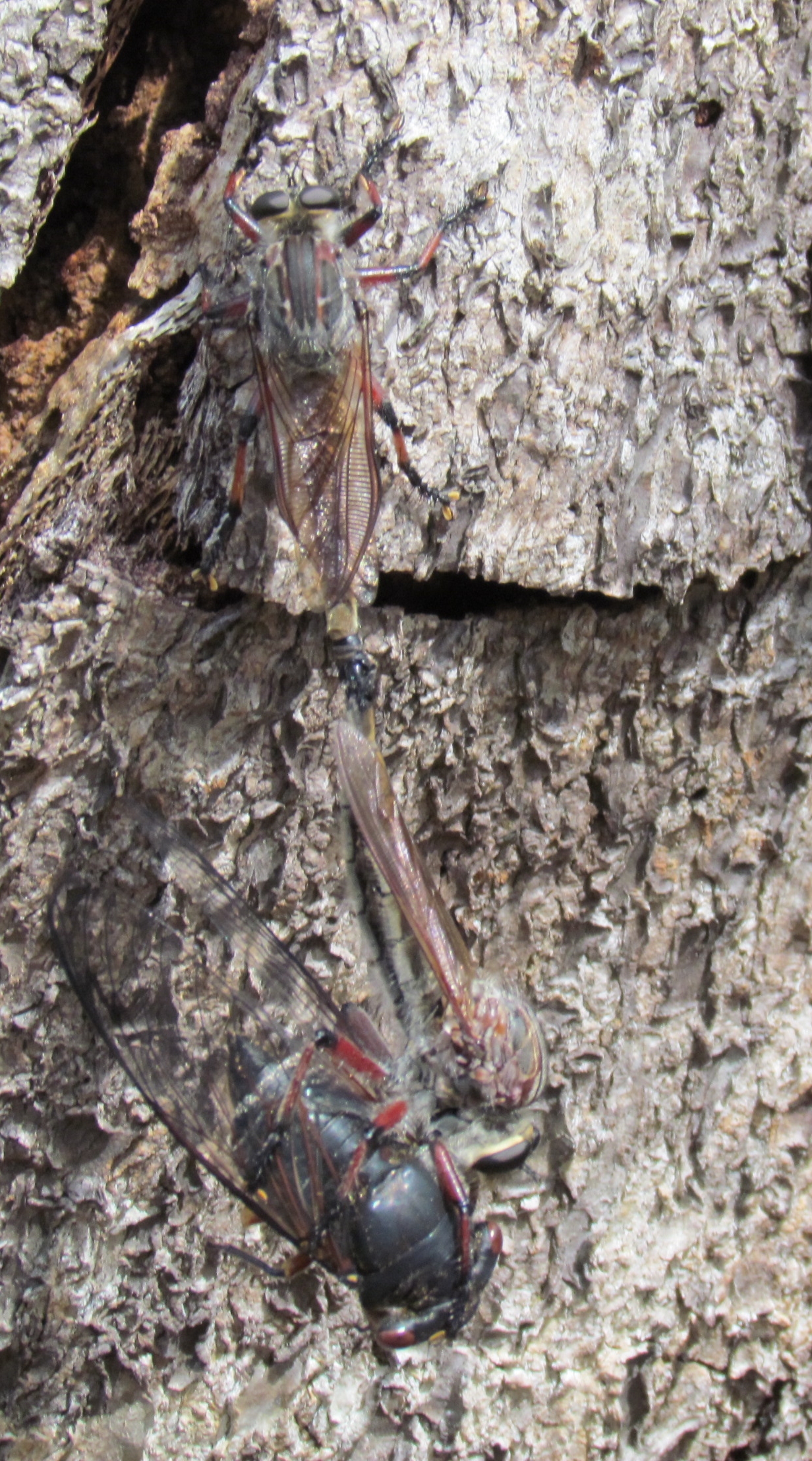
Two dragonflies mating while one chomps a cicada:
F-stops and focus and zooms, oh my!
F-stop: f/4
Exposure time: 1/250 sec
ISO speed: ISO-100
Exposure bias: 0 step
Focal length: 12 mm
Max aperture: 4
Metering mode: Pattern
Flash: No flash, compulsory
Talk about hostile mergers and acquisitions! Did you know that dragonflies are carnivorous? This worm did not, and neither did the TC.
Before we go any further, I have to admit I’m not sure that the happy couple are dragonflies. Their wings are parallel to their bodies, not at right angles. They don’t look like damselflies either, though. These critters were large: about 4 cm long. Do you know what they are?
One of the pair has a cicada firmly grasped in its legs. The trio was very mobile, and flew up and around the TC twice while she photographed it.
Another shot, where you can see the cicada more easily:
F-stops and focus and zooms, oh my!
F-stop: f/4.5
Exposure time: 1/160 sec
ISO speed: ISO-160
Exposure bias: 0 step
Focal length: 29 mm
Max aperture: 4.34375
Metering mode: Pattern
Flash: No flash, compulsory
A kookaburra, shot at maximum telephoto range (150 mm, 35x zoom, equiv. 840mm):
F-stops and focus and zooms, oh my!
F-stop: f/5.8
Exposure time: 1/80 sec
ISO speed: ISO-400
Exposure bias: 0 step
Focal length: 150 mm
Max aperture: 5.0625
Metering mode: Spot
Flash: No flash, compulsory
The TC is inordinately proud of that shot. It was tricky to keep the bird in focus at such a long distance. She played around with the depth of field (there’s another of her newly acquired terms) and exposure, took a number of shots, then chose the one she liked best.
We’ve already covered trees and birds, two of the TC’s favourite subjects. Here’s the third:
F-stops and focus and zooms, oh my!

F-stop: f/3.5
Exposure time: 1/60 sec
ISO speed: ISO-250
Exposure bias: -1 step
Focal length: 8 mm
Max aperture: 3.625
Metering mode: Spot
Flash: Flash, auto, redeye
This is the blog of Mark Wordsworm, the travelling worm. I’m a 25-year-old bookmark and can proudly boast my own Hallmark serial number, 95 HBM 80-1. You’ll probably want to read all about me and my Travelling Companion (the TC) .
Today’s travel notes
Me and the TC spent last week driving up New Zealand’s North Island, making our way from the southern end to Auckland in the north. We started in Wellington, where the TC attended a conference. Then we drove across the green hills to Napier on the east coast, and back to Taupo in the centre surrounded by thermal springs and geysers. We oohed and aahed over the steaming Craters of the Moon and the wasteland surrounding Pohutu at Rotorua, before heading north to Tauranga on the coast and finally to Auckland.
My impressions? How green everything is! How remarkable to see gouts of steam spouting upward from forests and valleys, even from farmyards and roadside gutters. It’s like being in the middle of a Tolkien scene.
Travel tip
Don’t trust blindly in your GPS. We spent over half a day wandering around the mountains outside Napier, trying to find our way to Taupo. The GPS kept insisting we should turn into roads that were clearly suitable only for the most rugged 4WD. Indeed, entry to most of them was barred by bright yellow boom gates! Eventually we just followed the highway and a map.
Recommended accommodation
The Nautilus, on the Marine Parade in Napier. Quality, comfort, space and great value for money.
Hotel DeBrett, on High Street in Auckland. Quirky style, warm welcome, quality and beauty.
The book I’m in
The Sirens of Titan, by Kurt Vonnegut. A brilliant book! It’s a bit of George Orwell with more than a touch of Douglas Adams. This worm reckons that this book, written in 1959, must have had a big influence on the Hitchhiker’s Guide to the Galaxy. If you’re partial to the darker side of life blended with sci fi and black humour, this book is a must read.
The photos
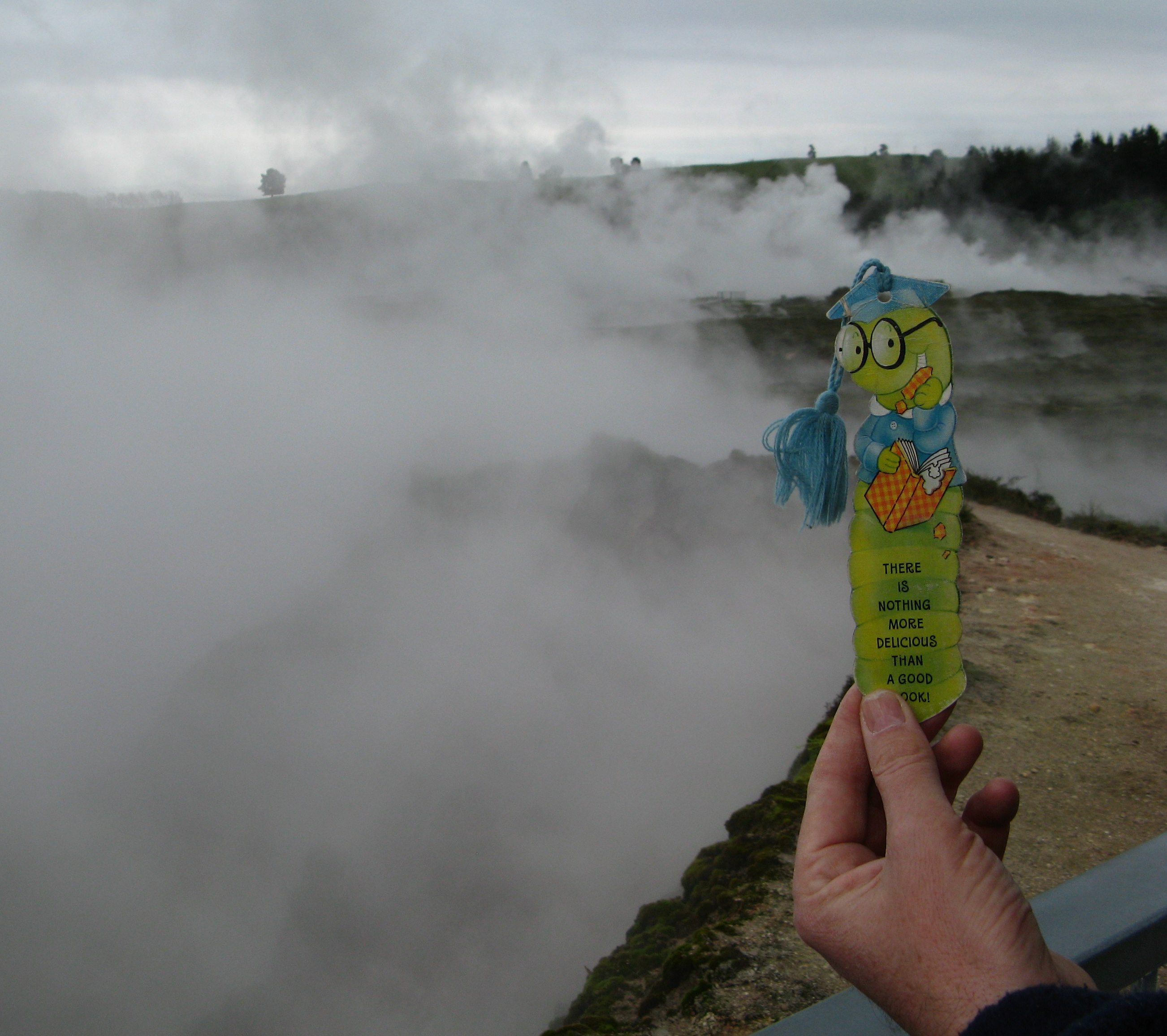
Me at Craters of the Moon, outside Taupo:
New Zealand's North Island
That’s steam you see boiling up from the crater below me. As is her wont, the TC is quite happy for me to be exposed to the utmost peril in the interests of a good photo. Has she considered, I wonder, what such hot wet stuff could do to a bookmark like me? Talk about pulp fiction!
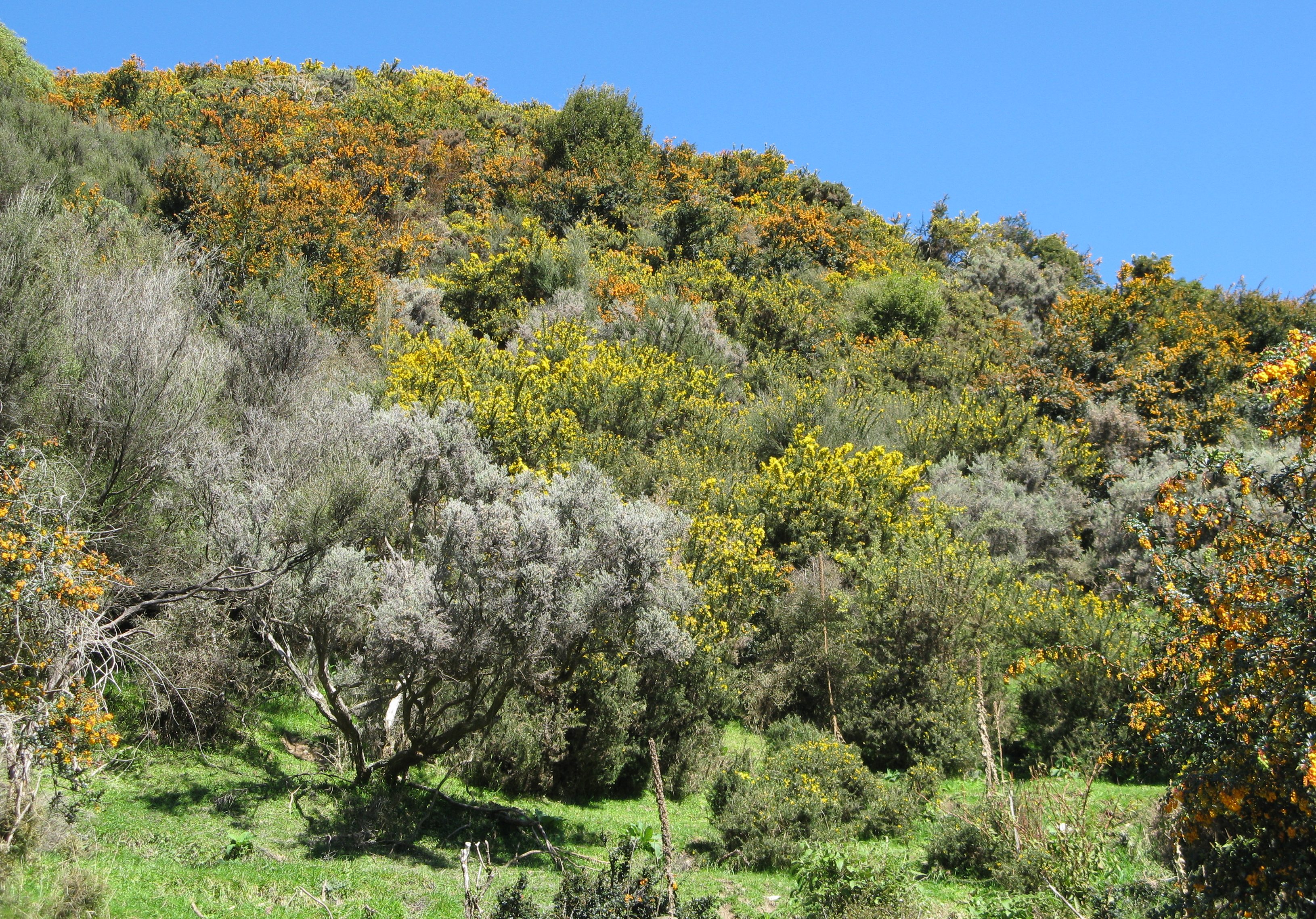
Wellington is built upon and surrounded by hills of various shapes and sizes. We were there in early spring, birds a-tweeting and flowers bursting out all over the place:
New Zealand's North Island
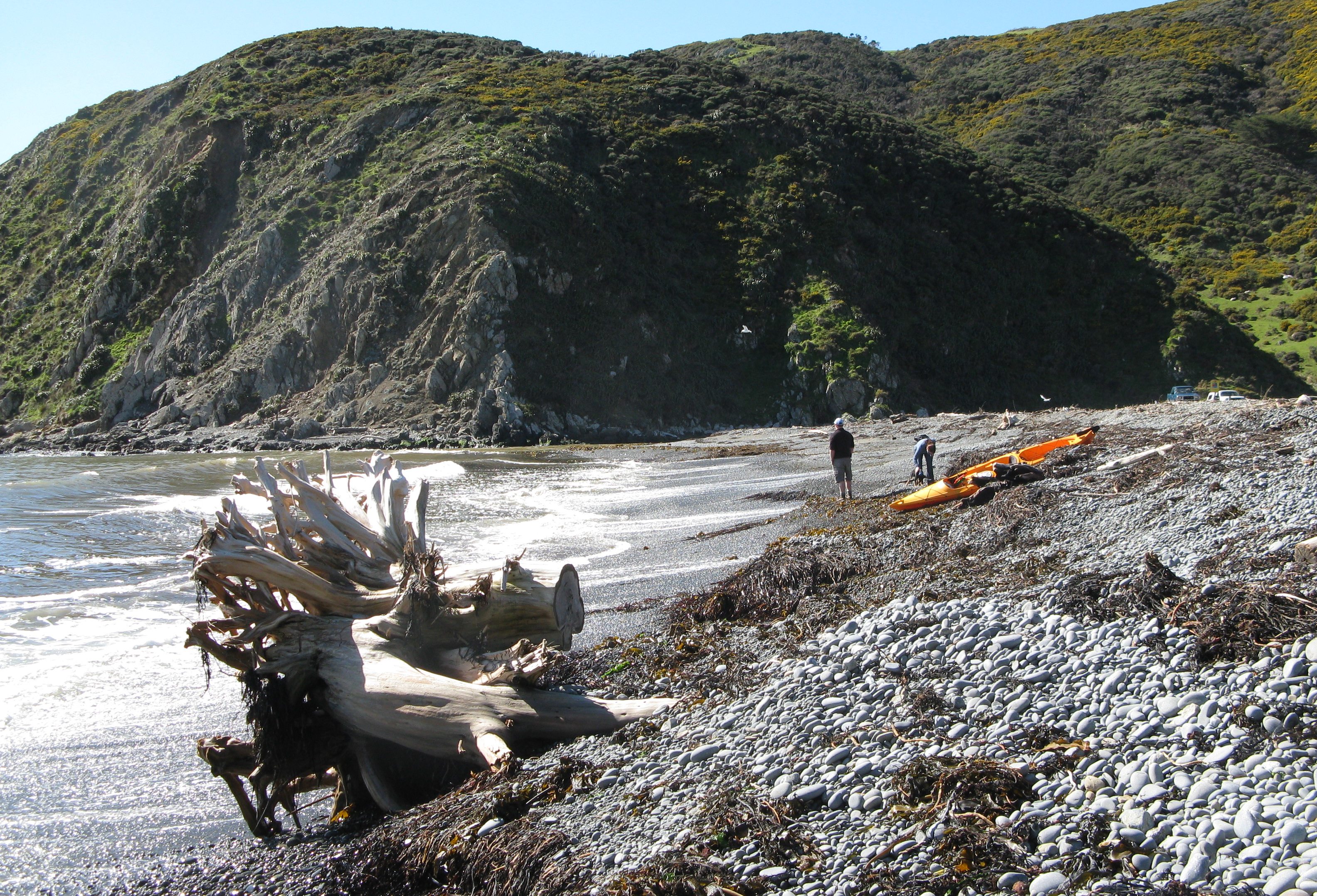
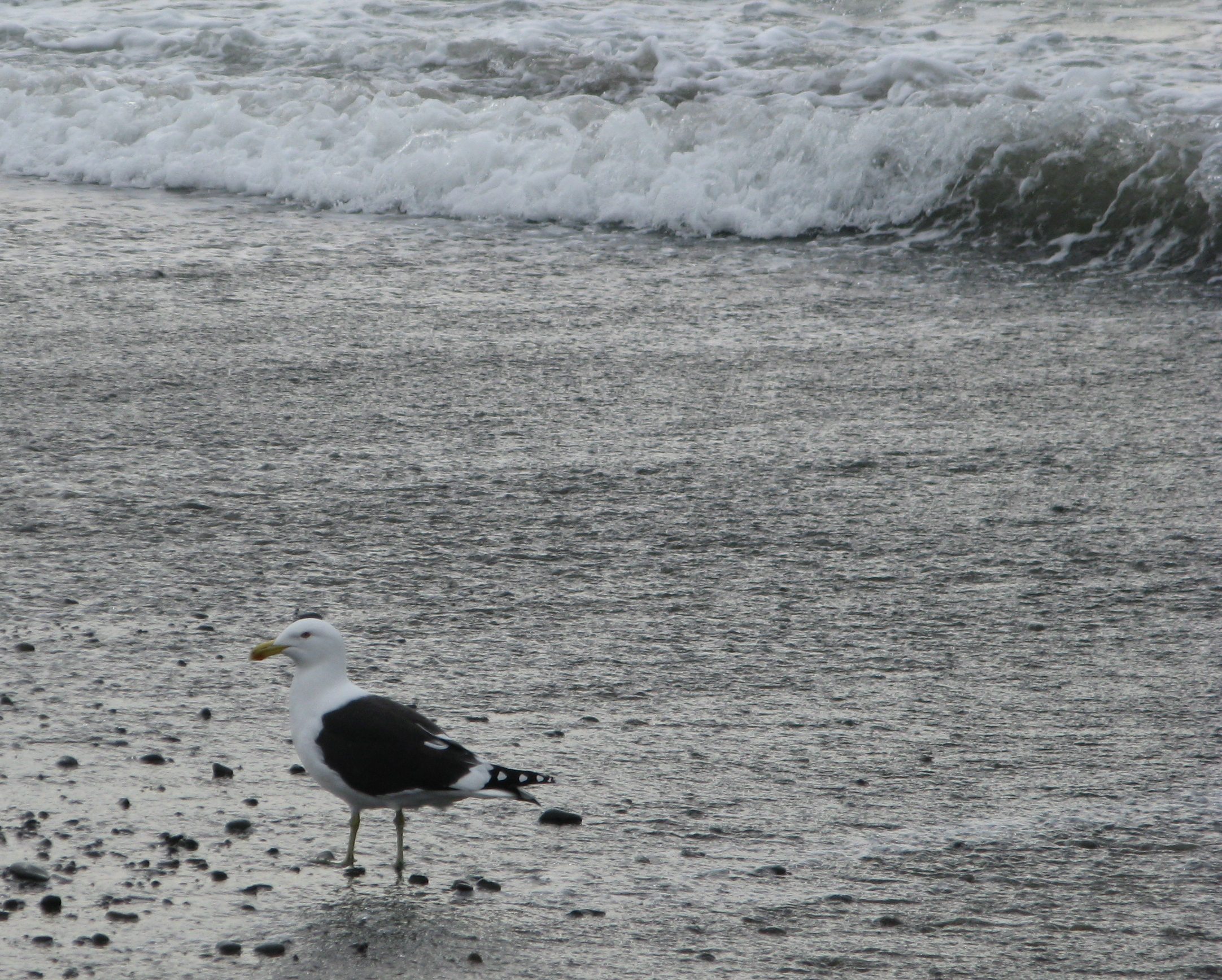
Huge dead trees clutter the countryside. The beaches are made of black pebbles. This is Makara, near Wellington:
New Zealand's North Island
On to Napier. More black beach. Jonathan was there before us:
New Zealand's North Island
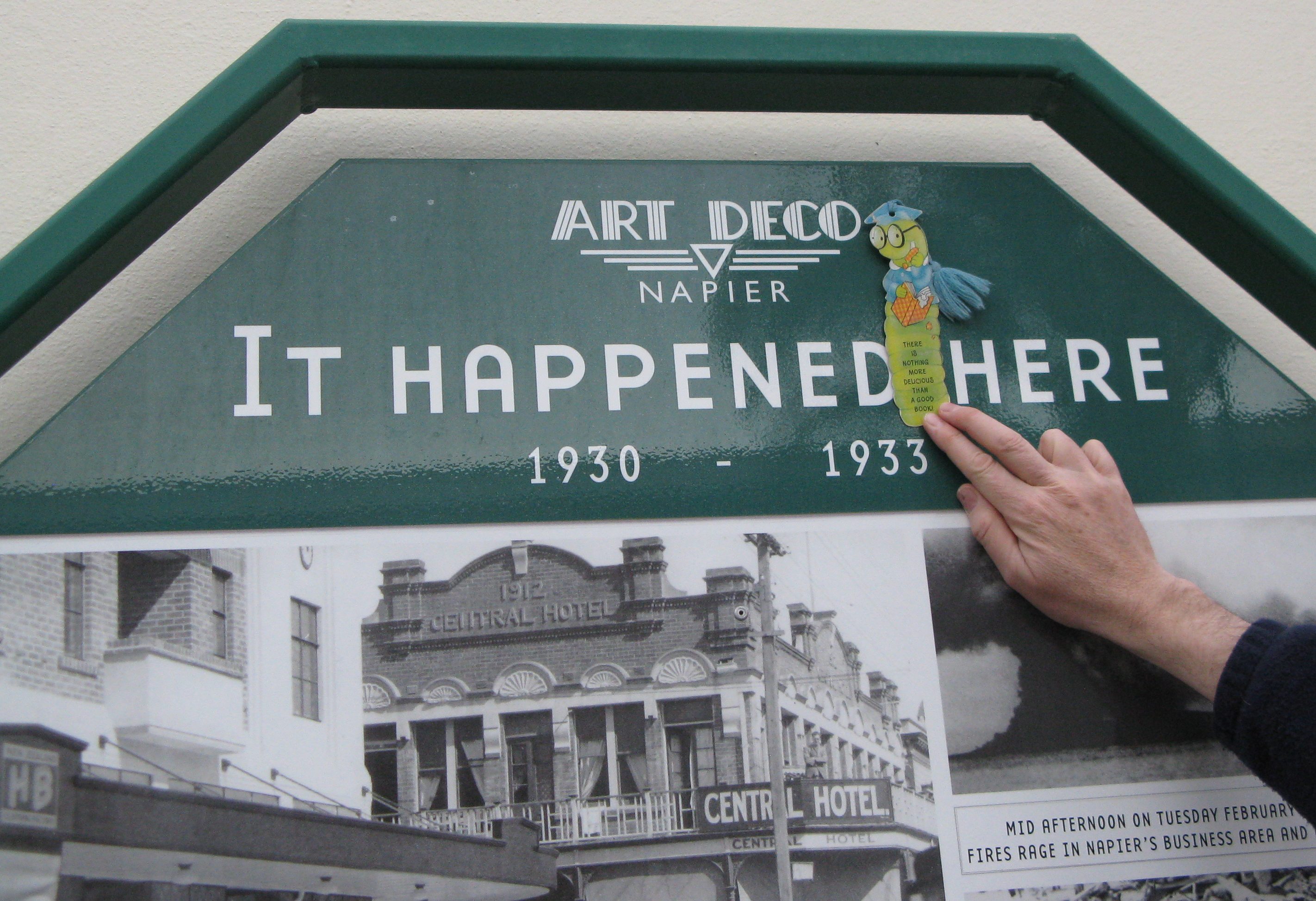
Art Deco, Napier. It happened here:
New Zealand's North Island
An earthquake hit Napier in the 1920s, followed by a devastating fire in 1931. The city rebuilt the town centre, Art Deco style. It was the height of the Great Depression. The work gave many a family their daily crust.
The Daily Telegraph building in Napier:
New Zealand's North Island
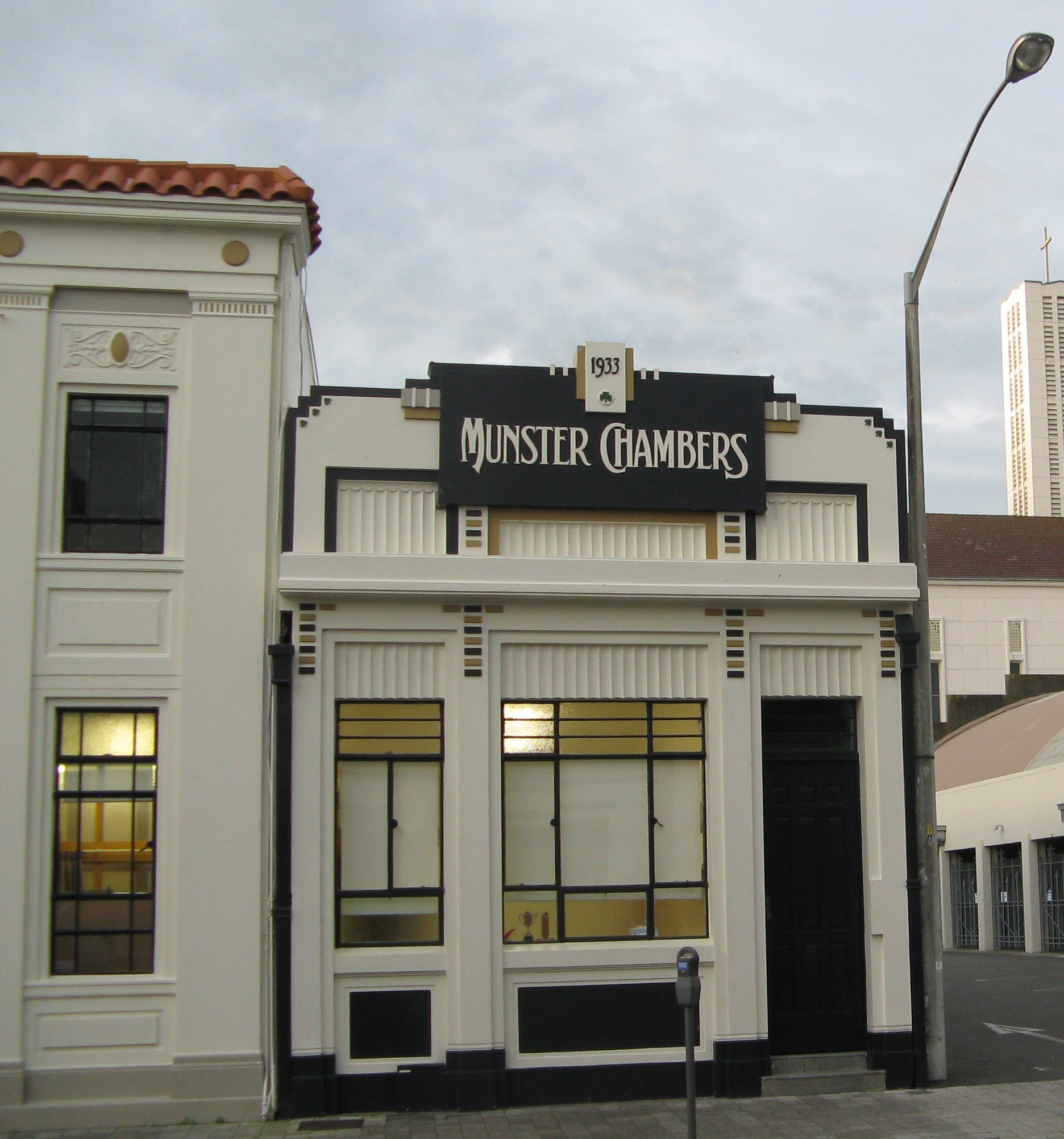
Munster Chambers in Napier:
New Zealand's North Island
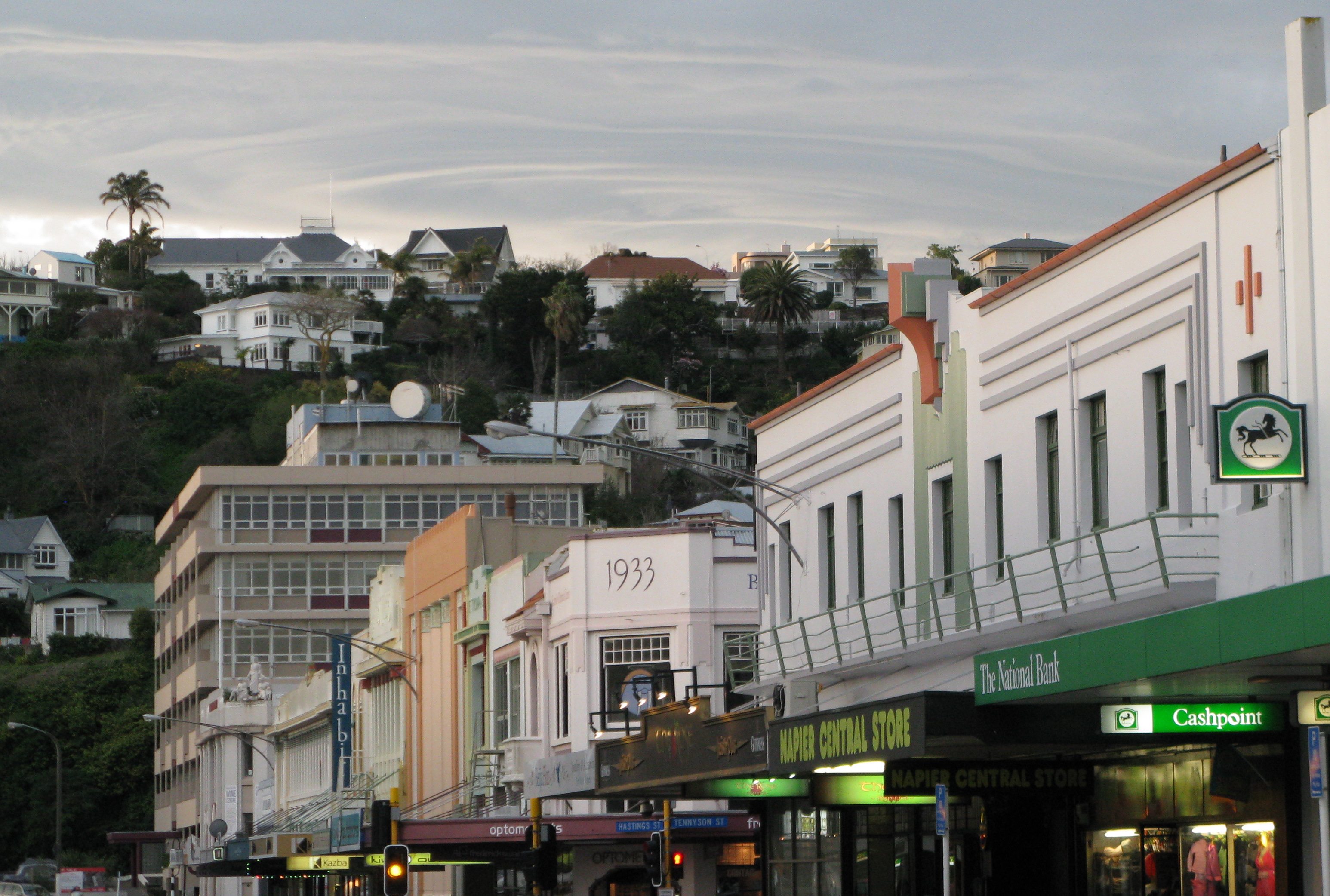
A Napier main street, with the posh houses on the Bluff behind:
New Zealand's North Island
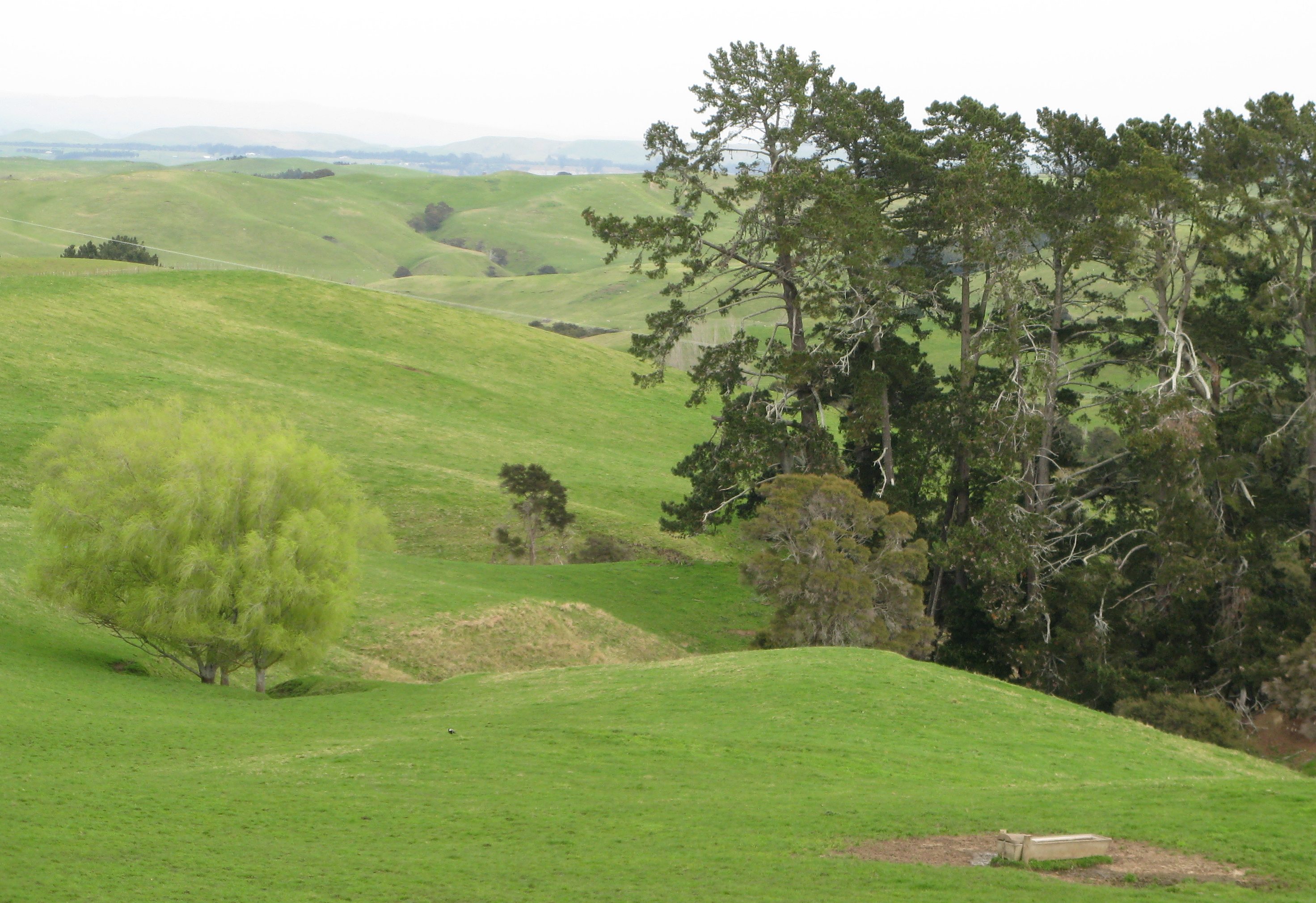
How green everything is! This is a typical scene on the drive from Napier on the east coast, to Taupo in the centre:
New Zealand's North Island
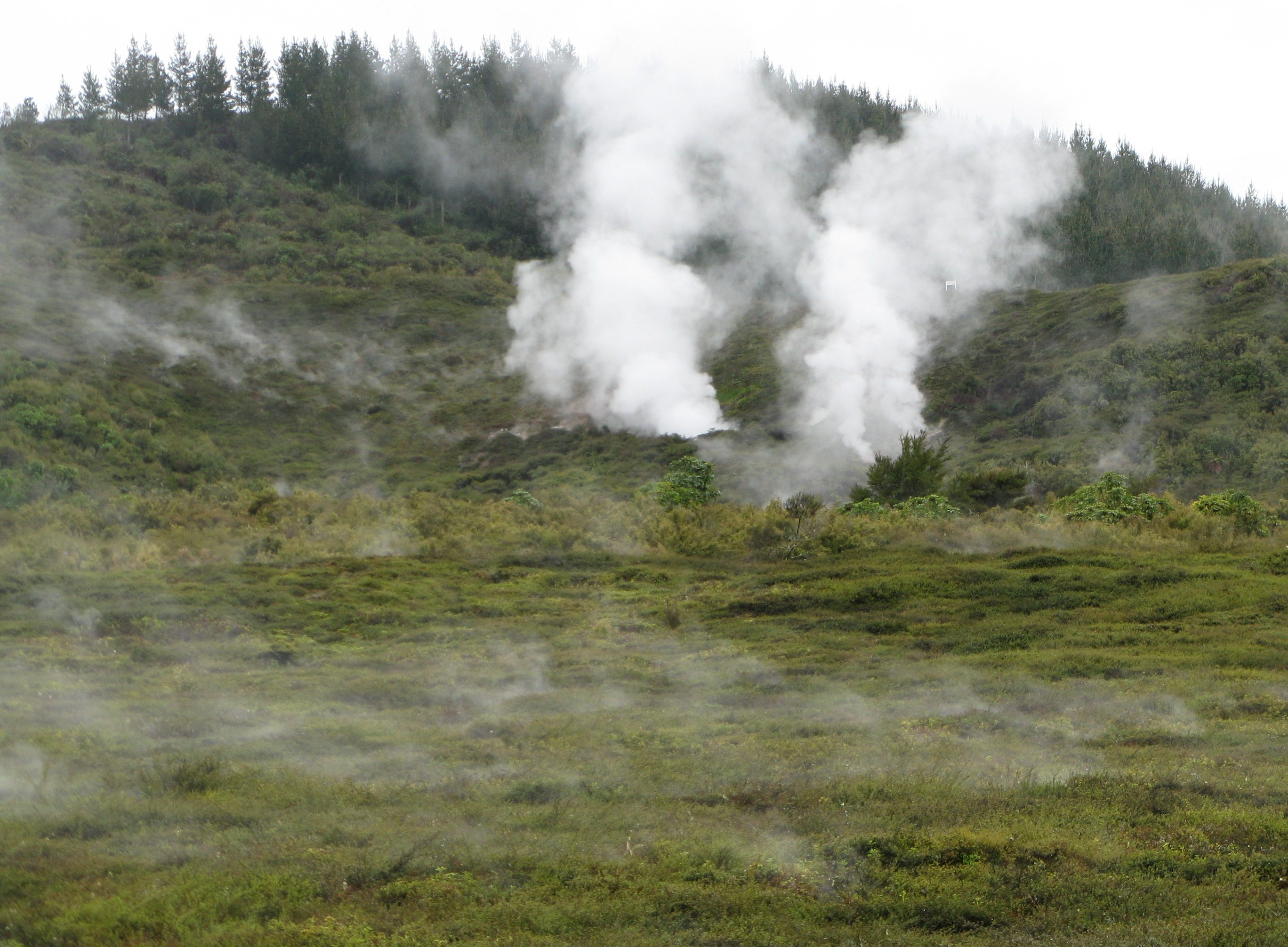
We almost drove past Craters of the Moon, never having heard of it. Then the TC saw the signpost and we turned in on a whim. Here’s a tip: Don’t drive past. It’s well worth a visit. Quiet. Birdsong. Bubbling mud. The scent of sulphur. Bright colours in the vegetation and the mud.
New Zealand's North Island
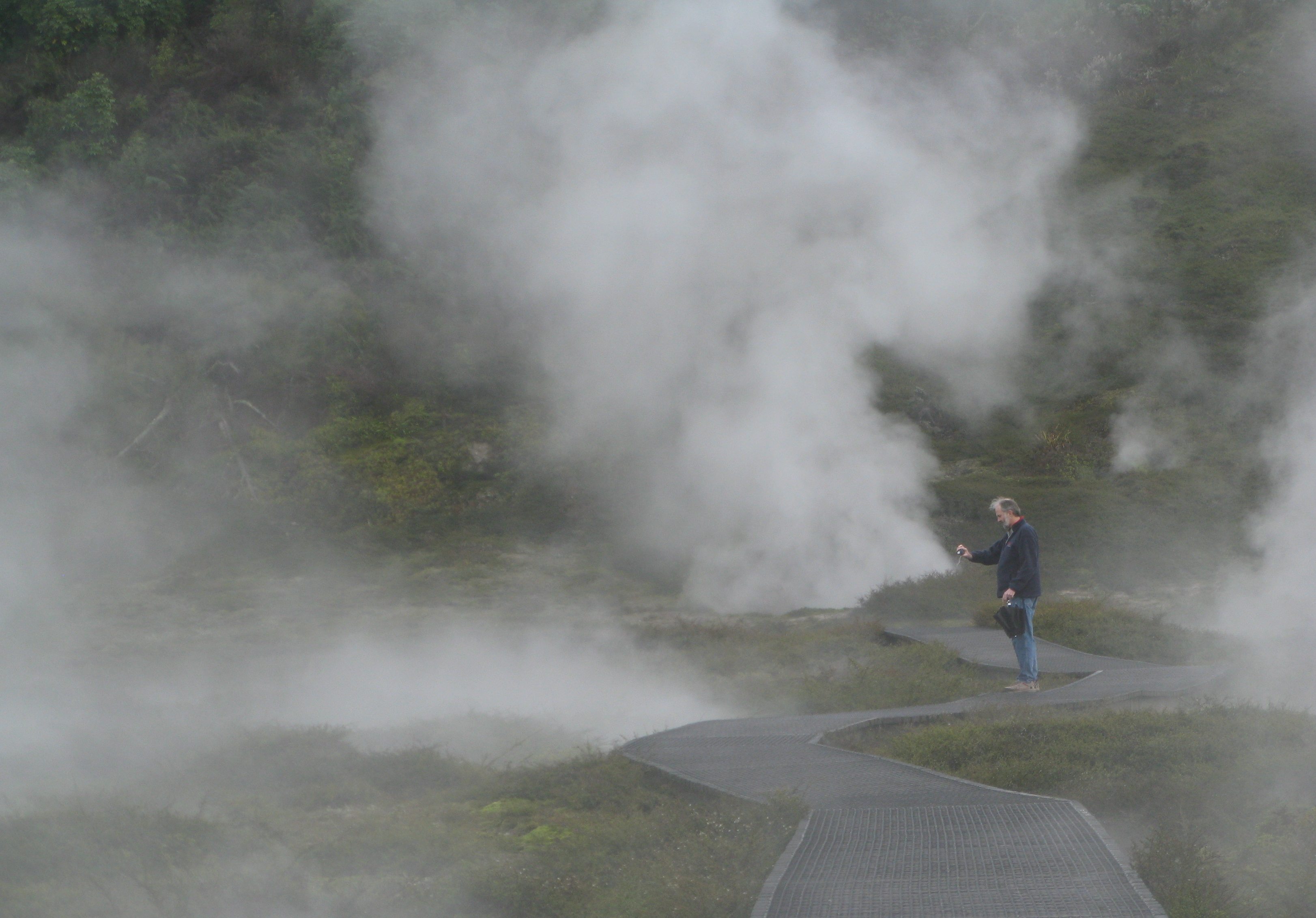
Don’t stray off the walkway:
New Zealand's North Island
This video gives you a good idea of what it’s like. Please ignore the strands of the TCs hair that occasionally skitter across the image:
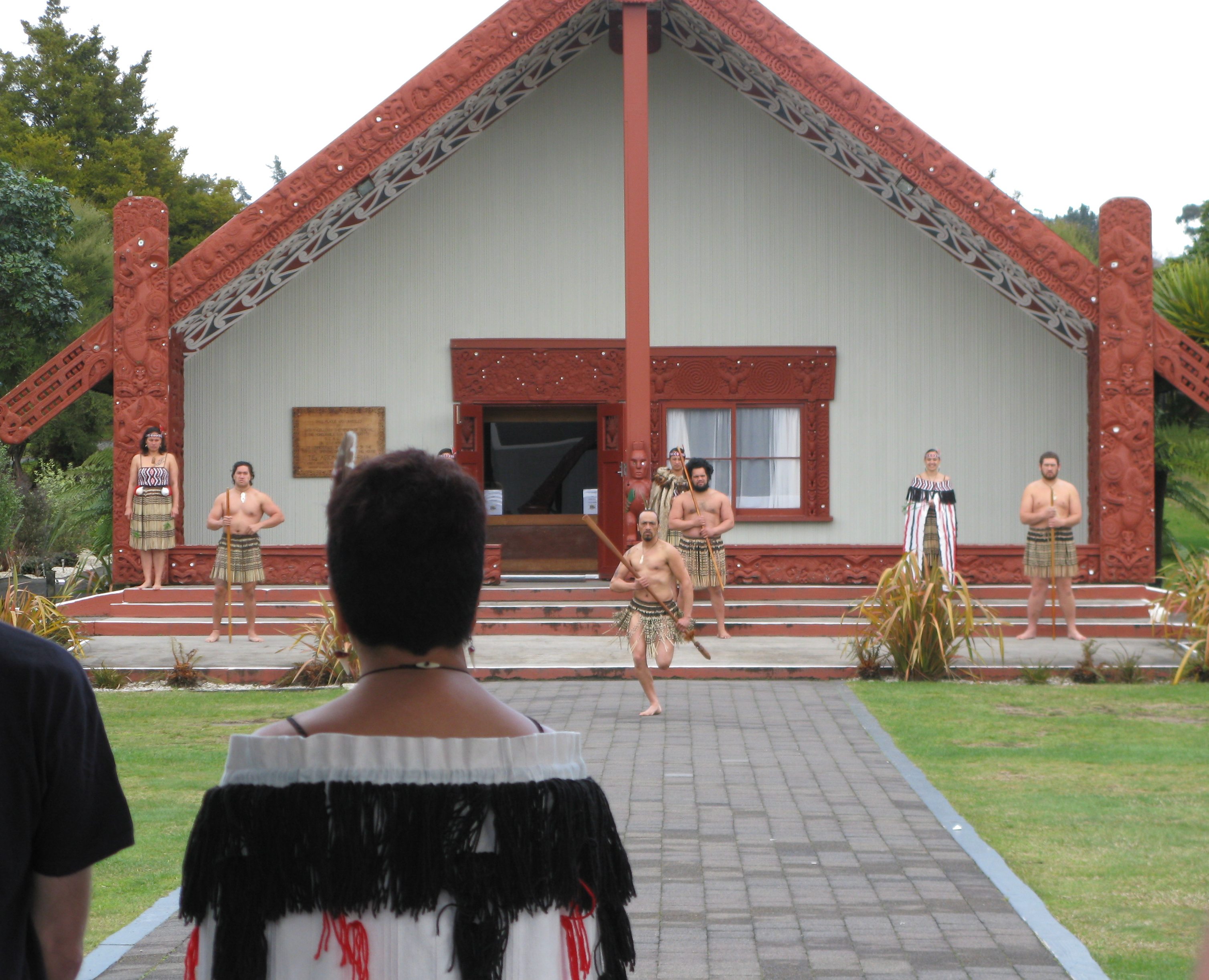
At Rotorua we attended the Maori welcome ceremony. This worm thought the singing and dancing were beautiful:
New Zealand's North Island
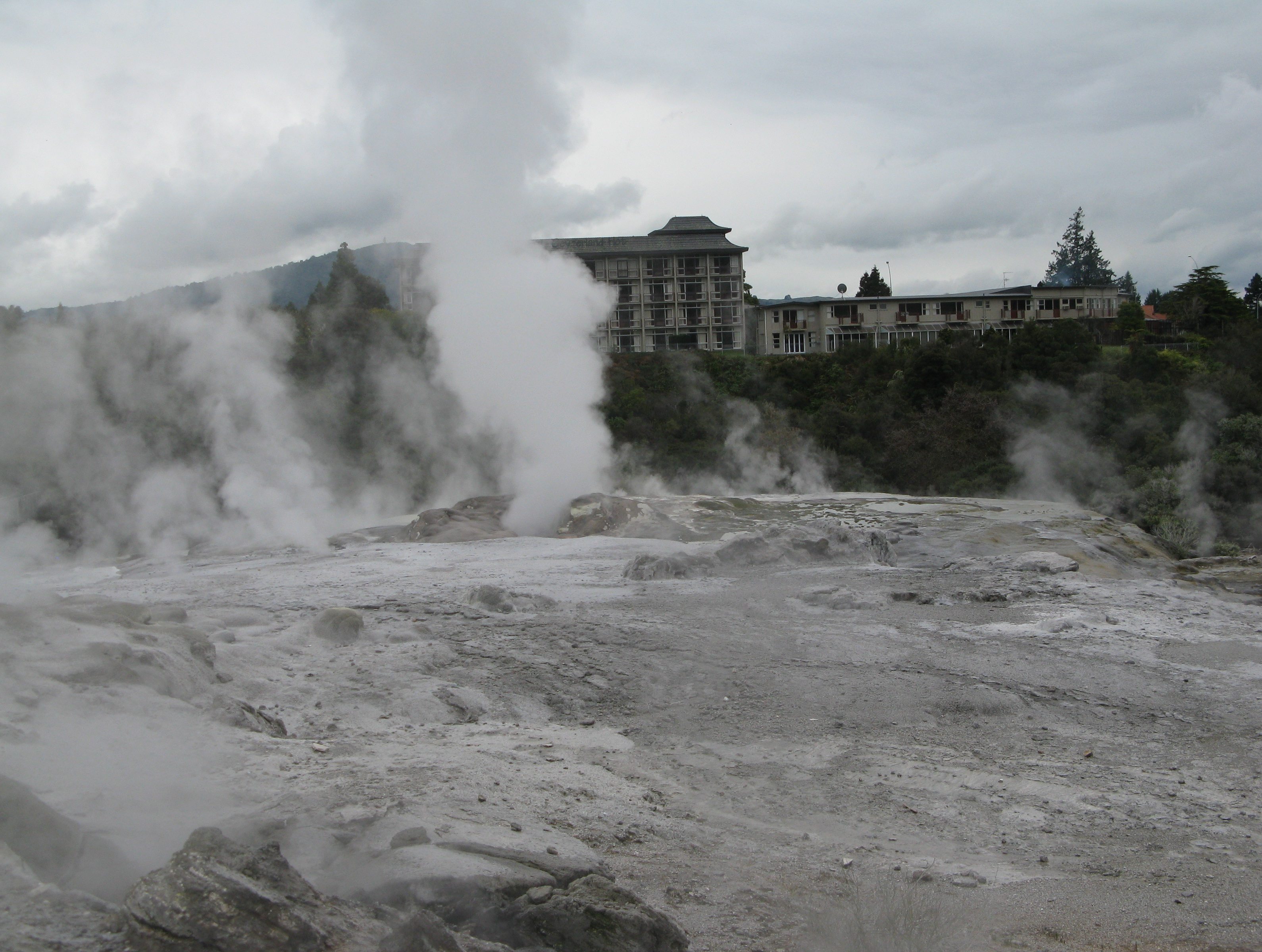
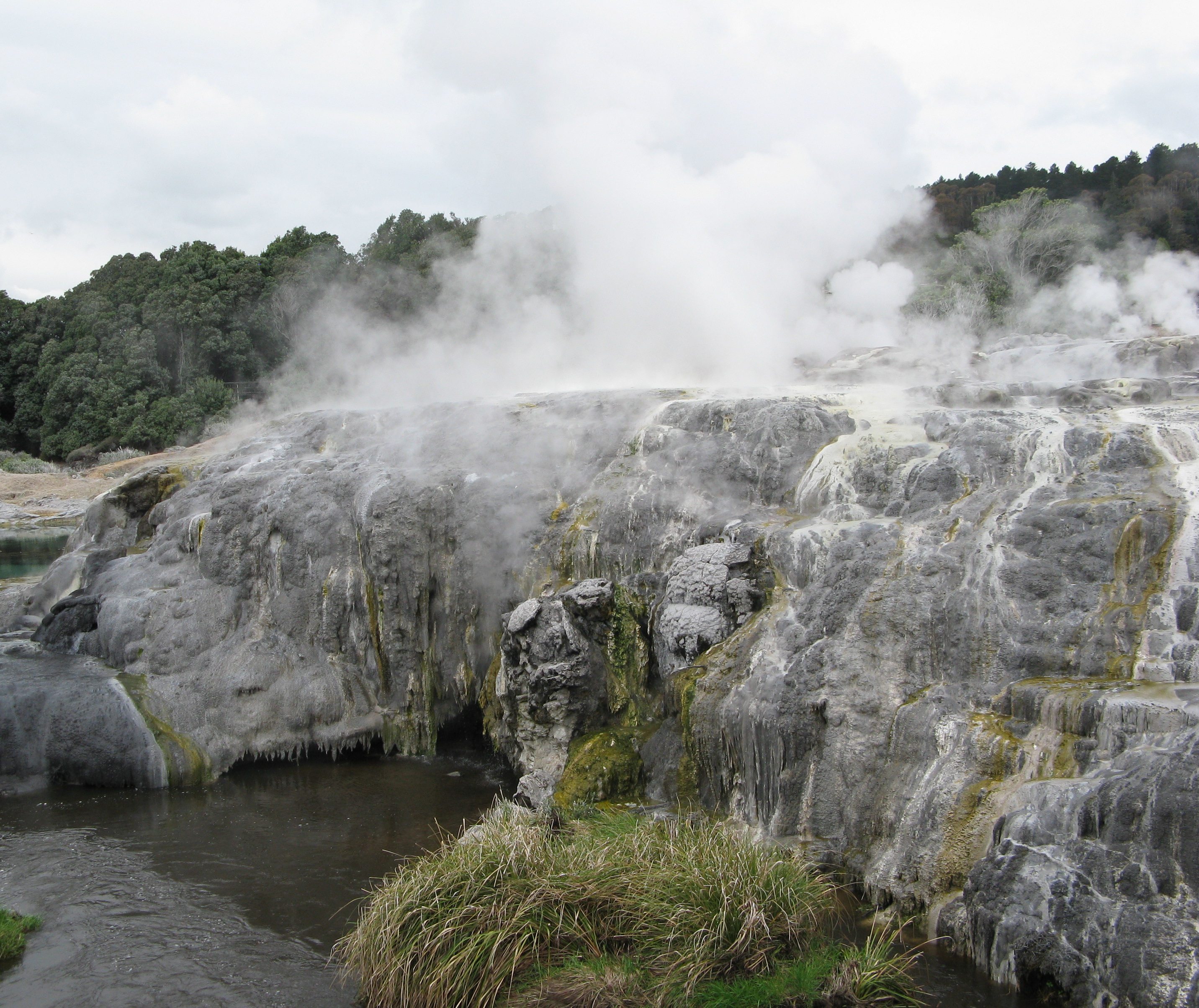
The ground surrounding Pohutu geyser is bleak and blasted:
New Zealand's North Island
Stark yet appealing, here it is from another angle:
New Zealand's North Island
This video captures the slightly surreal feeling of Pohutu, the big geyser at Rotorua. In the distance is a model with her camera crew. In the foreground is the wasteland that surrounds the geyser.
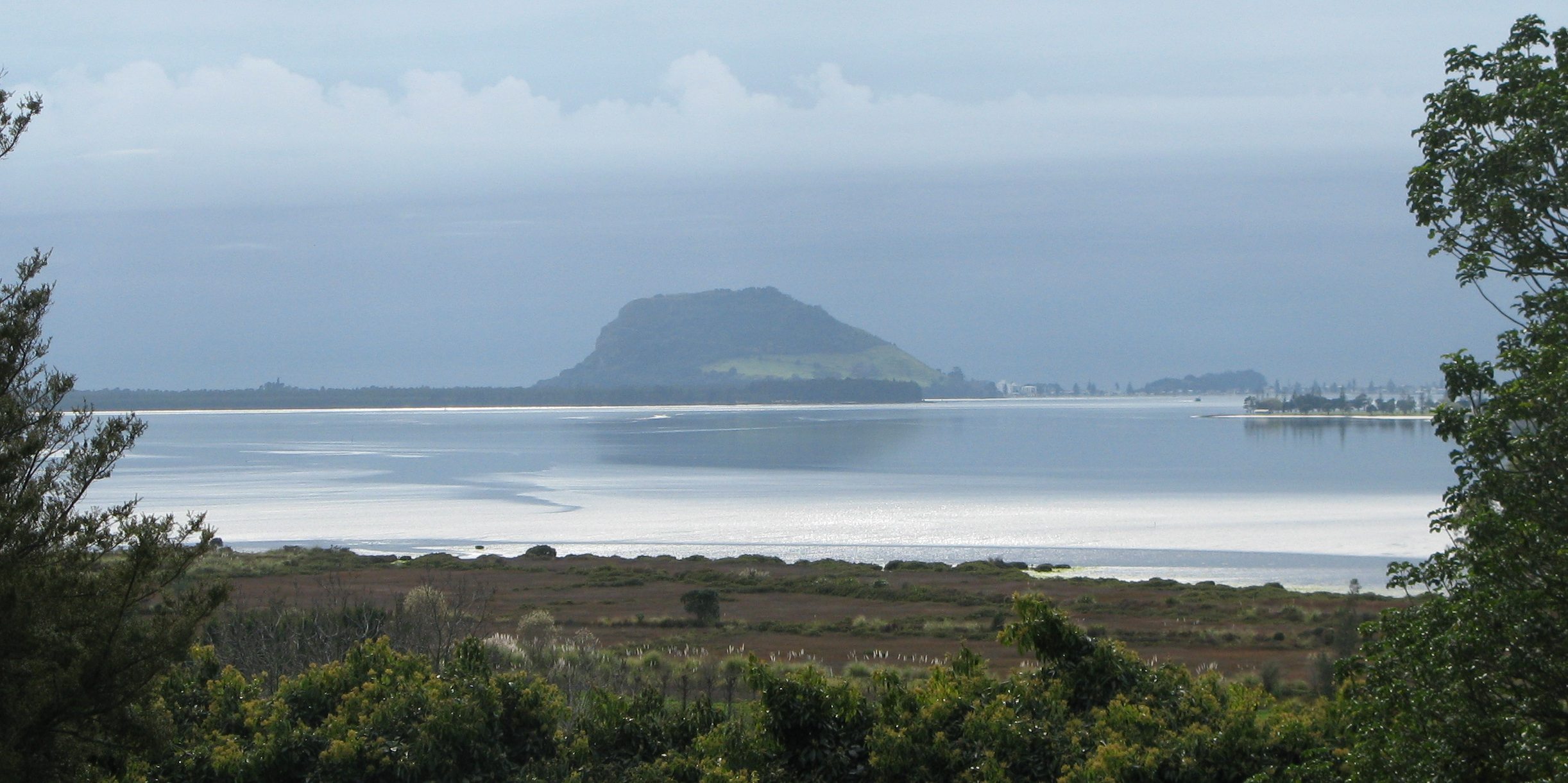
After Rotorua we drove to Tauranga on the north east coast. The walk around Mount Manganui is good. It takes about an hour at a leisurely pace, with good views of natural forest, the bay and the straits between Matakana island and the mainland. Here’s a view of Mount Manganui and the Bay of Plenty, seen from Te Puna near Tauranga:
New Zealand's North Island
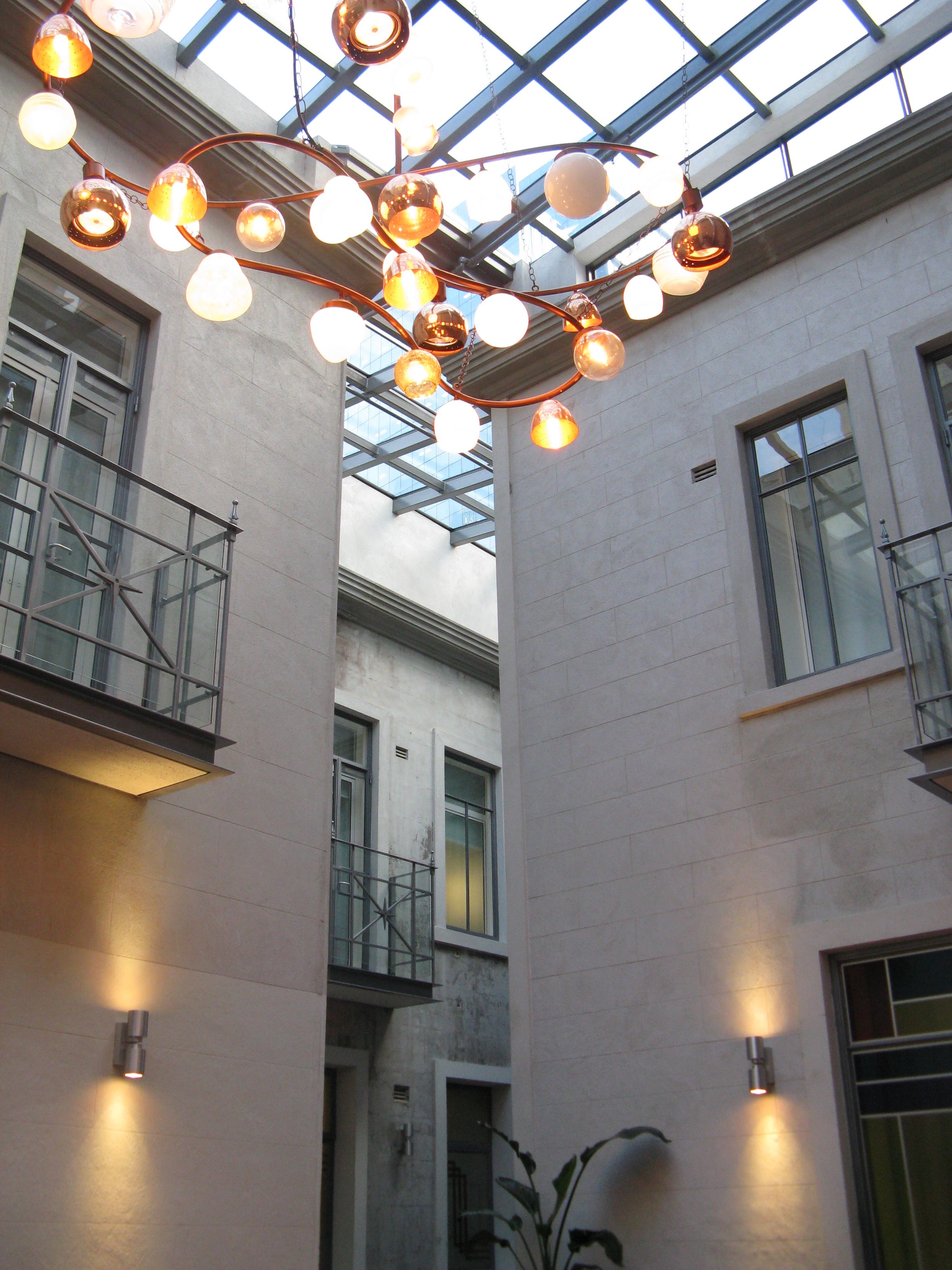
Auckland is a great city, no doubt. But when we arrived it was pouring with rain. We found the Hotel DeBrett and opted for an afternoon of DVDs, chocolate and luxury. This is the glass-roofed courtyard in the middle of the hotel, where you have breakfast, coffee and company:
This is the blog of Mark Wordsworm, the travelling worm. I’m a 25-year-old bookmark and can proudly boast my own Hallmark serial number, 95 HBM 80-1. You’ll probably want to read all about me and my Travelling Companion (the TC) .
Today’s travel notes
Me and the TC are back in San Francisco for a flying visit. The TC is working here for a week, so this worm has tagged along as usual, keeping her book warm and generally looking after her. Today, Sunday, is her only day off on this trip. So we all got in to a Smart Car and drove over the Bay Bridge, to see what happens outside San Francisco.
My impressions? Oakland and Berkeley are worth the drive, if you have time on your hands, if only to see the Bay Bridge and the view of SFO from the other side.
Travel tip
Smart Cars are larger inside than you may think.
Recommended restaurant
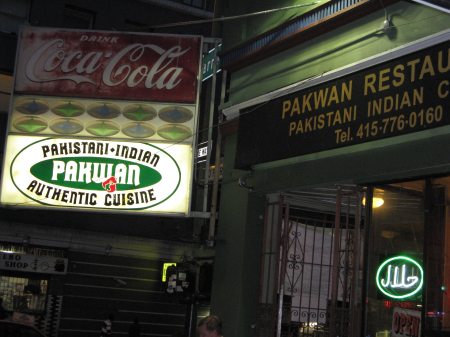
Pakwan restaurant, corner of O’Farrel and Jones streets, San Francisco. Quite outstanding. See photos and words below.
The book I’m in
Gone Tomorrow, by Lee Child. The TC hasn’t had much time for reading, so I’m still stuck in the same book as when I wrote my previous post. No matter. I’m quite attached to the book!
The photos
Me with Peg and the food at the Pakwan restaurant:
San Francisco, Berkeley and Oakland
The Pakwan restaurant is on the corner of O’Farrel and Jones streets, San Francisco. It offers “Pakistani-Indian authentic cuisine”. The space itself is not all that impressive, but the food is simply delicious. The price is very reasonable too.
San Francisco, Berkeley and Oakland
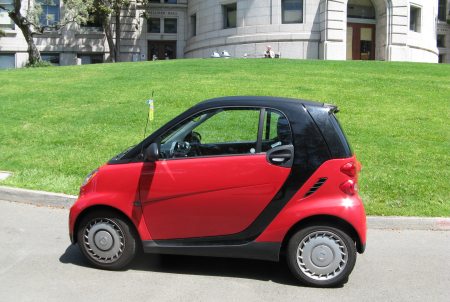
Me with the Smart Car that we hired for the day. I’m attached somewhat precariously (as usual) to the aerial:
lackadaisical
Me and Smarty Tyres are parked in the grounds of the University of California, in Berkeley. Here’s one of the attractive buildings on campus:
San Francisco, Berkeley and Oakland
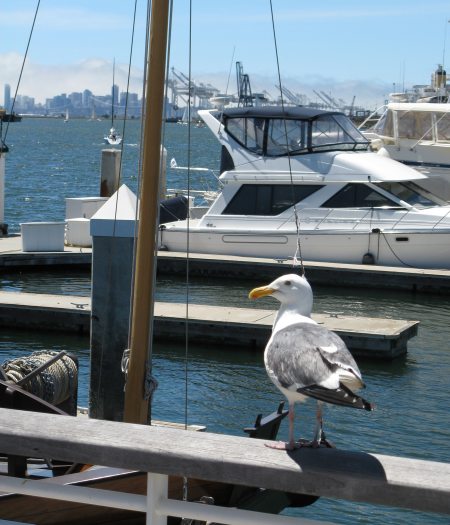
Next we drove down to Oakland. Surprise, Jonathan was there! Here he is, admiring the view from Oakland docks of the mist coming down over San Francisco:
This is the blog of Mark Wordsworm, the travelling worm. I’m a 25-year-old bookmark and can proudly boast my own Hallmark serial number, 95 HBM 80-1. You’ll probably want to read all about me and my Travelling Companion (the TC) .
Today’s travel notes
Me and the TC are usually pretty easy to please, but we were just a wee bit disappointed with our recent day-trip to Litchfield National Park. The park is in Australia’s Northern Territory, about 100 km from Darwin. It was 16th May, about 3 weeks ago, and we were in Darwin to attend a conference. We took a coach trip to Litchfield, because the TC was nervous about driving around the bush on her own.
“Bah humbug,” she was thereafter heard to exclaim. “Litchfield is a walk in the park.”
My impressions? Tame, but with some pretty colours. The termites and waterfalls are good.
Travel tip
If you’re looking for a full-on nature experience, don’t take a coach tour to Litchfield.
The book I’m in
Gone Tomorrow, by Lee Child. This worm is quite taken by Jack Reacher, the hero of this book. He’s a modern-day swashbuckling pirate, in a ruthlessly homeless kind of way. I wouldn’t like to bump up against him on a dark night. Unless he’s on my side, of course.
The photos
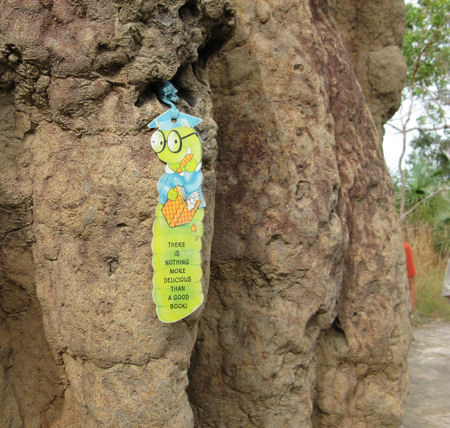
Me knocking on the door of a cathedral termite mound:
Litchfield National Park in the Northern Territory
The termite mounds in the Northern Territory are fascinating, even awe-inspiring. The TC rabbits on about them looming up from the bushes and standing silently in amongst the trees. We saw a number of different types. The cathedral termite mounds are huge and shapely:
Litchfield National Park in the Northern Territory
The magnetic termite mounds are eery and otherworldly. They’re thin and wide, and all built in parallel lines. Wherever you find them, they’re lined up to the the Earth’s north-south axis. I wrote a bit about the magnetic mounds we found near Humpty Doo, just outside Darwin. Here’s one, with a cathedral mound behind it, in the Litchfield National Park:
Litchfield National Park in the Northern Territory
Termite mounds are extremely hard. Our coach driver told us that people used to crush termite mounds and mix the resulting grounds with water, then spread it to make airstrips in World War 2 and later tennis courts.
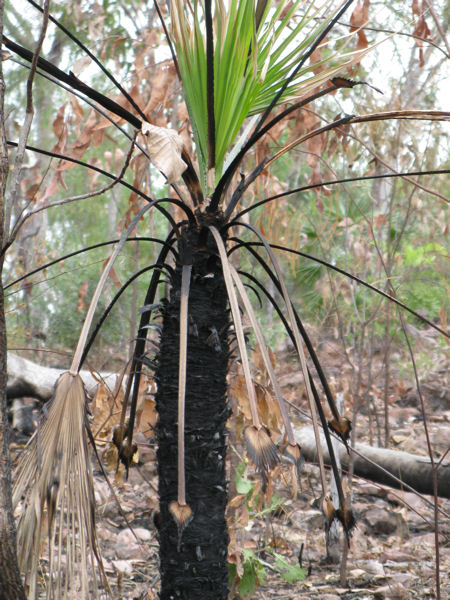
Another fascinating fact from our coach driver: 80% of the trees in that area of the Northern Territory are hollow. Their trunks have been eaten out by termites. The termites and the trees survive quite happily this way, with the termites providing nutrients to the tree and the soil. This is a picture of a palm tree with a termites’ nest inside:
Litchfield National Park in the Northern Territory
Litchfield has a number of pretty rock pools where you can go swimming. You do need to make sure you’re well into the dry season and all the salties (salt-water crocodiles) have retreated towards the sea. The TC went swimming in the pool under the Florence Falls:
Litchfield National Park in the Northern Territory
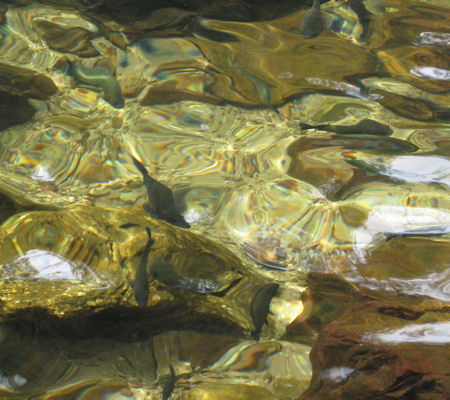
A number of large black fish shared the experience. One of them made so bold as to give her a painful nip in the thigh. I’m glad I wasn’t in the water with these fellows:
Litchfield National Park in the Northern Territory
There’s a pretty walk around the Florence Falls. It’s a bit spoilt by the helpful signs explaining how you can make your garden look like this too. Nevertheless, we managed to look past the signs and enjoy the bush and the lovely colours enhanced by a recent burn:
Litchfield National Park in the Northern Territory
More colours:
Litchfield National Park in the Northern Territory
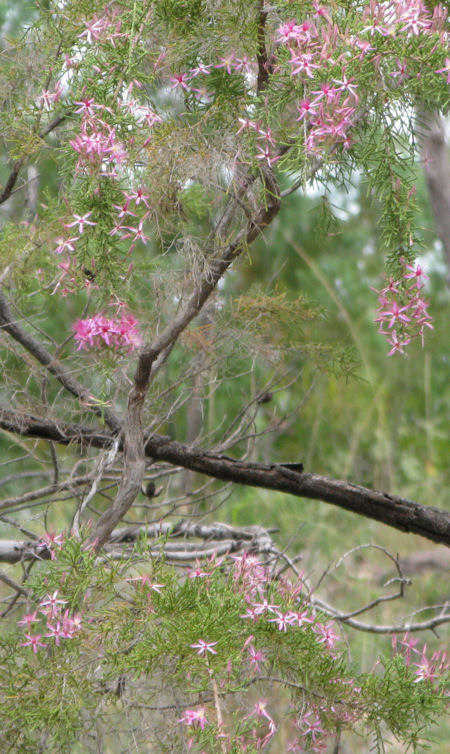
A bit of pink:
Litchfield National Park in the Northern Territory
Some yellow:
Litchfield National Park in the Northern Territory
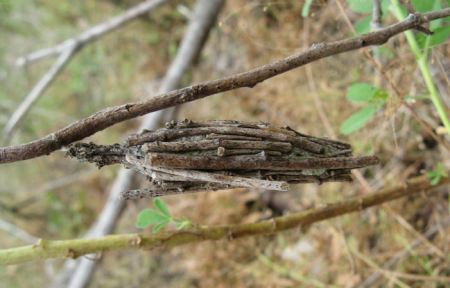
This dude is very interesting. I’m not sure exactly what it is. It’s a creature inside a coat of sticks. All you can see of the creature is the bit that attaches it to the stick. Is it a fellow worm? An insect perhaps? Let me know if you know what it is:
Litchfield National Park in the Northern Territory
These are the Wangi falls:
Litchfield National Park in the Northern Territory
The wetlands around the Wangi falls were more like the swamps we were expecting to see in the Northern Territory:
Litchfield National Park in the Northern Territory
Summing it up, this worm thinks that if you only have a day to spend then the Spectacular Jumping Crocodile Cruise is more interesting. On that tour, you see the wetlands around Humpty Doo as well as the Adelaide River with the salties, and a bit of the bush around Darwin too. I wrote a blog post about it. If you have more time, then probably Kakadu is the thing. We didn’t have time for that this trip.
If you’ve seen a lot more of Litchfield than we did and you found it awe-inspiring, let me know.
This is the blog of Mark Wordsworm, the travelling worm. I’m a 25-year-old bookmark and can proudly boast my own Hallmark serial number, 95 HBM 80-1. You’ll probably want to read all about me and my Travelling Companion (the TC) .
Today’s travel notes
Darwin is an interesting place to be. I suspect it’s a city of many faces, depending on when you’re there and who you’re travelling with. One thing is guaranteed: the heat. At 12 degrees south, it’s decidedly tropical. Darwin is in the Northern Territory, at Australia’s Top End. The TC and I were there in May, soon after the start of the dry season. If that’s dry, this worm would prefer not to be there in the wet.
My impressions? It’s a bit warm in Darwin.
Travel tip
If you plan to walk down Stokes Hill Wharf, take your time. It’s a long wharf and, in case I haven’t mentioned it, Darwin is a bit warm.
Another tip for free: Go looking for the crocs. I wrote about them last week.
New word of the day
“Calenture” – a tropical fever suffered by sailors, who think the sea is a green field and want to jump into it.
The book I’m in
DON’T TELL MUM i WORK ON THE RIGS she thinks I’m a piano player in a whorehouse, by Paul Carter. This book is full-on, extreme energy. Paul Carter tells tall tales of his many years spent working on oil rigs in and around Australia. Adventure and danger, funny and nasty, they all rub up against each other in this book. Highly recommended.
The photos
Me hanging out on a Darwin city street:
In and around Darwin
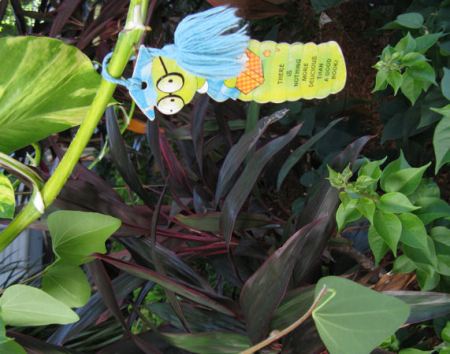
I promised a devoted follower that my next post would tell a tale of peril. Here it is. The TC wanted to show the enormous size of the ivy leaves in Darwin. Note her lamentable lack of regard for my safety. Now you see me, now you…
In and around Darwin
… don’t!
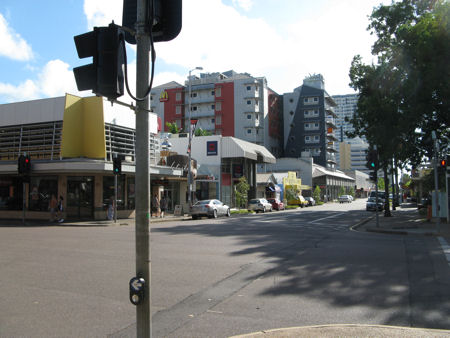
Truth be told, Darwin city centre is not much to write home about. This picture is taken from the corner of Mitchell and Knuckey streets, looking up Knuckey. It’s all happening, folks:
In and around Darwin
Here’s The Mall on Smith street:
In and around Darwin
Darwin is “one of Australia’s most modern capital cities”. That sounds pretty impressive, and even more so when you learn why it’s true. The city has had to be rebuilt twice in recent history: once after the Japanese bombed it in World War 2, and then again after Cyclone Tracy hit in 1974. Tracy just about flattened the town hall (originally the Palmerstone Town Hall). The Darwinites have preserved the ruins, to remind people of that blustery Christmas Eve in 1974:
In and around Darwin
Tracy was quite a ruthless gal. She holds the record for being the most compact tropical cyclone ever to hit Australia. Indeed, she was the most compact world-wide until Marco in 2008.
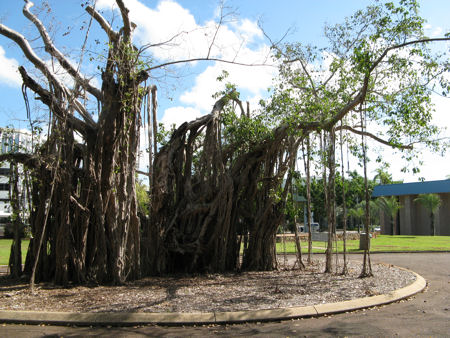
Not far away from the town hall ruins, this old man banyan tree stands in Darwin’s Civic Square:
In and around Darwin
Banyan trees are fairly ruthless in their own right. The banyan starts life as a seed, eaten by a bird and then deposited on another tree’s branch as part of a bird dropping. The banyan starts growing and sends down roots to the ground. The host tree becomes cocooned in banyan roots and branches. Eventually the host dies and the banyan lives on. With good reason, banyans are also called “strangler figs”.
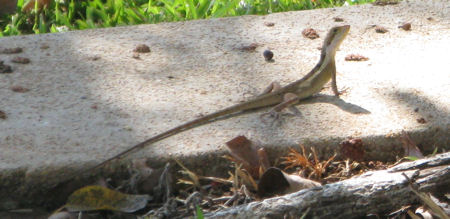
Cyclones and stranglers aside, it’s peaceful around the great banyan now, with birds tweeting and lizards scurrying:
In and around Darwin
This debonair traveller took a close look at the strangler’s roots:
In and around Darwin
Later we moseyed down Stokes Hill Wharf. The TC confessed her disappointment at not finding the wharf littered with plaques and other memorabilia related to Baz Luhrmann’s film “Australia”. Between you and me, I will point out that she would have been the first to complain if we’d found hundreds of tourist traps. The wharf is also the place where many Japanese bombs fell during the WW2 attack on Darwin. Wikipedia says that more bombs were dropped on Darwin than on Pearl Harbor. Here’s a view of the wharf today, just before the TC and I started our long walk:
In and around Darwin
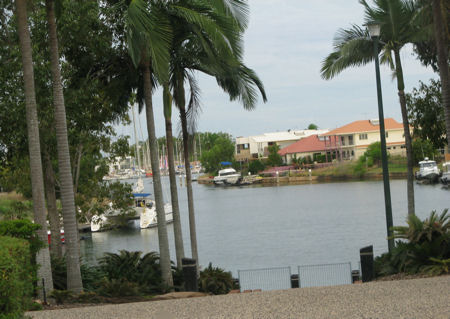
Some of the locals are a trifle scathing of the new suburbs springing up around Darwin. People say the new houses are built without regard for “natural air conditioning”. Evidently the earlier houses were better built to take advantage of breezes. Take it from this worm, there’s precious little breeze to take advantage of. What air there is, is moist and warm. It licks your face like a bulldog’s tongue.
The TC professed admiration for many of the new buildings. The new suburb we saw had direct boating access to the harbour and the Timor sea. Here’s another interesting tidbit, courtesy of this worm: the tidal variation is 6 to 8 metres. That means that the water level drops by 8 metres when the tide goes out. So there’s a system of locks to keep the boats afloat.
In and around Darwin
Outside Darwin there’s a tiny place with the picturesque name of Humpty Doo. (Yes, really.) Close by we spotted these eery constructions:
In and around Darwin
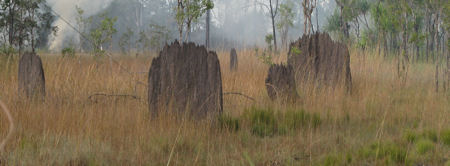
They’re about the same height as the TC, about 4 feet across, sharp on top and only as wide as the TC’s hand. They all face in exactly the same direction. Seeing them, you feel restful and tranquil because they’re just there and they’re so neat. And yet, underlying the tranquillity is an unease. They’re weird, because they’re so neat.
They are magnetic termite mounds. The termites build them all facing in the same direction, more or less exactly on the Earth’s north-south axis. Boffins say that the termites do this to keep warm, by catching the sun’s rays. This worm finds it hard to believe anyone would need to catch more warmth in Darwin. Here’s a closer look at one of the mounds:
In and around Darwin
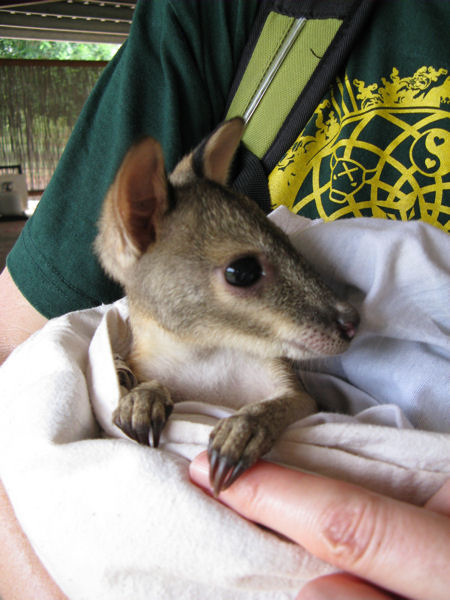
While we were at an Aboriginal art centre just outside Darwin, the TC was given a baby wallaby to hold. Sally is her name. A car hit Sally’s mother while Sally was in her mother’s pouch. Sally survived and is now thriving on bottled milk and tender loving care of one of the staff members at the art centre. Here’s the obligatory cute snap:
In and around Darwin
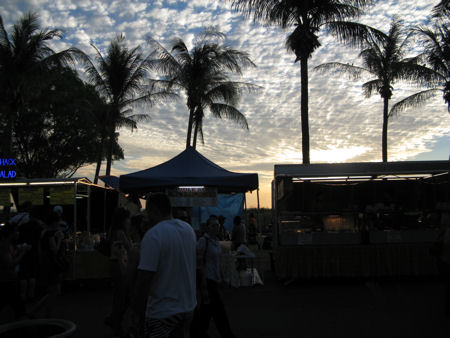
One of Darwin’s “must do” activities is a trip to the Mindil Beach Market. It happens every Thursday and Sunday evening during the dry season:
In and around Darwin
You can buy all sorts of things there, including dinner. The TC found the food “ordinary”, but she has expressed some enthusiasm for the smoothies. Best of all, though, is to be there when the sun goes down.
In and around Darwin
Drift down to the beach, just the other side of the stalls, and watch the sunset.
This is the blog of Mark Wordsworm, the travelling worm. I’m a 25-year-old bookmark and can proudly boast my own Hallmark serial number, 95 HBM 80-1. You’ll probably want to read all about me and my Travelling Companion (the TC) .
Today’s travel notes
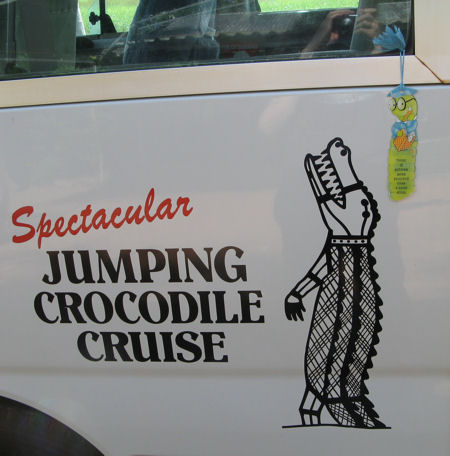
Peg, the TC and I have all been in Darwin, in Australia’s “Top End”, for the past week. The TC, bless her cotton socks, booked herself on a Spectacular Jumping Crocodile Cruise. As is her wont, she took me along. I consented to pose in front of the bus for the obligatory snapshot, then retreated to the safety of my book nestled deep in the TC’s bag. Peg was nowhere to be seen. She’s a very together type of gal and knows when to keep herself out of harm’s way.
My impressions? The Northern Territory’s salties are horrifyingly beautiful.
Travel tip
Believe it when they tell you not to put your arm out over the side of the boat.
The book I’m in
Past Caring, by Robert Goddard. Definitely a “the thot plickens” type of book. This worm recommends it whole-heartedly.
The photos
Me and the only type of jumping croc that I allow anywhere near me:
Jumping crocodiles near Darwin
We were lucky enough to have the one and only Rod as our bus driver and guide. He knows a great deal about the bush, the swamps and the history of Darwin. I was sorry when the tour ended, because he’d only been able to relate a fraction of the stories he knows of Darwin and surrounds. The photo below shows us driving over the dyke at Fogg Dam. Rod told us all about the doomed Humpty Doo rice project, of which Fogg Dam is part. People built the dyke to control the water in the Adelaide River wetlands, so that they could grow rice. Alas, after the first big wet season most of the rice ended up in the Timor Sea. Did you notice the crocodile toys on the dashboard? We were very soon to see the real thing!
Jumping crocodiles near Darwin
A pretty little Jacana bird wanders through an idyll soon to be shattered:
Jumping crocodiles near Darwin
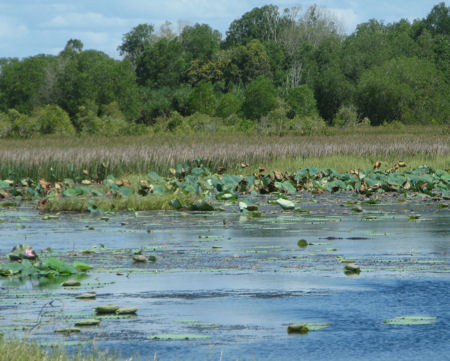
A late-blooming Lotus lily lures and lulls the unwary:
Jumping crocodiles near Darwin
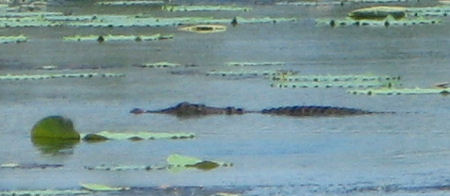
But wait. Take a closer look at those low-lying dark humps at the middle right:
Jumping crocodiles near Darwin
Oh yes, the TC has spotted her first crocodile.
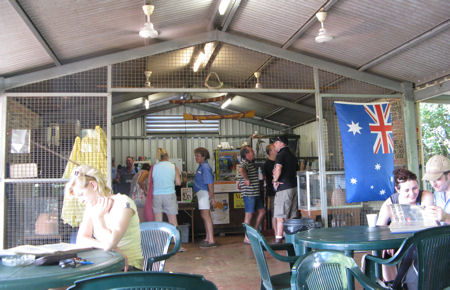
Next stop, the reception room for the Spectacular Jumping Crocodiles Cruise:
Jumping crocodiles near Darwin
Then out onto a reassuringly solid-looking boat:
Jumping crocodiles near Darwin
Gotcha! We walked straight on through that boat and onto the much more intimate craft that would ferry us around the croc-infested banks of the Adelaide River:
Jumping crocodiles near Darwin
The TC, of course, was delighted. So much more real. So much more opportunity to get close to the crocs. Better photographs. Yada yada yada.
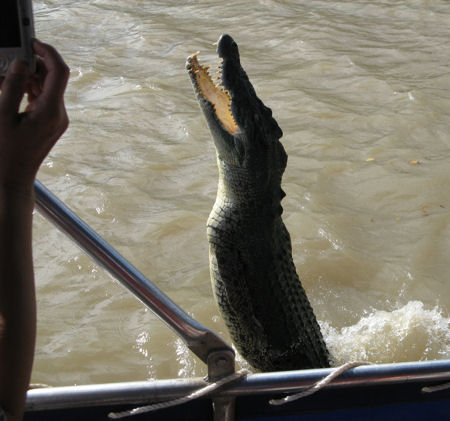
Sure enough, we were but a couple of metres off the mooring point when this charmer hove into view:
Jumping crocodiles near Darwin
That was when yours truly, the Travelling Worm, huddled deeper into my book and did my utmost not to attract the TC’s attention. It’s at times like this that she’s apt to whip me out and parade me in front of whatever’s going on, to snap that killer photograph. (Aah, bad choice of words on two counts, worm!)
From this point on it’s all go:
For the faint of heart, here’s a still of the same crocodile:
Jumping crocodiles near Darwin
For the tender of heart, here are some baby crocodiles. They’re hatchlings, about 6 inches long:
Jumping crocodiles near Darwin
Aah, so cute! Beware, mum is not far away:
Jumping crocodiles near Darwin
Isn’t she gorgeous? Here’s the video:
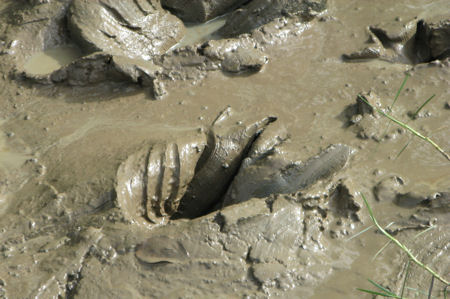
So, if you ever see a footprint like this:
Jumping crocodiles near Darwin
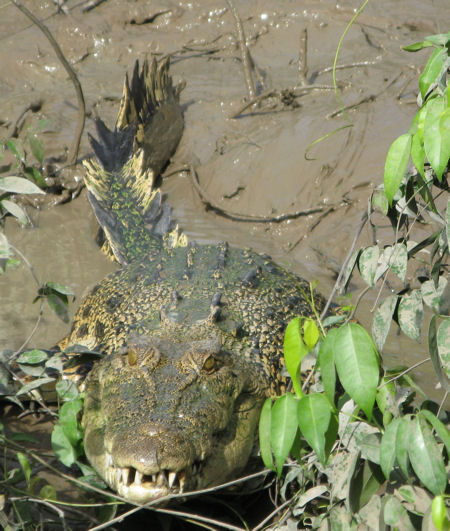
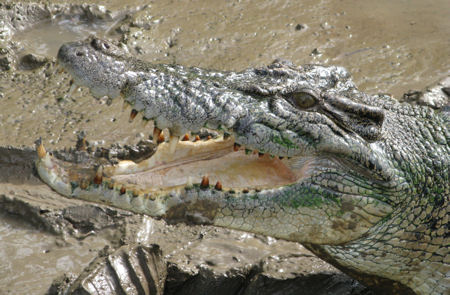
Then look out for a poser like this:
Jumping crocodiles near Darwin
Now I’m back home in the arms of my loved ones. Drool has had his nose put out of joint by my tale of creatures more prehistoric even than he. Peg is, as so often, my anchor:
This is the blog of Mark Wordsworm, the travelling worm. I’m a 25-year-old bookmark and can proudly boast my own Hallmark serial number, 95 HBM 80-1. You’ll probably want to read all about me and my Travelling Companion (the TC) .
Today’s travel notes
For someone who professes to be the friend and companion of a travelling worm, it seems to this worm that the TC has an unhealthy fascination with birds. She’s been taking pictures of the black cockatoos that have just arrived in our neck of the woods.
Needless to say, I stayed well out of sight. Black cockatoos are partial to the odd grub or two, and I don’t rate their level of discernment very highly. I think they’d pounce first and ask questions second.
“Oops, sorry, did I just swallow Mark Wordsworm, the famous Travelling Worm?”
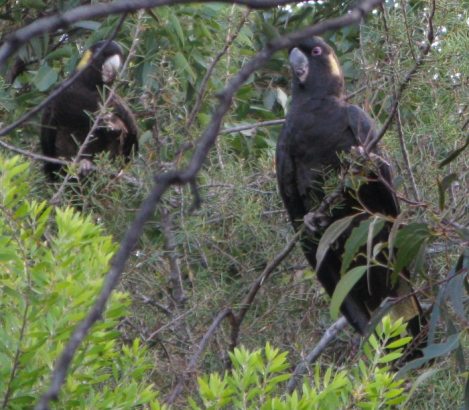
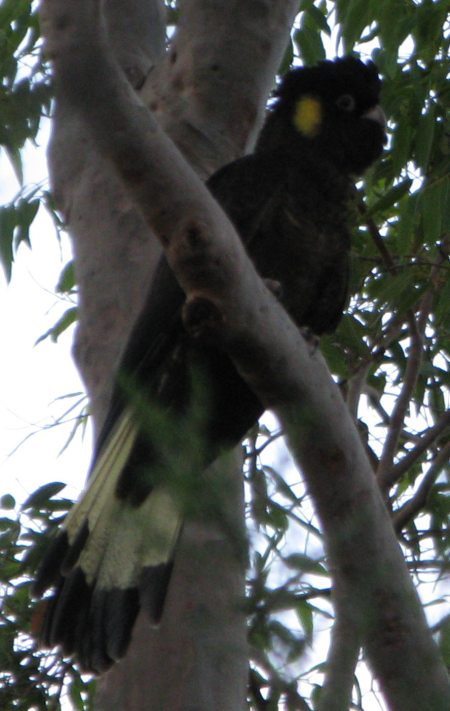
These are the Sydney yellow-tailed black cockatoos. They seem to drop in at around this time every year, probably because a certain type of gum tree is in flower.
The book I’m in
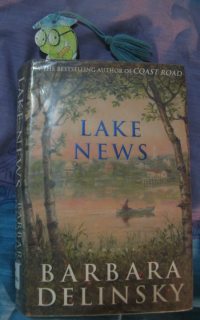
Lake News, by Barbara Delinsky.
The photos
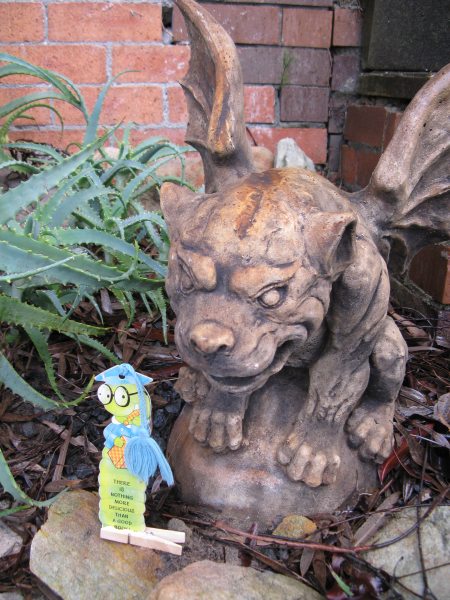
Me not inviting attention from a big cocky bird:
The black cockatoos are in town
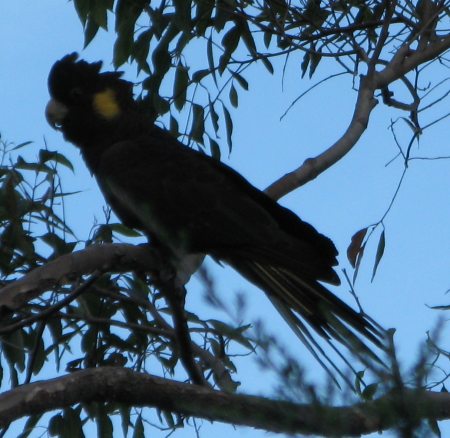
Black cockatoos are difficult photographic subjects, because they’re… well, black. Here’s what the TC managed to get.
Looking savvy:
The black cockatoos are in town
Looking cute and fluffy:
The black cockatoos are in town
Showing off the yellow tail:
The black cockatoos are in town
Prowling along a branch in silhouette, pretending to be a black panther and then spoiling it by squealing like an eagle:
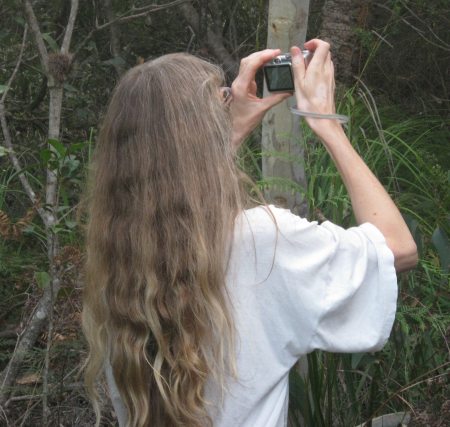
The TC in hot pursuit, snapped by the TC-once-removed:
This is the blog of Mark Wordsworm, the travelling worm. I’m a 25-year-old bookmark and can proudly boast my own Hallmark serial number, 95 HBM 80-1. You’ll probably want to read all about me and my Travelling Companion (the TC) .
Today’s travel notes
The TC is mad. Not raving, just quietly but significantly bananas. This is by now a well-established fact. Nevertheless it bears repeating. In particular, if she invites you out on a walk and says the clouds mean nothing, don’t believe her!
Last week she went walking in the Manly Dam reserve in a rain storm.
My impressions? I do concede that the TC is right when she says the Ozzie bush is beautiful in the rain.
Travel tip
Don’t wear shoes that matter to you. When it rains in the Australian bush, you’ll be up to your ankles in fast-flowing mud within five minutes.
The book I’m in
Blindman’s Bluff, by Faye Kellerman. I’ve moved on a few pages since yesterday. I’m still near enough the middle of the book to feel secure, but it’s getting close to the time when I start worrying that the thickness of pages left is not enough to prevent me warping.
The photos
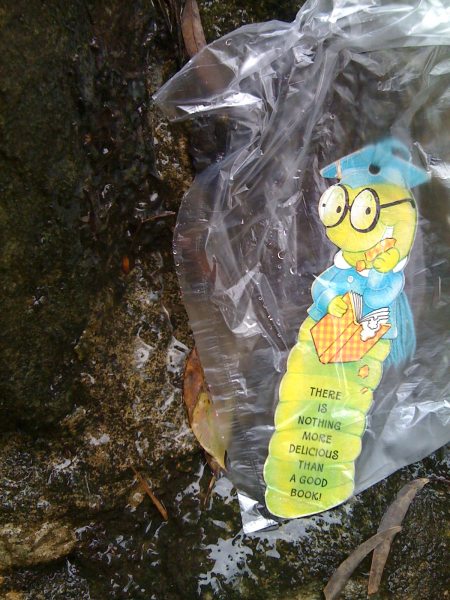
Me in the Sydney wet. I tend to go to pieces in a storm, and my famous blue raincoat is torn at the shoulder. Luckily I had another effective, if less stylish, waterproof covering with me:
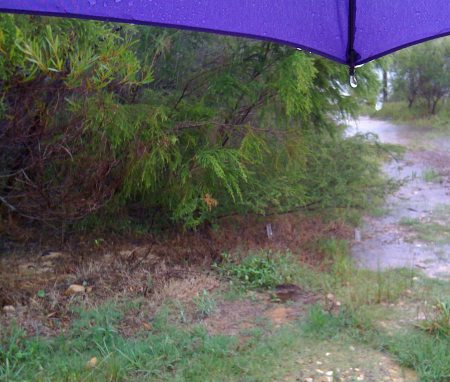
Picture this: It’s pouring with rain, all sensible souls are playing couch potato couch potato, but there’s the TC setting off into the bush with her purple umbrella unfurled:
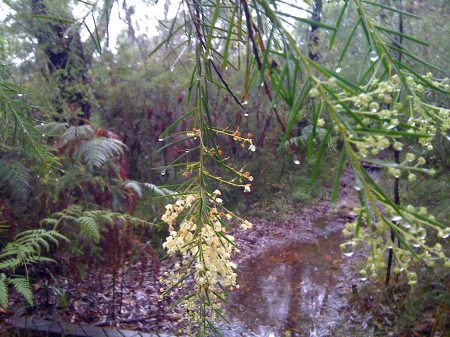
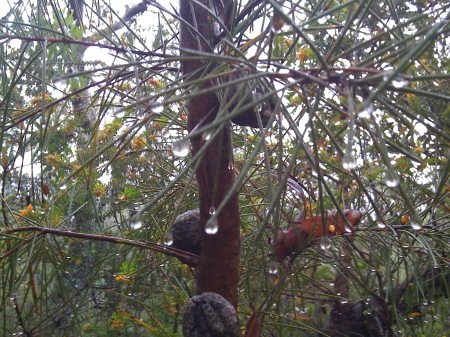
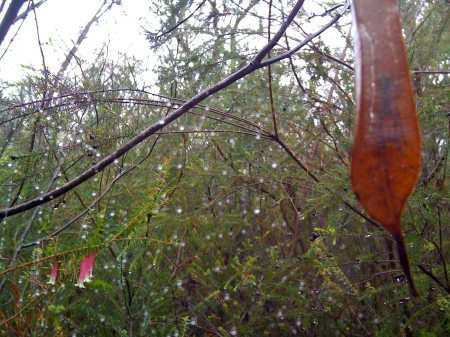
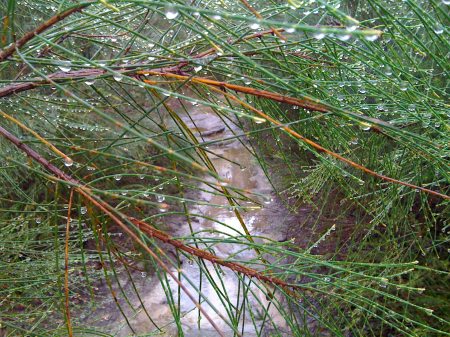
It’s not long before she starts ooh-ing and aah-ing at the sights she beholds. The only camera at hand is her iPhone, but she is not deterred. Every photo in this blog post was taken on the iPhone:
“Ooh,” coos the TC, “the fairies have strung up their party lights behind an Old Man Banksia”:
Raindrops dangle:
If you look carefully, you’ll see the spider lurking in the leaf on his rain-spangled web:
Don’t expect to stay dry even if it’s not actually raining. Dripping branches bar your way:
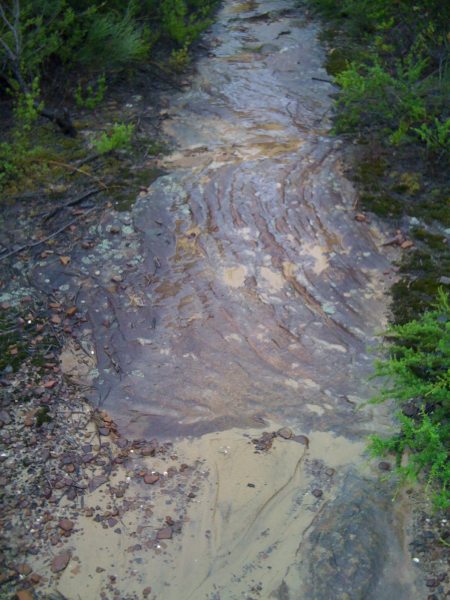
Rivulets of water make swirling patterns in the sand, echoing the patterns in the rock:
Here’s a vista with a rain-lit bush in the foreground:
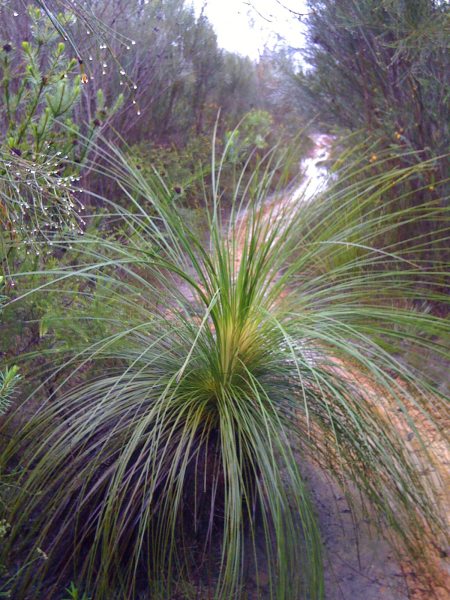
A grass tree in the wet. People also call these plants blackboys or Xanthorrhoea:
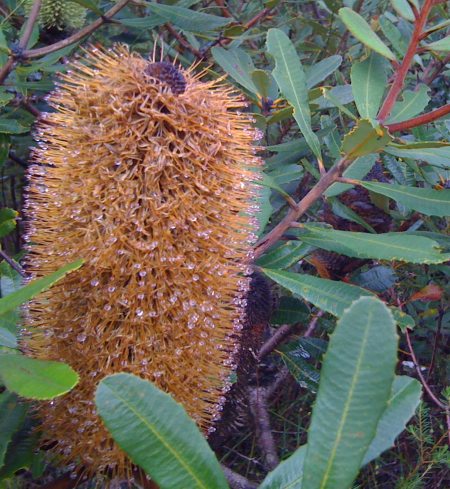
Raindrops perched on the flower of an Old Man Banksia:
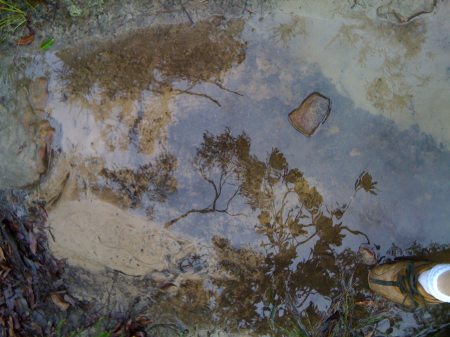
A path full of puddles mirroring the trees, with the TC’s somewhat inelegant and extremely sodden foot at bottom right:
Two mini waterfalls where there’s usually just dry rock:
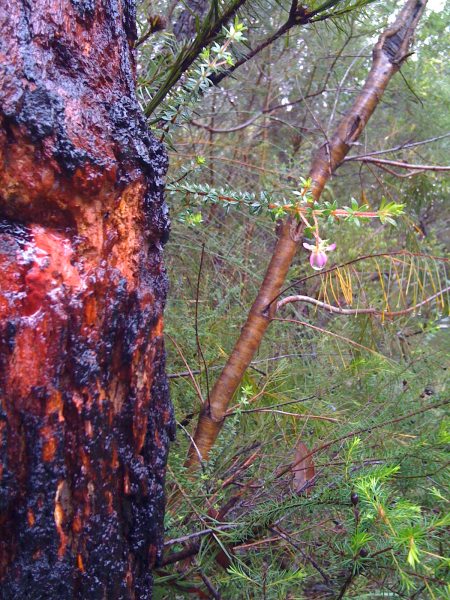
The “bleeding” gum trees look even more bloody and gruesome when they’re wet:
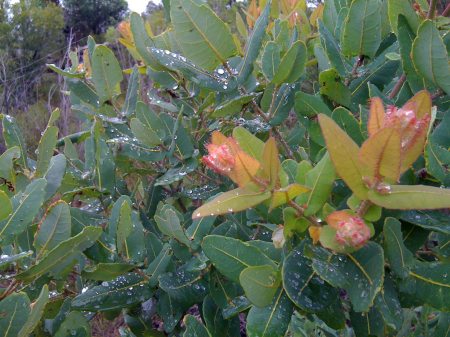
More droplets sprinkled on leaves and flowers:
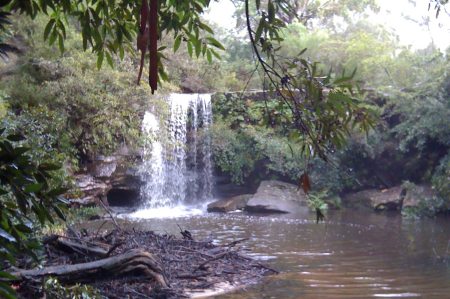
This is the waterfall in the Manly Dam reserve, in full spate after recent heavy rainfall. The TC took this photo today, a week after all the others:





































 Travelling Worm